Free, instant freight quotes are everywhere online, and they work well for fast price checks. The catch is that an instant number only turns into a reliable booking when it comes as an itemized, all-in total with a clear validity window and matches a shipment brief you control. Give the same complete details to every provider, and platforms like Or-ner can carry that quote through booking, tracking, and customs without the invoice shifting underneath you.
TL;DR:
- Providing complete shipment details, including dimensions, weight, and commodity description, is crucial for an accurate, itemized freight quote and to avoid billing adjustments later.
- Comparing quotes fairly requires standardizing scope, Incoterms, and service parameters across providers, then analyzing inclusions, exclusions, and cost per unit for genuine cost savings.
- Invisible surcharges like detention, demurrage, or customs fees often appear only on invoices, making itemized estimates and free-time guarantees essential before booking.
- Freight quotes expire quickly in volatile markets, so it’s necessary to refresh estimates within 48 to 72 hours of pickup to ensure the price reflects current market conditions.
- Platforms like Or-ner close the gap between quotes and final invoices by pairing itemized, all-in prices with integrated booking, tracking, and customs support, minimizing invoice surprises.
Table of Contents
- How Instant Free Freight-Quote Platforms Work
- Exact Shipment Info to Provide for an Accurate Free Quote
- How to Compare Free Freight Quotes Fairly
- Hidden Fees and Red Flags in a Free Freight Quote
- Quote Validity and Timing: When to Refresh
- How Or-ner Turns an Instant Quote Into a Reliable Booking
- Get a Free, Itemized Freight Quote From Or-ner
- Sources
- FAQ
How Instant Free Freight-Quote Platforms Work
Two kinds of pricing show up when you request quotes online. Algorithmic quotes generate instantly because the lane, equipment, and commodity fall inside a carrier’s standard rate table. Manually issued quotes take longer because a pricing team has to check capacity, verify a commodity classification, or price around an unusual routing.
Most quote platforms bundle a few core features once you get past the price itself.
- Multi-carrier or multi-mode comparison on a single search
- A booking portal that turns the accepted quote into a confirmed shipment
- Tracking and status updates once cargo moves
- Document handling for bills of lading, commercial invoices, and customs paperwork
An instant number equals a bookable price only when your shipment fits standard parameters. Oversized freight, hazardous materials, temperature-controlled cargo, or anything needing special equipment usually triggers a manual review before the price is locked. Real-time platforms that price against current lane capacity and fuel surcharges tend to hold up better than static rate tables, which quote off outdated market conditions.
Exact Shipment Info to Provide for an Accurate Free Quote
Quote requests get delayed or repriced for one reason more than any other: missing or vague shipment data. Seven fields separate an accurate quote from a rough estimate, and skipping even one usually means a follow-up email and a slower turnaround.
- Origin and destination — full address or port, including whether it’s residential, commercial, or a port/terminal.
- Per-package dimensions and total weight — length, width, height for each unit, since volume drives chargeable weight on many lanes.
- Packaging type and stackability — pallets, crates, loose cartons, and whether units can stack.
- Commodity description and HS code — this affects customs duties, insurance, and whether the freight needs special handling.
- Incoterm — EXW, FOB, CIF, or DDP determines which leg of the journey and which fees the quote actually covers.
- Realistic ready date — not an aspirational date, since capacity and pricing shift with timing.
- Special requirements — temperature control, hazardous class, tail-lift delivery, or inside delivery.
Dimensions matter more than shippers expect. Providing estimated rather than measured dimensions is the single biggest driver of post-pickup billing adjustments, because carriers re-weigh and re-measure at the dock and rebill the difference.
Pro Tip: Keep a standard shipment brief on file (origin, destination, dimensions, weight, commodity, Incoterm, ready date, special handling) and paste it into every quote request. It cuts back-and-forth email and makes every quote you receive directly comparable.
How to Compare Free Freight Quotes Fairly
The lowest number on a quote sheet is often not the cheapest option once you dig into scope. Comparing quotes fairly means normalizing scope and inclusions first, not just lining up totals side by side.
Start by sending every provider the identical brief: same Incoterm, same scope (door-to-door versus port-to-port), same equipment or cubic-meter volume, same ready date. A quote built on a different scope than its competitor isn’t a competing price. It’s a different service.
Once quotes come back, run each one through a short checklist:
- Does the total include every line item, or is it a base rate with fees layered on later?
- What’s excluded — inland haulage, customs clearance, insurance, destination handling?
- How many free days does the quote include before demurrage or detention kicks in?
- How long is the quote valid, and does that window cover your actual ready date?
- What’s the carrier’s liability coverage, and does it match what your cargo is worth?
Then calculate cost per unit: total freight cost divided by the number of units shipped. Per-unit landed cost is the most reliable way to judge whether a lower headline rate actually saves money once surcharges and transit time are factored in. A quote with a lower headline rate but fewer free days at destination can easily cost more once demurrage charges apply.
Hidden Fees and Red Flags in a Free Freight Quote
Surcharges are normal in freight pricing. The problem is when they’re invisible until the invoice arrives. Common ones include Bunker Adjustment Factor (BAF), Currency Adjustment Factor (CAF), Peak Season Surcharge (PSS), demurrage, detention, documentation fees, and customs exam charges. Who pays which one usually depends on the Incoterm you agreed to, which is exactly why locking that term into every request matters.
A few warning signs suggest a quote won’t survive contact with the real invoice:
- No itemized breakdown, just a single lump total
- Line items marked “as per actual” with no estimated range
- A validity window under 24 hours with no explanation
- No mention of free time or demurrage terms at all
Run three checks before you book: get free days in writing, not verbally promised. Demand an itemized breakdown alongside any all-in total. Ask for both figures together because the all-in number models your likely invoice, while the breakdown exposes floating charges you’d otherwise discover after pickup. Then simulate a worst-case invoice using your actual free-time allowance against a realistic customs clearance delay. Free time is effectively a priced line item: a shorter window can turn a modest rate advantage into a net loss once demurrage applies.
Quote Validity and Timing: When to Refresh
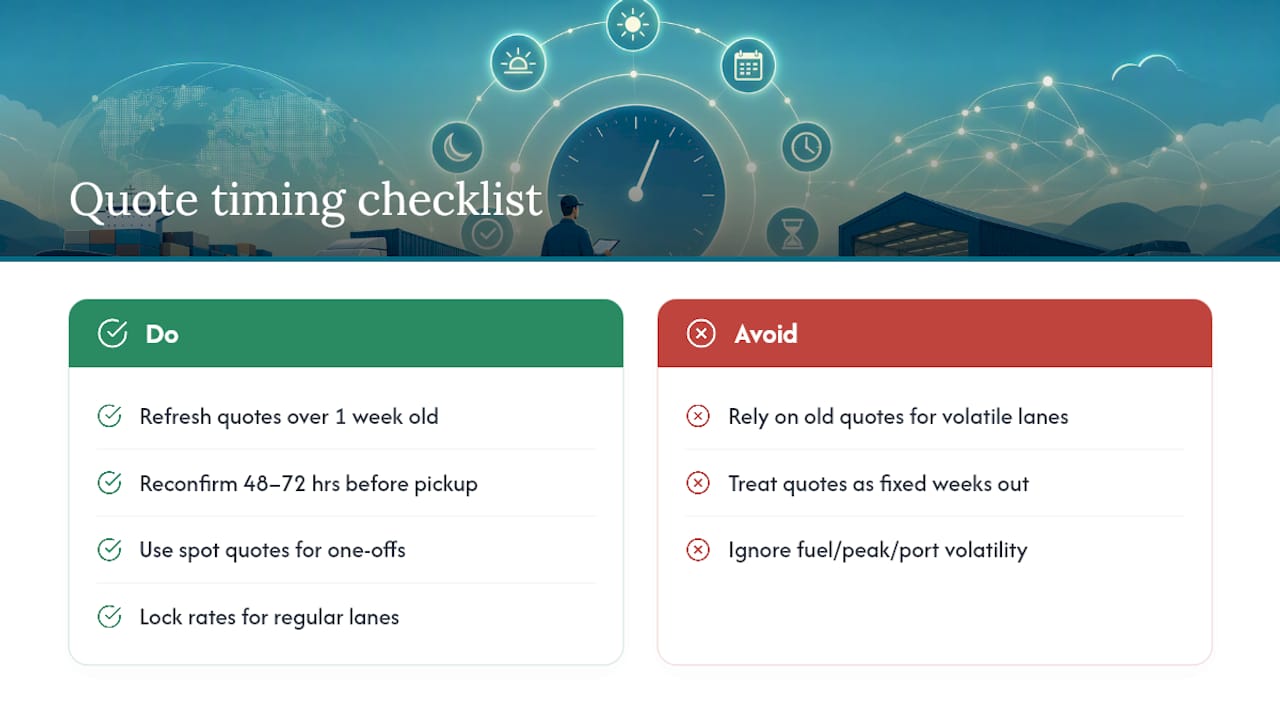
Freight quotes expire, and treating one like a fixed price weeks out is how budgets go wrong. Validity windows usually run between 24 hours and 30 days, with many providers defaulting to a week or less on volatile lanes.
Fuel surcharges, peak-season demand, and port congestion push rates around often enough that a quote from two weeks ago may no longer reflect what a carrier will actually charge. The practical rule: refresh any quote for a shipment scheduled more than a week out, and reconfirm within 48 to 72 hours of pickup if the lane has a history of volatility.
Spot quotes make sense for one-off or unpredictable shipments. If you ship the same lane regularly, a contract or locked rate protects you from the swings that make instant quotes short-lived in the first place.
How Or-ner Turns an Instant Quote Into a Reliable Booking
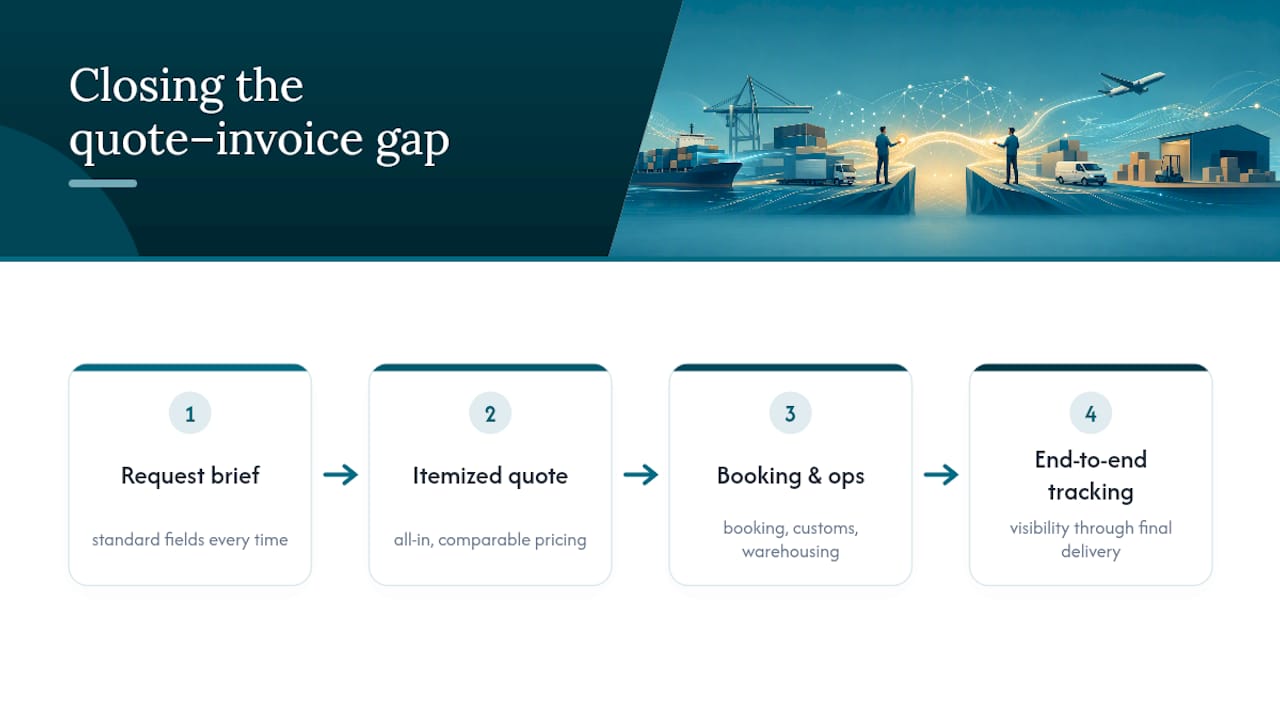
The gap between a quote and an invoice is where most shippers get burned, not in the quote itself. Some platforms close that gap by pairing itemized, all-in quotes with the booking, tracking, customs clearance, and warehousing steps that follow, so the number you accept matches the number that shows up on the final invoice.
That starts with a standard request brief: same fields every time, so quotes come back comparable instead of scattered across different scopes. Itemization is mandatory, not optional, and once a shipment books, tracking visibility carries through customs and final delivery. Fewer blind spots between quote and delivery mean fewer invoice surprises for the freight booking process your team relies on every week.
— Maayan
Get a Free, Itemized Freight Quote From Or-ner
Some logistics platforms provide an itemized, all-in quote instead of a bare number that grows fees after commitment. This approach helps ecommerce and B2B shippers understand exactly what’s included, what’s excluded, and how many free days they have before demurrage exposure starts, before signing off.
Getting started takes less prep than most shippers expect. Pull together your shipment brief (origin, destination, dimensions, weight, commodity, Incoterm, ready date, and any special handling), submit it through a suitable platform, and expect an itemized quote back with a stated validity window. From there, booking, tracking, and customs documentation may be managed together rather than scattered across emails and carrier portals. Follow the freight booking process step by step to see exactly what happens between a confirmed quote and a scheduled pickup, or reach out to an account representative if you’re shipping enough volume to discuss contract rates instead of spot pricing.
Sources
Every figure and comparison method in this guide comes from published freight-industry guidance: the 2026 freight market outlook on quote validity and volatility, CargoLinked’s breakdown of accurate-quote requirements, LandedCost’s guide to comparing quotes, and CharterSync’s rate-accuracy guide. For Incoterm details that affect quote scope, Transport-morski is a solid reference. For deeper reading on Or-ner’s own process, see the freight booking checklist and the service comparison guide.
- 2026 freight market outlook
- What Info Do You Need for an Accurate Freight Quote? | CargoLinked
- How to read and compare freight quotes like a pro
- Freight Quote Guide: How to Get Accurate Rates in 2026 | CharterSync
FAQ
What Is the Cheapest Way to Transport Freight?
Ocean freight is usually the cheapest mode per unit for large or heavy shipments, though it’s also the slowest. Comparing per-unit landed cost across multiple itemized quotes, rather than headline rates alone, is the most reliable way to find genuine savings.
What Are Current Freight Rates?
Rates shift constantly with fuel surcharges, capacity, and seasonal demand, so there’s no single fixed number. Instant quote platforms that price against real-time lane conditions give a more accurate current-rate snapshot than static rate tables.
What Does “Free Freight” Actually Mean?
“Free freight” typically refers to a seller absorbing shipping costs into the product price rather than freight being free in an absolute sense. In freight quoting, “free” refers to the quote request itself being free and instant, not the shipment.
What’s the Alternative to Requesting a Freight Quote Directly?
The main alternative is working with a freight forwarder or logistics platform like Or-ner that requests, compares, and books quotes on your behalf. That approach trades a bit of manual comparison work for itemized quotes, integrated tracking, and support handling customs and documentation in one place.