
TL;DR:
- Air freight accounts for a small volume but 33% of global trade value, indicating its strategic importance.
- It significantly enhances ecommerce supply chains through speed, demand response, and resilience.
- Successful use involves strategic planning, hybrid shipping, and partnering with experienced freight forwarders.
Air freight moves 33% of global trade value every year, roughly $8.3 trillion, while accounting for less than 1% of total cargo volume. That single statistic tells you everything about why online retailers who ignore air freight are leaving serious competitive advantage on the table. This guide breaks down how air freight works, when it delivers genuine ROI for ecommerce businesses, and how to integrate it into a smarter supply chain strategy without overspending or overcomplicating your operations.
Table of Contents
- Understanding air freight: The essentials
- How air freight powers ecommerce supply chains
- Cost, speed, and reliability: Deciding if air freight fits your business
- Getting started with air freight: Tips for ecommerce retailers
- A practical perspective: Air freight’s true role in modern ecommerce
- Streamline your air freight logistics with expert solutions
- Frequently asked questions
Key Takeaways
| Point | Details |
|---|---|
| Air freight’s high value | Although it moves less than 1% of cargo by volume, air freight handles 33% of all trade value. |
| Ecommerce agility | Air freight enables rapid response to demand, minimizing stockouts and unlocking new markets for online retailers. |
| Faster global delivery | A global air network can cut international delivery times by up to 88% compared to alternatives. |
| Hybrid shipping strategy | Combining air with ocean freight helps balance cost and speed, especially for unpredictable demand. |
Understanding air freight: The essentials
Air freight is the transportation of goods via aircraft, either as cargo on dedicated freighter planes or in the belly of commercial passenger flights. Unlike ocean or ground freight, air freight prioritizes speed and reliability over raw volume capacity. For ecommerce businesses that live and die by delivery windows and customer expectations, understanding this mode is foundational.
Here are the core concepts every online retailer should know:
- Air waybill (AWB): The contract between the shipper and the airline. It serves as a receipt, a tracking document, and a declaration of the goods being transported. Every air shipment has one.
- Consolidation: When a freight forwarder groups multiple smaller shipments together into one larger consignment to reduce per-unit costs. Great for smaller ecommerce sellers who don’t fill a full plane.
- Express vs. standard air freight: Express services, like those offered by DHL, FedEx, or UPS, deliver door to door within 1 to 3 days. Standard air freight uses scheduled airline capacity and typically takes 3 to 7 days but costs significantly less.
- Chargeable weight: Airlines price shipments by either actual weight or volumetric weight, whichever is higher. Volumetric weight accounts for the physical space your cargo takes up in the hold.
The scale of air freight is genuinely staggering. According to IATA demand data, growth is projected at 2.6% in 2026 despite broader trade slowdowns, fueled heavily by ecommerce, consumer electronics, and AI hardware. That growth signal alone tells you this is a freight mode worth mastering.
Here is a quick comparison to put air freight in context alongside other shipping modes:
| Freight mode | Transit time | Relative cost | Best use case |
|---|---|---|---|
| Air freight | 1 to 7 days | High | Urgent, high-value, or time-sensitive goods |
| Ocean freight | 15 to 45 days | Low | High-volume, low-urgency bulk shipments |
| Ground freight | 1 to 10 days | Medium | Regional or domestic delivery |
| Rail freight | 10 to 20 days | Medium-low | Mid-distance, moderate volume |
For ecommerce retailers sourcing internationally, especially from Asia, understanding the air freight forwarding process is critical to getting goods to customers before your competitors do. Working with the right freight forwarder benefits your business by handling customs documentation, booking cargo space, and consolidating shipments so you are not buried in logistics administration.
How air freight powers ecommerce supply chains
Once you know what air freight is, the next question is how it transforms ecommerce supply chains in practice. The answer goes well beyond simply “getting things there faster.” Air freight fundamentally changes how you manage inventory, respond to market shifts, and protect revenue during disruptions.
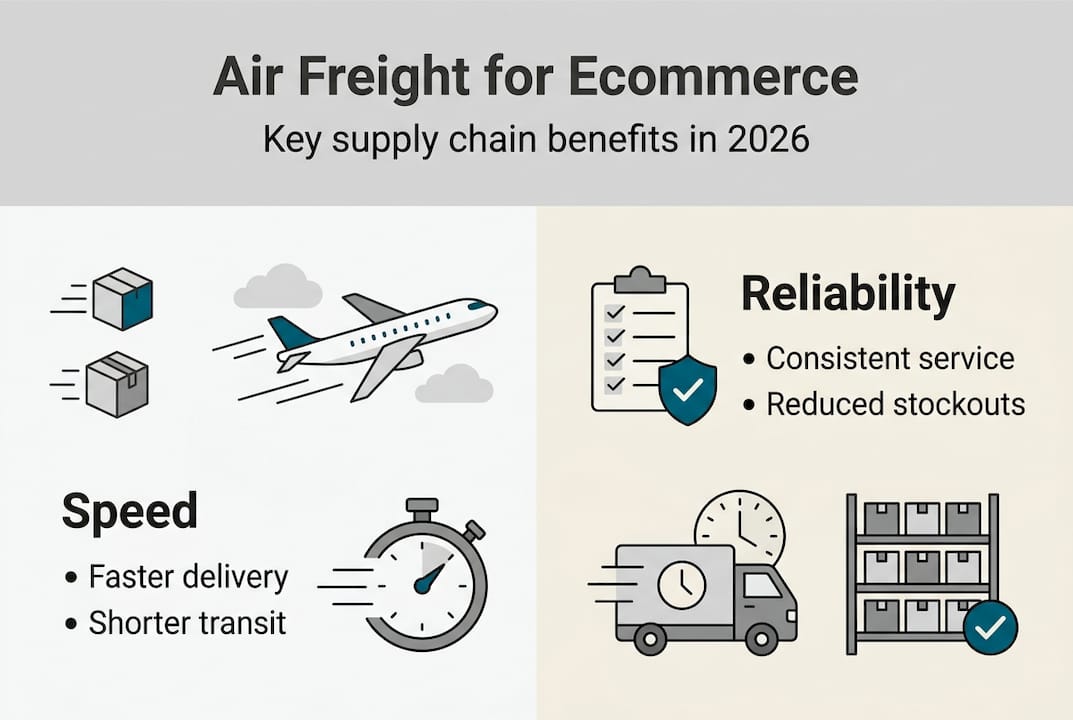
For ecommerce businesses, air freight enhances supply chain efficiency by enabling just-in-time inventory, rapid market response, and resilience when disruptions hit. Hybrid air-ocean strategies, where you ship the bulk of your volume by ocean but reserve air for urgent restocks, optimize overall costs while maintaining flexibility.
Here are the key impacts air freight delivers for online retailers:
- Speed to market: New product launches can reach your warehouse in days, not weeks. Getting to market first in a trend-driven category like apparel, electronics accessories, or seasonal décor can mean capturing the bulk of early-adopter demand before competitors catch up.
- Demand spike response: Flash sales, influencer moments, and viral product features can spike orders overnight. Air freight lets you replenish inventory fast enough to capitalize on that demand rather than display an out-of-stock message at the worst possible moment.
- Supply chain resilience: Port congestion, weather disruptions, or factory delays can strand ocean freight for weeks. Having air freight as a backup mode protects your revenue stream and your customer relationships when the unexpected happens.
- Reduced holding costs: Because goods arrive faster, you can hold less safety stock in your warehouse. That frees up capital and storage space, which is a significant operational benefit for ecommerce businesses paying per-pallet fulfillment fees.
- Global reach with predictability: Air freight schedules are far more reliable than ocean schedules, where delays of 7 to 14 days beyond estimated arrival are common. That predictability makes demand planning considerably easier.
Pro Tip: Time your air freight shipments to arrive 2 to 3 weeks before a major sales event or seasonal launch. This gives you buffer time for customs clearance, quality checks, and warehouse intake without paying for rush express rates unnecessarily.
“The smartest ecommerce brands don’t think of air freight as an emergency option. They build it into their planning as a strategic tool, using it for launches, trend responses, and disruption recovery while letting ocean freight handle their base inventory flow.” Senior Logistics Consultant
Better inventory management tips for ecommerce start with understanding which SKUs carry enough margin and enough risk to justify air freight costs. Likewise, managing supply chain disruptions effectively almost always involves having air freight relationships established before you actually need them urgently.

Cost, speed, and reliability: Deciding if air freight fits your business
Equipped with its role, it’s now key to evaluate when air freight should be part of your shipping mix. The cost premium is real, but so are the revenue protection benefits when air freight is used strategically.
| Factor | Air freight | Ocean freight | Ground freight |
|---|---|---|---|
| Transit time | 1 to 7 days | 15 to 45 days | 1 to 10 days |
| Cost per kg | $4 to $8+ | $0.10 to $0.50 | $0.50 to $2 |
| Reliability | Very high | Moderate | High |
| Volume capacity | Low | Very high | Medium |
| Best for | Urgent, high-value goods | Bulk, non-urgent goods | Regional deliveries |
Air freight delivers the most value in these specific situations:
- High-value products where shrinkage, damage, or theft risk makes the slower journey on an ocean vessel a genuine financial exposure
- Perishable or time-sensitive goods including cosmetics with expiry dates, seasonal fashion, or event-driven merchandise
- Inventory recovery situations where a stockout is actively costing you sales every day the replenishment is delayed
- New product launches where you need your first batch in-market fast to capture reviews, momentum, and algorithm ranking signals on platforms like Amazon
- Low-weight, high-margin items where the freight cost as a percentage of product value remains manageable
The revenue math matters more than the freight rate. Consider this: a real case study showed that smart global network distribution cut international delivery times by 88%, and stockout prevention protected well over $8,000 in revenue that would have been lost during the delay period. When you run those numbers against an air freight premium of a few hundred dollars, the decision becomes obvious.
The key calculation is straightforward: estimate your average daily sales revenue for the product in question, multiply it by the number of days an ocean freight delay would cause a stockout, and compare that lost revenue to the cost difference between ocean and air. In many cases, air freight pays for itself several times over.
Choosing between modes is not always binary, either. Many successful ecommerce brands use a split strategy: air freight for 20 to 30% of their fastest-moving or highest-margin inventory, ocean freight for the rest. Understanding air vs ocean freight cost trade-offs in detail will help you build a model specific to your product categories. From there, exploring top freight booking options ensures you are working with carriers and forwarders that match your volume, budget, and service level requirements.
Getting started with air freight: Tips for ecommerce retailers
Now that the decision process is clear, here’s how to start using air freight effectively in your ecommerce supply chain. The first shipment is often the hardest because of paperwork and unfamiliar processes, but with the right steps it becomes routine quickly.
- Define your shipment requirements. Identify the weight, dimensions, commodity type, and destination before reaching out to any carrier or forwarder. This prevents delays caused by cargo restrictions, especially for products containing batteries, liquids, or pressurized components.
- Choose your service level. Express air (door to door, 1 to 3 days) costs significantly more than standard air freight (3 to 7 days). For most planned restocks, standard air is sufficient. Reserve express only for genuine emergencies or extremely high-value recovery situations.
- Work with a licensed freight forwarder. Forwarders handle booking, documentation, and customs on your behalf. For most ecommerce businesses shipping internationally, attempting to manage this independently adds risk without saving meaningful money.
- Prepare your documentation. Every international air shipment requires a commercial invoice, packing list, air waybill, and sometimes a certificate of origin or product-specific permits. Missing documents are the single most common cause of customs delays.
- Confirm your incoterms. These define who is responsible for the goods at each point in the journey. EXW (ex works) means you take responsibility from the supplier’s door. DDP (delivered duty paid) means the freight cost includes all duties and taxes to your destination. Know which applies to your shipment before you book.
- Track and audit your shipments. Use a platform with real-time tracking visibility to monitor your cargo and catch exceptions early. A shipment flagged at customs on day two is far less damaging than one you didn’t notice until day seven.
Pro Tip: Build a relationship with your freight forwarder before you need them urgently. A forwarder who knows your product catalog, your common lanes, and your compliance requirements will get you better rates and faster service than one you call cold in a crisis.
Understanding the types of logistics services available will help you combine air freight with warehousing, last-mile delivery, and fulfillment services intelligently. For high-volume operations, integrating EDI freight forwarding capabilities into your systems can automate bookings, reduce manual errors, and give your logistics team far better visibility across all shipments simultaneously.
As global networks demonstrate, cutting international transit times by 88% is achievable when you combine air freight with strategically positioned fulfillment centers. The combination of fast inbound freight and optimized outbound fulfillment is where the biggest efficiency gains live for growing ecommerce brands.
A practical perspective: Air freight’s true role in modern ecommerce
Here is something most logistics content gets wrong: air freight is not inherently better than ocean freight. It is a tool, and like any tool, it performs brilliantly in some situations and wastefully in others. The brands that get the most value from air freight are not the ones shipping everything by air. They are the ones who have done the math, built hybrid strategies, and use air deliberately rather than reflexively.
One of the most consistent mistakes we see ecommerce businesses make is treating air freight as their default mode for reorders simply because it feels safer. That instinct is understandable. But when you run the true cost across a year of shipments, the premium compounds fast. A product that generates 35% gross margin can see that margin effectively cut in half by routine air freight premiums when ocean freight would serve the same purpose with better planning.
The more sophisticated calculation involves your product’s lifetime value, its velocity on the shelf, and its seasonality curve. A product that sells 80% of its annual volume in a 6-week window has a completely different air freight calculus than one with flat, year-round demand. The seasonal product almost always justifies air freight for its peak replenishment because a stockout during that 6-week window is catastrophic. The flat-demand product rarely does.
The brands that consistently win at logistics are those that build flexibility into their supply chain rather than chasing the fastest possible speed on every shipment. Understanding the key differences air vs ocean freight at a strategic level, not just a rate-card level, is what separates reactive logistics management from genuinely competitive supply chain design. Speed is a competitive weapon. But used indiscriminately, it becomes an unnecessary cost that erodes the margins you worked hard to build.
Streamline your air freight logistics with expert solutions
If the gap between where your logistics operation is today and where it needs to be feels significant, you are not starting from scratch. The right platform and the right partners make a measurable difference quickly.
At or-ner.com, we built our platform specifically for ecommerce businesses navigating exactly these trade-offs. From freight booking explained to real-time shipment tracking and customs clearance support, our tools give you visibility and control across every leg of your supply chain. Whether you are booking your first international air shipment or optimizing a multi-modal strategy across dozens of SKUs, our freight booking guide walks you through every step. For domestic fulfillment and last-mile delivery, our reliable courier services ensure your customers receive orders on time, every time. Let us help you move faster, smarter, and at better cost.
Frequently asked questions
What types of goods are best suited for air freight?
High-value, time-sensitive, perishable, or lightweight items are best transported by air freight, since these categories justify the premium over the faster transit speed. Electronics, cosmetics, fashion, and AI hardware are among the fastest-growing air freight categories, driving projected 2026 demand growth of 2.6% globally.
How fast is air freight for international ecommerce shipments?
Modern global networks can cut international air freight delivery times by up to 88% compared to traditional methods, particularly when combined with strategically positioned fulfillment centers near the destination market.
What is the main benefit of air freight for ecommerce retailers?
Air freight allows you to respond quickly to market demand and avoid costly stockouts, with research confirming that air freight enhances efficiency through just-in-time inventory and rapid disruption recovery for online retailers.
Is air freight always more expensive than ocean or ground freight?
Air is typically pricier per kilogram, but the speed and revenue protection exceeding $8,000 per critical shipment demonstrates that the total cost of a stockout often far outweighs the freight rate premium.