
A warehouse management system is the operational software that gives logistics teams real time control of receiving, inventory, picking, packing, and shipping, turning scattered warehouse tasks into one connected, trackable process. The main payoff is accuracy and speed: fewer picking errors, faster order cycles, and a live view of stock across every location. Logistics managers, e-commerce operators, and third-party logistics providers rely on it to keep inventory data honest and warehouse labor productive.
TL;DR:
- Choose cloud for faster rollout and lower upfront costs, but use hybrid control when robotics need local response or regulations require data residency.
- Prioritize mature, bidirectional APIs linking ERP, transportation, and automation; dense robotics or conveyor systems may also require a WES for local control.
- Begin with cycle counts for high value or fast moving stock, then add directed picking and labor tools before introducing automation or AI.
- Organizations often report return on investment within 12 to 18 months when a scoped pilot targets measurable improvements and budgets for integration and training.
Table of Contents
- How a WMS Fits Into the Supply Chain Tech Stack
- The Main Benefits of Adopting a Warehouse Management System
- What a WMS Actually Does, From Receiving to Shipping
- Choosing Between Cloud, On-Premise, and Hybrid WMS Models
- Integration Requirements and the Technology Powering Modern Warehouses
- How to Evaluate, Select, and Implement a WMS
- Which Industries Benefit Most, and What They Should Measure
- Putting These Principles Into Practice
- What Logistics Teams Should Prioritize Going Into 2026
- Let Us Handle the Warehousing So You Can Focus on Growth
- FAQ
- Sources
How a WMS Fits Into the Supply Chain Tech Stack
A warehouse management system handles execution, not planning. It directs the physical work inside a facility: where a pallet goes, which picker takes which order, when a truck leaves the dock. That is different from an ERP, which manages finance, purchasing, and high-level planning, and different from a transportation management system (TMS), which plans routes and carriers once goods leave the building. In highly automated sites, a warehouse execution system (WES) often sits between the WMS and the automation hardware, translating warehouse-level instructions into machine-level commands.
Real-time inventory visibility is the piece that ties these systems together. When a WMS updates stock counts the moment an item is scanned, every connected system, from the storefront to the finance ledger, works from the same numbers. For businesses running several warehouses or selling across multiple channels, that shared visibility is what prevents overselling and stockouts.
A few things define where WMS sits in the stack:
- It executes decisions made upstream by ERP and planning tools rather than setting overall business strategy.
- It feeds real-time stock and order status back to ERP, e-commerce platforms, and transportation systems.
- It becomes more strategic in regulated or omnichannel operations, where traceability and multi-channel order accuracy carry real financial and legal weight.
For a deeper look at how adoption and cloud migration are reshaping this layer of the stack, see our overview of WMS trends in retail and supply chain.
The Main Benefits of Adopting a Warehouse Management System
The clearest case for a WMS comes down to three things: fewer errors, faster throughput, and a workforce that spends less time walking and searching. Directed workflows replace guesswork, so pickers follow optimized paths and receiving staff put stock away in locations the system has already chosen based on turnover and slotting logic.
Space utilization improves alongside labor productivity, since a WMS can recommend slotting changes as demand patterns shift, keeping fast movers close to packing stations and freeing up premium floor space. On the compliance side, lot, serial, and expiry tracking give regulated industries an audit trail that manual spreadsheets cannot match.
Cloud deployment is now the default path to these gains. Cloud WMS accounted for the majority of US market revenue in 2024, and cloud implementations go live faster than on-premise systems, which shortens the time before a warehouse starts seeing these benefits.
The main benefit categories worth tracking from day one:
- Inventory accuracy and reduced shrinkage from real-time scanning instead of periodic manual counts.
- Higher order throughput per labor hour thanks to directed picking and optimized task sequencing.
- Better space utilization through data-driven slotting rather than static storage assignments.
- Stronger traceability and audit readiness for regulated goods like food and pharmaceuticals.
For practical steps that translate these benefits into day-to-day operations, our guide on WMS best practices for ecommerce walks through implementation specifics.
What a WMS Actually Does, From Receiving to Shipping
A warehouse management system covers the full operational cycle, not just inventory counts. Breaking it down by process shows where the software earns its keep:
- Receiving and directed put-away: Inbound goods are scanned against purchase orders, then the system assigns a storage location based on velocity, size, or storage rules rather than leaving it to whoever has an open hand truck.
- Inventory control: Lot, serial, and expiry tracking keep regulated or perishable stock traceable, while cycle counting replaces disruptive full inventory shutdowns with ongoing spot checks.
- Picking: The system supports multiple strategies, including wave picking for batching similar orders, zone picking for large facilities, and cluster picking for high-volume e-commerce, choosing the right method based on order profile and facility layout.
- Packing and shipping: Packing instructions reduce dimensional weight waste, and integration with carrier systems auto-generates labels and shipping documents, while dock and yard controls schedule trailers to avoid congestion.
- Labor management and KPI generation: The system tracks productivity by task and worker, generating the throughput, accuracy, and utilization metrics that managers use to spot bottlenecks.
Pro Tip: Start cycle counting on your highest-value or fastest-moving SKUs first. That is where inventory errors cost the most and where accuracy gains show up fastest in your numbers.
Picking strategy deserves particular attention because it is where most daily labor hours go. Wave picking suits predictable batch schedules, zone picking reduces travel time in large footprints, and cluster picking fits high-SKU-count e-commerce orders where pickers collect multiple orders in a single pass. A good warehouse layout makes any of these strategies more effective, which is why slotting and layout planning are worth revisiting once order patterns change. Our warehouse layout planning guide covers the physical side of this decision in more depth.
Choosing Between Cloud, On-Premise, and Hybrid WMS Models
The deployment model shapes both cost and speed of rollout. Cloud SaaS has become the default choice for most warehouses because it lowers upfront capital requirements and gets facilities live faster than traditional on-premise installs, a gap confirmed by recent industry survey data on automation and fulfillment. On-premise still makes sense for facilities with strict data residency rules or extremely high-volume, latency-sensitive automation that cannot tolerate any network delay.
Hybrid models are gaining ground specifically because they split the difference: cloud analytics and reporting run centrally, while time-sensitive control logic for robotics or conveyor systems runs locally to avoid lag. Pharmaceutical and other regulated operations often lean toward hybrid setups to satisfy data-residency requirements while still getting cloud-based visibility, a pattern reflected in how regulated industries are structuring their WMS deployments.
Architecture matters as much as hosting location:
- Modular WMS platforms let a warehouse add functions like labor management or slotting optimization in phases, spreading cost and risk over time.
- Monolithic, all-in-one systems can be faster to deploy initially but harder to adjust later as needs change.
- A phased rollout, starting with core inventory and picking functions before layering in automation modules, tends to reduce disruption during go-live.
Integration Requirements and the Technology Powering Modern Warehouses
A WMS rarely works alone. It needs to exchange data with ERP systems for financials and purchasing, with TMS platforms for outbound shipping, and increasingly with a WES when automation intensity rises. As robotics and conveyor density increase, the WES takes over real-time equipment coordination while the WMS keeps managing inventory logic and order orchestration.
Hardware integration is where a lot of projects get tested. Autonomous mobile robots (AMRs) and automated storage and retrieval systems (ASRS) need tight, low-latency communication with the WMS or WES layer, and Warehouse 4.0 research points to IoT, RFID, augmented reality, and autonomous vehicles as the technologies most shaping how smart warehouses operate today. RFID specifically has become a practical lever for improving real-time accuracy without a full automation overhaul, which we cover in our guide to RFID in warehousing.
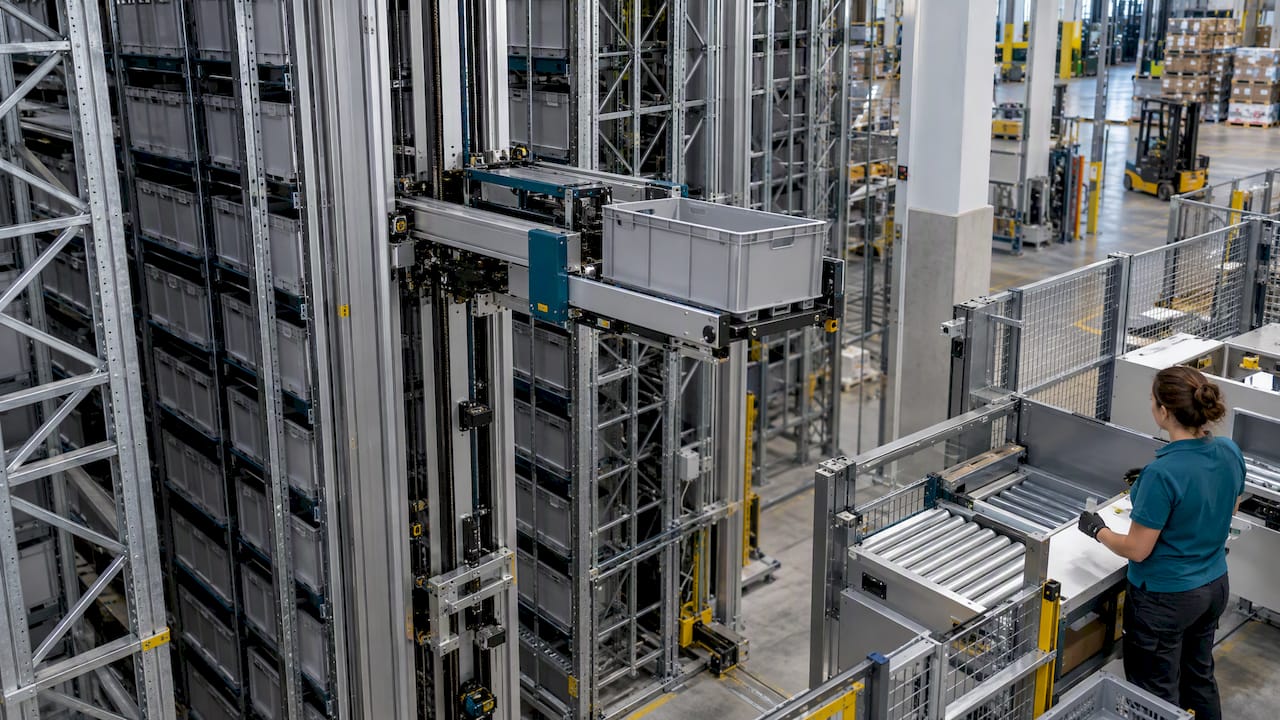
Integration is also the single biggest execution risk. Integration across WMS, WES, and partner systems is the most commonly cited challenge in deploying smart distribution technology, even as more executives treat AI as a competitive necessity rather than a nice-to-have.
Key integration and technology considerations:
- APIs need to support real-time, bidirectional data exchange with ERP and TMS platforms, not batch updates run once a day.
- Automation hardware like AMRs and ASRS requires a WES layer once robot density or conveyor complexity passes a basic threshold.
- Network connectivity, including private LTE or 5G where mission-critical robotics are involved, is becoming a prerequisite rather than an upgrade.
- AI use cases in forecasting and slotting are promising, but a lack of clear deployment plans and operational expertise keeps many projects stuck at the pilot stage.
Manufacturers running WMS alongside shop-floor systems should also look at how MES platforms handle machine-level data, since the same integration logic that connects a WMS to automation hardware applies to manufacturing execution systems on the production side. For a broader look at where AI fits into logistics decision-making, see our piece on the role of artificial intelligence in logistics.
How to Evaluate, Select, and Implement a WMS
Choosing a WMS works best as a structured evaluation rather than a feature checklist. Selection should prioritize integration readiness with automation hardware and ERP over a long list of nice-to-have features that may never get used.
- Score vendors on integration readiness first: confirm API maturity and existing connectors to your ERP, TMS, and any automation hardware you run or plan to add.
- Scope a pilot before a full rollout: a smaller facility or single process, like cycle counting or directed picking, proves value without betting the whole operation.
- Budget for integration and training, not just licensing: high implementation and integration costs are a primary barrier, especially for smaller operations, and training time is often underestimated.
- Track ROI against specific process metrics: many organizations see ROI within 12 to 18 months when the project scope includes focused, measurable process improvements rather than a vague modernization goal.
- Build in governance from day one: data quality rules, user permissions, and cybersecurity checks need to be part of the implementation plan, not an afterthought added after go-live.
Pro Tip: A staged rollout that fixes inventory controls and cycle counting first, then adds directed picking, then labor management, then automation and AI modules, tends to deliver visible wins faster than trying to launch everything at once.
Real-time data governance deserves its own attention during implementation, since a WMS is only as reliable as the data feeding it. Our guide to real-time data in logistics covers the governance side of this in more detail.
Which Industries Benefit Most, and What They Should Measure
Different business models lean on different parts of a WMS. E-commerce operations care most about order accuracy and returns processing, since a single mispick can cost more in customer service time than it saves in picking speed. Third-party logistics providers prioritize fast client onboarding and strict service-level agreement compliance, since a WMS that cannot configure new client rules quickly becomes a bottleneck.
Pharmaceutical and food operations need tight lot and expiry control for traceability and recall readiness. Manufacturers use WMS functions to manage staging areas and work-in-progress inventory feeding the production line, where timing matters as much as accuracy.
Across all of these, a few KPIs show up consistently:
- Order accuracy rate, tracked as a percentage of orders shipped without error.
- Units picked per labor hour, the core throughput metric for staffing decisions.
- Inventory accuracy from cycle counts versus system records.
- On-time shipment rate against carrier cutoffs and client SLAs.
Our best practices guide for ecommerce fulfillment breaks these metrics down further for online sellers specifically.
Putting These Principles Into Practice
Our warehousing and fulfillment operations follow a modular, integration-first approach that provides real-time inventory visibility, directed workflows, and connections to major e-commerce platforms such as Amazon. The platform combines warehousing, inventory management, catalog management, and order fulfillment in one connected system rather than a patchwork of disconnected tools.
That approach lets us support everything from a single-location e-commerce seller to a multi-warehouse brand managing cross-border volume, without forcing a rebuild every time order volume or channel mix changes. For readers who want to see how fulfillment and warehousing decisions play out operationally, our guide on ecommerce fulfillment solutions and our breakdown of order fulfillment fundamentals go deeper into the mechanics.
What Logistics Teams Should Prioritize Going Into 2026
Modular deployments and an integration-first mindset matter more than feature lists right now. Teams that treat AI as a scoped pilot tied to one clear process, like slotting or demand forecasting, see faster, more defensible wins than those chasing a full platform overhaul. Balance quick, measurable fixes against longer modernization work rather than waiting for a perfect system. If you are starting an evaluation, map your integration points before you look at a single vendor demo.
— Maayan
Let Us Handle the Warehousing So You Can Focus on Growth
Evaluating and implementing a WMS takes real time and budget. We offer warehousing, fulfillment, and inventory management as part of one connected logistics platform, so you get real-time stock visibility and automated workflows without building or maintaining the system yourself.
A global network of warehouses and fulfillment centers integrates with major e-commerce platforms and supports catalog management alongside storage, helping sellers and brands achieve operational control without a lengthy implementation timeline. Check our warehousing and fulfillment services to see what fits your volume and sales channels.
FAQ
What is a warehouse management system in logistics?
A warehouse management system in logistics is software that controls and tracks warehouse operations in real time, including receiving, put-away, inventory, picking, packing, and shipping. It gives logistics teams live visibility into stock levels and order status across one or more facilities.
What is a WMS in supply chain?
Within the supply chain, a WMS is the execution layer that carries out the physical warehouse tasks planned by upstream systems like ERP. It feeds real-time inventory and order data back to those systems so the rest of the supply chain works from accurate, current numbers.
What are the 5 essential warehouse management processes?
The five core processes most warehouse management systems handle are receiving and put-away, inventory control, picking, packing and shipping, and labor management with KPI tracking. Each process builds on accurate data from the one before it, which is why inventory accuracy is usually the first thing to fix.
How long does it typically take to see ROI from a WMS?
Many organizations report ROI within 12 to 18 months after a WMS upgrade, particularly when the project targets specific, measurable process improvements rather than a broad system replacement. Cloud deployments tend to reach that timeline faster than on-premise installs because go-live periods are shorter.
What is the biggest barrier to WMS adoption?
High initial implementation and integration costs, along with cybersecurity concerns, are the most commonly cited barriers, especially for small and medium enterprises. Integration across WMS, WES, and partner systems is also consistently flagged as the hardest part of execution, even when the budget is available.
Sources
- 2025 Software/Automation Outlook Survey: WMS reigns, AI rises – Modern Materials Handling
- The 2025 State of AI in Distribution – Distribution Strategy
- US Warehouse Management System Market Size, Share & 2030 Growth Trends Report – Mordor Intelligence
- Warehouse 4.0 literature review – PMC
- 2025 Warehouse Automation & Order Fulfillment Study – SAPinsider / Peerless Research