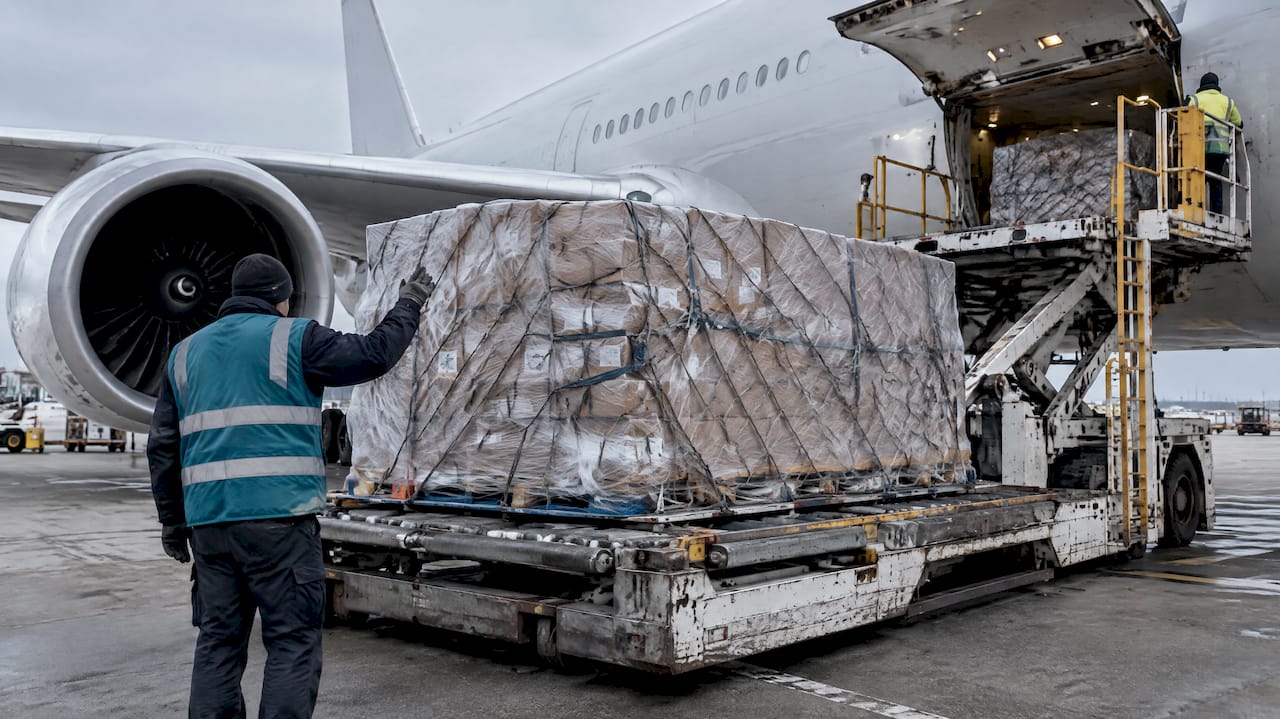
International air freight moves goods by aircraft across borders, and the decision rule is simple: use it when time or value outweighs cost. That makes it the right mode for time-sensitive orders, high-value cargo, perishable goods, or emergency spare parts, where a delay costs more than the premium you pay to fly it. It remains the fastest international shipping option and consistently the most expensive per kilogram.
TL;DR:
- International air freight charges are based on whichever is higher: actual weight or volumetric weight, often resulting in higher billed weight for large, lightweight shipments.
- Key surcharges such as fuel, security, terminal handling, and customs fees significantly impact the total cost, which varies with capacity demand and seasonality.
- Fast, high-value, or perishable cargo benefits most from express or charter services, while scheduled and groupage shipments are better suited for predictable volumes at lower costs.
- Proper packing, securement, and cold chain documentation are critical to prevent delays caused by handling issues or compliance failures during customs and airport procedures.
- Choosing carriers with strong operational capabilities, clear processes, and certifications like CCSP reduces risk of delays, especially when combined with comprehensive pre-shipment checks and real-time tracking systems.
Table of Contents
- Choosing between express, scheduled, and charter air service
- How international air freight rates get calculated
- Booking, documentation, and security screening explained
- Packing, palletization, and cold chain rules that prevent delays
- What to look for when evaluating carriers and forwarders
- How Or-ner supports air freight execution for shippers
- A pre-shipment checklist worth running every time
- Get an air freight estimate and simplify cross-border shipping
- FAQ
- Sources
Choosing between express, scheduled, and charter air service
Not every shipment needs the fastest, most expensive option on the board. Express or next-flight-out service gets cargo on the first available flight, often with dedicated ground handling, and suits urgent parts, medical shipments, or last-minute ecommerce orders. Scheduled freight rides on regular carrier routes at a lower price point and fits predictable, recurring volume. Consolidated or groupage shipments combine multiple shippers’ cargo into one booking, cutting cost for smaller loads that cannot fill a pallet on their own.
Capacity decisions matter as much as speed. Dedicated freighter aircraft carry oversized or high-volume cargo that will not fit in a passenger belly hold, while belly cargo space on passenger flights offers more frequent departures on many routes. A full charter makes sense for large, time-critical loads, like a factory relocation or a disaster-response shipment, where a shipper needs an entire aircraft’s capacity on a fixed schedule.
Special-handling variants add another layer of choice:
- Temperature-controlled service maintains cold chain integrity for pharmaceuticals, vaccines, and perishable food.
- Express/next-flight-out suits urgent, high-value, or time-critical cargo.
- Scheduled freight works for predictable, recurring shipments at lower cost.
- Charter service gives a shipper exclusive aircraft capacity for oversized or large-volume loads.
How international air freight rates get calculated
Air freight pricing starts with weight, but not the weight on your bathroom scale. Carriers charge based on whichever is higher: actual gross weight or dimensional (volumetric) weight, calculated from the shipment’s cubic dimensions. Say a pallet measures 120 cm by 100 cm by 150 cm and weighs 150 kilograms actual. Using the standard air freight divisor of 6,000, the volumetric weight comes to 300 kilograms. Because 300 exceeds the actual 150, the carrier bills for 300 kilograms, not 150.
Beyond the base per-kilogram rate, several line items typically show up on a quote:
- Fuel surcharges, which shift with jet fuel prices and can change monthly.
- Security fees, tied to screening and handling requirements.
- Terminal handling charges at origin and destination airports.
- Customs and CBP processing fees, including the per-airway-bill fee that applies to express consignment facilities under 19 CFR 24.23.
- Peak season or capacity surcharges during high-demand periods like the fourth quarter.
Lane capacity and demand swings drive pricing more than any single fee. IATA reported international cargo tonne-kilometer growth of 4.8% year over year in October 2025, and growth accelerated to 5.5% in December, with available capacity (ACTK) up roughly 4.5% to 5% over the same periods, according to IATA’s December 2025 market analysis.
Booking, documentation, and security screening explained
Air freight rarely starts or ends at an airport. A shipment typically begins with a truck pickup at the shipper’s warehouse, moves through origin airport build-up, flies the air sector, then clears customs and travels the final ground leg to the consignee. Each handoff is a point where delay can creep in, and ground coordination failures are a common cause of missed deadlines.
A typical booking and documentation sequence looks like this:
- Book the shipment with a carrier or forwarder, confirming routing, cut-off times, and Incoterm responsibilities as outlined by Trade.
- Prepare the air waybill (AWB), the contract of carriage and the core document that tracks the shipment from origin to destination.
- Assemble commercial invoice and packing list, which customs authorities use to assess duties and verify contents.
- File export declarations where required, such as AES, ACR, or ACE filings, along with any Partner Government Agency data for regulated goods.
- Clear security screening. The TSA requires 100% screening of air cargo on passenger flights, and shippers who use Certified Cargo Screening Program facilities can screen cargo earlier in the supply chain and avoid secondary screening delays at the airport.
Missing or inconsistent paperwork at any of these steps is one of the most common reasons shipments sit on the tarmac instead of flying on schedule.
Packing, palletization, and cold chain rules that prevent delays
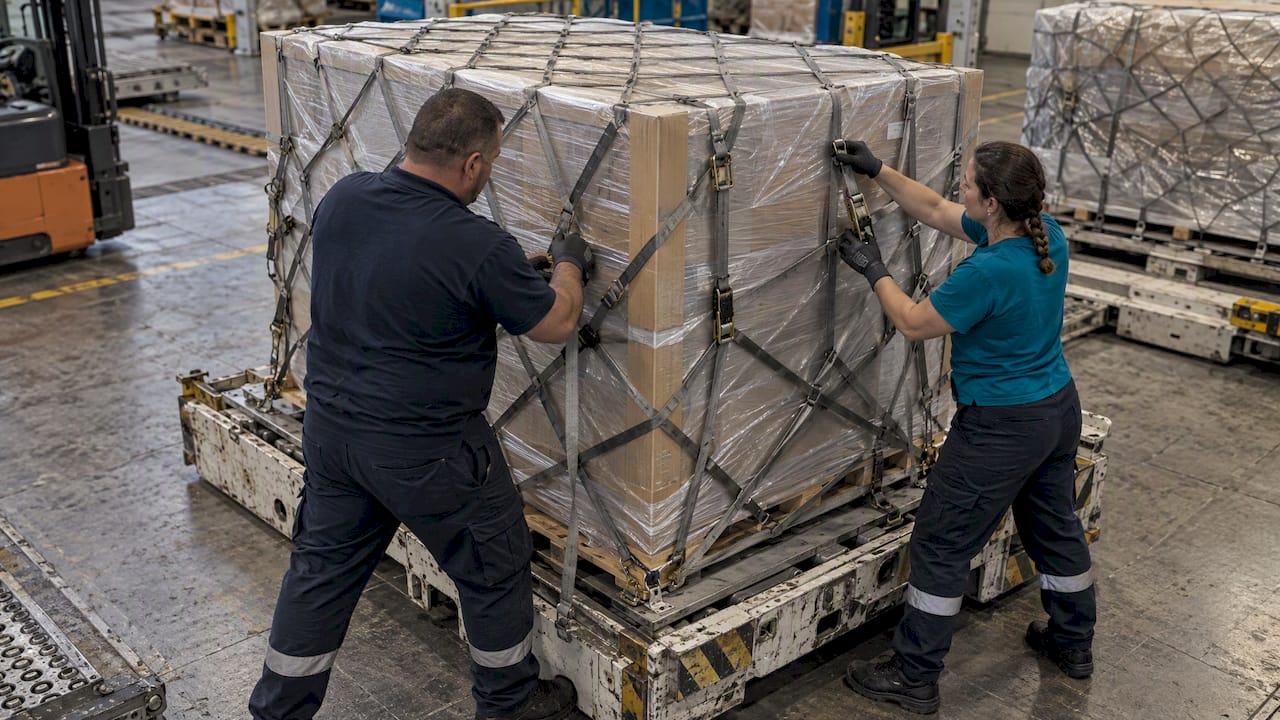
Air cargo gets handled, stacked, and moved through tighter spaces than ocean freight, so packing has to account for weight limits, securement, and compatibility with aircraft cargo holds. Pallets need to meet unitization standards, respect maximum piece and pallet weights set by the carrier, and be wrapped and strapped tightly enough to survive multiple handling transfers without shifting.
Dangerous goods require their own documentation and labeling under international air transport rules, and getting this wrong can mean a shipment gets refused at the airport rather than delayed in transit. Temperature-controlled cargo adds further checkpoints: continuous temperature monitoring, validated packaging, and documentation that proves the cold chain held from pickup to delivery.
Key practices worth building into a standard operating procedure:
- Confirm maximum weight per pallet and per piece with the carrier before building the shipment.
- Secure cargo with proper strapping and shrink wrap to prevent shifting during handling.
- Verify dangerous goods documentation matches the actual contents before tendering the shipment.
- Use calibrated temperature loggers for cold chain shipments and retain the data as proof of compliance.
Pro Tip: Build a pre-shipment checklist that pairs each cargo type (standard, dangerous goods, temperature-controlled) with its required documentation, so nothing gets missed during a rush booking.
What to look for when evaluating carriers and forwarders
Picking a carrier or forwarder on price alone is how shipments end up stuck in customs or bumped off a full flight. A stronger evaluation looks at operational depth: lane-specific transit time reliability, direct access to freighter capacity rather than relying solely on belly space, and the strength of the forwarder’s customs brokerage team. Freight forwarders handle documentation, booking, and compliance much like a travel agent manages a complex itinerary, which makes their in-house expertise a meaningful differentiator.
A practical checklist for comparison:
- CCSP participation, which signals faster security clearance and fewer screening delays.
- Clear SLA cut-off times for booking, document submission, and ground pickup.
- Door-to-door capability, including customs brokerage, tracking, warehousing, and returns handling.
- Transparent liability terms that spell out who covers loss or damage at each stage.
Watch for red flags: vague routing with no named carrier, rates well below market with no explanation, or a forwarder that cannot describe its documentation workflow in specific terms.
How Or-ner supports air freight execution for shippers
Our platform is designed to integrate freight booking, customs clearance, and warehousing into a single system to reduce delays that typically occur at handoffs. Real-time tracking and exception management flag problems like missed cut-offs or stalled customs filings while there is still time to fix them, which keeps dwell time down on both ends of the air sector.
A pre-shipment checklist worth running every time
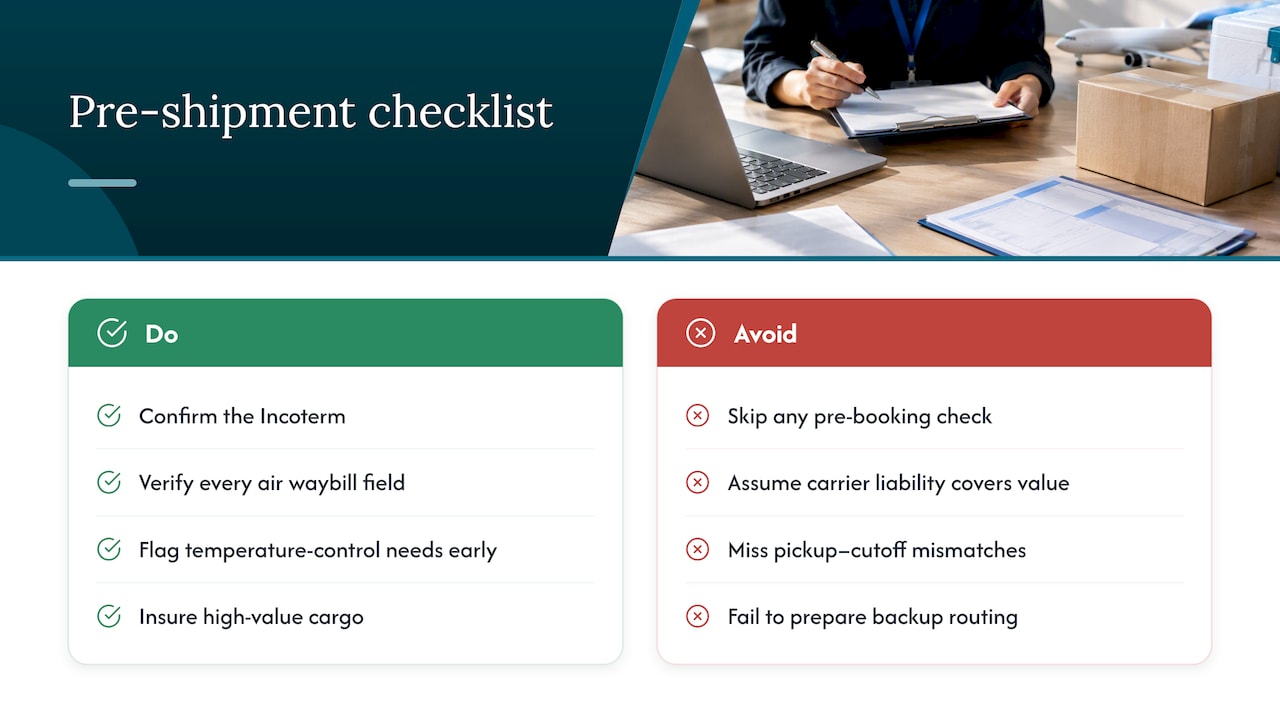
Before booking, confirm the Incoterm, verify every data field on the air waybill, check whether your facility or forwarder is CCSP certified, and flag temperature-control needs early. On the operations side, confirm ground pickup windows match the flight cut-off, have a backup routing ready in case the primary flight is full, and insure high-value cargo rather than assuming the carrier’s standard liability covers your exposure.
These steps take minutes to run through, but skipping any one of them is usually what turns a routine shipment into an expensive delay.
— Maayan
Get an air freight estimate and simplify cross-border shipping
If you are weighing express against scheduled service, or trying to line up customs clearance with a warehouse handoff, we built our platform to handle that coordination in one place. Freight booking, customs clearance, warehousing, and real-time tracking run through a single system, so you are not chasing status updates across separate vendors.
We work primarily with ecommerce sellers, wholesalers, and manufacturers who need reliable execution on recurring international shipments, not one-off personal parcels. That focus shapes how our tools are built: catalog management and inventory visibility sit alongside freight booking, so a growing brand can scale shipping volume without adding headcount for every new lane.
- Get a freight estimate through our freight shipping estimate tool to compare air options for your lane.
- Pair air freight with fulfillment using our customs clearance and warehousing services for door-to-door coverage.
- Review our full service lineup on the Or-ner homepage if you are evaluating providers for the first time.
FAQ
What is international air freight?
International air freight is the transport of goods by aircraft across national borders, typically chosen for time-sensitive, high-value, or perishable cargo. It moves faster than ocean or ground transport but costs more per kilogram, which is why shippers reserve it for situations where speed justifies the premium.
How much does international air freight cost?
Air freight pricing combines a base per-kilogram rate with fuel surcharges, security fees, terminal handling, and customs processing charges, and the final cost depends heavily on the lane, season, and available capacity. Because rates shift with capacity and demand trends that IATA tracks, getting a current quote for your specific route and weight is more reliable than relying on a general figure.
What are the 4 types of freight?
Common categories include air freight, ocean freight, rail freight, and road (truck) freight, each suited to different combinations of speed, cost, and cargo type. Air freight serves time-sensitive and high-value shipments, while ocean and rail typically handle larger, less urgent volumes at lower cost per unit.
Does FedEx do international freight?
Several major parcel and logistics carriers offer international air freight alongside their express parcel services, typically through dedicated freight divisions. When comparing providers, it helps to check whether their freight service matches your shipment size and documentation needs rather than assuming parcel-level service extends automatically to freight-level cargo.
What documents do I need for international air freight?
A standard international air freight shipment requires an air waybill, a commercial invoice, and a packing list, with export filings such as AES or ACR added when required by the origin country. Shippers moving regulated goods may also need Partner Government Agency documentation, which a freight forwarder can help assemble to avoid clearance delays.
Sources
- TSA — Cargo screening program
- IATA — Air Cargo Market Analysis October 2025
- eCFR — 19 CFR 24.23 Fees for processing merchandise
- Trade