Enterprise global parcel tracking is a control-tower system that pulls carrier, air, ocean, and road data into one dashboard to produce dynamic ETAs and flag exceptions before they become customer problems. The payoff is operational, not cosmetic: predictable delivery windows, fewer manual status inquiries, and inventory plans that match reality instead of a carrier’s static promise. We build this kind of visibility into our own platform, alongside booking, customs, and fulfillment tools.
TL;DR:
- Visibility systems should incorporate cross-border identifiers like DUNS and LEI to meet evolving customs and regulatory requirements.
- Setting exception alert thresholds at 48 hours of ETA deviation reduces false alarms and improves overall operational efficiency.
- Integrating tracking data directly into booking, customs, and WMS workflows ensures that exceptions trigger immediate actionable responses.
- The most effective platforms are easy to use, with role-based interfaces that prioritize relevant information for each team member.
- Disruptions such as port closures or natural disasters significantly degrade tracking accuracy unless multiple data sources and redundancy measures are in place.
Table of Contents
- Core capabilities that define enterprise-grade visibility
- Business value: KPIs and measurable outcomes to expect
- Implementation checklist: how to pilot and scale parcel visibility
- Tactical best practices: alert design and data quality
- Privacy and data security considerations in global parcel tracking
- How global disruptions affect tracking accuracy
- User experience and accessibility of tracking platforms
- Comparing leading global parcel tracking providers
- Why we favor an integrated control-tower approach
- Start a pilot with Or-ner
- FAQ
- Sources
Core capabilities that define enterprise-grade visibility
Basic tracking shows you where a parcel was last scanned. Enterprise visibility tells you where it will be, when it will arrive, and whether that timeline just changed enough to matter. The gap between the two comes down to five capabilities.
A real control tower acts as a single source of truth across parcel, air, ocean, and road shipments, so a logistics manager stops toggling between five carrier portals to answer one order status question. That dashboard is only as good as the data feeding it: carrier APIs, telematics feeds, RFID reads, and milestone events all need to land in one normalized stream, not in five incompatible formats.
From there, dynamic ETA recalculation takes over. Machine learning models combined with deterministic lane rules adjust arrival estimates as conditions change, instead of locking in a date at booking and ignoring reality until delivery. Exception management sits on top of that: configurable alert thresholds flag only the delays that matter, and each exception gets tagged with its likely service-level impact so a planner knows which fires to fight first.
The newest requirement is cross-border lineage. As customs authorities push for better traceability, platforms need to be ready to collect and transmit party identifiers such as DUNS, GLN, LEI, and Altana ID, a concept regulators call Global Business Identifiers. Integration hooks into your TMS, WMS, ERP, and OMS complete the picture, turning a tracking feed into something your planning systems can actually act on.
A buyer checklist for this category typically includes:
- Single dashboard covering parcel, air, ocean, and road in one view.
- Carrier and device integrations spanning APIs, telematics, RFID, and milestone data.
- Dynamic ETAs that recalculate automatically rather than stay fixed at booking.
- Configurable exception alerts tagged by service-level impact.
- GBI readiness for cross-border party identifiers and customs data.
Pro Tip: Ask any vendor to show you a live exception alert end to end, from trigger to resolution, before you sign anything.
Business value: KPIs and measurable outcomes to expect
Visibility programs earn their budget through measurable outcomes, not dashboards that look impressive in a demo. More than half of firms surveyed by the MIT Center for Transportation & Logistics report that end-to-end visibility drives sales growth, with roughly similar shares crediting it for automation gains and faster delivery, each cited by about 51 to 53% of respondents.
More than half of surveyed firms link end-to-end visibility directly to sales growth and faster delivery, which turns a tracking investment into a revenue conversation rather than a pure cost center.
Once a pilot is running, a handful of KPIs tell you whether it is working:
- ETA accuracy, measured against actual delivery time.
- On-time delivery percentage by lane and carrier.
- Exceptions per 1,000 shipments, tracked over time to spot trends.
- Mean time to resolution for flagged exceptions.
- Demurrage and detention savings from earlier container and dock planning.
These numbers translate into real decisions. Accurate ETAs let replenishment teams prioritize the SKUs actually at risk of stocking out instead of reacting to every late scan. Fewer blind spots mean fewer panicked expedited shipments booked at premium rates. And visibility into returns transit lets customer service teams set honest refund timelines instead of guessing.
Implementation checklist: how to pilot and scale parcel visibility
Rolling out enterprise tracking works best as a scoped pilot, not a company-wide switch flipped overnight. Here is a sequence that keeps the project manageable.
- Run discovery first. Inventory every carrier and transport mode in use, map your highest-volume lanes, list affected SKUs, and identify who owns shipment data on each side of the handoff.
- Pick pilot lanes and KPIs. Choose two or three representative lanes, set baseline metrics for ETA accuracy and on-time rate, and agree on what success looks like before you integrate anything.
- Build the technical integration. Connect carrier APIs, map data fields consistently across systems, start collecting GBI-type identifiers for cross-border lanes, and sync events into your ERP, TMS, and WMS.
- Set up operational workflows. Define alert thresholds, for example flagging only shipments with an ETA deviation greater than 48 hours, assign a single owner for each exception type, and document the escalation path.
- Govern the pilot. Run it for 8 to 12 weeks, track results against your baseline, and use that evidence to plan a phased rollout to additional lanes.
Research into real-time tracking case studies backs the 48-hour threshold specifically: practitioner data shows it reduces the frequent ERP recalculations and alert fatigue that come from reacting to every minor schedule shift. The same research points to enterprises like Hilti integrating real-time tracking directly with ERP systems to cut demurrage costs and tighten warehouse planning, evidence that visibility pays off most when it drives automated re-planning rather than sitting in a dashboard nobody checks.
For deeper technical detail on the platform side of this, our enterprise parcel-tracking guide walks through the feature set in more depth.
Pro Tip: Baseline your current exception rate before the pilot starts. Without it, you have no way to prove the new system improved anything.
Tactical best practices: alert design and data quality
The fastest way to kill a visibility program is to flood planners with alerts until they start ignoring all of them. Good threshold design is what keeps the system useful instead of annoying.
The same case-study research that supports the 48-hour rule recommends setting thresholds by lane and SKU criticality rather than applying one blanket rule everywhere. High-impact SKUs get lower thresholds and a human review step before any automated re-plan fires. Low-impact shipments only escalate on larger deviations, which keeps planners focused on what actually needs attention.
Case studies show control-tower visibility is now the top must-have capability for shippers, cited by 68% of respondents in recent industry research, ahead of other technology investments shippers are weighing.
A few rules keep the system honest over time:
- Assign one exception owner per lane, so accountability never falls between two teams.
- Set escalation and resolution SLAs that match the business impact of each alert tier.
- Pair ML-driven ETAs with deterministic lane rules and require human review for critical SKUs.
- Make carrier onboarding simple, since carriers only share quality data when the process to do so is quick and the benefit, like fewer status-check calls, is clear.
That same CSCMP research notes that control-tower rollouts succeed when exception ownership and SLAs are defined before the technical integration even starts, not after. Governance first, technology second. For trend context on where delivery visibility is heading industry-wide, Get It Picked’s roundup of package delivery trends is a useful outside reference.
Privacy and data security considerations in global parcel tracking
Global visibility data includes sensitive information: shipment contents, customer addresses, supplier relationships, and increasingly, party identifiers tied to specific legal entities. Treating this data casually creates real exposure, especially once GBIs start linking shipment records to named companies in a traceable way.
A sound approach limits data access by role, so a warehouse team sees operational status while financial or legal identifiers stay restricted to compliance staff who need them. Encryption in transit and at rest is table stakes for any platform moving data across multiple carrier and customs systems, and so is a clear data retention policy that does not keep shipment-level detail indefinitely.
Cross-border visibility adds another layer: data about a shipment moving between countries may fall under different privacy rules depending on origin, transit, and destination. A platform built for global trade needs to handle that variation rather than apply one country’s standard everywhere, and it should let you control which parties, internal or external, see which fields.
Carrier data-sharing agreements deserve the same scrutiny. Before onboarding a carrier into your visibility system, confirm what data they collect, how long they retain it, and who else they share it with. A platform that centralizes dozens of carrier feeds is only as trustworthy as its weakest data-handling link, so vetting that chain matters as much as the dashboard itself.
How global disruptions affect tracking accuracy
Tracking systems are built on the assumption that carriers, ports, and customs offices operate within a predictable rhythm. Disruptions, whether from pandemics, natural disasters, port strikes, or regional conflicts, break that rhythm and expose how much a tracking system depends on clean, timely scan data.
When a port closes or a region loses power, scan events stop flowing even though the physical shipment is still moving or waiting somewhere. A tracking platform that only shows the last confirmed scan will display a stale status for days, while one that blends scan data with deterministic lane logic can at least flag that a shipment is in a disrupted zone and estimate a wider confidence range instead of a false precise date.
This is where the gap between basic tracking and real visibility shows up most clearly. Systems that rely purely on carrier-reported milestones go quiet during a disruption. Systems built with redundancy, multiple data sources per lane, telematics as a backup to carrier scans, and lane-level disruption flags, can keep giving planners something usable even when one data source fails.
The practical takeaway for ecommerce sellers and logistics managers is to ask any platform how it behaves when a primary data source goes dark, not just how it performs on a normal day. A system that degrades gracefully during a port closure or weather event is worth more than one with slightly tighter ETAs under ideal conditions.
User experience and accessibility of tracking platforms
A control tower only creates value if the people who need it can actually use it without a training manual. For ecommerce operations teams juggling dozens of lanes, the dashboard needs to surface what matters, exceptions, at-risk shipments, upcoming arrivals, without burying it under every scan event ever recorded.
Role-based views matter here. A warehouse manager needs incoming arrival windows and dock scheduling, while a customer service team needs order-level status they can relay to a shopper in plain language. A platform that forces every user into the same dense view wastes the time of people who only need a narrow slice of it.
Accessibility also means availability across devices and reasonable uptime, since a logistics manager checking an exception from a phone during a delay should get the same information as someone at a desktop. Clear visual hierarchy, consistent terminology across carriers (so “in transit” means the same thing regardless of which carrier reported it), and straightforward export options for reporting all reduce the friction between having data and acting on it.
For sellers managing high order volumes, especially those integrated with marketplaces like Amazon, a tracking interface that surfaces exceptions without manual digging saves real staff hours every week. That operational detail, more than visual polish, is what separates a platform teams actually adopt from one they tolerate.
Comparing leading global parcel tracking providers
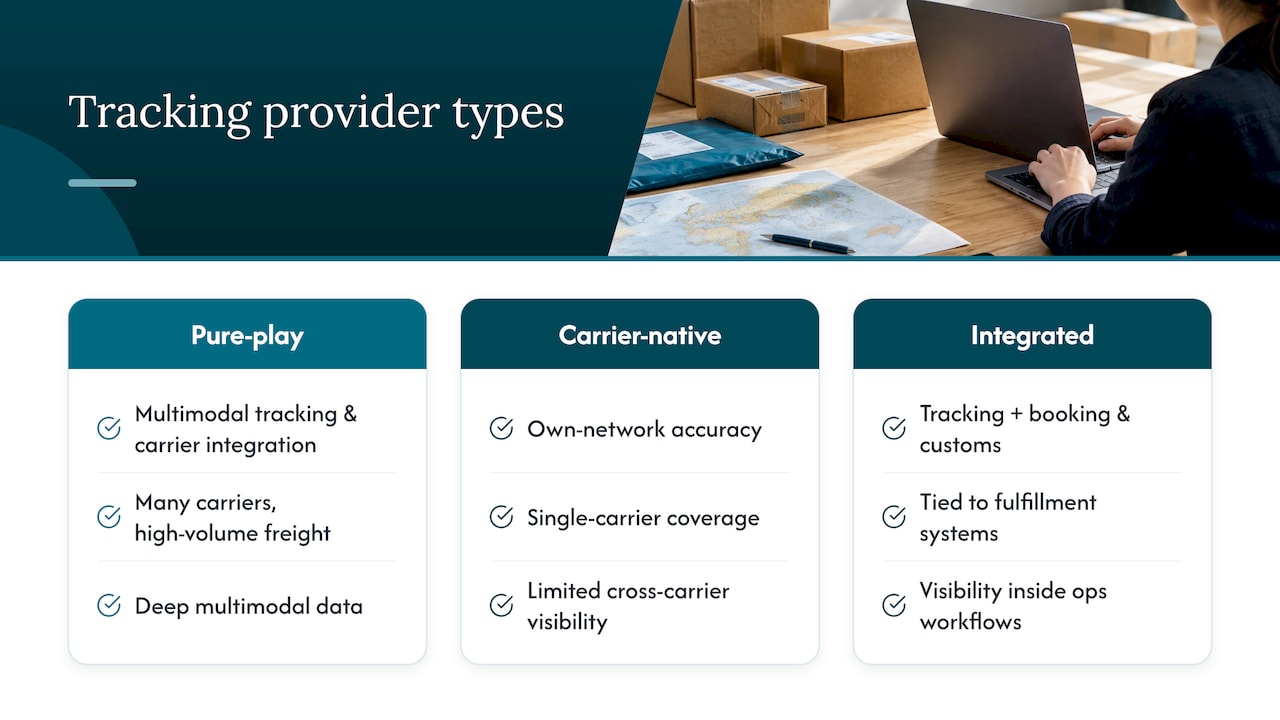
Enterprise visibility platforms generally fall into a few categories, and understanding the differences helps you evaluate what you actually need. Pure-play visibility platforms focus narrowly on multimodal tracking and carrier integration, often serving large shippers with complex, high-volume freight networks across many carriers.
Carrier-native tracking tools, offered directly by shipping companies, give accurate data for their own network but rarely unify visibility across multiple carriers or transport modes, which leaves ecommerce sellers juggling several logins when they ship through more than one carrier.
Integrated logistics and fulfillment platforms take a different approach: tracking is one piece of a broader service that also includes freight booking, customs clearance, and warehousing. This model fits ecommerce sellers and wholesalers who want visibility tied directly to the operational systems already handling their freight and fulfillment, rather than a standalone tracking tool that still needs separate booking and customs workflows layered on top.
Research on real-time visibility technologies finds that platforms perceived as easy to use see higher adoption, and that visibility consistently improves contingency planning and customer satisfaction when it reaches pallet and item-level detail. That finding matters most when comparing providers: a platform with impressive data depth that your team finds hard to use will underperform a simpler one your staff actually opens every day.
Why we favor an integrated control-tower approach
Running pilots across multiple carriers and lanes has shown us that visibility only pays off when it is tied to the systems that make decisions, not left as a passive dashboard. Our approach at Or-ner centers on connecting tracking data directly into booking, customs, and fulfillment workflows so an exception triggers action rather than just a notification. We handle carrier onboarding, customs and GBI data collection, and the technical integration work so your team can focus on the lanes that matter most.
— Maayan
Start a pilot with Or-ner
We bring real-time shipment tracking, carrier integrations, and customs readiness together with the freight booking and warehousing you already need, so visibility is not a bolt-on tool but part of how shipments get booked, cleared, and delivered.
Our platform supports features such as real-time tracking across ocean, air, and road in one view; carrier integrations and readiness for cross-border compliance; customs clearance and warehousing integrated into workflows; and fulfillment and inventory management for ecommerce and wholesale sellers.
If you are ready to pilot visibility on your highest-volume lanes, visit Or-ner to see our full range of courier, freight, and fulfillment services, or get a freight booking estimate to start scoping your pilot lanes today.
FAQ
What is enterprise global parcel tracking?
Enterprise global parcel tracking is a control-tower system that combines carrier integrations, dynamic ETAs, and exception management into one dashboard covering parcel, air, ocean, and road shipments. It gives logistics teams one source of truth instead of checking multiple carrier portals separately.
How is this different from consumer parcel tracking tools?
Consumer tracking tools let a shopper check a single tracking number against delivery status. Enterprise visibility is built for logistics and ecommerce teams managing thousands of shipments across multiple carriers, lanes, and systems, with alerts, KPIs, and integration into ERP and TMS platforms.
What are Global Business Identifiers and why do they matter?
Global Business Identifiers, or GBIs, are standardized party identifiers such as DUNS, GLN, LEI, and Altana ID that CBP is evaluating to improve supply-chain traceability for imports. Sellers and manufacturers shipping cross-border should expect to collect and transmit these identifiers as customs requirements evolve.
What alert threshold should we start with for exceptions?
A widely adopted starting point is flagging shipments only when the ETA deviates by more than 48 hours, which practitioner case studies show reduces alert fatigue and unnecessary ERP recalculations. From there, you can tighten thresholds for high-impact SKUs and loosen them for low-priority shipments.
Sources
- CSCMP 29th Annual Third-Party Logistics Study (2025)
- Current State of eCommerce — MIT Center for Transportation & Logistics
- Federal Register — Heightened Import Disclosures for Supply Chain Visibility (CBP)
- Real-time tracking case studies and recommended alert thresholds