

Most American logistics managers know how quickly inventory accuracy can slip in a busy ecommerce warehouse. When tracing every item matters, even a few percent of lost or miscounted inventory leads to delays and customer complaints. RFID technology catches attention for its ability to lift inventory accuracy above 95 percent and help American ecommerce teams handle higher demand without extra labor. This overview explains what RFID means for your warehousing operation and uncovers practical insights for making every order count.
Table of Contents
- RFID Technology Defined for Warehousing
- Types of RFID Systems in Inventory Management
- Key Benefits for Ecommerce Fulfillment Operations
- Integration With WMS and Real-Time Tracking
- Challenges, Costs, and Common Pitfalls
Key Takeaways
| Point | Details |
|---|---|
| RFID Enhances Inventory Management | RFID technology significantly improves inventory visibility and accuracy, reducing errors and out-of-stock scenarios. |
| Three Types of RFID Tags | Understanding passive, active, and semi-passive RFID tags aids in selecting the appropriate technology based on specific tracking needs. |
| Integration with WMS is Crucial | Integrating RFID with Warehouse Management Systems streamlines operations and supports real-time inventory updates for better decision-making. |
| Challenges and Costs of Implementation | Businesses should be aware of the substantial costs and potential challenges of RFID implementation, emphasizing the need for thorough planning and testing. |
RFID Technology Defined for Warehousing
Radio Frequency Identification (RFID) represents a transformative tracking technology reshaping modern warehouse management. At its core, this wireless system enables instantaneous product identification and location tracking using electromagnetic fields. Warehouse management experts confirm RFID provides unprecedented inventory visibility without requiring direct line-of-sight scanning.
The technology operates through four critical components working in seamless synchronization: RFID tags, antennas, readers, and host computer systems. RFID tags attached to products or pallets contain microchips storing unique identification data. When these tags pass near specialized antennas, radio waves trigger the tags to transmit their stored information, allowing precise real-time tracking across warehouse environments.
Warehousing professionals recognize RFID’s significant performance advantages over traditional tracking methods. Unlike manual barcode scanning, RFID enables simultaneous tracking of multiple items, dramatically reducing labor time and human error. Research indicates RFID can elevate inventory accuracy beyond 95% and decrease retail out-of-stock scenarios by up to 50%, translating into substantial operational cost savings for logistics managers.
Pro tip: When implementing RFID, start with a pilot program in a controlled warehouse section to validate technology performance and optimize tag placement strategies before full-scale deployment.
Types of RFID Systems in Inventory Management
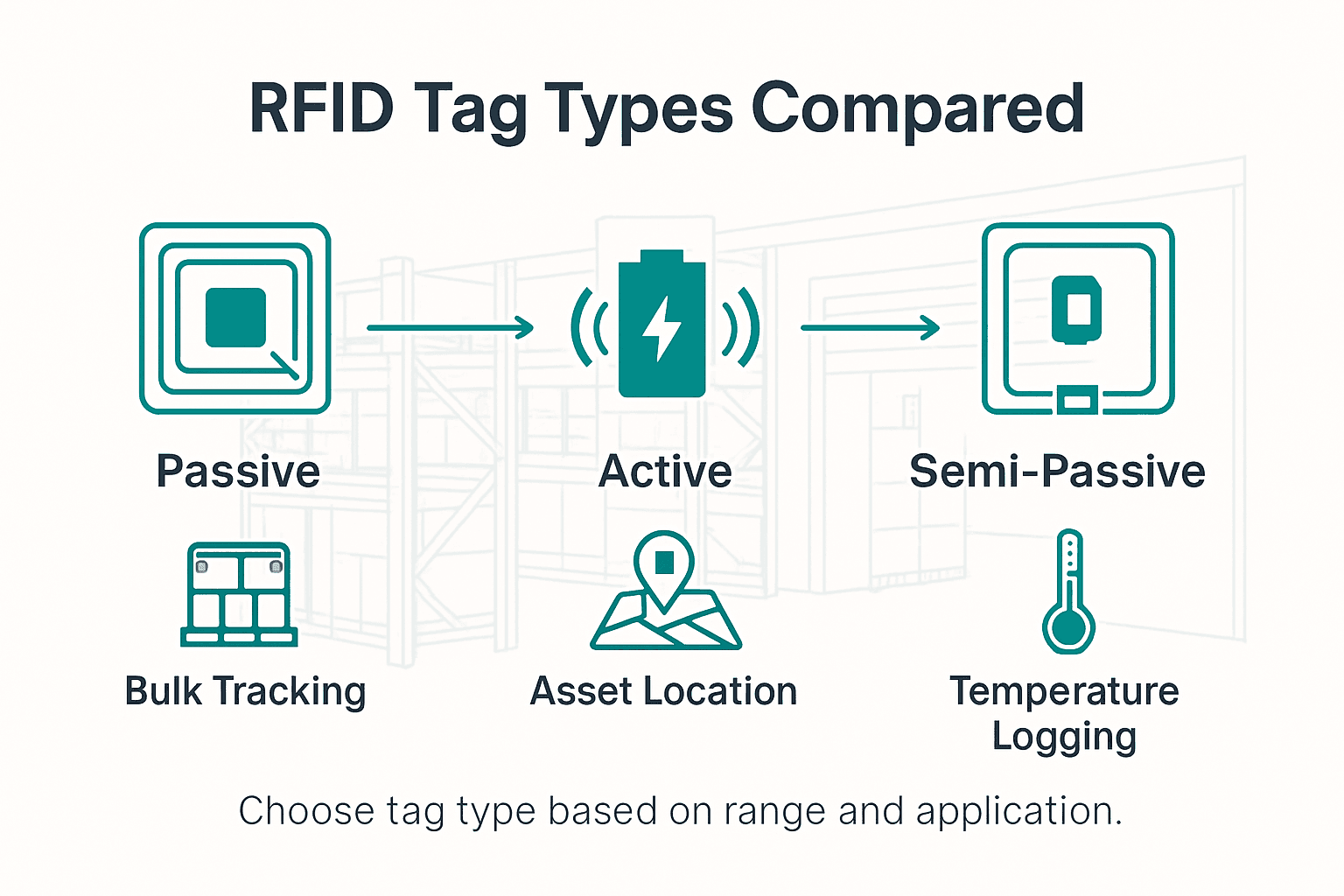
RFID systems in warehouse inventory management are classified into three primary categories based on power source and transmission capabilities: passive, active, and semi-passive tags. Global RFID standards organizations highlight the critical differences between these systems that enable tailored tracking solutions for diverse logistics needs.
Passive RFID tags represent the most economical option, drawing power directly from the reader’s radio waves. These tags typically operate at shorter ranges and are ideal for close-proximity tracking scenarios. In contrast, active RFID tags include an internal battery, allowing transmission ranges up to hundreds of meters and supporting real-time location tracking for large warehouse environments. Semi-passive tags occupy a middle ground, featuring a battery that enables more sophisticated sensing capabilities while still requiring reader activation for data transmission.

Here is a comparison of the three main RFID tag types used in warehouse inventory management:
| Tag Type | Power Source | Typical Range | Best Use Case |
|---|---|---|---|
| Passive | Powered by reader | Short (up to 10m) | Close-proximity item tracking |
| Active | Internal battery | Up to 100 meters | Large warehouse asset monitoring |
| Semi-passive | Battery + reader | Moderate (10–30m) | Environmental sensing and tracking |
Frequency bands play a crucial role in RFID system performance. Different frequency ranges like Ultra-High Frequency (UHF), High Frequency (HF), and Low Frequency (LF) determine signal penetration, read range, and interference resistance. Radio frequency identification technologies enable logistics managers to select systems matching specific inventory management requirements, from close-range item tracking to expansive asset monitoring across complex distribution centers.
Pro tip: Conduct a comprehensive warehouse mapping and inventory density assessment before selecting an RFID system to ensure optimal tag type and frequency band matching your specific operational environment.
Key Benefits for Ecommerce Fulfillment Operations
Radio Frequency Identification (RFID) technology is revolutionizing ecommerce fulfillment by providing unprecedented inventory management capabilities. Supply chain research demonstrates that RFID enables precise real-time tracking, dramatically transforming how online retailers manage their inventory and order processing workflows.
The core benefits of RFID in ecommerce fulfillment are multifaceted and significant. Automated scanning eliminates manual inventory checks, reducing human error and labor costs. RFID systems can simultaneously track multiple items without line-of-sight requirements, enabling faster order processing and more efficient warehouse operations. These technologies support advanced inventory optimization strategies that help businesses prevent stockouts, improve shelf replenishment, and accelerate delivery timelines.
For ecommerce operations, RFID delivers substantial competitive advantages. Real-time inventory visibility allows businesses to maintain optimal stock levels, reduce carrying costs, and respond quickly to demand fluctuations. The technology supports omnichannel fulfillment strategies by providing accurate, instantaneous data across multiple sales channels. Advanced RFID systems can track products from warehouse receipt through final delivery, offering unprecedented transparency and operational intelligence that directly translates into improved customer satisfaction and reduced operational expenses.
Pro tip: Implement a phased RFID rollout, starting with high-volume product categories to validate technology performance and gradually expand across your entire inventory management system.
Integration With WMS and Real-Time Tracking
Warehouse Management Systems (WMS) represent the critical technological backbone for integrating RFID tracking capabilities into complex logistics operations. Intelligent warehouse management research demonstrates how RFID technology seamlessly connects with WMS platforms, transforming traditional inventory tracking into a dynamic, automated process that provides unprecedented visibility and control.
The integration mechanism involves sophisticated RFID readers strategically positioned throughout warehouse zones that continuously capture and transmit item-level data directly into the WMS. These readers automatically track product movement, location changes, and inventory quantities without manual intervention. Supply chain tracking technologies enable real-time updates that support instantaneous inventory reconciliation, allowing businesses to maintain accurate stock levels and respond immediately to inventory fluctuations.
For ecommerce operations, this integration delivers multiple strategic advantages. The WMS can now generate precise inventory reports, predict potential stockouts, and optimize warehouse layouts based on actual product movement patterns. Advanced RFID-WMS systems support complex omnichannel fulfillment strategies by providing granular tracking across multiple sales channels, reducing errors, and dramatically accelerating order processing times. The technology enables warehouse managers to transition from reactive inventory management to proactive, data-driven operational strategies.
Below is a summary of key business impacts gained by integrating RFID with warehouse management systems (WMS):
| Benefit | Description | Business Impact |
|---|---|---|
| Real-time tracking | Continuous item movement capture | Reduces errors and manual counting |
| Instant inventory updates | Data feeds directly into WMS | Improves stock accuracy |
| Automated data reconciliation | Matches products and locations seamlessly | Accelerates order processing |
| Proactive decision-making | Analytics enable forecasting | Supports faster, data-driven decisions |
Pro tip: Select a WMS platform with native RFID integration capabilities and conduct comprehensive staff training to maximize the technology’s potential and ensure smooth implementation.
Challenges, Costs, and Common Pitfalls
RFID implementation represents a significant technological investment for warehousing operations, with substantial financial and operational considerations. Comprehensive supply chain research reveals that complete warehouse RFID system installations can exceed $2 million, presenting a considerable barrier for smaller ecommerce businesses seeking technological modernization.
The primary challenges encompass multiple dimensions beyond raw monetary investment. Technological adoption studies highlight critical implementation obstacles such as environmental interference, tag readability issues, and complex data management requirements. Metal surfaces, liquid environments, and physical warehouse layouts can dramatically impact RFID signal transmission, necessitating sophisticated planning and potentially requiring multiple reader installations to ensure comprehensive coverage.
Successful RFID integration demands a strategic approach that balances technological capabilities with practical implementation constraints. Organizations must invest in comprehensive staff training, develop robust data management protocols, and carefully evaluate their specific warehouse infrastructure. The most successful deployments involve phased implementations that allow gradual technology absorption, enabling teams to adapt to new tracking methodologies while minimizing operational disruptions. Critical considerations include selecting compatible hardware, ensuring cybersecurity protocols, and developing clear performance metrics to validate technological investments.
Pro tip: Conduct a thorough pilot program in a controlled warehouse section to validate RFID performance, identify potential signal interference challenges, and develop a nuanced implementation strategy before full-scale deployment.
Unlock Precision in Warehouse Inventory with Reliable Courier Services
Facing challenges like inventory inaccuracies and complex RFID integration can slow your ecommerce operations. This article highlights pain points such as environmental interference affecting RFID signals and the need for seamless Warehouse Management System integration to achieve real-time tracking and automated inventory reconciliation. To overcome these hurdles and accelerate your warehouse accuracy, leveraging a trusted logistics partner that offers end-to-end visibility and flexible solutions is essential.
Experience the power of a comprehensive platform that supports scalable warehousing, inventory management, and reliable courier services. At or-ner.com, you gain access to tools designed to streamline workflows, enhance data-driven decision-making, and provide real-time shipment tracking across ocean, air, and land transport modes. Whether you are managing high-volume ecommerce SKU’s or expanding globally, trusted technology integration combined with professional support empowers you to reduce operational costs and elevate customer satisfaction.
Take the next step to transform your inventory accuracy and fulfillment efficiency today.
Explore Reliable Courier Services

Visit https://or-ner.com now to optimize your warehouse with powerful logistics solutions tailored for ecommerce growth and inventory accuracy.
Frequently Asked Questions
What is RFID technology in warehousing?
RFID stands for Radio Frequency Identification, and it is a wireless system that enables instant product identification and location tracking using electromagnetic fields, enhancing inventory management in warehouses.
How do RFID systems improve inventory accuracy?
RFID systems allow for simultaneous tracking of multiple items without the need for line-of-sight, which minimizes human error and significantly increases inventory accuracy, often exceeding 95%.
What are the main types of RFID tags used in warehousing?
The three primary types of RFID tags are passive, active, and semi-passive. Passive tags are powered by the reader and have a short range, while active tags have their own battery, allowing longer distances. Semi-passive tags combine both features, facilitating advanced sensing capabilities.
What are the key benefits of integrating RFID with warehouse management systems (WMS)?
Integrating RFID with WMS provides real-time tracking, instant inventory updates, automated data reconciliation, and proactive decision-making, which collectively enhance efficiency and accuracy in inventory management.