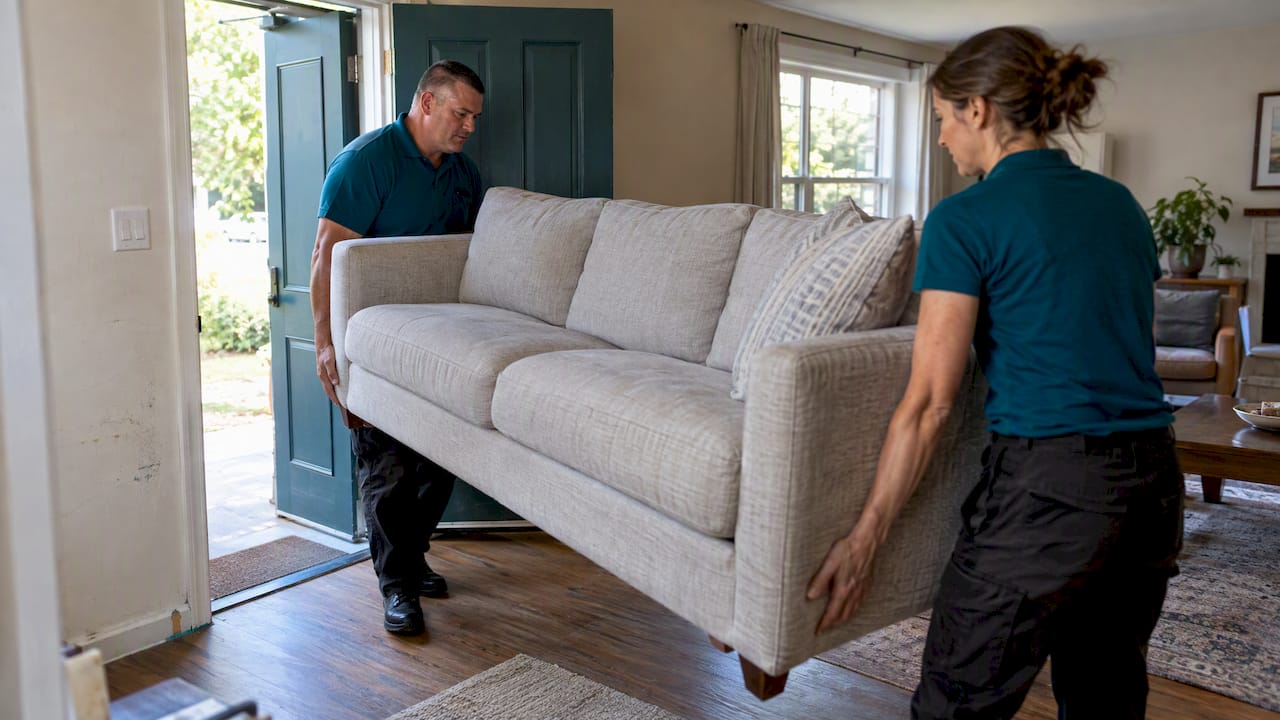
White glove home delivery is a premium in-home service that covers room-of-choice placement, full assembly or installation, and removal of all packaging and debris. It fits consumers buying furniture, large appliances, or fitness equipment, and businesses shipping bulky or complex items like medical devices and server racks. Cost and scheduling depend heavily on site access, so the exact scope should be confirmed before you book.
TL;DR:
- Providers sell threshold delivery, room placement, stair carries, and full service as separate tiers; electrical or plumbing hookups may require a licensed technician.
- Submit item dimensions, doorway and elevator measurements, access rules, and delivery path photos at booking; incomplete details can trigger failed attempts or extra fees.
- Get a written estimate with a delivery date, compare included services rather than totals, and check local tax treatment of separately itemized charges.
- Reserve the premium tier for items needing complex assembly or regulated handling; use standard or threshold delivery when customers can manage installation themselves.
Table of Contents
- What White Glove Delivery Includes
- Which Products and Industries Typically Need White Glove Service
- How White Glove Delivery Works: Process and Timeline
- How White Glove Pricing Works and What Drives the Cost
- How to Choose and Vet a White Glove Provider
- Integrating White Glove Delivery Into Business Fulfillment
- Handling Reverse Logistics and Returns With White Glove Service
- Customization Options for Packaging and Special Handling
- When White Glove Is Worth It, and When It Isn’t
- How Or-ner Supports White Glove Delivery for Ecommerce Sellers and Businesses
- FAQ
- Sources
What White Glove Delivery Includes
White glove isn’t one fixed service. Providers typically sell it in tiers, and knowing the difference keeps you from assuming a feature is included when it isn’t. At the basic end sits threshold delivery, where the item stops at your door or garage. Room-of-choice delivery moves it to the actual room you want, and stair carry adds manual transport up flights where no elevator exists. Full-service tiers add assembly or installation and complete debris removal, leaving nothing behind but the finished product.
Some categories need more than placement. Appliance hookups, electrical work, or plumbing coordination often require a licensed or certified technician rather than a general delivery crew, and that requirement should show up in your quote, not as a surprise on delivery day.
Regardless of tier, a credible provider should hand you a consistent set of deliverables:
- Time-stamped photo proof of the completed placement or installation
- A signed digital checklist confirming scope performed and condition on arrival
- A documented process for reporting and resolving damage claims
Industry explainers describe this bundle, inside placement, assembly, and debris removal, as the baseline definition of white glove service, distinguishing it from standard parcel or curbside delivery.
Which Products and Industries Typically Need White Glove Service
Some items are simply too large, fragile, or complex for a standard carrier to drop at the curb. On the consumer side, this covers furniture, mattresses, major appliances, home fitness equipment, pianos, and oversized televisions, items where incorrect handling or self-assembly risks damage or injury.
Commercial buyers have a parallel list: medical devices that require calibrated placement, server racks that need precise positioning and cabling, modular office pods, and retail store fixtures that must be installed to spec before a location opens.
A few shared criteria usually determine whether an order should move from standard shipping to white glove:
- Size and weight that make a two-person carry impractical without specialized equipment
- Fragility where a drop or improper tilt causes irreversible damage
- Installation requirements that demand assembly, mounting, or hookup rather than simple placement
- Regulatory or safety rules tied to the equipment category, common in medical and lab environments
Demand for this tier has grown alongside ecommerce, as larger and pricier purchases increasingly move through online checkout rather than showroom pickup, pushing retailers to build out curated delivery capability.
How White Glove Delivery Works: Process and Timeline
The process runs in four stages, and skipping detail at the booking stage is the single biggest cause of delays or added fees later.
- Booking: You provide accurate item dimensions, stair or elevator measurements, building access rules (loading dock hours, parking restrictions, permit requirements), and ideally photos of the delivery path.
- Pre-delivery planning: The provider converts that information into a digital checklist covering site constraints, crew size, and any third-party trades needed for hookups.
- On-site execution: The crew calls ahead with an arrival window, places the item in the designated room, completes assembly, and walks you through an inspection before leaving.
- Proof of delivery: Photos and a signed digital checklist close out the job and serve as the reference point if a damage claim comes up later.
Practitioner guidance consistently points to the same failure mode: incomplete or inaccurate access information. A booking checklist covering door and frame dimensions, elevator limits, entry-path photos, and building contact details is the cheapest way to avoid a failed attempt or an unexpected access surcharge.
Timelines vary by product category and distance. Furniture with long manufacturing lead times, remote delivery addresses, winter weather, and peak-season capacity constraints are the most common causes of delay beyond the originally quoted window.
Pro Tip: Take dated photos of your entry path, stairwell, and elevator before your delivery window opens: it takes five minutes and resolves most access disputes before they happen.

How White Glove Pricing Works and What Drives the Cost
Providers bill white glove service a few different ways: per-piece handling fees, hourly labor rates for the crew, flat tiered pricing based on service level, or a surcharge layered on top of standard freight. None of these models is inherently cheaper, so comparing quotes means comparing what’s actually included, not just the bottom-line number.
Several factors push the price up regardless of billing model:
- Stair carries, which require more time and sometimes a larger crew
- Assembly complexity, especially for items needing tools or technical expertise
- Number of handlers required for weight or size
- Haul-away of old items or packaging debris
- Access challenges, including narrow doorways or restricted building entry
- Last-mile distance to rural or remote addresses
Invoice presentation matters beyond the total. In at least one state, how delivery and installation charges are itemized affects whether they’re taxable. Virginia tax guidance treats combined delivery and installation charges as potentially taxable unless they are separately stated and meet local exemption criteria, a detail that matters for both individual buyers tracking their receipts and businesses handling sales tax compliance.
Before committing, get a written estimate that includes the delivery date, not just a price range. State-level consumer guidance in New Jersey requires delivery dates to be written into furniture contracts, with remedies available if delivery is late or the item arrives damaged.
How to Choose and Vet a White Glove Provider
Picking a provider on price alone is how most delivery disputes start. A short, consistent vetting process catches problems before they become your problem.
Start with the baseline checklist:
- Confirmed insurance limits that cover the full replacement value of your item
- Background-checked, trained delivery crews, not subcontracted labor with no vetting
- Documented SLAs and KPIs, such as on-time performance and damage rates
- A clear, written claims process with stated resolution timelines
Ask vendors direct questions and get answers in writing: What exactly is included in the quoted price? What happens if a staircase or doorway turns out to be narrower than reported? What’s the policy on missed delivery windows or cancellations? Vague answers to any of these are a warning sign.
Require proof, not promises. Photo documentation and time-stamped digital checklists are now standard among serious providers, since digital checklists and photo proof-of-delivery reduce disputes and speed up claims when something does go wrong. Ask for references or examples of past performance metrics rather than taking service quality on faith.
| What to check | Why it matters |
|---|---|
| Insurance coverage limit | Confirms replacement value is actually covered, not just a token amount |
| Background checks and training | Reduces risk of damage, theft, or unsafe handling in your home |
| Documented SLAs/KPIs | Gives you a measurable standard the provider is accountable to |
| Photo proof-of-delivery | Creates a time-stamped record if a claim dispute arises |
| Written claims process | Sets expectations for how long resolution takes |
Finally, give the provider accurate measurements, site photos, and access codes at booking. This single step, more than any contract clause, is what prevents the extra fees and failed attempts tied to access constraints.
Integrating White Glove Delivery Into Business Fulfillment
For sellers running white glove as part of a broader fulfillment operation, the service has to be built into the system, not handled as a one-off exception. Our ecommerce fulfillment services support freight booking, real-time tracking, customs clearance, and warehousing, giving operations teams the visibility to manage white glove SKUs alongside standard shipments rather than as a separate workflow.
A practical implementation starts with a few concrete steps:
- Tag white glove SKUs at the warehouse management level so they automatically route to the right scheduling and handling process
- Run a pre-delivery QA check on each unit before it leaves the facility
- Build scheduling windows that account for stair carries, assembly time, and any required trades
- Set up exception management and automated customer communication for delays or access issues
Track the same KPIs the industry already uses for white glove performance: on-time delivery rate, damage claims, and net promoter score, feeding digital proof-of-delivery data straight into your analytics so problems surface early rather than after a customer complaint.
Pro Tip: Brief every white glove partner with the same checklist you’d use internally: SKU specs, access constraints, and required trades. Consistency here is what keeps performance metrics comparable across partners.
For more detail on how white glove service fits into a broader delivery strategy, see our white glove delivery explainer.
Handling Reverse Logistics and Returns With White Glove Service
Returns are where white glove service either earns its premium or exposes its gaps. A damaged recliner or an oversized treadmill can’t just be dropped at a shipping counter, and a returns process that ignores this reality creates friction for both the customer and the business absorbing the cost.
A workable reverse logistics setup for white glove items mirrors the original delivery process in reverse: the same crew type that handled installation should handle removal, with its own digital checklist documenting the item’s condition at pickup. This protects both sides in a damage dispute, since the proof-of-delivery photos taken at installation can be compared directly against pickup photos.
For businesses, this means reverse logistics can’t be bolted onto a generic returns workflow built for small parcels. Scheduling a pickup crew, coordinating disassembly where needed, and routing the item back through warehousing or disposal requires the same planning rigor as the original delivery, including confirmed access details and a realistic timeline. Skipping that planning is how return costs quietly erode the margin on higher-value SKUs.
Businesses managing this at scale benefit from the same warehousing and inventory visibility used on the outbound side. Our warehousing and customs clearance capabilities support returned inventory moving back into stock or being routed for disposal, keeping reverse logistics inside the same system as the original fulfillment rather than treated as an afterthought.

Customization Options for Packaging and Special Handling
Standard packaging rarely survives the handling a white glove item goes through, and providers that specialize in this tier typically offer packaging customization as part of the service rather than an add-on.
Custom crating is common for fragile or high-value pieces, built to the item’s exact dimensions rather than a generic box with padding. Climate-sensitive items, including certain medical devices or musical instruments, may need insulated or moisture-controlled packaging to survive transit without damage. Multi-piece furniture or equipment often ships with labeled component packaging so the on-site crew can assemble in the correct sequence without guesswork.
Special handling instructions should be documented and attached to the shipment itself, not communicated verbally, so every handler along the route, from the warehouse to the final delivery crew, works from the same information. This is particularly relevant for businesses shipping regulated or fragile goods across borders, where handling instructions need to survive multiple handoffs and customs steps intact. Our guidance on packing rules for fragile SKUs covers how to document these requirements so they travel with the shipment rather than getting lost between carriers.
Getting packaging specifications right at the outset reduces damage claims downstream, which matters more for white glove shipments precisely because the items involved tend to carry higher replacement costs.
When White Glove Is Worth It, and When It Isn’t
White glove earns its cost when assembly complexity, regulatory handling, or customer expectations are high. A hospital installing diagnostic equipment, a furniture buyer with no tools or time, or a brand selling premium goods where unboxing experience matters: all of these justify the premium.
It’s a weaker fit when the item is simple to move and assemble, or when your customer base is price-sensitive and willing to self-install. In those cases, threshold or standard final-mile delivery protects margin without hurting satisfaction.
Businesses should treat this as a segmentation decision, not an all-or-nothing policy: reserve white glove for SKUs where the operational complexity actually translates into customer value, and route everything else through simpler, cheaper logistics.
— Maayan
How Or-ner Supports White Glove Delivery for Ecommerce Sellers and Businesses
Running white glove well means managing booking, tracking, customs, and warehousing as one connected system instead of patchwork vendors. A platform can bring freight booking, real-time shipment tracking, customs clearance, warehousing, and inventory management together, so white glove SKUs move through the same visibility layer as the rest of your catalog.
That means fewer blind spots between the warehouse and the final delivery crew, and fewer exceptions that turn into customer complaints. Specifically, support can include:
- Freight booking and cross-border shipping for large or high-value items moving internationally
- Customs clearance and warehousing integrated with inventory management, so white glove stock stays visible from intake to delivery
- Catalog management and ecommerce shipping support for sellers running mixed SKU catalogs
- 3PL services covering pick and pack, storage, labeling, and palletization for items that need special prep before they ship
If you’re scaling a catalog that includes bulky, fragile, or installation-heavy products, get a freight estimate and we’ll walk through how your specific SKUs fit into a white glove-ready fulfillment setup.
FAQ
What exactly does white glove delivery include?
White glove delivery typically includes inside delivery to your room of choice, full assembly or installation, and removal of all packaging and debris. The exact scope varies by provider, so confirming included services in writing before booking is the best way to avoid surprise omissions.
How much does white glove delivery typically cost?
Pricing depends on the billing model a provider uses, whether per-piece, hourly, flat-tier, or surcharge-based, and on cost drivers like stair carries, assembly complexity, and haul-away needs. Always request a written estimate with a specific delivery date rather than relying on a verbal quote.
What happens if my white glove delivery is damaged or late?
Reputable providers document delivery with time-stamped photos and signed checklists specifically to resolve damage disputes quickly. In some states, consumer guidance requires delivery dates to be written into contracts and allows buyers to cancel or request a refund if a delivery misses its estimated window by a set period.
Do I need to prepare anything before a white glove delivery?
Yes. Providing accurate measurements, photos of the delivery path, and building access details at booking significantly reduces the risk of extra fees or a failed delivery attempt. This single step addresses the most common cause of white glove delivery problems.
Can white glove service handle returns as well as deliveries?
Many white glove providers offer reverse logistics using the same crews and documentation process used for the original delivery, including condition photos at pickup. This is particularly useful for bulky or assembled items that can’t be returned through standard parcel channels.
Sources
- What is White Glove Service? | Supply & Demand Chain Executive
- White-Glove Delivery: Giving Your Shipments the Red-Carpet Treatment – Inbound Logistics
- Buying Furniture – New Jersey Division of Consumer Affairs
- Purchasing furniture tips – Maryland Attorney General
- 24-99 | Virginia Tax