Hire a specialized fragile-item courier, not a general parcel network. Custom packing or crating, combined with fewer handovers between pickup and delivery, is what actually keeps breakables intact, and a clear declared-value policy protects you when something still goes wrong. One platform-based option worth evaluating for businesses shipping breakables domestically or across borders is described here. Start by requesting a quote or a pilot shipment before committing volume.
TL;DR:
- Specialized couriers minimize touchpoints through custom packing, real-time tracking, and dedicated handling to better protect fragile items during transit.
- Proper packing involves wrapping each item individually, double-boxing high-value pieces, and using crates for large or valuable shipments to prevent damage.
- Choosing a courier based on damage rate and liability terms, along with testing via pilot shipments, improves the chances of arriving intact and reduces costly replacements.
- Air freight offers faster transit with fewer handling points, but for large or delicate items, full truckload shipping with proper internal bracing is often ideal.
- Declared-value insurance and pre-shipment documentation are crucial for successful damage claims, especially when handling high-value or irreplaceable fragile goods.
Table of Contents
- What Do Courier Services for Fragile Items Actually Include?
- How Should You Pack and Crate Fragile Shipments?
- How Do You Choose the Right Courier for Breakables?
- Does Transit Mode Change How Fragile Items Should Be Packed?
- What Insurance and Documentation Do You Need for Fragile Freight?
- What Fragile Shipping KPIs Actually Predict Fewer Losses?
- How Or-ner Handles Fragile and High-Value Shipments
- Sources
- FAQ
What Do Courier Services for Fragile Items Actually Include?
A specialized courier does more than slap a “fragile” sticker on a box. Most providers in this category build their entire operation around minimizing touch points and controlling how an item moves from origin to destination.
Typical services include:
- Custom packing, crating, and palletization sized to the actual item, not a generic box
- White-glove delivery with two-person teams for furniture, art, and antiques
- In-home or in-office placement, plus lift-gate service for heavy or oversized pieces
- Real-time tracking with scheduled delivery windows instead of an all-day estimate
- Dedicated handling teams who follow the shipment rather than passing it between hubs
The gap between these providers and standard parcel carriers shows up in the fine print. Standard networks typically process a “fragile” label inside the same automated sorting flow as everything else, according to FLEX’s guidance on carrier selection, meaning the label alone rarely changes how the box gets handled. Specialized couriers instead build packing, routing, and damage guarantees into the service itself, which is the entire reason they cost more and why that cost is usually justified for high-value or irreplaceable items.
How Should You Pack and Crate Fragile Shipments?
Packing mistakes cause more damage claims than rough handling does. The CTU Code, the joint IMO, ILO, and UNECE standard for packing cargo transport units, lays out rules that apply just as well to a single crate as to a full container: distribute weight across the floor area, never stack heavy goods on top of light ones, and use blocking, bracing, or lashing to stop movement in transit.
A reliable packing sequence looks like this:
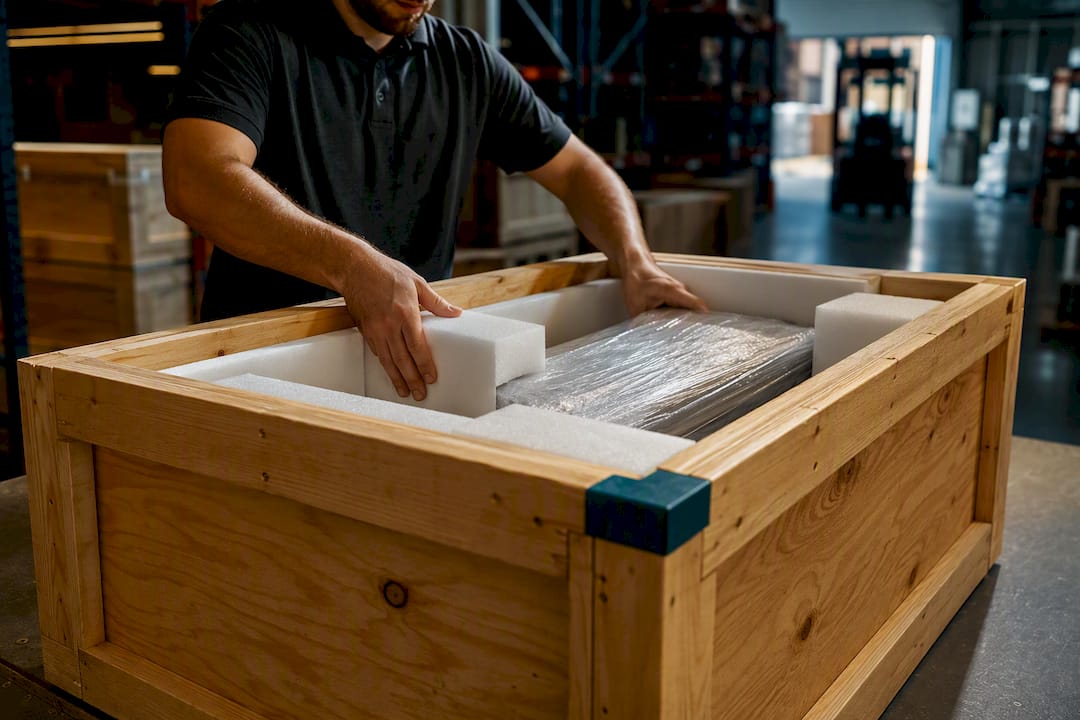
- Wrap each item individually in bubble wrap or foam, protecting corners and any protruding parts first.
- Cushion with at least two inches of packing material between the item and the box wall on every side.
- Double-box fragile or high-value pieces, placing the wrapped item inside a smaller box, then inside a larger one filled with cushioning.
- Crate items over a certain size or value; wood or engineered crates handle compression and stacking loads that cardboard cannot.
- Label orientation clearly, but treat the label as a reminder for humans, not a guarantee of special handling.
Artwork typically needs corner protectors and a rigid outer case. Electronics need anti-static wrap plus foam that isolates the unit from vibration. Furniture usually needs disassembly and blanket-wrapping before crating. The CTU Code quick guide warns that improper packing is a leading cause of cargo damage and injury, not just a cosmetic risk.
Pro Tip: Photograph the item from all angles before you pack it, then photograph the sealed box next to the shipping label. If a claim ever comes up, that pair of photos does more to prove pre-shipment condition than any description you could write.

How Do You Choose the Right Courier for Breakables?
Start with damage rate, not price. A courier charging 15% less does you no favors if even a modest damage rate wipes out the savings in replacement costs and customer complaints.
Ask providers to walk you through:
- Their actual packing process, not a marketing description of it
- The number of handovers between pickup and final delivery
- Declared-value terms and what documentation triggers a payout
- Whether tracking updates come from real scan events or estimated timelines
- How they handled a recent damage claim, start to finish
Watch for red flags: a sales rep who cannot describe how many hands touch the shipment, liability language that caps compensation far below replacement cost, or no willingness to run a trial. Pilot shipments across a few representative SKUs and delivery zones remain the most reliable way to validate a provider before committing real volume. Matching courier choice to your specific SKU characteristics, delivery zones, and service-level expectations, rather than picking one carrier for everything, tends to cut damage and failed deliveries measurably. For more detail on building that comparison, a guide on choosing shipping carriers covers the evaluation process step by step.
Does Transit Mode Change How Fragile Items Should Be Packed?
Speed and handling risk trade off against each other constantly. Air freight moves fast and limits how long an item sits exposed to vibration and temperature swings, but it costs more per pound and still involves ground handling on both ends.
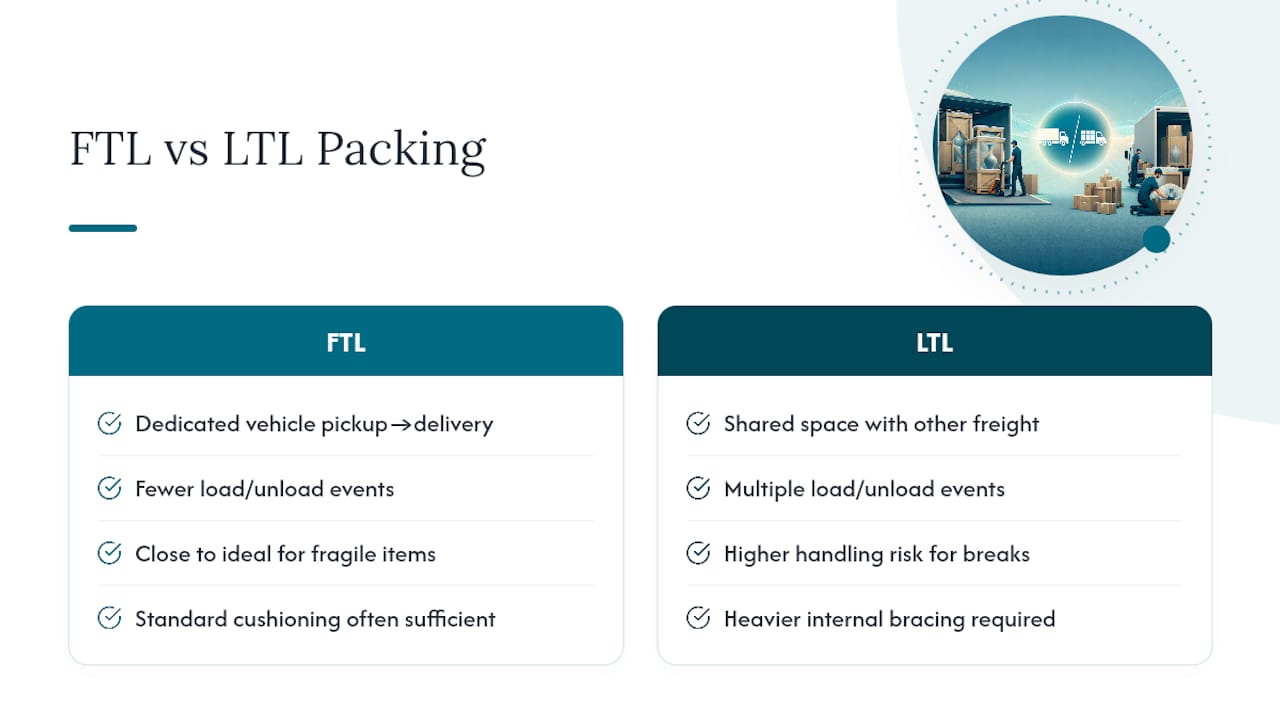
Full truckload (FTL) shipping keeps your freight on one vehicle from pickup to delivery, which is close to the ideal setup for anything breakable. Less-than-truckload (LTL) shipping is cheaper but shares space with other freight, meaning your pallet gets loaded and unloaded more times. That reality is why heavier internal bracing and full palletization are essentially mandatory for LTL shipments, where standard cushioning that works for a dedicated truck often isn’t enough.
Handovers matter more than most shippers realize. International shipments often pass through four to six handling points between origin and destination, and each one is a chance for a dropped pallet or a mishandled box. Ask any prospective courier for a process map showing every touchpoint your shipment will pass through.
A few practical notes on temperature: unless a provider explicitly offers climate control, assume the shipment travels at ambient temperature. That matters for musical instruments, certain electronics, and anything with adhesives or coatings sensitive to heat or cold.
What Insurance and Documentation Do You Need for Fragile Freight?
Carrier liability and declared-value insurance are not the same thing, and confusing them is where most shippers get burned. Carrier liability is usually capped low by default, often based on weight rather than actual value, while declared-value or third-party insurance covers the item’s real worth if you pay for it upfront.
Before you ship:
- Photograph the item and the packed box, and keep serial numbers or identifying details on file.
- Get a signed condition report from the courier at pickup if the item has any existing wear.
- Confirm the compensation cap in writing before the shipment leaves, not after a claim.
- Ask what documentation the courier requires to process a claim, and how long resolution typically takes.
Pre-shipment photos and a declared value on file are the evidence that makes or breaks a claim when something does arrive damaged. Providers experienced with fragile freight generally have a claims process built for this, rather than treating it as an exception.
What Fragile Shipping KPIs Actually Predict Fewer Losses?
Damage rate is the number that matters, not transit time. A courier that’s a day slower but loses far fewer shipments to breakage is the better deal every time you run the math on replacement costs and customer trust.
Claims resolution time deserves the same attention. A provider that pays out in a week versus one that strings you along for two months tells you how they’ll treat you on the shipment that actually goes wrong. Platform visibility, real tracking, warehousing data, and exception alerts close the gap between finding out about damage from a customer complaint and catching it before delivery. That’s the operational lens worth applying before you sign with anyone.
— Maayan
How Or-ner Handles Fragile and High-Value Shipments
Most fragile-item shippers end up choosing between a boutique white-glove courier with limited reach or a massive parcel network with no packing customization at all. Or-ner sits in between: a platform built for ecommerce sellers and businesses that need custom packing and crating, real-time tracking, and cross-border handling without losing the visibility a growing operation depends on.
That combination matters most when your shipment crosses borders or moves through a fulfillment network. One platform’s warehousing and customs clearance services connect packing and storage to the same platform tracking shipments door to door, which cuts down on the blind spots that come from juggling separate vendors for each leg. Businesses already running ecommerce fulfillment through this platform can fold fragile-item handling into the same workflow instead of managing it as a separate one-off arrangement, and the same logic applies to shippers moving breakables through international beverage and specialty-goods channels like Cave de Chimay’s European shipping operation.
If you’re ready to test this against your current setup, request a freight estimate for an upcoming shipment or ask about arranging a small pilot batch before committing full volume. Bring your packing specs and expected delivery zones to that first conversation. It’s the fastest way to see whether Or-ner’s process actually reduces your damage rate before you scale it up.
Sources
- How to choose a carrier for fragile shipments – FLEX
- How to ship fragile or high-value items safely: The complete guide – GoShip
- Choosing the Right Courier Partner for Smarter Shipping – eShipz
FAQ
What Is the Best Transport for Fragile Goods?
There’s no single best mode. Full truckload shipping minimizes handling for domestic freight, air freight limits exposure time for urgent or long-distance shipments, and either works well when paired with a courier that limits handovers and uses proper crating. The right choice depends on distance, budget, and how many times the shipment needs to change hands.
Is FedEx or UPS Better for Shipping Fragile Items?
Both are standard parcel networks that generally route fragile-labeled packages through the same automated sorting systems as everything else, so neither offers the dedicated handling a specialized fragile-item courier provides. For high-value or irreplaceable items, a courier built around custom packing and reduced handovers, such as those covered in Or-ner’s carrier comparison, is typically the safer route.
What Is the Best Way to Send Fragile Items Safely?
Wrap each item individually, cushion it with at least two inches of padding, double-box it, and crate anything large or high-value before shipping. Pair that packing with a courier that limits handovers and offers declared-value coverage, since smart packaging, the right carrier, and proper insurance together determine whether a fragile shipment arrives intact.
Does Or-ner Offer Custom Crating for Fragile Shipments?
Custom packing and crating services are offered as part of freight booking and fulfillment services for businesses shipping fragile or high-value goods. Pricing isn’t published, so request a freight estimate directly for specific shipments.
How Many Handovers Should a Fragile Shipment Have?
Fewer is always better. International shipments commonly pass through four to six handling points, and each one adds risk, so ask any courier for a process map showing exactly how many times your shipment changes hands before it reaches its destination.