Ocean freight equals basic ocean freight plus surcharges and assessorial charges plus inland and landed-cost add-ons. For LCL, you swap the per-container rate for chargeable weight, converting CBM through the carrier’s weight/measurement (W/M) rule. SOLAS VGM and the FMC’s demurrage rules often change the final invoice, and our team at Or-ner builds quotes around both.
TL;DR:
- For FCL, compare quotes only after matching container size, included surcharges, handling, and inland legs; a headline rate may omit charges that appear later.
- For LCL, chargeable quantity is whichever is greater, CBM or metric tons; confirm the quote’s conversion rule and measure cargo accurately to avoid invoice adjustments.
- File the verified gross mass before cutoff, including cargo, packing, and container tare weight; late filing can prevent loading and trigger rebooking charges.
- Demurrage and detention invoices must arrive within 30 calendar days, and billed parties have at least 30 days to request mitigation, a refund, or a waiver.
- A port to port quote excludes inland delivery; match it to the Incoterm and verify drayage, customs, duties, and terminal fees separately.
Table of Contents
- What are the core components of an ocean freight quote?
- How does FCL pricing work?
- How are LCL pricing and chargeable weight calculated?
- Which surcharges, assessorials, demurrage and detention can you expect?
- What documents and regulations affect the calculation?
- What landed-cost add-ons come after the ocean leg?
- How do you work through an FCL and an LCL example?
- How can you estimate, audit and reduce surprises on ocean freight bills?
- What are freight classes and commodity factors in ocean pricing?
- How do seasonal demand and market conditions move ocean freight rates?
- How do Incoterms affect who pays what?
- How do container types and sizes change the calculation?
- What do freight forwarders and consolidation do to your price?
- What payment terms and billing practices should you expect in ocean freight contracts?
- My view: use the math as a procurement tool, not just an estimate
- Get a clear, tariff-aware ocean freight quote with us
- FAQ
- Sources
What are the core components of an ocean freight quote?
Every ocean quote starts with basic ocean freight: the base rate for moving a container or a quantity of cargo from one port to another. In U.S. regulatory terms, basic ocean freight is the rate before additions, and the tariff must display the assessorial charges and surcharges that apply to your shipment’s parameters. You will see it in a carrier’s published tariff or in the rate terms of a negotiated agreement.
Everything else is added on top. A surcharge responds to a cost condition, such as fuel or congestion. An assessorial charge pays for a specific service or handling step. The line between them blurs on real invoices, which is why you should ask what each line pays for.
Typical lines you will meet:
- Basic ocean freight: the per-container or per-unit sea leg rate.
- Bunker adjustment factor (BAF): a fuel-linked surcharge that moves with bunker prices.
- Terminal handling charge (THC): the fee for moving the box through the terminal at origin or destination.
- Documentation fee: the cost of issuing the bill of lading and related paperwork.
- Security and peak-season fees: charges tied to regulation or demand surges.
- General rate increases (GRIs): carrier-wide increases applied to published tariffs.
GRIs and tariff changes are why a rate you were quoted last month may not hold today. Carriers must follow notice rules for tariff changes, and the FMC has monitored and reviewed surcharges and fees, stressing that they must be reasonable, clearly defined and serve a measurable purpose.
A quote is only comparable to another when both list the same set of lines. Before you compare two numbers, line them up item by item and note what is missing from each. A low headline rate with no surcharges listed is a draft, not a price.
How does FCL pricing work?
FCL (full-container load) pricing is per container. The carrier quotes a flat rate for a 20-foot, 40-foot or 40-foot high-cube box on a given lane, and that rate stays the same whether you fill the container or not. That makes FCL easy to calculate: container rate, plus surcharges, plus handling, multiplied by the number of boxes.
Several mechanics shape the final figure:
- Container size: the 40-foot box usually costs less than twice the 20-foot, which is why shippers with enough cargo often move up a size.
- Minimum quantity rules: a tariff rate item (TRI) is a single freight rate for a specified cargo quantity and conditions, so a rate may only apply when you ship at least the stated number of containers.
- Specialty cargo: refrigerated, hazardous or out-of-gauge freight changes handling and equipment needs, and the per-container price follows.
- Weight limits: overweight boxes can trigger extra fees or be refused for loading.
Weight also matters for a safety rule that touches billing. Under SOLAS, shippers must supply a verified gross mass, either by weighing the packed container (Method 1) or by weighing the cargo and packing materials and adding the container tare weight (Method 2). The VGM is then used for the ship’s stowage plan. A missing or late VGM can mean the box does not load, and rolled or rebooked containers can mean new charges.
For planning, read the container’s printed tare weight, add cargo and packing weight, and confirm the total before the cutoff. If your forwarder files the VGM for you, check that the figure matches your own.
How are LCL pricing and chargeable weight calculated?
LCL (less-than-container load) means your cargo shares a container with other shippers’ goods. Instead of a flat box rate, you pay per unit of space or weight, using whichever is greater. That greater figure is the chargeable weight, and the rule that picks it is the W/M (weight or measurement) rule.
The math runs in a straight line:
- Measure each package in centimeters: length, width and height, including pallets or crates.
- Compute CBM for each package by multiplying length by width by height in meters, then multiply by the number of identical packages and add the lines together.
- Weigh the cargo in metric tons, using the gross weight including packing.
- Apply the W/M rule. The conversion between CBM and weight depends on the W/M convention stated in the quote or tariff. Compare total CBM to total metric tons, and the higher number is your chargeable quantity.
- Multiply by the per-unit rate the consolidator quotes, then add origin and destination charges.
Chargeable weight differs from gross weight whenever your cargo is light for its size. A pallet of pillows might weigh 150 kg but occupy 2 CBM, so you pay for 2 units, not 0.15. A pallet of metal parts does the reverse: 800 kg in 0.6 CBM means you pay on weight, 0.8 units. Always confirm the exact conversion with your consolidator, because carriers state their own W/M convention in the quote or tariff.
Consolidation adds lines that a full container does not have. Expect fees for receiving and handling at the consolidation warehouse, palletization or shrink-wrap if your cargo arrives loose, and deconsolidation at destination. A minimum charge often applies, so very small shipments can cost more per unit than larger ones.
Measuring accurately matters more than most shippers expect. Carriers re-measure at the warehouse, and a gap between your declared dimensions and theirs becomes an invoice adjustment. If you want the arithmetic automated, our LCL shipping calculator checks CBM and W/M math for you.
Which surcharges, assessorials, demurrage and detention can you expect?
Beyond the base rate, a handful of charges appear on most ocean invoices. Knowing what each one is lets you judge whether it is legitimate.
Demurrage and detention are the two most disputed. Demurrage typically charges for exceeding free time on the terminal, and these are often marine terminal operator (MTO) charges. Detention applies when a container is kept beyond the free period outside the terminal. Billing relationships vary: the ocean carrier (VOCC) may bill, the terminal may bill, and arrangements differ from port to port.
Routine extras to review:
- Peak-season surcharge: added when demand outruns space, usually announced in advance.
- Port congestion surcharge: applied when delays at a port raise carrier costs.
- Security fees: tied to regulatory screening requirements.
- Red Sea or diversion surcharges: the FMC issued an advisory regarding Red Sea surcharges, noting that carriers must follow notice rules for rate changes.
- Assessorials such as THC, documentation, palletization, stuffing and unstuffing: service-based fees, charged per box, per shipment or per unit.
Ask whether each charge is a pass-through (the carrier or terminal’s actual cost, billed at cost) or a marked-up fee. Negotiated rate agreements can state that pass-through charges will be invoiced without markup. A legitimate surcharge has a name, a basis and a notice date. If a line has none of those, ask for the tariff rule behind it.
What documents and regulations affect the calculation?
Three bodies of rules reach directly into your invoice math.
- SOLAS VGM: every packed export container needs a verified gross mass. Method 2 requires adding the container’s tare weight to the weighed cargo and packing materials, so leaving tare out produces a wrong declaration.
- FMC demurrage and detention billing: the FMC’s final rule requires invoices to be issued within 30 calendar days and gives billed parties at least 30 days to request mitigation, refund or waiver. It also limits who can be billed.
- Invoice content: under 46 CFR Part 541, a demurrage or detention invoice must state the total amount due, the applicable rule and the specific rate used to calculate the charge.
Tariff rate items and negotiated rate arrangements decide which surcharges are locked in. An NRA can include or exclude surcharges and must say how pass-through charges are handled. Read that clause before signing. Our ocean freight documentation guide walks through the paperwork that supports each of these rules.
What landed-cost add-ons come after the ocean leg?
A port-to-port quote ends at the destination port. Your landed cost continues from there, and the pieces are easy to miss because they come from different parties.
Add these to reach a real total:
- Inland drayage: trucking the container from the port to your warehouse, plus any chassis or fuel fees.
- Origin and destination THC: confirm whether they are already inside the ocean rate.
- Customs duties and brokerage: duty is calculated on the declared value, and the broker charges a fee to file entry.
- VAT or sales taxes: where they apply in the destination country.
- Cargo insurance: typically priced as a percentage of insured value.
- Port handling and forwarding fees: documentation, release and similar charges.
Landed cost aggregates diverse fees such as drayage, port handling, forwarding and customs duties, making manual estimates prone to surprise unless a through-charge or NVOCC-managed approach is used.
To avoid double counting, ask one question of every quote: what does this price include, and where does it stop? Then build a single spreadsheet with one row per charge and one column for who bills it. A door-to-door quote bundles the inland leg, a port-to-port quote does not, and mixing the two is the most common source of errors.
How do you work through an FCL and an LCL example?
The figures below are illustrative inputs, not market rates, so replace them with numbers from your own quotes.
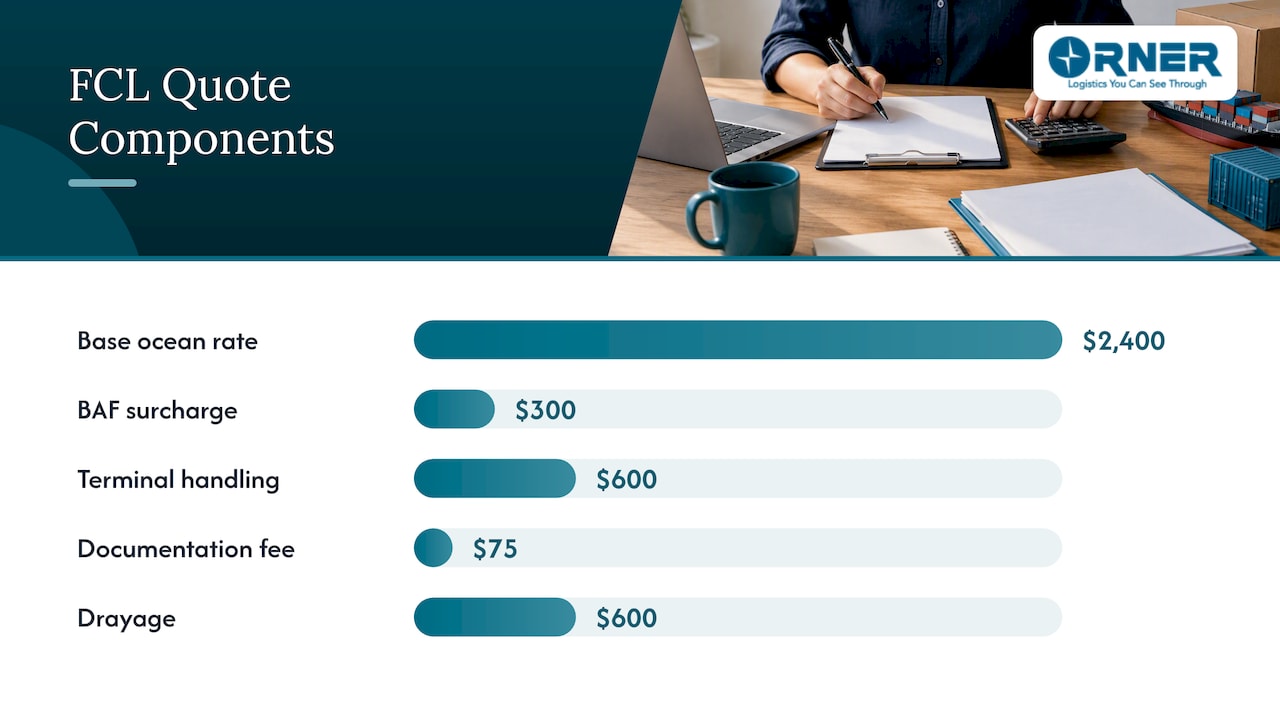
FCL example. Say you ship one 40-foot container with these assumed inputs: base ocean rate of $2,400, BAF of $300, origin THC of $250, destination THC of $350, documentation fee of $75 and drayage of $600.
- Add the sea leg and surcharges: $2,400 + $300 = $2,700.
- Add terminal handling: $250 + $350 = $600, giving $3,300.
- Add documentation: $3,300 + $75 = $3,375.
- Add drayage: $3,375 + $600 = $3,975 before duties and insurance.
LCL example. Say you ship 12 cartons, each 60 cm × 50 cm × 40 cm, weighing 18 kg each, with an assumed rate of $95 per W/M unit.
- Per carton: 0.6 × 0.5 × 0.4 = 0.12 CBM. For 12 cartons: 1.44 CBM.
- Weight: 12 × 18 kg = 216 kg, or 0.216 metric tons.
- Higher of the two: 1.44 (measurement wins).
- Ocean charge: 1.44 × $95 = $136.80.
- Add assumed consolidation and destination fees of $60 and $45: $241.80 total, before duties.
A simple calculator workflow keeps you honest: collect dimensions, gross weight, container type, origin and destination ports and the Incoterm, then pull the tariff lines from the quote or carrier tariff. Watch for mixed currencies, mixed units (inches versus centimeters) and fees quoted per shipment versus per unit. Our LCL shipping cost calculator follows the same steps.
For market context, the Bureau of Transportation Statistics publishes container freight rates per 40-foot container on transpacific routes, showing how widely base rates have swung.
How can you estimate, audit and reduce surprises on ocean freight bills?
Treat every invoice as a document to be checked against the quote. Our guide to auditing ocean freight invoices goes deeper, and this checklist covers the essentials.
- Match the tariff rule number for each surcharge to the carrier’s published tariff or your NRA.
- Confirm every line was in the quote, and ask for written justification of any that was not.
- Check who issued each charge: carrier, terminal, forwarder or trucker.
- Verify demurrage and detention dates against the free time and the 30-day invoicing window.
- Confirm the VGM was filed and matches the declared weight.
- Check units and currency line by line.
On contracts, ask for an all-in rate when you want a predictable total, and itemized rates when you want to see where each dollar goes. Either way, require the carrier or forwarder to disclose surcharges in writing before you book.
Operationally, submit the VGM before the cutoff, schedule drayage to land inside free time, and pack accurately so re-measurement does not change your charge.
Pro Tip: Keep a one-page “quote vs. invoice” variance sheet for every shipment. After reviewing several shipments, recurring lines may become apparent, and those are the ones to consider negotiating out of your next contract.
What are freight classes and commodity factors in ocean pricing?
You may hear “freight class” in trucking, where the NMFC system classifies goods by density, handling and liability. Ocean freight does not use those classes. It prices by container for FCL and by W/M for LCL, and the commodity enters through other factors.
The factors that move your price:
- Cargo nature: dangerous goods need special documentation, segregation and often a surcharge. Refrigerated cargo needs a reefer container and power during transit.
- Density: low-density goods hit the measurement side of the W/M rule, so you pay for space rather than weight. High-density goods hit the weight side.
- Value and liability: high-value commodities may need more insurance and tighter handling.
- Dimensions: out-of-gauge cargo that does not fit a standard box needs special equipment and costs more.
- Commodity description: the tariff may list specific rates by commodity, so an inaccurate description can trigger a correction.
Declare the commodity precisely. A vague description invites a carrier audit, and a correction after loading can bring fees and delays. If you are unsure whether cargo counts as dangerous, ask before you book, because rejection at the terminal is costly.
How do seasonal demand and market conditions move ocean freight rates?
Ocean freight pricing is largely a supply and demand story. When vessel space is tight and cargo is plentiful, carriers raise rates and add surcharges. When capacity outruns cargo, rates soften and carriers compete harder on price.
Several recurring patterns drive swings:
- Peak shipping seasons: retail inventory builds ahead of the holidays push demand up, and carriers often announce peak-season surcharges.
- Lunar New Year: factory closures change cargo flows around the holiday, shifting demand before and after it.
- Disruptions: port congestion, weather, strikes and conflicts such as the Red Sea diversions lengthen routes and add cost.
- Fuel prices: the BAF moves with bunker costs, so oil price changes reach your invoice.
- Equipment imbalances: when empty containers are in the wrong place, carriers price to reposition them.
The Bureau of Transportation Statistics’ data on transpacific container rates shows how volatile base rates can be across just a few years. Quotes carry validity dates for this reason, so lock a rate in writing and book inside the validity window.
For planning, build a buffer into your landed-cost estimate during peak periods. Booking earlier, shipping off-peak where your sales calendar allows and negotiating a contract rate can all dampen exposure.
How do Incoterms affect who pays what?
Incoterms are the standard trade terms that divide cost and risk between buyer and seller. They decide which party books the ocean leg, who pays origin and destination charges and where risk transfers. They do not set the price, but they decide whose invoice a charge lands on.
Common terms for sea freight:
- FOB (Free On Board): the seller delivers goods on board at the origin port. The buyer pays the ocean freight and everything after.
- CIF (Cost, Insurance and Freight): the seller pays freight and minimum insurance to the destination port, while risk passes to the buyer once goods are loaded.
- CFR (Cost and Freight): like CIF, but insurance is not included.
- EXW (Ex Works): the buyer handles almost everything from the seller’s door.
- DAP and DDP: the seller delivers to a named place, with DDP also covering import duties.
Before you accept a quote, confirm which Incoterm it assumes. A freight quote built on FOB origin looks different from one built on door-delivered terms, and comparing them directly misleads you. Check which party pays THC at each end, who arranges customs clearance and who carries insurance.
The practical rule: match your freight quote to the Incoterm in the purchase contract, so every charge has an owner before the cargo leaves.
How do container types and sizes change the calculation?
Container choice sets both the base rate and the capacity you are buying. The standard sizes are the 20-foot, 40-foot and 40-foot high-cube, and each carries a different per-container rate and a different load limit.
What to weigh:
- 20-foot container: suits dense, heavy cargo, since it often hits weight limits before it fills with volume.
- 40-foot container: roughly doubles the floor space for typically less than double the rate.
- 40-foot high-cube: adds extra height for light, bulky goods, often at a small premium.
- Reefers and specialty boxes: refrigerated, open-top, flat-rack and tank containers price above standard boxes because of equipment cost and handling.
Capacity math decides the cheapest choice. Divide your total CBM by the container’s usable volume to see how many boxes you need, then compare the cost of one 40-foot against two 20-foot boxes, including the extra THC and drayage the second box brings. For a small load, LCL may beat the smallest container. As a rough planning rule, compare your total CBM to what a full box would give you, and ask your forwarder for both FCL and LCL quotes when your volume sits near that line.
Tare weight also matters, because it is part of the verified gross mass and differs by container type. Use the figure printed on the specific box.
What do freight forwarders and consolidation do to your price?
A freight forwarder arranges the movement on your behalf, buying space from carriers and bundling services around it. A non-vessel-operating common carrier (NVOCC) issues its own bill of lading and takes on carrier-like responsibility without owning ships. Both can change your price, usually in two ways: through the rates they buy at and through the fees they add.
Forwarders with volume commitments often buy space at better rates than a small shipper could secure alone. They then quote you a rate with their margin included, plus charges for the services they provide, such as documentation, customs filing and handling. For LCL, the consolidator combines many shippers’ cargo into full containers and charges each shipper by chargeable weight.
Questions that clarify the pricing:
- Is the quote all-in, or are surcharges listed separately?
- Which charges are passed through at cost, and which carry a markup?
- Does the quote cover door-to-door or port-to-port?
- Who issues the bill of lading, and who is liable if something goes wrong?
Our ocean freight forwarding guide explains these roles in more detail. A good forwarder makes cost lines visible and auditable, which is worth more than a slightly lower headline rate with unclear extras.
What payment terms and billing practices should you expect in ocean freight contracts?
Ocean freight is invoiced in stages, and the timing of each stage affects both your cash flow and your dispute rights. Understanding the cycle lets you plan and challenge charges on time.
Common billing practices include:
- Prepaid versus collect: under prepaid terms the shipper pays freight at origin. Under collect terms the consignee pays at destination, and the bill of lading is typically released after payment.
- Credit terms: forwarders often extend payment windows, such as 15 or 30 days from invoice, to approved customers. New accounts may pay upfront.
- Itemized versus all-in invoices: an itemized invoice shows each line, while an all-in invoice shows one total.
- Invoice timing for demurrage and detention: the FMC’s rule requires invoices within 30 calendar days, so a bill that arrives later may be disputed.
- Currency and exchange: confirm which currency the invoice uses and when the exchange rate is fixed.
In contracts, look for clauses on rate validity, surcharge changes, payment due dates, late fees and dispute procedures. Negotiated arrangements should state clearly how surcharges and pass-through charges are treated. Pay undisputed amounts on time and raise disputes in writing quickly, because delays can weaken your position.
My view: use the math as a procurement tool, not just an estimate
The formulas in this guide are most valuable when they live in your process, not in a one-time estimate. I would build the FCL and LCL worksheets into every quote request, so each offer arrives in the same format and can be compared line by line. A quote that cannot be mapped to those lines deserves a follow-up question before it earns a booking.
Treat the invoice checklist as a routine control, and escalate early. If a demurrage bill lacks the rate or rule, or arrives outside the 30-day window, dispute it in writing under the FMC’s rules.
— Maayan
Get a clear, tariff-aware ocean freight quote with us
We help you turn the math above into one auditable number. Our team handles:
- Freight booking with itemized lines you can check against the tariff
- Landed-cost estimates that include drayage, handling and duties
- Customs clearance support alongside your shipment
We also help with VGM and documentation, and plan drayage to avoid demurrage. Request a freight estimate and we will walk through every line with you.
FAQ
How is ocean freight calculated for a full container?
Ocean freight for FCL is priced per container, based on size and lane. You add surcharges, terminal and documentation fees, and inland drayage to reach the total. Rates may require a minimum number of containers, as defined in the tariff rate item.
How is LCL freight calculated?
LCL is priced on chargeable weight, which is the greater of cargo volume in CBM or weight in metric tons under the W/M rule. Multiply that figure by the consolidator’s per-unit rate, then add consolidation and destination fees. Always confirm the carrier’s own conversion convention.
What is the difference between demurrage and detention?
Demurrage is a charge for keeping a container at the terminal beyond free time, while detention applies to holding the equipment beyond its allowed period. Billing parties vary, as FMC research on billing relationships shows.
How long do carriers have to send a demurrage invoice?
Under the FMC’s final rule, demurrage and detention invoices must be issued within 30 calendar days. Billed parties then have at least 30 days to request mitigation, refund or waiver, as described in the FMC’s announcement.
What does a demurrage invoice have to include?
A compliant invoice states the total amount due, the applicable demurrage or detention rule and the specific rate used. These minimum contents are set out in 46 CFR Part 541.
Sources
- FMC Monitoring and Review of Surcharges and Fees – Federal Maritime Commission
- World Shipping Council
- FMC Publishes Final Rule on Detention and Demurrage Billing Practices – Federal Maritime Commission
- eCFR :: 46 CFR Part 541 – Demurrage and Detention
- The Intermodal Movement of LCL Freight: The Problem Areas