
An LCL shipping calculator takes your cargo’s cubic measurement and gross weight, converts them into a single chargeable revenue ton using the W/M rule, then multiplies that figure by the lane rate and layers on origin and destination fees. The result is an all-in estimate, not just an ocean-line quote. Most calculators also flag minimum charges and rounding rules that can quietly push your number higher than the raw math suggests.
TL;DR:
- Most LCL shipments are billed on volume when CBM exceeds gross weight in revenue tons, meaning bulky, light cargo often costs more than dense freight.
- Accurate CBM calculation requires including pallet height and overhang, as CFS re-measures shipped cargo and can adjust the invoice accordingly.
- Surcharges such as BAF, PSS, and GRI are generally fixed and should be considered separately from origin and destination CFS fees for precise landed cost estimates.
- Comparing LCL and FCL options is advisable once shipment volume approaches 12 to 15 CBM, as full container costs can sometimes be more economical.
- Proper packing decisions made before port entry, like repalletizing, can significantly reduce billed CBM and overall costs more than rate negotiations.
Table of Contents
- How LCL Calculators Compute Chargeable Weight (W/M)
- Calculating CBM: Formulas and Measurement Rules
- How to Use an LCL Calculator: Inputs and Outputs Explained
- Cost Components Beyond the Ocean Freight Line
- Worked Examples: Two Calculator Runs Compared
- Practical Tips to Avoid LCL Billing Surprises
- Orner’s Tools for Planning and Booking LCL Freight
- Get a Firm LCL Quote Instead of Guessing
- Rethinking What “Accurate” Means for LCL Estimates
- Sources
- FAQ
How LCL Calculators Compute Chargeable Weight (W/M)
Every LCL rate hinges on one formula: chargeable revenue tons equal whichever is bigger, your total cubic meters (CBM) or your gross weight in kilograms divided by 1,000. Carriers call this the W/M rule, short for “weight or measure,” and it’s the backbone of how LCL ocean freight is billed.
Here’s why the rule matters beyond the math itself:
- One revenue ton equals either 1 CBM or 1,000 kg, whichever produces the higher number for your shipment.
- Most tariffs apply a minimum revenue ton, so a very small shipment still gets billed as a full revenue unit.
- Density decides the winner. Cargo around 1,000 kg per cubic meter sits right at the break-even point; lighter, bulkier freight gets billed on volume, and dense freight like machinery parts or stone gets billed on weight.
- The container freight station (CFS) re-measures your cargo on arrival, and that number, not your calculator input, is what actually gets invoiced.
That last point trips up a lot of shippers. You can run a calculator with perfect numbers, but if your packed dimensions don’t match what the CFS records, your estimate and your invoice will disagree.
Calculating CBM: Formulas and Measurement Rules
Getting CBM right starts with measuring the packed shipment, not the product spec sheet. A CBM calculator converts length, width, and height into cubic meters, and the formula only works if your units are consistent.
- Measure length, width, and height of each carton or pallet in centimeters, using the absolute outside edges, including any strapping or overhang.
- Multiply length × width × height in centimeters, then divide by 1,000,000 to get cubic meters (for inches, convert to centimeters first by multiplying by 2.54).
- Add pallet height to your cargo height. A 15 cm pallet under a 100 cm carton means your real height is 115 cm, not 100.
- Multiply the per-unit CBM by the number of identical units, then sum across different SKUs.
- Round up to two decimal places rather than down. CFS operators round in the carrier’s favor, and so should your estimate.
Skipping the pallet height or overhang is the single most common input error shippers make, and it’s an easy one to avoid once you know to look for it.
How to Use an LCL Calculator: Inputs and Outputs Explained
A useful LCL shipping cost calculator asks for a specific set of inputs and returns a specific set of outputs. Get the inputs wrong and the output is just a nicely formatted guess.
Inputs to have ready:
- Origin and destination ports or cities
- Packed dimensions and gross weight per carton or pallet
- Total number of units
- Incoterm (FOB, EXW, CIF, and so on)
- Cargo type or commodity description
- Whether the shipment is palletized
Outputs to expect:
- Chargeable revenue tons (the higher of CBM or weight ÷ 1,000)
- Ocean freight line, usually a rate per RT
- Origin CFS charges
- Destination CFS and handling charges
- Applicable surcharges
- An estimated all-in total
Once you have that estimate, don’t treat it as a booking price. Use it as a benchmark: copy the same CBM, weight, and Incoterm into requests to two or three providers, and ask each to return an itemized, all-in quote that splits ocean, origin, and destination charges separately. That’s the only way to compare offers apples to apples.
Cost Components Beyond the Ocean Freight Line
The ocean freight line is usually the smallest surprise in an LCL quote. It’s the accessorials that catch people off guard, and a real estimate needs to account for all of them.
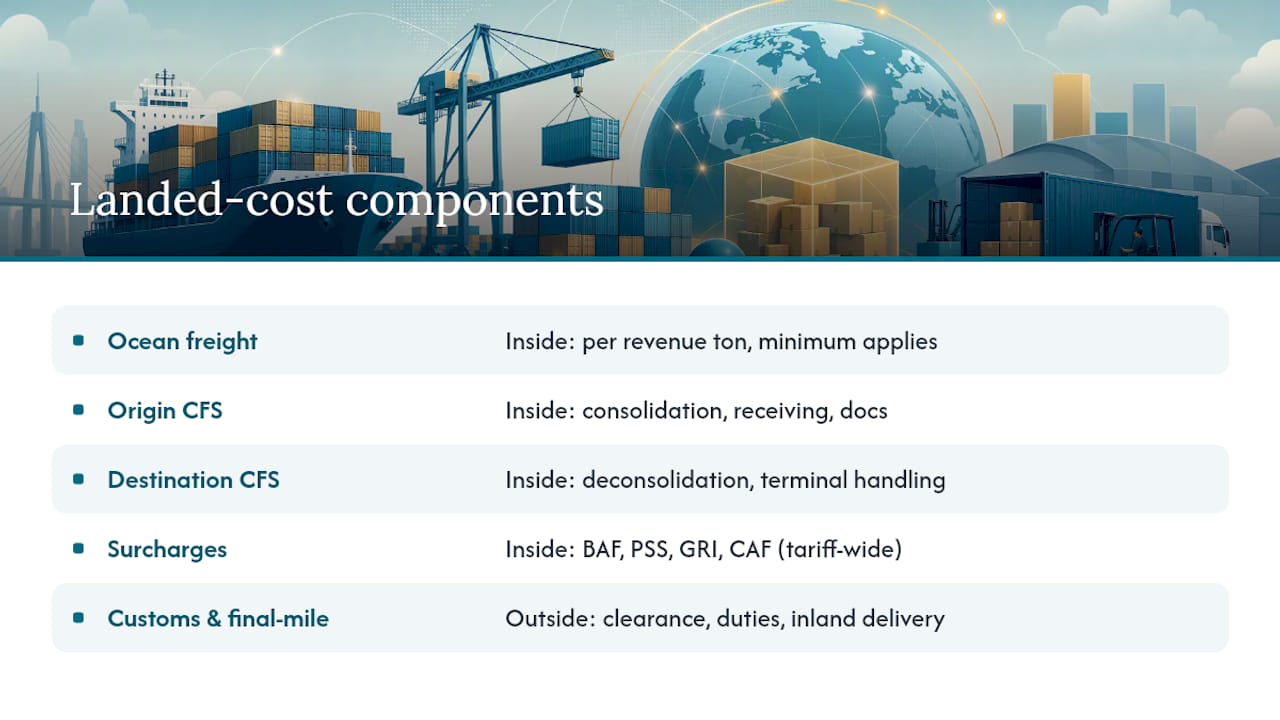
Ocean freight rate. Priced per revenue ton, with a minimum ocean charge that applies even to sub-1-CBM shipments. This is the number most calculators lead with, and the one most shippers assume is the whole story.
Origin CFS charges. Covers consolidation handling, warehouse receiving, and export documentation at the origin container freight station. These fees are usually flat or tiered by weight bracket rather than scaled to distance.
Destination CFS and terminal handling (THC). Covers deconsolidation, cargo release, and terminal handling at arrival. This is often where the biggest gap between estimate and invoice shows up, since destination fees vary widely by port.
Surcharges. Bunker Adjustment Factor (BAF), Peak Season Surcharge (PSS), General Rate Increase (GRI), and Currency Adjustment Factor (CAF) all ride on top of the base rate. These tend to apply uniformly across a carrier’s tariff and are rarely negotiable line by line.
Customs, duties, drayage, and final mile. Customs clearance, duties and taxes, inland drayage, and last-mile delivery sit outside the ocean quote entirely but belong in any real landed-cost estimate. If your shipment needs cargo protection during transit, it’s worth reviewing freight insurance options as a separate line item, since it’s rarely bundled into a standard LCL quote.
Worked Examples: Two Calculator Runs Compared
Numbers make this concrete faster than formulas alone. Here are two scenarios that show how the W/M rule changes which number actually drives your bill.
Example A: bulky, light cargo. Ten pallets, each 120 cm × 100 cm × 150 cm (including pallet height), gross weight 180 kg per pallet. Per-pallet CBM: 1.2 × 1.0 × 1.5 = 1.8 CBM, times 10 pallets = 18 CBM total. Total weight: 1,800 kg ÷ 1,000 = 1.8 RT. Since 18 CBM beats 1.8 RT, the shipment bills on volume at 18 RT.
Example B: denser, mid-sized cargo. Six crates, each 100 cm × 100 cm × 100 cm, gross weight 950 kg per crate. Per-crate CBM: 1.0 CBM, times 6 = 6 CBM total. Total weight: 5,700 kg ÷ 1,000 = 5.7 RT. Here CBM (6) still edges out weight (5.7), but the margin is thin, which is exactly the density range where a small measurement error flips which number wins.
| Shipment | Total CBM | Weight RT | Billed RT | Driver |
|---|---|---|---|---|
| Example A | 18 | 1.8 | 18 | Volume |
| Example B | 6 | 5.7 | 6 | Volume (close call) |
Both examples bill on volume, but Example B shows how close the crossover point can be. Indicative ocean linehaul on busy lanes such as China to the US commonly runs $80 to $180 per CBM before origin and destination fees, so the billed RT in either example can swing your total by hundreds of dollars depending on the lane and season.
Practical Tips to Avoid LCL Billing Surprises
Small habits separate shippers who get invoiced close to their estimate from those who get an unpleasant surprise three weeks later.
Measure the packed shipment at its absolute maximum outside dimensions, pallet and overhang included, since incorrect declared dimensions are the leading cause of billing disputes and re-measure fees at the CFS. Remember that CFS re-measurement is binding, not your calculator input. If your shipment is creeping toward 12 to 15 CBM, request both an LCL and FCL quote, because that’s the range where a full container sometimes beats consolidated freight on price. Always ask for itemized quotes and confirm the provider’s minimum RT and rounding policy before comparing numbers. Focus negotiation on CFS and local handling fees rather than the ocean-line rate or surcharges like BAF and PSS, which are typically applied uniformly across a carrier’s tariff and leave little room to move.

Pro Tip: Repalletizing cargo or changing carton orientation often shaves more off your billed CBM than any rate negotiation will. A few centimeters saved on height across ten pallets can drop you a full revenue ton.
Orner’s Tools for Planning and Booking LCL Freight
Running the numbers is only half the job. Orner’s LCL Shipping Cost Calculator applies the same W/M logic covered here to your actual lane and cargo details, and pairs with a freight shipping estimate tool for cross-checking broader landed costs, including truck freight portions of your route.
Beyond the estimate, some platforms support the full booking cycle: requesting a firm quote, confirming customs clearance requirements, and tracking the shipment from origin CFS to final delivery. Such continuity matters as estimates that can’t turn into bookable, trackable shipments aren’t much use to shippers working against deadlines.
Get a Firm LCL Quote Instead of Guessing
An estimate is a planning tool. A firm quote is what you actually pay. Orner closes that gap by letting you run the numbers on the LCL Shipping Cost Calculator and then move straight into requesting an all-in quote that separates origin CFS, ocean freight, destination CFS, customs, and final-mile delivery into clear line items, rather than one bundled number you have to take on faith.
That itemized structure is what lets you compare Orner’s quote against anything else you’ve collected and know exactly what you’re paying for at each stage. Once your cargo dimensions and weight are locked in, the calculator output carries straight into a booking request, so there’s no re-entering data or waiting on a callback to get a real number. If you’re managing recurring LCL lanes, Orner’s customs clearance and warehousing services also cover what happens after the ship docks, from deconsolidation through delivery.
Head to the Orner freight estimate page and enter your next shipment’s dimensions and weight to see where it lands.
Rethinking What “Accurate” Means for LCL Estimates
Most shippers treat an LCL calculator as a shortcut to a price. It’s actually a shortcut to the right question. The number that matters isn’t the total the tool spits out. It’s whether your CBM input matches what the CFS will measure on arrival, because that gap is where nearly every billing dispute originates.
There’s a quiet bias in how these tools get used: shippers plug in product dimensions instead of packed dimensions, then act surprised when the invoice runs higher. Pallet height and overhang aren’t rounding errors, they’re the difference between an estimate you can trust and one that’s fiction from the moment you hit calculate.
The other blind spot is treating surcharges and ocean rates as the negotiation battleground. They’re mostly fixed, applied uniformly across a carrier’s tariff, and not worth the back-and-forth. The real leverage sits in CFS and local handling fees, and in the packing decisions you make before the cargo ever reaches the port. A calculator can tell you your chargeable weight. It can’t tell you that repalletizing six crates might save you more than a week of rate negotiation would. That’s the part worth spending your time on.
— Maayan
Sources
- LCL Ocean Freight Calculator — W/M Revenue Ton Estimator
- CBM Calculator for Seafreight FCL & LCL Shipping – IncoDocs
- LCL Rate Calculator — W/M Planning Estimate | Suaid Global
FAQ
What Does an LCL Shipping Calculator Actually Return?
It returns your chargeable revenue tons, calculated using the W/M rule, along with an estimated all-in cost that typically includes the ocean freight line plus origin and destination CFS fees. Some tools also flag applicable surcharges and minimum charges separately.
How Do I Calculate CBM From Package Dimensions?
Measure length, width, and height in centimeters at the packed shipment’s outer edges, then multiply the three figures and divide by one million to get cubic meters. Always include pallet height and any overhang, since those get counted at the CFS regardless of what you enter in a calculator.
What Is the Minimum Charge for an LCL Shipment?
Most carriers apply a minimum of 1 CBM or 1 revenue ton per the W/M billing rule, meaning even a very small shipment gets billed as a full revenue ton. Rounding rules also vary by provider, so confirm them before comparing quotes.
When Should I Compare LCL and FCL Instead of Just Booking LCL?
Once your shipment approaches roughly 12 to 15 CBM, it’s worth requesting both an LCL and FCL quote, since a full container can sometimes come out cheaper than consolidated freight at that volume. The break-even point shifts by lane and season, so this is a case-by-case check, not a fixed rule.
Does Orner Offer a Free LCL Shipping Calculator?
Yes, Orner’s LCL Shipping Cost Calculator is available to use for lane-specific planning before you request a firm quote. Pricing for booked shipments and managed services is available directly on the site rather than through the calculator itself.