An ocean freight invoice lists every charge for moving your cargo, from pickup to final delivery. Before you approve payment, verify it line-by-line against your service contract, the carrier’s published tariff, the original quote, and the terminal arrival record. That four-way check catches the errors that a quick glance never will.
TL;DR:
- Most invoice errors stem from mismatched origin charges, such as duplicate drayage or packing fees, which can be flagged by verifying receipts and supplier records.
- Surcharges like BAF, CAF, and others are often complex and updated frequently; always compare their formulas and effective dates against published carrier indexes.
- Destination charges, including terminal handling and drayage, should be verified against port fee schedules and delivery orders to uncover possible duplicate billing.
- Invoices should always match the four key documents: the service contract, published tariff, original quote, and terminal arrival record, to catch inconsistencies early.
- Regular, ongoing audits of high-volume lanes and surcharge-heavy shipments prevent errors from accumulating and reduce costly billing disputes over time.
Table of Contents
- What Are Pre-Carriage and Origin Charges on an Ocean Freight Invoice?
- How Is Ocean Freight Calculated for Main Carriage?
- What Destination and Terminal Charges Should You Expect?
- Bill of Lading vs Invoice: What’s the Difference?
- What Surcharges Appear on Ocean Freight Invoices and How Do You Validate Them?
- How Do Demurrage and Detention Charges Actually Work?
- Practical Ocean Freight Invoice Audit Checklist
- How Do You Dispute an Incorrect Ocean Freight Charge?
- Or-ner Resources for Verifying Ocean Freight Invoices
- Currency, Exchange Rates, and Why Conversion Dates Matter
- What Invoice Timeline and Payment Terms Should You Expect?
- Tariff Rates vs Contract Rates: Which One Applies?
- Why Invoice Audits Should Be a Habit, Not a Project
- How Or-ner Supports Freight Invoice Verification
- Sources
- FAQ
What Are Pre-Carriage and Origin Charges on an Ocean Freight Invoice?
Origin charges cover everything that happens before your container reaches the port. They show up first on the invoice and they’re also where mismatched paperwork causes the most confusion, because three or four different vendors may have touched the shipment before it ever left your supplier’s dock.
Pickup and drayage move the container from the factory or warehouse to the port of loading. This charge should tie directly to a trucking receipt or a drayage confirmation showing date, origin address, and container number. If the invoice shows drayage but you arranged your own inland trucking, that’s a duplicate charge waiting to be disputed.
Packing and stuffing fees cover loading cargo into the container, sometimes called container loading or CFS (container freight station) charges. Verify these against the warehouse receipt or your supplier’s own invoice. A stuffing fee with no corresponding warehouse activity on record is a red flag.
Export clearance and filing fees round out the origin leg:
- Customs export declaration fees, billed per shipment or per filing
- ISF (Importer Security Filing) fees for US-bound cargo, typically charged per filing
- Documentation prep fees tied to the export customs entry
Who owns which of these charges depends entirely on your Incoterm. Under FOB, the seller handles origin charges up to the ship’s rail; under EXW, the buyer absorbs nearly all of it, including pickup. If an origin charge appears on your invoice that your Incoterm assigns to the seller, that’s the first thing to flag.
How Is Ocean Freight Calculated for Main Carriage?
The base ocean freight rate, also called linehaul, is the largest single line item on most invoices and the easiest one to check against a contract. Carriers quote it per TEU or FEU (twenty-foot or forty-foot equivalent unit) for full container loads, or per weight/measurement ton for LCL (less than container load) cargo. That rate should match, dollar for dollar, what’s written in your service contract or, absent a contract, the carrier’s published tariff.
Fuel and currency adjustments ride on top of the base rate and change more often than shippers expect:
- BAF (Bunker Adjustment Factor), also called FAF or bunker surcharge, offsets fuel price swings and typically resets monthly or quarterly based on a published fuel index
- CAF (Currency Adjustment Factor) compensates for exchange rate movement between the carrier’s home currency and the invoice currency
- LSS (Low Sulphur Surcharge) covers compliance costs tied to IMO fuel emissions rules
Each of these typically references a specific index or formula the carrier publishes, and that formula is what you check the invoiced amount against, not just the dollar figure itself.
Pro Tip: Ask your carrier or forwarder for the current BAF/CAF calculation sheet when you sign a contract, then keep it on file. When the surcharge changes next quarter, you’ll have a baseline to compare against instead of taking the new number on faith.
One distinction trips up a lot of shippers: if you have a signed service contract (an NRA or negotiated rate agreement), that contract controls billing, not the carrier’s general tariff. The tariff only governs when no specific contract rate applies to your shipment. An invoice that quietly reverts to tariff rates on a contracted lane is one of the more common billing errors auditors find, and it’s one of the more expensive ones because it’s a full linehaul markup, not a small surcharge miss.
What Destination and Terminal Charges Should You Expect?
Destination charges arrive after main carriage and often come from a different vendor than the one who billed you for the ocean leg. That handoff between carrier, terminal operator, and destination trucker is exactly where invoices start arriving out of order and charges start getting duplicated.
- Destination THC (Terminal Handling Charge) covers unloading the container at the arrival port. It’s billed separately from origin THC, which covers the same function at the port of loading, and the two should never appear as a single combined line unless your contract explicitly bundles them.
- Wharfage and gate fees cover the physical handling of cargo across the terminal, often billed by the port authority or terminal operator rather than the ocean carrier.
- Destination drayage moves the container from the port to your warehouse or distribution center, verified the same way as origin drayage: a trucking receipt with matching container and date.
- Chassis and intermodal fees cover the wheeled equipment that carries the container over the road, and increasingly show up as a separate line since chassis pools became a distinct billing category in many US ports.
Verify destination charges against the terminal’s own published fee schedule and the delivery order, not just the forwarder’s invoice. Because destination charges typically arrive on a separate bill from the ocean freight invoice, sometimes weeks apart, you need a system for reconciling multiple vendor invoices against a single shipment. That’s where a lot of double billing hides. If your drayage carrier bills you and your forwarder’s invoice also shows a drayage line for the same container, one of those is wrong.
Bill of Lading vs Invoice: What’s the Difference?
A bill of lading is a legal contract of carriage and title document. It proves the carrier received your cargo and states the terms under which it will deliver it. An invoice, by contrast, is simply a bill for services rendered. The B/L doesn’t charge you for anything; the invoice does, and the two documents should always reference each other.
Every legitimate ocean freight invoice needs to carry these identifiers, matched exactly against your B/L and booking confirmation:
- Master and House Bill of Lading numbers
- Booking reference number
- Shipment or container ID
- Named shipper and consignee, matching your contract
Prepaid vs collect terms determine who the carrier bills directly, and this is where double billing sneaks in most often. On a prepaid shipment, the shipper pays the carrier before cargo moves; on collect, the consignee pays at destination. If your forwarder’s invoice and the carrier’s invoice both show ocean freight charges for the same B/L, check the prepaid/collect designation first. It’s the single fastest way to spot whether you’re looking at a legitimate pass-through charge or an accidental double bill.
What Surcharges Appear on Ocean Freight Invoices and How Do You Validate Them?
Beyond BAF and CAF, carriers apply a rotating list of surcharges tied to seasonal demand, security regulations, and port congestion. Xeneta’s breakdown of standard sea freight invoice components confirms these show up on nearly every ocean invoice in some form:
- ISPS (International Ship and Port Facility Security) fee, a flat security surcharge tied to post-9/11 maritime regulations
- PSS (Peak Season Surcharge), applied during high-demand shipping windows, typically summer and pre-holiday months
- GRI (General Rate Increase), a carrier-wide rate hike announced with advance notice, not a per-shipment fee
- Congestion surcharge, applied when a specific port is experiencing delays severe enough to affect vessel turnaround
- Emergency bunker surcharge, a short-notice fuel surcharge layered on top of standard BAF during sudden fuel price spikes
A typical ocean invoice bundles a base linehaul rate with eight or more separately calculated surcharges, each carrying its own formula and effective date. That volume of moving parts is exactly why ocean freight invoices generate more billing disputes than air or trucking invoices, where the charge structure is simpler.
For each surcharge, confirm the effective date against the carrier’s published circular and check that the formula matches what your contract specifies, not a rate the carrier applied retroactively. Surcharge stacking, where a general rate increase and a peak season surcharge both apply to the same shipment without contract language addressing overlap, is one of the most common ways invoices inflate past what the contract allows. A well-negotiated service contract includes a clause capping or excluding surcharge stacking; if yours doesn’t, that’s worth raising at your next contract renewal.
Recovery rates on ocean freight audits typically land between a few percent and values higher on surcharge-heavy lanes(https://freightsurcharge.com/blog/freight-invoice-audit-checklist-10-things-check-every-time) — a strong signal that the surcharge stack, not the base rate, is where most recoverable money sits.
How Do Demurrage and Detention Charges Actually Work?
Demurrage and detention get lumped together constantly, but they charge for different things. Demurrage is the fee for keeping a container at the port or terminal past its free time. Detention is the fee for keeping the carrier’s container or chassis outside the terminal, at your warehouse or yard, past the allotted free days. Mixing them up on an invoice, or being billed both for the same days, is a common error worth flagging immediately.
Free time starts when the terminal issues a container-availability notification confirming the container is ready for pickup, not necessarily when the vessel docks. That timestamp, not the vessel arrival date, is what determines your free days and it’s frequently the single most disputed data point on a demurrage bill.
- Request the EDI 315 or equivalent availability notice, not just the vessel’s arrival date, for every demurrage dispute
- Cross-check gate-in and gate-out records at the terminal against the billed date range
- Verify the free-time allowance matches your contract, since it varies by carrier and by port, and confirm the invoice used calendar days, not business days, if that’s what your contract specifies
Pro Tip: Save your terminal’s container-availability notification the moment it lands in your inbox. Under OSRA-22, disputes must be submitted in writing with supporting evidence, and that timestamp is often the deciding piece of proof in a demurrage dispute.
Practical Ocean Freight Invoice Audit Checklist
A four-way match is the backbone of any real invoice audit. It compares the invoice against the service contract (your negotiated rates), the published tariff (the fallback rate structure), the original quote (what you were told to expect), and the terminal arrival record (physical proof of what actually happened). Any invoice that fails to line up with all four deserves a hold before payment.
Run through these ten checks on every ocean freight invoice before approval:
- Base linehaul rate matches the contract or tariff for the correct origin/destination pair
- Every surcharge has an authorized effective date and a traceable formula
- Currency conversion used the correct rate and date, not a stale or estimated figure
- Container count on the invoice matches the booking confirmation and B/L
- Weight and volume figures match the packing list, not an estimated or rounded number
- Demurrage and detention start dates trace back to the EDI 315 or gate record
- No duplicate charges appear across the ocean carrier and forwarder invoices
- Line-item math adds up correctly, including any percentage-based fees
- Tax and VAT calculations use the correct rate for the destination country
- Payment terms match what was agreed, including any early-payment discount
Pro Tip: If you can only audit a fraction of your invoices, prioritize your highest-dollar lanes and any shipment with more than five surcharge lines. That’s where errors cluster and where a missed mistake costs the most.
Manual review works fine at low volume. Once you’re processing more than a handful of ocean shipments a month, freight audit tools or third-party audit services start paying for themselves, since the math involved in checking currency, surcharge dates, and container counts across dozens of invoices a week is exactly the kind of repetitive task software catches faster than a person scanning a PDF.
How Do You Dispute an Incorrect Ocean Freight Charge?
Document the discrepancy the moment you find it. Note the specific line item, the amount you believe is wrong, and which of the four reference documents (contract, tariff, quote, or arrival record) supports your position. Send a written dispute to the billing party, not a phone call, and request a corrected invoice rather than a credit memo.
Set a firm deadline, typically 30 days, for a response before escalating. If the dispute involves detention or demurrage specifically, OSRA-22 gives shippers stronger standing to demand that the carrier justify the charge in writing, using the tariff or contract as evidence. For non-demurrage disputes, escalation usually runs through your forwarder first, then the carrier’s billing department, and only to the Federal Maritime Commission if the carrier ignores a documented, timely complaint.
Push back on “credit on next shipment” as a resolution. It’s a common shortcut, but it buries the dispute instead of resolving it and makes tracking whether the error actually gets corrected nearly impossible. Insist on a corrected invoice that references the original quote or contract number directly.
- Keep a dispute log with dates, amounts, and resolution status for every open item
- Track which vendors generate repeat disputes, since a pattern usually points to a systemic billing error worth raising at the contract level
- Confirm the corrected invoice, not just a promised credit, before marking the dispute closed
Or-ner Resources for Verifying Ocean Freight Invoices
Verifying an ocean freight invoice by hand across five vendors and a dozen line items is tedious work, and that’s exactly the kind of workflow Or-ner’s platform is built to support. The platform provides booking visibility to compare the original quote and contracted rate against shipment IDs, helping avoid the need to search through separate emails.
A centralized documentation repository can keep bills of lading, arrival notices, and booking confirmations attached to shipment records, streamlining the four-way match process. For deeper reference on the documents themselves, Or-ner’s guides on the ocean freight bill of lading and the 2025 ocean freight documentation guide walk through what each document should contain and how it ties back to your invoice. A solid freight booking checklist up front also prevents a lot of the mismatches that surface on the invoice later.
Currency, Exchange Rates, and Why Conversion Dates Matter
Most ocean carriers bill in US dollars, but not always, and even dollar-denominated invoices often reference a CAF calculated against a home-currency benchmark, usually the carrier’s country of registration. That’s where conversion dates start affecting your total more than shippers expect.
The exchange rate applied to a currency-adjusted line item should reflect the rate on the invoice date or the rate specified in your contract, not whatever rate happened to be convenient when the invoice was generated. A carrier using a stale exchange rate from weeks earlier, when currency moved in the carrier’s favor, is a subtle but real way invoices get inflated without any surcharge changing at all.
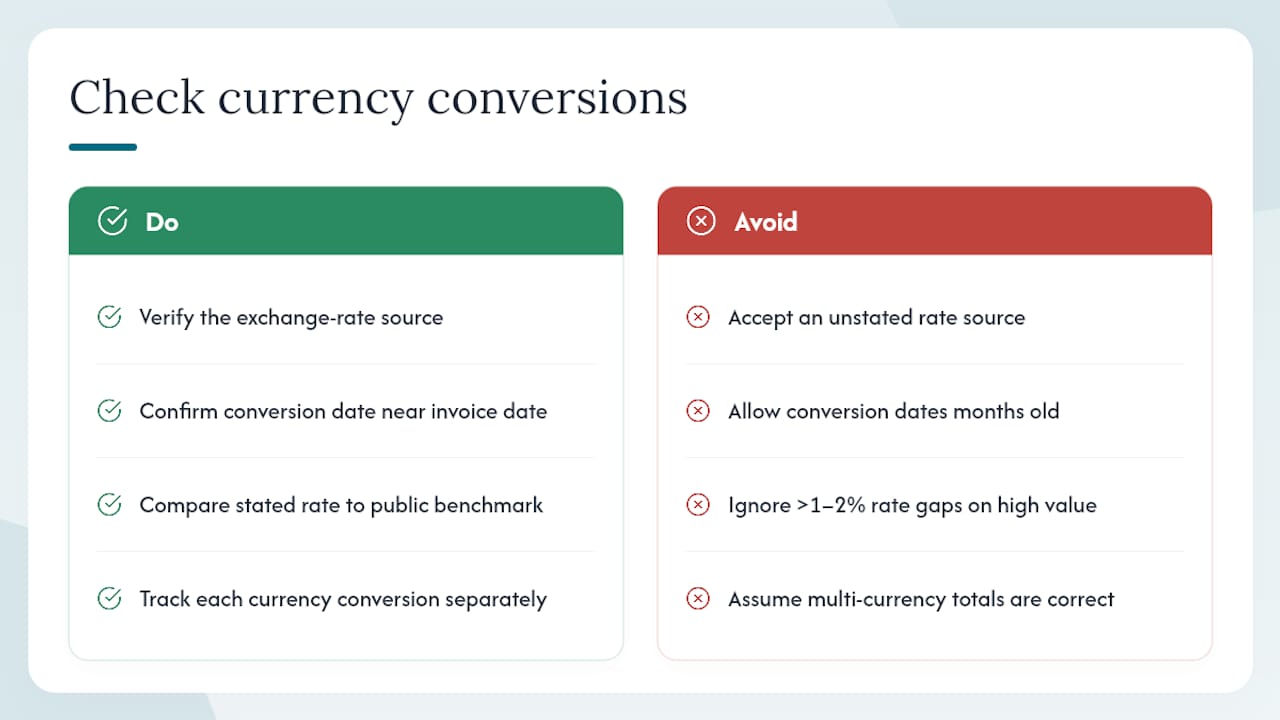
Check three things whenever a currency adjustment appears:
The invoice should state which exchange rate source it used, whether that’s a central bank rate, an XE.com snapshot, or a rate published in the carrier’s own tariff circular. If the source isn’t stated, ask for it. The invoice should also state the conversion date, and that date should fall within a reasonable window of the invoice date, not months prior. Finally, compare the stated rate against a public benchmark rate for that same date. A gap of more than a percentage point or two is worth questioning, especially on high-value shipments where even a small rate discrepancy adds up across multiple containers.
Multi-currency shipments, where origin charges bill in one currency and destination charges bill in another, compound this problem. Track each currency conversion separately rather than assuming the total in your invoice currency is automatically correct just because the final number looks reasonable.
What Invoice Timeline and Payment Terms Should You Expect?
Ocean freight invoices don’t arrive all at once. Origin charges often bill first, sometimes before the vessel even departs, while destination charges, demurrage, and detention typically arrive after delivery, occasionally weeks later once the terminal finalizes its own billing cycle. That staggered timeline is normal, but it means your accounts payable team needs a system for matching each partial invoice back to the same shipment rather than expecting one consolidated bill.
Standard payment terms on ocean freight invoices run anywhere from net 15 to net 30 days from the invoice date, though larger shippers with negotiated service contracts sometimes secure net 45 or net 60 terms as part of the broader rate agreement. Some carriers offer a small early-payment discount, often 1% to 2%, for payment within 10 days.
Late payment on ocean freight invoices carries real consequences beyond a strained vendor relationship. Carriers can place a hold on future bookings, and in some contracts, late fees compound monthly. That’s exactly why a fast, accurate audit process matters: you want to catch errors quickly enough to dispute them before the payment deadline, not after you’ve already paid and are trying to claw back a refund. Building a standard turnaround time internally, say, 5 business days from invoice receipt to audit completion, keeps disputes ahead of the payment clock instead of behind it.
Tariff Rates vs Contract Rates: Which One Applies?
Every ocean carrier publishes a general tariff, a default rate schedule that applies to any shipment without a specific negotiated agreement. Most shippers moving meaningful volume don’t actually pay tariff rates. They negotiate a service contract, sometimes called an NRA (negotiated rate agreement), that locks in specific rates and terms for a defined trade lane over a set period, typically a year.
The contract rate governs whenever one exists and covers your shipment’s specific lane and container type. The published tariff only applies as a fallback, for shipments that fall outside your contract’s scope, for spot shipments booked without an existing agreement, or for accessorial charges the contract doesn’t specifically address.
This distinction matters because carriers occasionally bill at tariff rates on a shipment that should have qualified under an existing contract, whether through a system error, an expired contract that wasn’t renewed in the carrier’s records, or a shipment that technically falls just outside the contract’s defined scope. Always confirm which rate structure applies to a given shipment before assuming the invoiced rate is correct, and keep a current copy of your signed contract accessible to whoever handles invoice approval. An invoice reviewer who has never seen the actual contract rate can’t catch a tariff substitution, no matter how carefully they check the math.
Why Invoice Audits Should Be a Habit, Not a Project
Treating invoice verification as a one-time cleanup misses the point. Ocean freight billing has too many moving parts, surcharges, currency dates, demurrage timestamps, for a single audit to fix the underlying problem. The real fix is a standing review gate: someone checks every invoice above a dollar threshold before it gets paid, every time.
Prioritize your highest-volume lanes first. That’s where a repeated error compounds fastest and where the recovery math justifies the review time. And push your next contract renewal to include explicit language against surcharge stacking. A clause that caps how many peak-season and emergency surcharges can apply to a single shipment protects you long after this quarter’s invoices are paid.
— Maayan
How Or-ner Supports Freight Invoice Verification
If you’re managing ocean freight across multiple carriers and forwarders, chasing down five PDFs to run a four-way match on every shipment gets old fast. A logistics platform can give booking visibility and a centralized documentation record tied to each shipment, enabling contract rates, original quotes, and arrival records to be reviewed alongside invoices.
That visibility matters most at the booking stage, since a clean, well-documented booking is what prevents half the invoice disputes described above from ever happening. Or-ner’s freight booking process walks through exactly how to set a shipment up so the paperwork matches from day one, and the platform’s analytics and exception management flag discrepancies before they turn into a payment delay. If you’re ready to bring more structure to how your team books and reconciles ocean freight, start with Or-ner’s freight booking guide and see how the documentation trail comes together for your next shipment.
Sources
The ASEAN sea freight components chapter backs the standard charge categories referenced throughout. Eller Audit’s ocean freight audit guide supports the four-way match methodology and OSRA-22 dispute context. Xeneta’s invoice breakdown confirms typical line items, and the Freight Surcharge Decoder checklist informed the audit priorities above.
- Chapter: Sea freight components — ASEAN handbook
- Ocean Freight Audit: A Plain-English Guide for Ocean Shippers — Eller Audit
- A full breakdown of everything in a sea freight invoice — Xeneta
FAQ
What Is a Freight Invoice in Shipping?
A freight invoice is a bill from a carrier or forwarder listing every charge tied to moving cargo, including the base ocean freight rate, fuel and currency surcharges, terminal handling, and any documentation fees. It’s distinct from the bill of lading, which is a contract of carriage rather than a bill.
How Do You Check Ocean Freight Charges?
Run a four-way match: compare the invoice against your service contract, the carrier’s published tariff, the original quote, and the terminal arrival record. Confirm the base rate, surcharge dates, currency conversion, and container count all line up before approving payment.
What Is the Difference Between a Bill of Lading and an Invoice?
A bill of lading is a legal document proving the carrier received your cargo and stating the terms of carriage; an invoice is simply the bill for services rendered. The invoice should always reference the B/L number so the two can be matched.
How Is Ocean Freight Charged?
Ocean freight is charged per container (TEU or FEU) for full container loads, or per weight/measurement ton for less-than-container-load cargo, based on the rate in your service contract or the carrier’s tariff if no contract applies. Fuel and currency surcharges like BAF and CAF are added on top of that base rate.
Can a Logistics Platform Help Audit Ocean Freight Invoices?
Yes. A platform like Or-ner centralizes booking data and shipment documentation so you can compare the invoice against the original quote and contract without hunting through separate vendor emails.