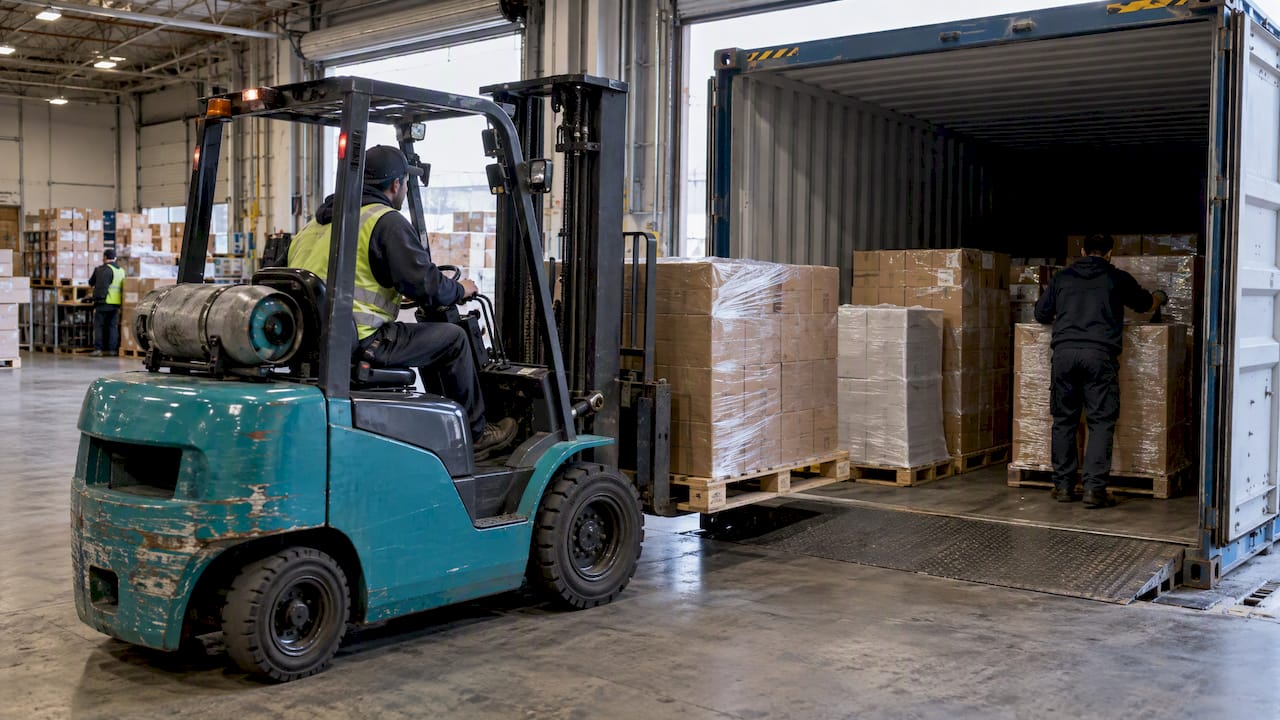
Use an LCL shipping cost calculator when you need an instant, route-specific estimate before committing to a booking. Feed it accurate numbers and it gives you a usable planning figure in minutes instead of days.
To get a number worth trusting, have these ready:
- CBM (cubic meters): length × width × height of every carton or pallet, converted to meters
- Gross weight in kilograms
- Origin and destination ports or postal codes
- INCOTERM (FOB, CIF, DAP, etc.)
- Service level: port-to-port or door-to-door
Pro Tip: A calculator estimate excludes most surcharges that show up on your final invoice. Treat it as a budgeting figure, then request a firm quote once your ship date and cargo details are locked.
Key Takeaways
An accurate LCL estimate requires precise CBM measurement, the correct INCOTERM, and a clear-eyed accounting of surcharges that generic calculators routinely omit.
| Point | Details |
|---|---|
| Measure CBM precisely | Round dimensions up and confirm packaging before entering figures into any calculator. |
| Budget for surcharges separately | THC, BAF, documentation, and inland haulage often sit outside the base freight quote. |
| Know your breakeven point | Shipments approaching 20 CBM or more are worth checking against FCL pricing. |
| Escalate before shipping | Convert a calculator estimate into a firm quote once your ship date and cargo details are fixed. |
| Use a platform for live rates | Or-ner combines real-time carrier pricing, consolidated invoicing, and customs support in one booking flow. |
Table of Contents
- What Is LCL Shipping and When Should You Use It?
- What Cost Components Show Up in an LCL Freight Calculator?
- How Does an LCL Shipping Calculator Compute Your Rate?
- How Do You Use an LCL Calculator to Get a Reliable Estimate?
- When Is LCL Cheaper Than FCL Shipping?
- What Hidden Fees Can Change Your LCL Estimate?
- Where Do Online LCL Calculators Fall Short?
- Turn Your LCL Estimate Into a Booked, Trackable Shipment
- Sources
- FAQ
What Is LCL Shipping and When Should You Use It?
LCL, or less-than-container-load, means your cargo shares a container with other shippers’ goods instead of filling one on its own. A freight forwarder consolidates multiple shipments at a container freight station (CFS), loads them together, then deconsolidates them at destination so each shipper’s goods continue separately. Most carriers set a minimum chargeable volume, commonly around 1 CBM, even if your actual cargo measures less.
LCL suits businesses moving smaller, frequent volumes: ecommerce sellers restocking inventory, wholesalers testing new SKUs, or manufacturers shipping partial production runs. The tradeoff is service complexity. Extra handling at both CFS locations adds cost and time that a full container skips entirely, and that gap is exactly what an LCL shipping estimate tool needs to account for.
What Cost Components Show Up in an LCL Freight Calculator?
An LCL freight calculator breaks your total into distinct line items, and understanding each one lets you sanity-check any number the tool spits out.
- Ocean freight (CBM rate): the carrier’s per-cubic-meter charge for your route, multiplied against your chargeable volume, subject to the minimum chargeable CBM most carriers enforce.
- Origin and destination CFS handling: fees for consolidating your cargo into the container and deconsolidating it at destination.
- Terminal handling charges (THC): port-side fees for moving containers on and off the vessel.
- BAF and peak-season surcharges: bunker adjustment factor covers fuel cost volatility; peak-season surcharges apply during high-demand months, often August through October.
- Inland haulage: trucking from your warehouse to the origin port, and from the destination port to the final delivery address.
- Customs clearance and documentation: brokerage fees, bill of lading charges, and any certificates your commodity requires.
- Cargo insurance: optional but recommended, since ocean freight liability coverage is often minimal by default.
Miss any of these when you calculate LCL shipping costs and your budget will run short the moment the actual invoice arrives.
How Does an LCL Shipping Calculator Compute Your Rate?
The math behind any LCL shipping price estimator follows the same basic formula: calculate your chargeable volume, multiply by the carrier’s CBM rate, then layer on the fixed and variable surcharges.
Start with cubic meters. Multiply length × width × height in meters for each carton, then sum the totals. If your carrier rounds up to the nearest 0.1 CBM or enforces a 1 CBM minimum, your billed volume can land higher than your actual measurement, a detail that trips up first-time shippers more than any other line item.
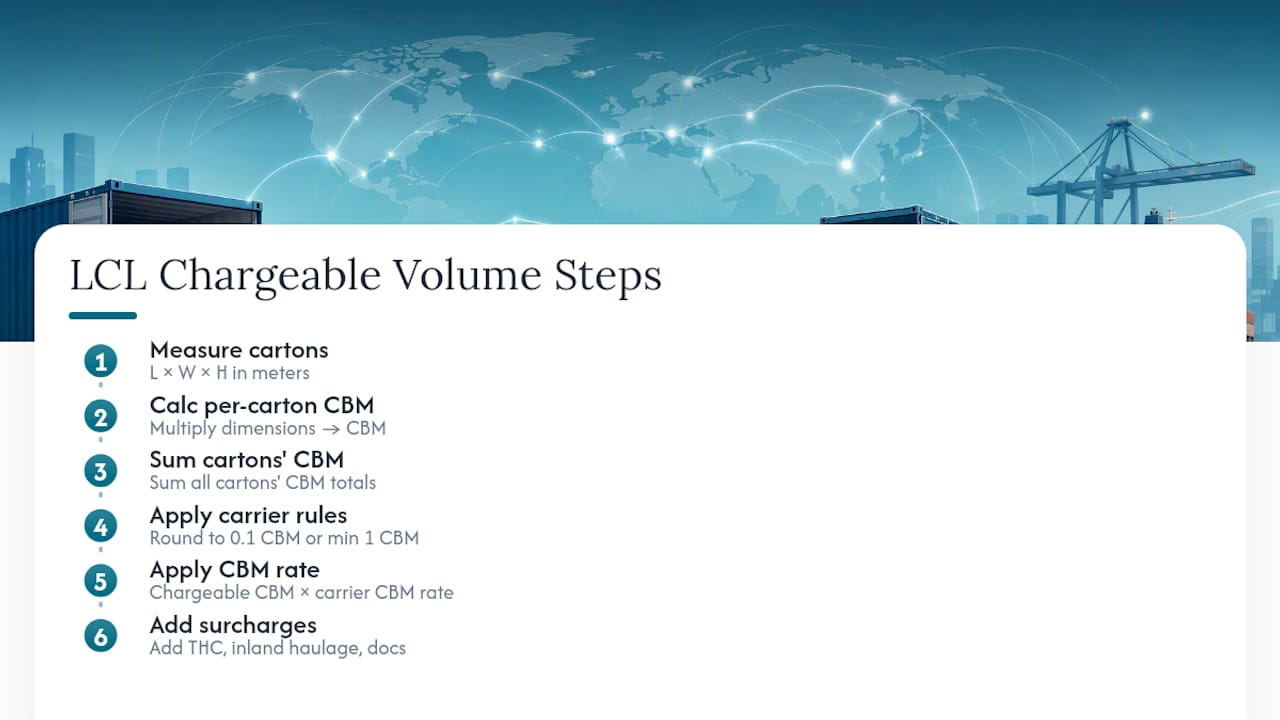
Here’s a simplified walkthrough:
That figure gives you a workable planning number, not a guaranteed invoice total. Adding terminal handling, inland haulage, and documentation to the raw ocean freight line is exactly how a properly built calculator arrives at a number you can actually budget against.
How Do You Use an LCL Calculator to Get a Reliable Estimate?
Getting a number worth trusting takes a bit more discipline than plugging in guesses.
- Measure every carton or pallet precisely. Round dimensions up, never down, and confirm packaging changes with your supplier before quoting.
- Decide between port-to-port and door-to-door. This choice sets your INCOTERM and determines which inland legs the estimate needs to include.
- Enter the correct INCOTERM. FOB shifts destination costs to you; CIF or DAP shifts more responsibility to the seller. Getting this wrong skews your entire estimate.
- Add pickup and delivery addresses, plus commodity type. Some categories (batteries, liquids, textiles) trigger extra documentation or handling fees the calculator needs to price in.
- Review what’s included and what’s excluded. Ask directly about customs duties, insurance, and demurrage before you finalize a budget.
- Request a firm quote once your ship date is set. Once cargo details and timing are fixed, escalate to a formal freight booking rather than budgeting off an estimate that’s a week old.
Pro Tip: Precise measurement of pack geometry and accurate palletization details reduce estimate error and help you avoid re-weigh or re-measure fees once your cargo hits the CFS.
When Is LCL Cheaper Than FCL Shipping?
LCL charges by the cubic meter, and that per-unit rate runs higher than the effective per-CBM cost of a full container. Once your shipment approaches container capacity for a standard 20-foot container, FCL usually wins on price.
A few practical signals point you toward one or the other:
- Under 10 to 12 CBM: LCL almost always comes out cheaper.
- Approaching 20 CBM or more: run the FCL math before booking LCL by default.
- Tight delivery windows: FCL skips the consolidation and deconsolidation steps, cutting transit time.
- High-value or fragile cargo: fewer touchpoints under FCL means less handling risk.
There’s no fixed threshold that works for every shipper. The right call depends on your fill rate, how much slack your delivery schedule allows, and what extra handling risk you’re willing to absorb in exchange for paying by the cubic meter instead of the container.
What Hidden Fees Can Change Your LCL Estimate?
Most calculator sticker shock comes from fees that never made it into the original estimate. Terminal handling charges and CFS fees at both ends of the route are the biggest recurring gaps, since many free online tools quote ocean freight alone and leave the rest as a footnote.
Watch for these specifically:
- Documentation fees for bills of lading, certificates of origin, and customs paperwork.
- Inland haulage on both ends, which varies heavily depending on distance and local trucking availability.
- Customs duties and taxes, calculated separately from freight and dependent on your commodity’s classification.
- Peak-season or BAF adjustments, which can shift week to week during high-volume shipping periods.
- Consolidation and stuffing fees charged at the CFS for combining your cargo with other shipments.
- Insurance gaps, since standard ocean liability coverage rarely reflects your cargo’s full declared value.
Where Do Online LCL Calculators Fall Short?
No calculator sees real-time carrier space availability, and that’s the biggest gap between an online estimate and your actual invoice. Surcharges like BAF and peak-season adjustments shift on short notice, and inland haulage pricing varies by exact postcode in ways a generic tool can’t fully capture.
You tighten the estimate by controlling what you can control: exact CBM measurements, complete pickup and delivery addresses, accurate pallet counts, and a declared cargo value that matches your commercial invoice. Getting the INCOTERM right matters just as much, since it determines which surcharges land on your side of the ledger.
This is where a platform with live rate data closes the gap a static calculator can’t. Or-ner’s booking system pulls current carrier rates instead of averages, consolidates every line item into a single invoice, and layers in customs support so the number you see during booking matches what actually lands on your account. Real inland partners factor in too. Regional trucking providers illustrate how much pickup distance alone can shift your final landed cost, which is exactly the variable a generic calculator tends to flatten into a rough average.

A practitioner’s note on quoting mistakes
The most common error isn’t bad math, it’s stale assumptions: shippers plug in last quarter’s CBM rate or forget peak-season surcharges entirely. A rough estimate is fine for budgeting, but locking a shipment date without a fresh quote from a platform built for booking is how landed costs quietly balloon.
— Maayan
Turn Your LCL Estimate Into a Booked, Trackable Shipment
A calculator gets you a budget number. Booking the shipment is where the real savings or overruns actually happen, and that’s the gap Or-ner closes.
Or-ner pulls live carrier rates instead of static averages, so the figure you see during booking is closer to your final invoice than any generic calculator can get you. Consolidated billing rolls ocean freight, terminal handling, inland haulage, and documentation into one line instead of five separate invoices from five separate vendors. Customs clearance support runs alongside your booking rather than as a separate scramble once your cargo lands, and real-time tracking means you’re not calling your forwarder to ask where your container is. For sellers managing packaging or palletization decisions that affect CBM, bulk packaging partners can also help tighten dimensions before you ever run a calculation.
If your estimate looks solid and your ship date is approaching, start a booking through Or-ner’s logistics platform and lock in a rate before space on your route tightens.
Sources
- LCL Shipping: How and When To Ship LCL – Shopify
- How to calculate the costs for LCL sea freight – IFB
- The hidden costs of LCL shipping: When air or FCL is the better choice – Simple Forwarding
FAQ
How do you calculate LCL shipping cost?
Multiply your chargeable CBM by the carrier’s per-CBM rate, then add terminal handling, inland haulage, documentation, and any applicable surcharges to reach a total estimate.
What are LCL charges in shipping?
LCL charges typically include the ocean freight CBM rate, origin and destination CFS handling, terminal handling charges, documentation fees, and inland haulage, along with seasonal surcharges like BAF that shift with fuel prices and demand.
Is LCL cheaper than air freight?
For small volumes, LCL often looks cheaper upfront, but once you factor in handling time and inventory holding costs, the gap can shrink or disappear entirely depending on how urgently you need the cargo.
What inputs does an LCL shipping calculator need?
Most tools require CBM, gross weight, origin and destination locations, your INCOTERM, and whether you need port-to-port or door-to-door service.
When should I request a firm quote instead of relying on a calculator?
Once your ship date, cargo details, and delivery address are confirmed, especially for high-value or time-sensitive shipments, book through a platform that can lock in current rates instead of relying on a general estimate.