TL;DR:
- Global ecommerce fulfillment networks have reduced international shipping costs by 71 percent.
- They improve customer experience through faster delivery, lower costs, and automated customs compliance.
- Building resilient, integrated logistics is essential for scalable, long-term ecommerce growth.
Global ecommerce fulfillment has a reputation for being expensive and painfully complex. That reputation is outdated. Cross-border fulfillment networks have slashed international shipping costs by 71%, dropping the per-package cost from $25-45 down to $8-12. That single shift changes the math on global expansion entirely. This guide breaks down what a global logistics network actually is, the concrete benefits it delivers for ecommerce brands, the real challenges you need to plan around, and the best practices that separate high-growth brands from the ones still struggling with expensive, fragmented fulfillment.
Table of Contents
- What is a global logistics network?
- Tangible benefits of global logistics networks for ecommerce
- Overcoming challenges: risks and realities of global logistics
- Best practices: optimizing your global logistics network
- Our perspective: why a global logistics network is a competitive essential in 2026
- Streamline your ecommerce with expert logistics solutions
- Frequently asked questions
Key Takeaways
| Point | Details |
|---|---|
| Major cost reduction | Global logistics networks can lower shipping costs for ecommerce by as much as 71%. |
| Faster international delivery | Multi-region fulfillment networks help brands achieve reliable 2-3 day delivery for global customers. |
| Mitigated risk and complexity | Advanced technology and regional planning help businesses navigate regulatory and visibility challenges. |
| Market expansion made easier | Global networks empower ecommerce brands to reach new customers and deliver consistent experiences worldwide. |
What is a global logistics network?
A global logistics network is a coordinated system of warehouses, fulfillment centers, transportation modes, and technology platforms that work together to move products across international borders. It is not just a collection of carriers and warehouses. The key is integration. Every node in the network shares data, follows standardized processes, and connects through a central technology layer that gives you visibility and control across every market you serve.
Here are the core components that make up a functioning global logistics network:
- Warehousing and fulfillment centers positioned in key regions to reduce last-mile delivery distances
- Multi-modal transport covering ocean freight, air cargo, and ground delivery depending on speed and cost needs
- Customs clearance and compliance tools that handle import and export documentation across different regulatory environments
- Real-time tracking technology that connects every shipment to a central dashboard
- Inventory management systems that sync stock levels across multiple locations automatically
- Integration with ecommerce platforms and marketplaces like Amazon, Shopify, and others
According to ShipBob’s 2026 State of Ecommerce Fulfillment Report, global network design is now the primary differentiator for ecommerce brands competing at scale, with broad geographic reach and integrated technology delivering measurable cost and time efficiencies.
The rise of omnichannel logistics has accelerated this shift. Shoppers expect the same fast delivery experience whether they order from your website, a marketplace, or a social commerce channel. A fragmented logistics setup cannot meet that expectation consistently. A properly designed global network can.
Brands are building or joining these networks for several practical reasons. They want to reach new markets without building local infrastructure from scratch. They want to reduce shipping costs by positioning inventory closer to end customers. They want resilience against regional disruptions. And they want the kind of operational consistency that builds long-term customer loyalty. Explore how global logistics solutions make all of this achievable without requiring a massive internal logistics team.
Tangible benefits of global logistics networks for ecommerce
The benefits here are not theoretical. They are measurable and they show up directly in your margin and your customer satisfaction scores.
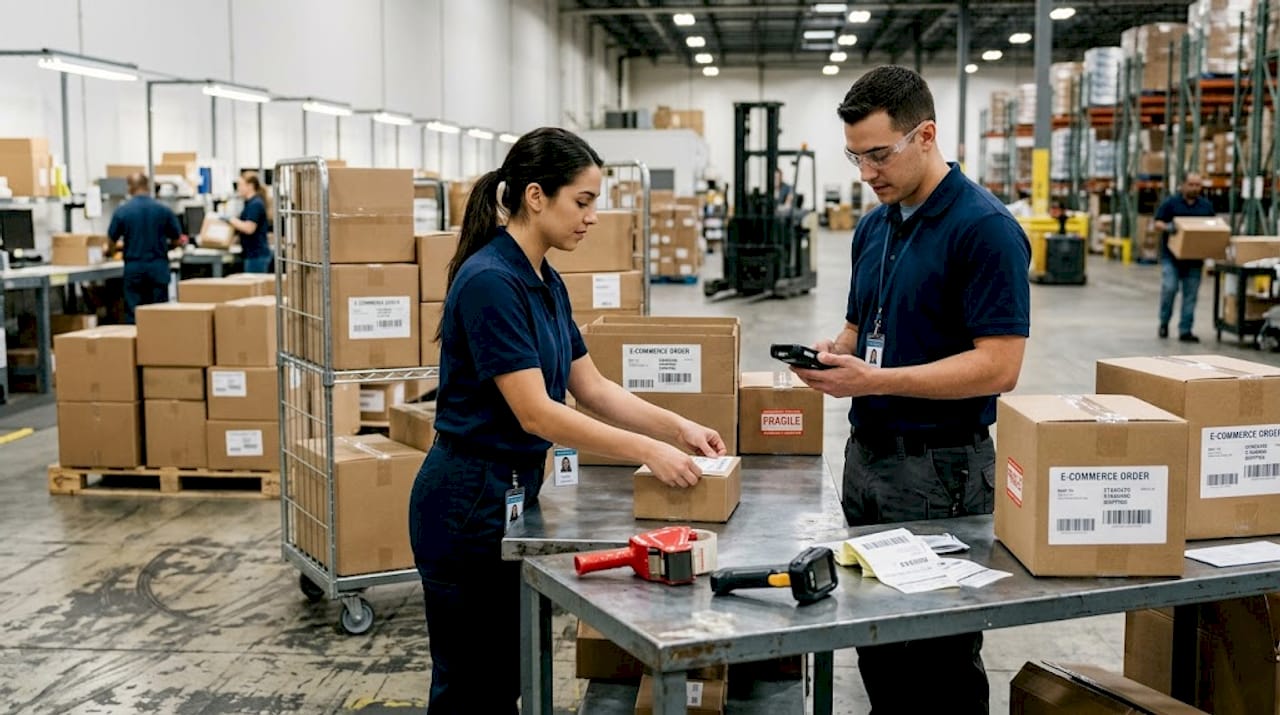
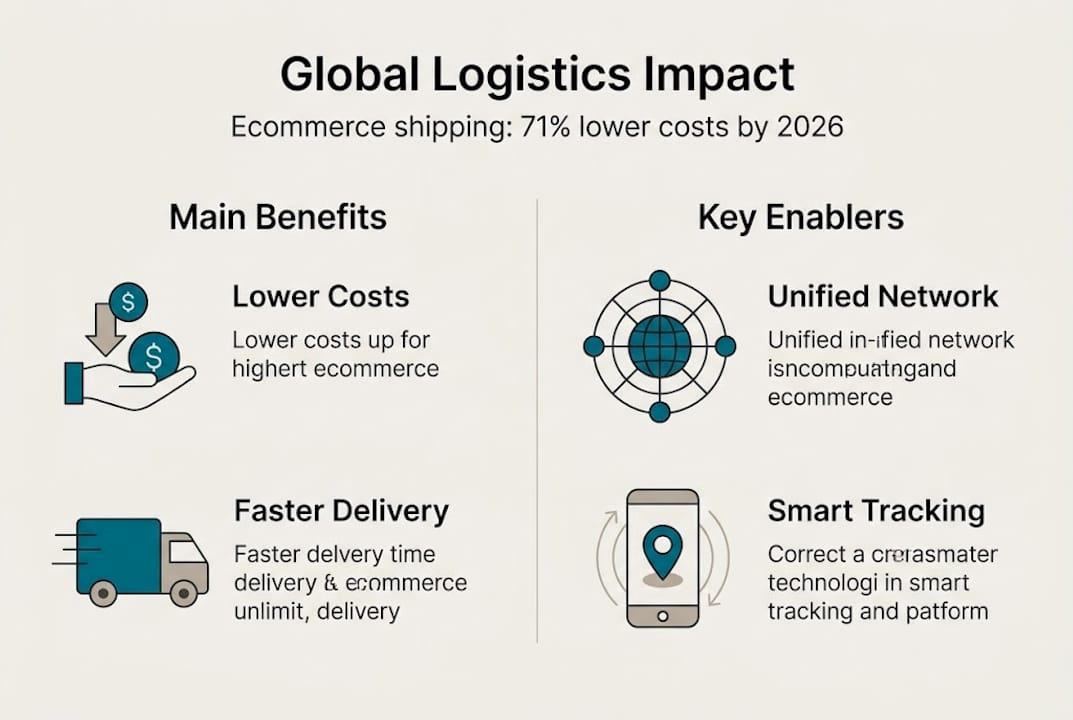
Cost savings are the most immediate win. Shipping costs drop 71% when brands move from fragmented carrier arrangements to coordinated global fulfillment networks, bringing per-package costs from the $25-45 range down to $8-12. That is not an incremental improvement. It is a structural cost advantage.
Speed has become a baseline expectation, not a premium feature.
“Fast, reliable delivery is no longer a differentiator. It’s the floor. Customers abandon carts the moment delivery times feel unreasonable.”
The numbers confirm this. By 2028, 38% of global ecommerce will be cross-border, meaning that brands without international delivery capability will be locked out of a growing share of global demand.
Here is a direct comparison of fragmented versus networked logistics outcomes:
| Metric | Fragmented logistics | Global network ||
|—|—|—|
| Cost per package | $25-45 | $8-12 |
| Delivery speed | 7-14 days | 2-3 days (possible for 69% of brands) |
| Customs handling | Manual, inconsistent | Automated, standardized |
| Inventory visibility | Limited | Real-time, multi-region |
| Scalability | Low | High |
The impact on customer experience is substantial. Cart abandonment rates spike when customers see long delivery windows or high shipping fees at checkout. A global network removes both friction points by enabling faster delivery at lower cost. That translates directly to higher conversion rates and repeat purchase rates.
Key benefits worth tracking for your business:
- Reduced shipping costs across all major trade lanes
- Faster average delivery windows in target markets
- Lower customs-related delays through automated compliance
- Improved inventory turnover through better stock positioning
- Access to new markets without heavy infrastructure investment
Learning the right cross-border shipping strategies helps you capture these benefits faster. And if you are evaluating outsourcing options, reviewing the third party logistics advantages for ecommerce brands makes the case for leveraging an established network rather than building one from scratch.
Overcoming challenges: risks and realities of global logistics
Global logistics networks create real advantages, but they also introduce real complexity. Understanding the risks upfront means you can build a network that handles them systematically rather than reactively.
Regulatory and customs complexity is the most common friction point. Every country has its own import rules, duty structures, restricted goods lists, and documentation requirements. A shipment that clears customs smoothly in one market can get held for weeks in another because of a minor labeling error or missing certificate. The brands that handle this best invest in automated compliance tools and maintain relationships with experienced customs brokers in each key market.
Visibility gaps are the second major risk. Managing fulfillment across multiple regions creates blind spots if your technology stack is fragmented. You can end up with stock sitting in the wrong region, delayed shipments that no one catches until the customer complains, and no clear picture of where bottlenecks are forming. Using predictive analytics in logistics addresses this by flagging exceptions before they escalate into customer-facing failures.
According to the Prologis Supply Chain Outlook Report 2026, regulatory complexity and visibility limitations remain the top disadvantages of global logistics, with a growing trend toward regional self-sufficiency driven by energy costs and geopolitical instability.
The most forward-thinking brands are moving beyond passive diversification. Instead of simply spreading inventory across more locations, they are building proactive risk architectures that include scenario planning, alternative routing, and real-time exception management.
Pro Tip: Do not just diversify your logistics network. Document a specific response plan for each major risk scenario: a port closure, a customs regulation change, a demand spike in a new market. That plan turns a disruption into a manageable event instead of a crisis.
Common risks and proven mitigation strategies:
- Customs delays: use automated documentation and pre-classified product codes
- Demand mismatches: rely on AI in logistics to forecast by region and season
- Carrier failures: maintain backup routing agreements across multiple carriers
- Regulatory shifts: assign a compliance owner and run quarterly regulatory reviews
- Geopolitical disruption: position safety stock in secondary fulfillment locations
Best practices: optimizing your global logistics network
Building a global logistics network is a process, not a one-time project. Here is a practical sequence to follow whether you are starting from scratch or scaling an existing operation.
- Map your current supply chain. Identify where your inventory sits, how orders flow to customers, where delays cluster, and what your actual per-unit fulfillment cost is by region.
- Define your target markets clearly. Not every market justifies dedicated fulfillment infrastructure. Prioritize by order volume, margin, and strategic fit before committing to regional expansion.
- Adopt multi-center fulfillment. Positioning inventory in multiple fulfillment centers reduces average shipping distances and delivery times. 84% of ecommerce brands now use 3PL providers, 59% use multiple fulfillment centers, and 69% are targeting 2-3 day delivery windows.
- Integrate your technology stack. Your ecommerce platform, warehouse management system, carrier connections, and analytics tools need to share data. Siloed systems create the exact visibility gaps that slow you down.
- Balance localization with standardization. Standardize your fulfillment processes globally, but localize the customer-facing elements: shipping options, returns policies, and regional carrier preferences.
- Plan for omnichannel from day one. Your network should handle direct-to-consumer, marketplace fulfillment, and wholesale distribution through the same infrastructure.
Use this cross-border logistics guide to align your strategy with established best practices across each expansion phase.
| Best practice | Primary outcome |
|---|---|
| Multi-center inventory placement | Faster delivery, lower shipping cost |
| 3PL partnership | Scalability without capital investment |
| AI-powered demand forecasting | Reduced stockouts and overstock |
| Automated customs compliance | Fewer delays, lower error rates |
| Omnichannel logistics readiness | Higher channel coverage, better margins |
Pro Tip: Use AI-driven demand forecasting to anticipate regional spikes before peak seasons, not during them. Brands that pre-position inventory based on predictive signals consistently outperform those that react to demand after it peaks.
Our perspective: why a global logistics network is a competitive essential in 2026
For years, the dominant logic in ecommerce logistics was simple: cut costs wherever possible. That thinking made sense when margins were tight and global expansion felt optional. It no longer holds.
The brands winning in global ecommerce today are not the ones with the cheapest shipping rates. They are the ones with the most resilient, transparent, and customer-focused logistics operations. Market expansion, customer consistency, and compliance matter just as much as cost efficiency, and the brands that treat them as secondary priorities are increasingly vulnerable to competitors that do not.
What surprises us is how many ecommerce businesses still treat logistics as a back-office function rather than a growth lever. Regulatory changes, supply shocks, and shifting consumer expectations do not slow down. A flexible, highly visible global network is what lets you adapt quickly instead of scrambling.
The cross-border shipping benefits go well beyond cost. And when you look at what the most scalable brands have built, the common thread is a logistics infrastructure designed for long-term resilience, not just short-term efficiency. The right logistics network is not a nice-to-have for global growth. It is the foundation everything else is built on. Explore an end-to-end fulfillment overview to see what that kind of infrastructure looks like in practice.
Streamline your ecommerce with expert logistics solutions
If the insights in this guide resonate with where your business needs to go, the next step is connecting with logistics expertise that can actually execute at global scale. OR-NER gives ecommerce sellers access to reliable courier services across key markets, backed by real-time tracking, customs clearance support, and a network of fulfillment centers built for cross-border speed and reliability.
Whether you are scaling your first international expansion or optimizing a complex multi-region operation, OR-NER’s platform is built to meet you where you are. Explore our cross-border logistics strategies and use our global logistics guide to map the right fulfillment path for your business.
Frequently asked questions
What is the biggest benefit of a global logistics network for ecommerce sellers?
The biggest benefit is a major reduction in shipping costs, up to 71% lower per package, combined with faster and more reliable international delivery across key markets.
How does a global logistics network improve the customer experience?
It enables faster delivery windows, consistent service across every region you ship to, and fewer delivery errors, all of which directly drive higher customer satisfaction and repeat purchases.
Are there risks with implementing a global logistics network?
Yes, the main risks are regulatory complexity and visibility gaps, both of which can be managed effectively with the right technology stack and a proactive regional risk strategy.
What technology is most effective for improving logistics network efficiency?
AI-powered predictive analytics delivers the highest impact by forecasting regional demand, optimizing routing decisions, and flagging potential disruptions before they affect your customers.