

TL;DR:
- Global ecommerce shipping regulations have rapidly increased compliance complexity in 2026.
- Businesses must adapt through local warehousing, automated compliance checks, and informed logistics partners.
- Choosing between DDP and DAP depends on customer expectations, market thresholds, and operational capabilities.
Ecommerce shipments crossing international borders face a regulatory environment that has shifted faster in the past 12 months than in the previous decade. The US eliminated its $800 de minimis exemption in 2025, the EU is rolling out a €3 per-parcel fee in mid-2026, and packaging void space limits are tightening across major markets. For logistics managers and ecommerce operators, these changes are not abstract policy news. They translate directly into surprise duties, returned shipments, and margin erosion. This guide walks you through the specific rule changes, the compliance traps to avoid, and the practical steps to keep your cross-border operations running smoothly and profitably.
Table of Contents
- How global shipping regulations are changing in 2026
- Key compliance challenges for ecommerce shipping
- DDP vs. DAP shipping: pros, cons, and compliance factors
- Strategies for staying compliant and optimizing shipping in 2026
- Why most ecommerce shipping struggles are rooted in regulation lag
- Ready to simplify compliance? Optimize with ORNER
- Frequently asked questions
Key Takeaways
| Point | Details |
|---|---|
| Regulation changes impact cost | New de minimis rules and fees in 2026 mean more duties and higher shipping complexity. |
| Local inventory is crucial | Stocking goods closer to customers reduces compliance risks and supports fast returns. |
| Incoterm choice affects experience | Using DDP gives buyers clarity but increases seller responsibility; DAP is simpler but can frustrate customers. |
| Automation boosts compliance | Leveraging automated tariff and documentation systems streamlines adaptation to changing global rules. |
How global shipping regulations are changing in 2026
For years, de minimis thresholds gave ecommerce sellers a cost advantage by allowing low-value shipments to enter markets duty-free. Governments have now recognized the revenue they were leaving on the table, and the correction is sharp. Understanding shipping regulations basics is no longer optional for any seller moving goods across borders.
According to McKinsey, de minimis thresholds changes vary significantly by region: the US eliminated its $800 exemption in August 2025, with full duties applied especially to shipments from China starting May 2025; the EU maintains a €150 duty-free threshold but requires VAT collection via IOSS and adds a €3 handling fee from July 2026; the UK threshold sits at £135; Canada at CAD 20; and Australia at AUD 1,000.
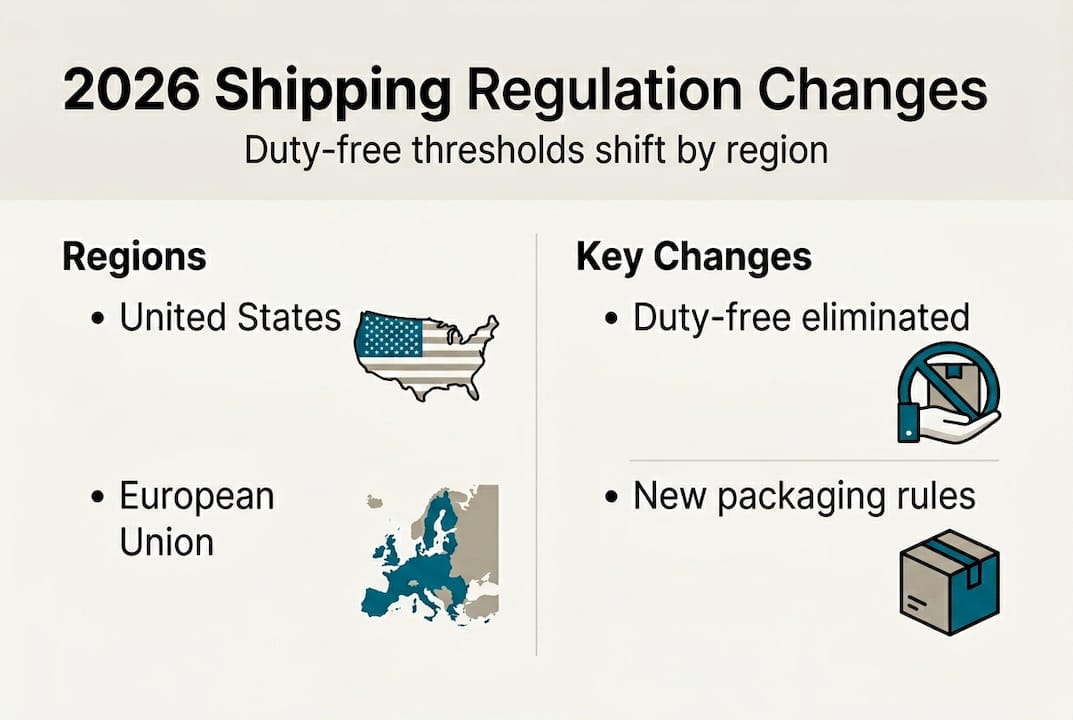
| Region | Duty-free threshold | Key 2026 change |
|---|---|---|
| United States | $0 (exemption eliminated) | Full duties on all imports, China-origin May 2025 |
| European Union | €150 | €3 per-parcel fee from July 2026, VAT via IOSS |
| United Kingdom | £135 | VAT at point of sale required |
| Canada | CAD 20 | Very low threshold, most parcels dutiable |
| Australia | AUD 1,000 | Relatively high threshold still in place |
The motivations behind these changes are straightforward. Governments want to protect domestic retailers who pay full duties on locally sourced goods, and they want to recover VAT and import revenue that cross-border ecommerce had effectively bypassed. The EU’s €3 fee is specifically designed to fund customs processing infrastructure.
Here is how these changes affect your operations directly:
- US sellers and importers must now calculate and collect duties on every shipment, removing the low-value workaround that many direct-to-consumer brands relied on.
- EU-bound shipments require IOSS registration to avoid double VAT charges at the border, plus the new €3 fee will add up quickly at volume.
- UK shipments must have VAT collected at checkout, not at the door, or carriers will charge recipients and create friction.
- Canada’s CAD 20 threshold is so low that virtually all ecommerce parcels are dutiable, making accurate customs documentation non-negotiable.
- Australia’s AUD 1,000 threshold remains the most favorable, but GST on digital and physical goods still applies for registered sellers.
The scale of disruption is real. Businesses that built their pricing models around duty-free entry are now absorbing costs they never planned for.

Key compliance challenges for ecommerce shipping
Understanding the rules is just step one. The real-world compliance hurdles you will face are often operational, not just regulatory. Many logistics teams find that the paperwork and system updates required to stay current are as disruptive as the rules themselves.
The most common pain points include:
- Surprise duties at delivery: When duties are not calculated at checkout, customers receive unexpected charges and often refuse the package.
- Shipments returned to sender: Incorrect or incomplete customs declarations trigger holds and returns, which cost you twice, once to ship and once to recover inventory.
- Customer confusion and chargebacks: Buyers who did not expect import fees dispute charges with their card issuers, creating chargeback risk.
- Non-compliance penalties: Repeated errors can result in carrier account restrictions or import privilege suspension in certain markets.
The EU’s Packaging and Packaging Waste Regulation (PPWR) adds another layer. Starting August 2026, global trade in 2026 guidance confirms that shipments must meet a 50% void space limit, meaning oversized boxes with excessive filler will be flagged. This forces packaging redesigns across many product categories.
“Post-2025 de minimis changes are pushing brands away from direct cross-border shipping toward local warehousing models. Returns handled via local hubs with duty drawback recovery are becoming the standard for compliant, cost-effective operations.”
Local inventory positioning is now a compliance strategy, not just a speed play. If you are streamlining shipments into the EU or UK, holding stock in a regional fulfillment center eliminates many of the duty and VAT complications entirely. For brands looking to cut shipping costs, local hubs also reduce last-mile expenses.
Pro Tip: Schedule a compliance audit at the start of each quarter. Regulations in 2026 are changing mid-year, and a rule that was accurate in January may be outdated by April. Build the review into your operations calendar, not just your annual planning cycle.
DDP vs. DAP shipping: pros, cons, and compliance factors
With those challenges in mind, your choice of incoterm determines where many of these risks and costs land. Two terms dominate ecommerce cross-border shipping: Delivered Duty Paid (DDP) and Delivered At Place (DAP).
DDP means the seller handles all duties, taxes, and customs clearance. The buyer receives the package with no additional charges. DAP means the seller ships to a named destination, but the buyer is responsible for paying duties and clearing customs on arrival.
| Factor | DDP | DAP |
|---|---|---|
| Who pays duties | Seller | Buyer |
| Customer experience | Seamless, no surprises | Risk of unexpected charges |
| Seller cost | Higher upfront | Lower upfront |
| Compliance burden | Seller manages all filings | Buyer or their agent handles customs |
| Best for | Premium brands, repeat buyers | B2B, experienced importers |
McKinsey’s analysis of DDP and DAP impact shows that DDP builds customer loyalty because it removes friction at delivery, but the seller absorbs foreign exchange risk and administrative complexity. DAP is cheaper to operate but regularly results in customer dissatisfaction when buyers are caught off guard by import fees.
Here is a three-point checklist for choosing between them:
- Know your customer base. Consumer-facing brands selling to first-time international buyers should default to DDP. B2B buyers and experienced importers can handle DAP.
- Assess your volume and margins. DDP makes financial sense when you have the volume to negotiate duty rates and the margin to absorb variance. At low volumes, DAP may preserve cash flow.
- Map your destination markets. Some markets, like Canada with its CAD 20 threshold, make DAP practically unworkable because almost every shipment triggers a duty event that buyers will not expect.
For a deeper look at how incoterms fit into your broader logistics setup, the freight forwarding process is worth reviewing before you finalize carrier contracts.
Pro Tip: Consider a hybrid model where your checkout system detects the destination country and automatically applies DDP pricing for markets with low thresholds and DAP for markets where buyers expect to handle duties. Several landed cost platforms can automate this in real time.
Strategies for staying compliant and optimizing shipping in 2026
Ready to stay ahead? Here is how your business can turn regulation challenges into operational advantage. The companies recovering fastest from de minimis disruption are not the ones with the biggest legal teams. They are the ones with the most adaptable logistics infrastructure.
Follow these repeatable steps:
- Update all shipping documentation templates. Ensure every commercial invoice, packing list, and customs declaration reflects current HS codes, accurate declared values, and correct country of origin. Errors here are the single biggest cause of clearance delays.
- Audit your tariff and duty exposure by market. Run a landed cost analysis for your top 10 destination countries. You may find that certain product categories are now uneconomical to ship direct and should be stocked locally instead.
- Build a multi-location inventory strategy. As McKinsey notes, de minimis changes are pushing brands toward local inventory over direct cross-border shipping. A regional warehouse in the EU or UK can eliminate most duty complications for those markets.
- Automate compliance checks at order creation. Do not wait until a shipment is at the border to discover a documentation problem. Integrate compliance validation into your order management workflow.
- Vet your logistics partners on regulatory knowledge. A carrier that does not stay current on destination country rules is a liability. Ask specifically about their customs brokerage capabilities and how they handle mid-year rule changes.
Automation in warehousing and modern warehouse management systems both play a direct role in making multi-location inventory strategies cost-effective and scalable.
Pro Tip: Invest in a landed cost software tool that pulls live duty rates and VAT rules by destination. These platforms also send trade alerts when thresholds or regulations change, so your team is not relying on manual research to stay current.
Why most ecommerce shipping struggles are rooted in regulation lag
Looking at these strategies, it is tempting to treat compliance as a checklist. Most ecommerce businesses that struggle with cross-border regulations are not failing because the rules are too complex. They are failing because they adopted a wait-and-see approach to changes that were signaled months in advance.
The US de minimis elimination, the EU PPWR packaging rules, and the UK VAT changes were all announced well before their effective dates. The companies that absorbed them smoothly were the ones that treated each regulatory shift as a prompt to rethink their supply chain, not just update a spreadsheet.
Our view is that compliance should be treated as a competitive advantage. When your competitors are scrambling to handle returned shipments and surprise duties, a well-structured logistics operation keeps fulfilling orders without interruption. That reliability is exactly what builds customer trust in international markets. Explore shipping solution comparisons to see how different approaches stack up when regulations tighten.
Build adaptive logistics capacity now, before the next rule change forces your hand.
Ready to simplify compliance? Optimize with ORNER
Navigating the 2026 regulatory landscape requires more than good intentions. It requires systems, partners, and tools that keep pace with shifting rules across every market you serve.
ORNER’s global logistics platform is built to support ecommerce businesses with automated customs documentation, tariff calculations, and reliable courier services that span ocean, air, and land transport. Whether you need a freight booking guide to streamline your operations or a full cross-border logistics guide to rethink your international strategy, ORNER gives you the tools and the network to stay compliant and competitive. Start with a platform built for the complexity you are actually facing.
Frequently asked questions
What is de minimis and how do new thresholds affect shipping?
De minimis is the minimum shipment value below which imports are exempt from duties and taxes. In 2026, the US has eliminated its $800 exemption and most major markets have tightened their thresholds, meaning a far larger share of ecommerce parcels now incur duties and VAT on arrival.
What are the penalties for non-compliance with global shipping regulations?
Penalties range from shipment holds and returns to origin, to fines and suspension of import privileges for repeat violations. Carriers may also restrict accounts that generate repeated customs errors.
Should ecommerce brands use DDP or DAP for international orders?
DDP delivers a smoother customer experience because the seller handles all duties upfront, but it increases the seller’s administrative and financial burden. DAP is cheaper to operate but risks customer dissatisfaction when buyers face unexpected import charges at delivery.
How can ecommerce companies remain compliant efficiently?
The most effective approach combines local warehousing strategies in key markets with automated landed cost calculations and logistics partners who actively monitor regulatory changes. Quarterly compliance audits also help catch mid-year rule updates before they cause disruptions.
Recommended
- International Shipping Tips: Streamline Your Global Deliveries – ORNER
- Freight booking tips for ecommerce sellers in 2026 – ORNER
- Understanding International Shipping Regulations – ORNER
- Global Trade Compliance: Streamlining Cross-Border Shipping – ORNER
- How Will Brexit Affect E Commerce Sales | ParcelPlanet