TL;DR:
- Proper preparation and understanding of Incoterms are essential for smooth cross-border shipping.
- Using DDP significantly improves delivery success rates and reduces cart abandonment.
- Automating documentation, diversifying carriers, and localizing processes optimize international logistics.
Unexpected customs fees and delayed deliveries are silently killing international sales for ecommerce businesses right now. 59% of global shoppers purchase cross-border, yet cart abandonment spikes the moment shipping costs feel unpredictable or import duties appear at the doorstep without warning. For merchants ready to grow beyond domestic borders, the gap between a frustrating customer experience and a seamless one often comes down to operational decisions made well before a parcel ever ships. This guide walks you through every stage of cross-border shipping, from foundational prep and first-shipment execution to troubleshooting and scaling, so you can ship internationally with confidence and profitability.
Table of Contents
- Laying the groundwork: Preparation and prerequisites
- Step-by-step: Executing your first cross-border shipment
- Troubleshooting and common mistakes to avoid
- Verifying, optimizing, and scaling your cross-border operations
- Our take: Why most cross-border shipping advice falls short
- Streamline your cross-border shipping with ORNER
- Frequently asked questions
Key Takeaways
| Point | Details |
|---|---|
| Choose the right Incoterm | Opt for DDP over DDU in core markets to boost conversion and prevent delivery failures. |
| Automate compliance | Using automated tools for documentation and HS codes minimizes errors and customs delays. |
| Localize for the customer | Adopt local payment methods, shipping choices, and micro-hubs to increase sales and satisfaction. |
| Track, analyze, improve | Regularly review shipping metrics to optimize costs, reduce cart abandonment, and scale efficiently. |
Laying the groundwork: Preparation and prerequisites
Now that you understand why cross-border shipping matters, let’s look at what you need to get started. Most merchants underestimate how much preparation separates a smooth international shipment from a customs nightmare. Getting your foundation right is not optional. It is the difference between a five-star review and a refund request.
Understanding Incoterms is the first critical step. These are standardized trade terms that define who pays for shipping, insurance, and duties at each stage. The two most relevant for ecommerce are DDP (Delivered Duty Paid) and DDU (Delivered Duty Unpaid). With DDP, your business handles all fees upfront. With DDU, the buyer gets an unexpected bill at the door, which frequently causes parcel refusals.
Before you book a single shipment, make sure you have these essentials in place:
- HS codes: Every product needs a Harmonized System code for customs classification. Wrong codes trigger delays, fines, or outright seizure.
- Country-specific restrictions: Some products are banned or require special permits in certain markets. Check destination country rules before listing internationally.
- Core documents: Commercial invoice, packing list, certificate of origin, and any required import permits.
- Compliance and tax partners: VAT registration, import duty calculation, and local tax rules vary dramatically by country.
- Tech and 3PL partners: A reliable third-party logistics provider and a platform that handles the freight documentation process will save you hours per shipment.
Automating documentation and HS codes can cut customs delays by 35%, which is a significant edge when you’re competing on delivery speed. Building automation into your workflow from day one, rather than retrofitting it later, is how the best cross-border operators stay ahead. A solid cross-border logistics guide can help you map these workflows before you go live.

| Stage | Requirement | Why it matters |
|---|---|---|
| Product | HS code classification | Determines duties and admissibility |
| Product | Restriction check | Prevents seizures or fines |
| Paperwork | Commercial invoice, packing list | Required for customs clearance |
| Paperwork | Certificate of origin | Affects tariff rates |
| Partners | 3PL with cross-border experience | Reduces execution errors |
| Partners | Tax/compliance advisor | Ensures VAT and duty accuracy |
Pro Tip: Start with one target market, validate your documentation process, carrier relationships, and landed cost calculations, then scale. Trying to enter five countries simultaneously multiplies your compliance risk without the learnings to manage it.
Step-by-step: Executing your first cross-border shipment
Once you have all prerequisites in place, execution is all about following proven steps. Even experienced logistics teams miss details when they skip a structured workflow. Here is the sequence that keeps shipments clean from origin to final mile.
- Get accurate quotes. DO use a multi-carrier quoting tool. DON’T commit to a carrier before comparing landed costs including duties and taxes.
- Classify your products. DO verify HS codes with a trade compliance tool. DON’T guess or copy codes from a competitor’s listing.
- Prepare your paperwork. DO use templates and auto-populate where possible. DON’T leave any field blank on a commercial invoice.
- Select your Incoterm and carrier. DO match DDP to core markets with high volume. DON’T default to DDU just because it feels simpler for your back office.
- Book and label your shipment. DO use integrated labeling software. DON’T handwrite any label or customs declaration.
- Track actively. DO set up exception alerts for customs holds. DON’T assume no news is good news on international lanes.
- Manage the final mile. DO work with local last-mile carriers when possible. DON’T rely on a single carrier for all destinations.
The data on Incoterms is impossible to ignore. DDP outperforms DDU with 99% versus 3% delivery success rates in high-risk lanes and reduces cart abandonment by 25 to 40%. That gap is not marginal. It is the kind of performance difference that decides whether a market is viable.
| Factor | DDP | DDU/DAP |
|---|---|---|
| Who pays duties | Seller | Buyer |
| Customer experience | Seamless, no surprises | Risk of unexpected fees |
| Delivery success rate | Up to 99% | As low as 3% in some lanes |
| Cart abandonment impact | Reduced by 25 to 40% | Higher due to cost uncertainty |
| Risk of refusal | Very low | High in duty-sensitive markets |
Expert note: Poorly communicated duties are one of the top causes of shipment refusal at the doorstep. When buyers receive an unexpected invoice from customs, many simply refuse the parcel, leaving you to absorb the return shipping cost, restocking fee, and lost sale. Build duty transparency into your checkout before this becomes a pattern.
Using a detailed shipping solutions comparison and a clear customs clearance guide during planning will sharply reduce execution errors on your first few shipments.
Pro Tip: Automate your labeling and documentation generation inside your order management system. Manual entry on international shipments introduces errors at a rate that compounds fast once you’re processing dozens of orders per day.
Troubleshooting and common mistakes to avoid
Even with a solid process, missteps happen. Here’s how to avoid and recover from the most costly ones. The merchants who scale internationally successfully are not the ones who never make mistakes. They are the ones who build recovery systems before they need them.
Common mistakes that derail cross-border shipments:
- Unclear or missing duty disclosure at checkout, leading to cart abandonment and parcel refusals
- Mismatched paperwork, such as invoice amounts that don’t align with declared value
- Choosing a carrier without local final-mile strength in the destination country
- Ignoring local payment preferences, which kills conversion before a shipment even happens
- No returns process, especially damaging during Q4 peak season
- Failing to diversify carriers, leaving you exposed when one partner has network disruptions
How to fix and prevent each:
Build a returns workflow before you launch in any new market, not after your first wave of refusals. Localize payment options at checkout. Up to 57% of Dutch transactions use iDEAL, and ignoring that in the Netherlands means losing more than half your potential buyers before they ever check out. Verify all paperwork against a pre-shipment checklist. Diversify across at least two carriers per major lane.
For businesses dealing with recurring delivery challenges, adding micro-hubs is one of the highest-impact moves available. Micro-hubs are local staging facilities near high-demand regions that pre-position inventory closer to buyers. They cut shipping costs by 71% and speed up delivery by 60% compared to direct international shipping. That is not a marginal improvement. It is a structural advantage.
For customs holds specifically, have a contingency playbook ready. Know your broker’s contact, understand what documentation is missing, and have a response timeline committed internally. A customs clearance explained resource can help your team prepare for the most common hold scenarios.
Pro Tip: Before rolling out shipping to a new country at scale, send a test batch of 10 to 20 orders. Observe how customs handles your product category, how the local carrier performs, and whether your paperwork triggers any flags. Fix issues at low volume before they become expensive at scale.
Verifying, optimizing, and scaling your cross-border operations
After you’ve shipped and resolved issues, it’s time to verify results and plan your next moves. Measurement is what separates merchants who plateau at their first international market from those who build a global business.
Analytics to track every month:
- On-time delivery rate by lane and carrier
- Return rate by destination country
- Cart abandonment rate at the shipping and duty disclosure step
- Landed cost accuracy versus actual invoiced costs
- Customer NPS or review scores segmented by region
To optimize, A/B test Incoterm selection in markets where you have enough volume to draw conclusions. Experiment with local carriers versus global integrators on specific lanes. Invest in a Transportation Management System (TMS) with API connectivity so your data flows automatically across platforms. Review your shipping benefits for growth strategy regularly as your volume shifts.
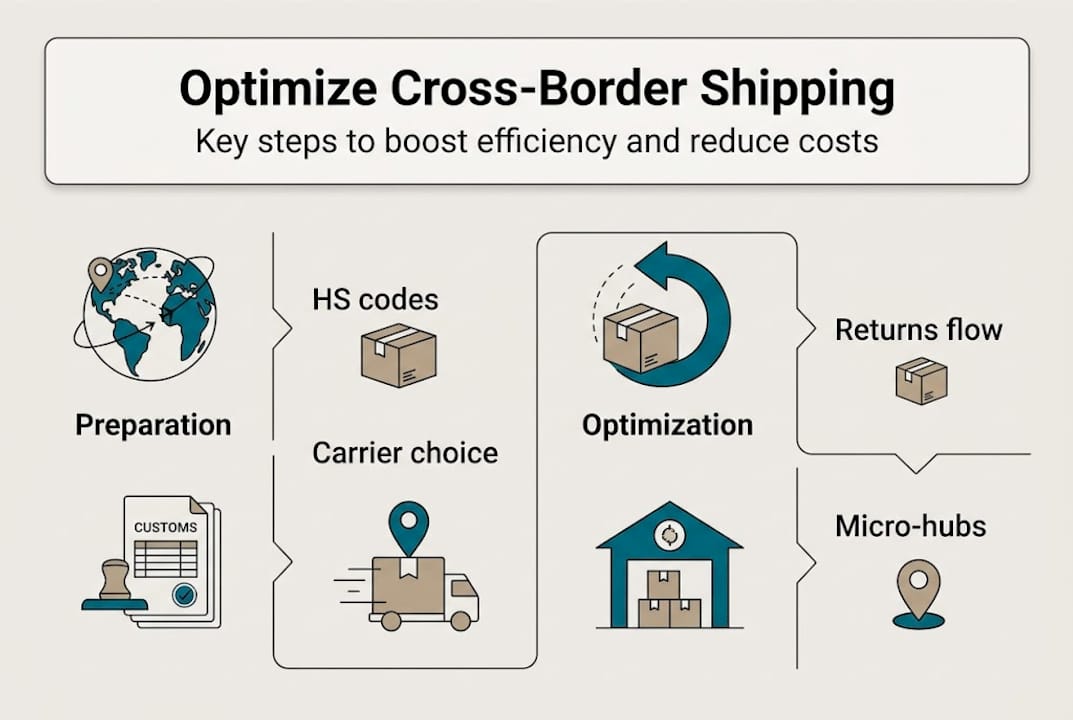
Returns are often the last thing merchants optimize, yet they directly affect repeat purchase rates. A streamlined ability to manage returns efficiently is increasingly a purchase driver for international shoppers, not just a post-sale function. Build it into your value proposition.
When volume justifies it, scale with bonded warehousing and 3PLs in key markets. Review cost reduction strategies to find where consolidation or regional hubs can improve your unit economics. The timing is right. The global cross-border ecommerce market is projected at $7.9 trillion by 2027, with 217 billion parcels shipped annually. The businesses building scalable cross-border infrastructure today are the ones who will capture the largest share of that growth.
Our take: Why most cross-border shipping advice falls short
Most guides on cross-border shipping stop at compliance checklists and carrier comparisons. That is necessary, but it is not sufficient. The merchants we see outperform consistently are doing something different. They are making the logistics process invisible to the customer.
When a buyer in Germany or Japan clicks purchase, they should not think about duties, transit times, or returns complexity. They should just receive a great product on time. Achieving that invisibility requires localizing checkout, automating every document touchpoint, and using 3PL for online retailers with actual regional expertise, not just global coverage on paper.
The contrarian truth is that cross-border shipping is not primarily a logistics problem. It is a customer experience problem that logistics solves. Businesses that frame it that way invest differently. They prioritize predictive delivery windows, local payment methods, and transparent landed costs over simply finding the cheapest carrier. Predictive analytics and multi-carrier strategies are no longer competitive advantages. They are baseline expectations. If you are not there yet, the gap is closing faster than most merchants realize.
Streamline your cross-border shipping with ORNER
If you’re ready to skip trial and error, ORNER’s tools and network make advanced cross-border logistics accessible from day one.
ORNER gives ecommerce businesses end-to-end control over international fulfillment, from reliable courier services and real-time tracking to customs clearance and bonded warehousing. Whether you’re shipping your first pallet overseas or managing high-volume multi-market operations, the platform is built to scale with you. Explore how to master the freight booking process and leverage bonded warehouse solutions to reduce landed costs and improve delivery speed across every lane you serve.
Frequently asked questions
What is the key difference between DDP and DDU for cross-border shipping?
DDP means the seller handles all duties and taxes upfront, while DDU requires the buyer to pay fees upon arrival. DDP achieves 99% delivery success versus just 3% for DDU in high-risk lanes, making it the stronger choice for core markets.
How can I reduce customs delays on international shipments?
Automate your documentation and use verified HS codes for every product category. Automating docs and HS codes cuts customs delays by up to 35%, which compounds into significant time savings at scale.
Why do most international shoppers abandon their carts?
Unclear shipping costs and surprise import duties are the primary drivers of cart abandonment on cross-border orders. Unclear duties and costs consistently rank as the top reasons global shoppers exit before completing checkout.
What is a micro-hub and how does it help my cross-border logistics?
A micro-hub is a local staging facility near your target market that pre-positions inventory for faster, cheaper delivery. Micro-hubs cut costs by 71% and reduce delivery times by 60% compared to shipping directly from your origin country.
When should I switch from DDU to DDP for a market?
Start with DDU when testing a new market at low volume, then transition to DDP as order numbers grow and the lane proves viable. Prioritizing DDP for core markets minimizes refusals and delivers a noticeably better end-customer experience.