Ocean freight moves over 80% of global trade by volume, yet most ecommerce sellers treat it as a last resort rather than a strategic advantage. The assumption is that sea shipping is slow, complicated, and only for giant corporations moving massive volumes. That assumption is costing businesses real money. Whether you sell home goods, apparel, or electronics, understanding how ocean freight works can dramatically reduce your landed costs, improve inventory planning, and give your supply chain a competitive edge. This guide breaks down the essentials so you can make smarter, more confident shipping decisions.
Table of Contents
- Ocean freight basics: Definition, process, and key players
- Types of ocean freight services: FCL, LCL, and special cargo
- Ocean freight vs. other shipping modes: Cost, speed, and decision factors
- The ocean freight journey: Steps, documents, and common challenges
- Choosing and working with a freight forwarder
- A smarter approach to ocean freight in ecommerce logistics
- Expert support for efficient ecommerce shipping
- Frequently asked questions
Key Takeaways
| Point | Details |
|---|---|
| Ocean freight definition | Ocean freight means moving goods internationally by sea, offering lower costs for bulk shipping. |
| Service options | FCL and LCL are main options—choose based on your shipment size and business needs. |
| Ocean freight is cost effective | Shipping by sea is usually the most budget-friendly way to send large quantities worldwide. |
| Freight forwarder value | A reliable freight forwarder simplifies your logistics and can minimize hidden costs and delays. |
Ocean freight basics: Definition, process, and key players
Ocean freight is the movement of goods packed into shipping containers across international sea routes. It is the backbone of global commerce, connecting manufacturers in Asia, Europe, and the Americas to markets worldwide. For ecommerce sellers sourcing products overseas, ocean freight is often the most practical way to move large volumes at a manageable cost.
The process follows a clear sequence. First, you or your freight forwarder books space on a vessel. Then goods are packed, labeled, and transported to the origin port. At the port, containers are loaded onto the ship. During transit, the vessel crosses international waters, sometimes stopping at intermediate ports. On arrival, customs clearance happens at the destination port before the cargo is trucked or railed to its final location. Understanding the documentation basics at each stage helps avoid costly delays.
Several key players make this process work:
- Shippers: The businesses or individuals sending the goods
- Freight forwarders: Agents who coordinate the entire shipment on your behalf
- Ocean carriers: Shipping lines like Maersk, MSC, or COSCO that operate the vessels
- Customs brokers: Specialists who handle import and export compliance
- Port operators: Facilities that load, unload, and temporarily store containers
Understanding the role of freight forwarders is especially important for ecommerce sellers who are new to international shipping. They act as your guide through a complex system.
“Shipping by sea is the most cost-effective mode for bulk goods, making it the preferred choice for global supply chains.”
Pro Tip: Even if you are shipping a relatively small order, ocean freight can beat air freight on cost once your shipment exceeds about 200 kilograms or a cubic meter of volume. Always compare both options before booking.
Common goods shipped via ocean freight include furniture, clothing, electronics, toys, and machinery. Basically, anything that is not time-sensitive and can tolerate a few weeks in transit is a strong candidate for sea shipping.
Types of ocean freight services: FCL, LCL, and special cargo
Not every shipment is the same size, and ocean freight services reflect that reality. Choosing the right service type directly affects your cost, transit time, and risk exposure.
Full Container Load (FCL) means your goods fill an entire container, either a standard 20-foot or 40-foot unit. You pay for the whole container regardless of whether it is completely full. FCL is ideal when you have enough volume to justify it, typically over 15 cubic meters. You get faster handling, lower risk of damage from other cargo, and often quicker customs clearance.
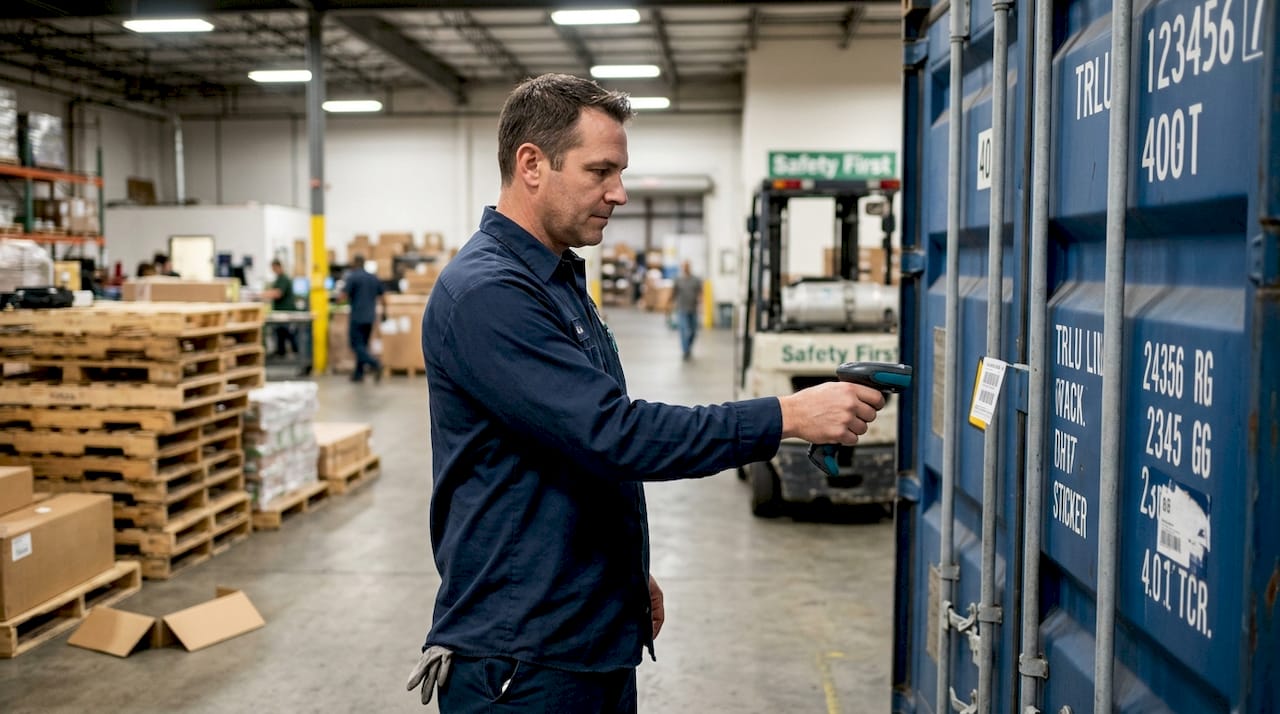
Less than Container Load (LCL) means your goods share container space with shipments from other businesses. You only pay for the space your cargo occupies. Small to midsize businesses often use LCL for cost savings when their shipment volume does not justify a full container.
| Service | Best for | Cost structure | Transit time |
|---|---|---|---|
| FCL | Large, high-volume shipments | Fixed per container | Faster |
| LCL | Smaller, growing businesses | Per cubic meter or weight | Slightly longer |
| Special cargo | Oversized, hazardous, or perishable goods | Custom pricing | Varies |
Special cargo categories include:
- Refrigerated (reefer) containers: For perishables like food or pharmaceuticals
- Flat rack containers: For oversized or oddly shaped items like machinery
- Hazardous cargo: Chemicals or batteries requiring special handling and documentation
- Out-of-gauge cargo: Items that exceed standard container dimensions
For a deeper look at how ocean and air options compare on cost and speed, check out this breakdown of sea freight vs. air freight.
Pro Tip: If you are growing your ecommerce business and your LCL shipments are consistently hitting 12 to 15 cubic meters, it is time to run the numbers on FCL. The price difference often becomes negligible, and you gain speed and reduced handling risk.
Ocean freight vs. other shipping modes: Cost, speed, and decision factors
Every shipping mode has a sweet spot. Ocean freight dominates on cost for heavy or bulky shipments. Air freight wins on speed. Rail and trucking fill regional gaps. Knowing where each mode fits helps you build a smarter logistics strategy.
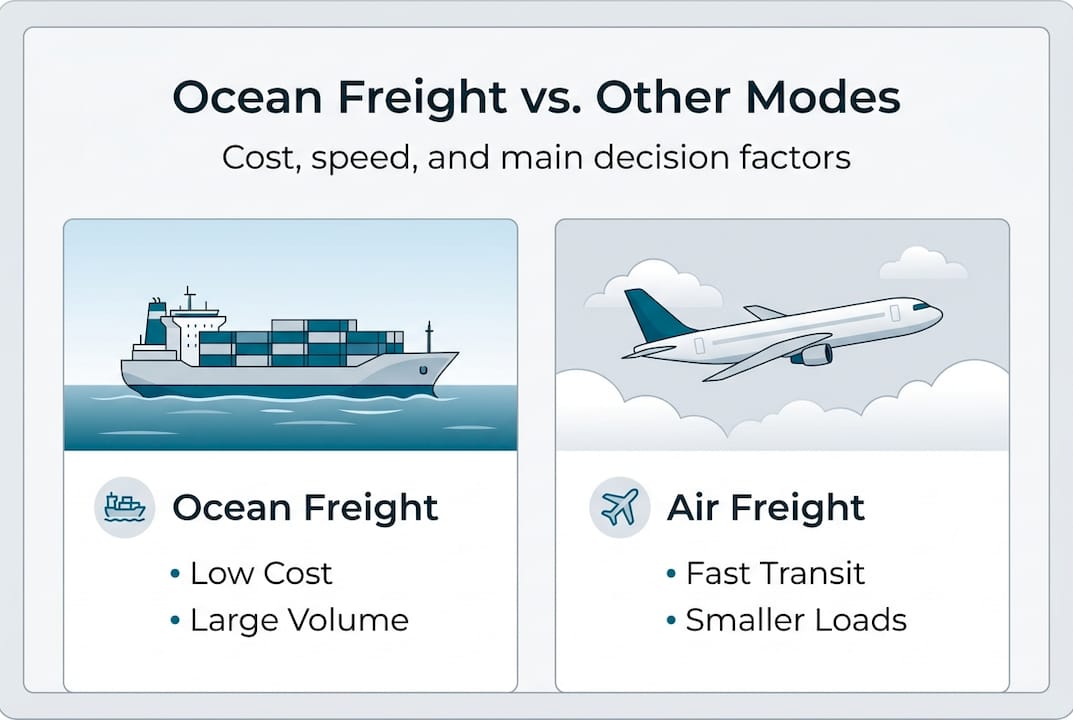
Ocean freight is 3 to 6 times cheaper than air freight for most international lanes. That gap is significant when you are moving thousands of units.
| Shipping mode | Typical transit time | Relative cost | Best use case |
|---|---|---|---|
| Ocean freight | 2 to 6 weeks | Low | Bulk, non-urgent goods |
| Air freight | 3 to 7 days | High | Urgent, high-value items |
| Rail freight | 2 to 4 weeks | Medium | Asia-Europe corridors |
| Road/trucking | 1 to 10 days | Medium | Regional, last-mile delivery |
Key decision factors for ecommerce businesses include:
- Shipment urgency: Is there a product launch or seasonal deadline?
- Product value density: High-value, low-weight goods may justify air freight
- Volume and weight: Heavier, bulkier shipments almost always favor ocean
- Cash flow timing: Longer transit times tie up inventory capital longer
- Carbon footprint: Ocean freight produces significantly less CO2 per ton-mile than air
For a full breakdown of the cost difference with air freight, the numbers often surprise sellers who have only ever used express couriers. And if you want a side-by-side framework, this guide on the best shipping choice comparison walks through real scenarios.
One often-overlooked factor is inventory buffer time. Because ocean freight takes longer, you need to plan your reorder points further in advance. Sellers who master this planning cycle actually gain a competitive advantage by maintaining steadier stock levels and avoiding costly stockouts.
The ocean freight journey: Steps, documents, and common challenges
Knowing the theory is one thing. Executing a real international shipment is another. Here is what the process actually looks like from start to finish.
- Booking: You or your freight forwarder secures space on a vessel and receives a booking confirmation
- Cargo preparation: Goods are packed, palletized, and labeled according to carrier and customs requirements
- Export customs: Your customs broker files export declarations at the origin country
- Port delivery: Cargo is delivered to the origin port and loaded into a container
- Ocean transit: The vessel departs and travels to the destination port, sometimes via transshipment hubs
- Arrival and import customs: Customs clearance happens at the destination port using your shipping documents
- Final delivery: Cargo is released and transported to your warehouse or fulfillment center
The essential documents for ocean freight include the Bill of Lading (proof of contract and ownership), the Commercial Invoice (value and description of goods), and the Packing List (detailed contents of each package). Missing or incorrect documents are one of the top causes of customs holds and delays.
For a thorough walkthrough of the shipping documentation guide and the full ocean freight procedures, these resources cover what to prepare before your first shipment.
“Errors in trade documentation are among the leading causes of shipment delays and unexpected demurrage charges at ports worldwide.”
Pro Tip: Always double-check that the consignee name, address, and HS (Harmonized System) tariff codes on your Commercial Invoice exactly match what your customs broker has on file. A single mismatch can hold your cargo for days.
Common challenges include port congestion, vessel schedule changes, incorrect HS codes, and underinsured cargo. Building buffer time into your delivery schedule and working with an experienced freight forwarder dramatically reduces the impact of these issues.
Choosing and working with a freight forwarder
A freight forwarder is not just a booking agent. They coordinate transport, customs, and compliance on your behalf, acting as a single point of contact for what would otherwise be a complicated web of carriers, port agents, and government agencies.
What a freight forwarder actually does:
- Negotiates rates with ocean carriers on your behalf
- Prepares and files customs documentation
- Tracks your shipment and alerts you to delays
- Arranges cargo insurance
- Consolidates LCL shipments to reduce your costs
- Manages compliance with import and export regulations
What they do not do: they do not take ownership of your goods, and they are not responsible for carrier delays outside their control.
When evaluating a forwarder, ask these questions:
- Do they specialize in your trade lane or product category?
- What technology do they use for tracking and communication?
- Can they provide references from ecommerce clients?
- How do they handle exceptions and delays?
- What are their fees, and are there hidden surcharges?
For sellers looking to cut shipping costs without sacrificing reliability, the right forwarder relationship is often more valuable than chasing the lowest spot rate. This import forwarder guide is a practical starting point for ecommerce businesses building their first forwarding partnership.
Pro Tip: Ask your forwarder for a Named Account Manager, not just a general support inbox. A dedicated contact who knows your shipment history will resolve problems faster and catch issues before they escalate.
A smarter approach to ocean freight in ecommerce logistics
Here is the uncomfortable truth most logistics articles skip: the businesses that struggle most with ocean freight are not struggling because of high rates. They are struggling because they treat shipping as an afterthought rather than a core business function.
Many ecommerce sellers spend hours optimizing their product listings but book freight with whoever offers the cheapest quote that week. That approach ignores total landed cost, which includes duties, port fees, demurrage, and the hidden cost of delayed inventory.
The sellers who scale smoothly invest in logistics expertise early. They build relationships with forwarders who understand their product categories. They use platforms with real-time visibility so they can react to delays before they become stockouts. They understand that a slightly higher freight rate from a reliable partner often costs less in the long run than a cheap rate from an unreliable one.
Transparency and proactive planning add more value than cost-cutting. Knowing where your cargo is, when it will arrive, and what documentation is pending gives you control. Understanding the full leveraging forwarders for success framework is where that control begins. Build your supply chain around visibility and reliability, and the cost savings will follow naturally.
Expert support for efficient ecommerce shipping
For sellers ready to improve their ocean freight and logistics outcomes, reliable partners make all the difference. Navigating carriers, customs, and documentation on your own is time-consuming and error-prone.
Orner’s platform is built specifically for ecommerce businesses that need scalable, transparent, and reliable logistics solutions. From freight booking to real-time tracking and customs clearance, every tool is designed to give you visibility and control over your shipments. Whether you are shipping FCL from Asia or managing LCL consolidations across multiple suppliers, Orner’s end-to-end logistics solutions connect your supply chain from origin to customer doorstep. Explore the full range of global logistics services and see how a smarter logistics partner can reduce your total shipping costs while improving delivery reliability.
Frequently asked questions
What is the difference between FCL and LCL in ocean freight?
FCL means your goods fill an entire container, giving you exclusive use of that space. LCL means your cargo shares container space with other shipments, and you only pay for the volume you use. Small to midsize businesses frequently choose LCL to keep costs manageable when volumes are low.
How long does an ocean freight shipment usually take?
Transit times for ocean freight typically range from 2 to 6 weeks depending on the origin and destination ports, the carrier’s schedule, and current port congestion levels. Always build buffer time into your inventory planning.
What documents do I need for an ocean freight shipment?
The three core documents in international trade are the Bill of Lading, Commercial Invoice, and Packing List. Additional documents like certificates of origin or import licenses may be required depending on the product type and destination country.
Is ocean freight always cheaper than air freight?
Ocean freight is 3 to 6 times cheaper than air freight for most international routes, making it the default choice for bulk shipments. Air freight is worth the premium only when speed is critical or when goods have very high value relative to their weight.