
TL;DR:
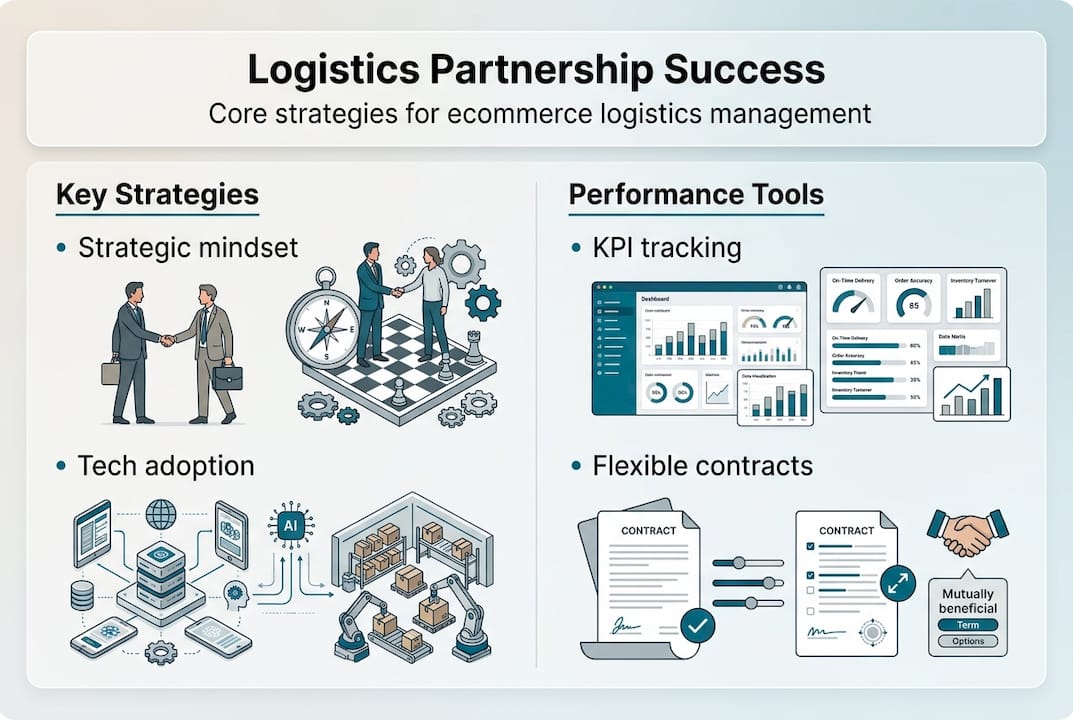
- Treat logistics partners as strategic extensions to build shared goals and trust.
- Leverage technology like WMS, OMS, and open APIs for transparency and automation.
- Monitor KPIs continuously and negotiate flexible contracts to adapt to growth and disruptions.
Most ecommerce businesses treat their third-party logistics providers like a utility bill: pay it, ignore it, and only call when something breaks. That mindset is expensive. The global 3PL market is projected to reach $3.62 trillion by 2034, yet most of the value gets left on the table because sellers manage partners reactively instead of strategically. The businesses that pull ahead are the ones treating logistics relationships as a core competitive advantage. In this article, we cover the exact strategies that turn a standard vendor arrangement into a high-performing logistics partnership.
Table of Contents
- Build strategic partnerships, not just vendor relationships
- Leverage technology for transparency and automation
- Monitor performance with actionable KPIs and scorecards
- Negotiate flexible contracts and address edge cases proactively
- What most logistics managers overlook about partnership success
- Take your logistics partnerships to the next level with ORNER
- Frequently asked questions
Key Takeaways
| Point | Details |
|---|---|
| Partnership mindset | Treating logistics partners as strategic allies promotes trust and shared success. |
| Tech-driven efficiency | Integrating technology platforms with partners increases transparency and accuracy. |
| KPI and contract rigor | Monitoring performance and negotiating flexible contracts enable ongoing improvement and risk management. |
| Contingency planning | Preparing for disruptions and peak periods ensures your logistics remain resilient. |
Build strategic partnerships, not just vendor relationships
The single biggest shift you can make in logistics management costs nothing upfront: change how you think about your partners. Most ecommerce operators approach 3PLs with a buyer-seller mentality. You pay, they ship. When something goes wrong, you complain. That cycle keeps both sides defensive and prevents the kind of collaboration that actually improves performance.
Viewing your 3PL as a strategic extension of your own operation, rather than an outside vendor, changes everything. Shared goals replace competing incentives. Collaborative risk management replaces blame. Trust replaces suspicion. These are not soft concepts; they directly affect fill rates, delivery times, and cost per order.
Here is what a genuine partnership looks like in practice:
- Shared performance goals tied to outcomes both sides care about, not just SLA checkboxes
- Transparent communication about volume forecasts, seasonal spikes, and product changes well in advance
- Joint problem-solving sessions when disruptions occur, rather than escalating finger-pointing
- Regular cadence reviews to assess what is working and what needs adjustment
Structured communication through weekly, monthly, and quarterly reviews, combined with dedicated account managers and shared technology platforms, creates the real-time visibility that prevents small issues from becoming costly failures. When both sides can see the same data, trust builds faster.
“The most resilient logistics networks are built on relationships, not just contracts. When your 3PL understands your growth plans, they can prepare for them with you.”
Pro Tip: Assign a dedicated internal account manager whose sole responsibility is the logistics partner relationship. This person owns communication, escalations, and quarterly reviews. It sounds simple, but most businesses skip it, and that gap is where misalignment quietly grows.
If you are just starting to think about partnering with logistics providers, it helps to understand what a healthy relationship structure looks like before you sign anything. Getting supplier relationship strategies right from the start is far easier than trying to fix a broken dynamic later.
Leverage technology for transparency and automation
A strong partnership is just the foundation. Transparency and speed come next, and that is where technology steps in.

The right tech stack eliminates the guesswork that causes delays, errors, and customer complaints. A Warehouse Management System (WMS) controls inventory movement inside the fulfillment center. An Order Management System (OMS) routes orders to the right node based on proximity, stock, and carrier availability. Open APIs connect your ecommerce platform directly to your 3PL, removing manual handoffs and the errors that come with them.
Providers with open APIs and AI-driven demand forecasting give you a structural advantage. AI forecasting predicts demand spikes before they happen, so your 3PL can pre-position inventory rather than scrambling to catch up. That shift from reactive to proactive is exactly what Gartner identifies as the hallmark of mature supply chain operations.
| Technology | Primary benefit | Impact on logistics |
|---|---|---|
| WMS | Inventory accuracy | Reduces pick errors and shrinkage |
| OMS | Order routing | Faster fulfillment and lower shipping cost |
| Open API | System integration | Eliminates manual data entry |
| AI forecasting | Demand prediction | Reduces stockouts and overstock |
| Real-time dashboards | Visibility | Faster issue detection and resolution |
Pro Tip: Require shared dashboard access as a non-negotiable in your 3PL contract. If your partner cannot give you real-time visibility into inventory levels, order status, and exception alerts, you are flying blind. Good shipment tracking software should surface problems before your customers do.
Beyond tracking, order tracking technology also improves the customer experience directly, reducing inbound support tickets and increasing repeat purchase rates. That is a downstream benefit most logistics managers undervalue.
Monitor performance with actionable KPIs and scorecards
Equipped with the right tools, quantifying success is the next step. You cannot manage what you do not measure, and in logistics, vague performance reviews lead to vague results.
The metrics that matter most for ecommerce logistics partners are:
- Order accuracy: Target 99% or higher. Errors here cost you in returns, reshipping, and customer trust.
- On-time delivery rate: Target 95% or higher. This is the metric your customers feel most directly.
- Dock-to-stock time: Target under 48 hours. Slow receiving creates invisible inventory gaps.
- Perfect order rate: Target 95% or higher. This composite metric captures accuracy, timeliness, and condition together.
- Inventory turnover: Target 8 to 12 times per year. Low turnover signals overstock; high turnover signals risk of stockout.
Tracking these KPIs continuously and reviewing them on a structured scorecard gives you an objective basis for partner conversations. Scorecards remove emotion from performance discussions and make it easier to identify trends before they become problems.
| KPI | Baseline performance | Best-in-class target |
|---|---|---|
| Order accuracy | 95% | 99%+ |
| On-time delivery | 85% | 95%+ |
| Dock-to-stock time | 72 hours | Under 48 hours |
| Perfect order rate | 88% | 95%+ |
| Inventory turnover | 4-6x per year | 8-12x per year |
Benchmarking is not just an internal exercise. Henkel saved $1.5 million through systematic benchmarking of its logistics operations, proving that comparing your performance against industry standards reveals opportunities that internal reviews miss.
For a deeper look at what these numbers mean in practice, explore logistics KPI examples and pair them with a solid vendor management guide to build your review process.
Negotiate flexible contracts and address edge cases proactively
With KPIs spotlighting opportunities and gaps, adaptability in your contracts becomes vital for navigating growth and uncertainty.
Rigid long-term logistics contracts are one of the most common traps ecommerce businesses fall into. You lock in pricing and terms when volumes are low, then find yourself unable to renegotiate when your business scales or market conditions shift. Flexible contracts protect you from that scenario.
Key elements to negotiate into every logistics contract:
- Success-based pricing tiers that reward volume growth with better rates
- 60 to 90 day exit clauses so you are never trapped with an underperforming partner
- Clear data ownership terms ensuring your inventory, order, and customer data stays yours
- Rights to add or remove fulfillment nodes as your geographic footprint changes
Flexible multi-node networks can reduce shipping costs by 15% by positioning inventory closer to your customers. That is not a small number. It compounds across every order you ship.
“Contracts should be written for the business you are becoming, not the business you are today.”
Edge cases are where unprepared businesses lose the most. Gartner recommends proactive contingency planning for scenarios including peak season volume surges, labor shortages, and supply chain disruptions. A business continuity plan (BCP) agreed upon with your 3PL before a crisis hits is worth far more than any reactive scramble during one.
Pro Tip: Negotiate the right to add or remove fulfillment nodes in your network as your order volume changes. This single clause gives you the flexibility to scale up during peak periods and pull back during slower months without penalty.
For practical guidance on handling peak season logistics, reverse logistics strategies, and overcoming logistics challenges, build your contingency playbook before you need it.
What most logistics managers overlook about partnership success
Here is the uncomfortable truth: you can implement every framework in this article, deploy the best technology, and still have a logistics partnership that underperforms. The reason is almost always the same. Trust broke down somewhere, and neither side addressed it directly.
Processes and technology are necessary. But they are not sufficient. The most resilient 3PL relationships are built on shared goals and collaborative risk management, not just contractual obligations. When expectations are misaligned, no dashboard or scorecard catches it fast enough to prevent damage.
The costliest logistics failures we see are not system errors or carrier delays. They are communication breakdowns that were visible weeks before the crisis but never surfaced because neither side felt safe raising the issue. That is a culture problem, not a process problem.
Investing in genuine strategic alignment, meaning regular honest conversations about what is working and what is not, consistently outperforms businesses that rely purely on metrics and SLAs. If you want effective logistics partnerships that hold up under pressure, build the relationship first. The systems support it; they do not replace it.
Take your logistics partnerships to the next level with ORNER
Ready to translate these strategies into results? ORNER is built specifically for ecommerce businesses that want more than a basic shipping arrangement.
Whether you are evaluating reliable courier services for the first time or optimizing an existing network, ORNER gives you the tools and visibility to make smarter decisions. Explore freight booking options that scale with your volume, and put the inventory management tips in this article into practice with a platform designed for real ecommerce operations. From real-time tracking to cross-border fulfillment, ORNER supports every layer of your logistics strategy.
Frequently asked questions
What are the most important KPIs to track for logistics partners?
Order accuracy, on-time delivery, dock-to-stock time, and inventory turnover are the most crucial KPIs for effective logistics partner performance. Tracking these consistently gives you an objective basis for partner reviews and continuous improvement.
How does technology improve communication with logistics partners?
WMS, OMS, and open API integrations enable real-time tracking, shared dashboards, and faster issue resolution for transparent communication and streamlined operations. Shared visibility removes the information gaps that cause most partner disputes.
What clauses should you include in a logistics contract?
Include success-based tiers, 60-90 day exit clauses, clear data ownership, and options for multi-node networks to protect your operation during changes. These terms give you flexibility without sacrificing accountability.
How can logistics managers handle disruptions and peak season effectively?
Use multi-3PL or 4PL networks, automation for labor shortages, rapid returns processing, and proactive contingency planning. Building your business continuity plan before disruptions occur is the single most effective preparation step.