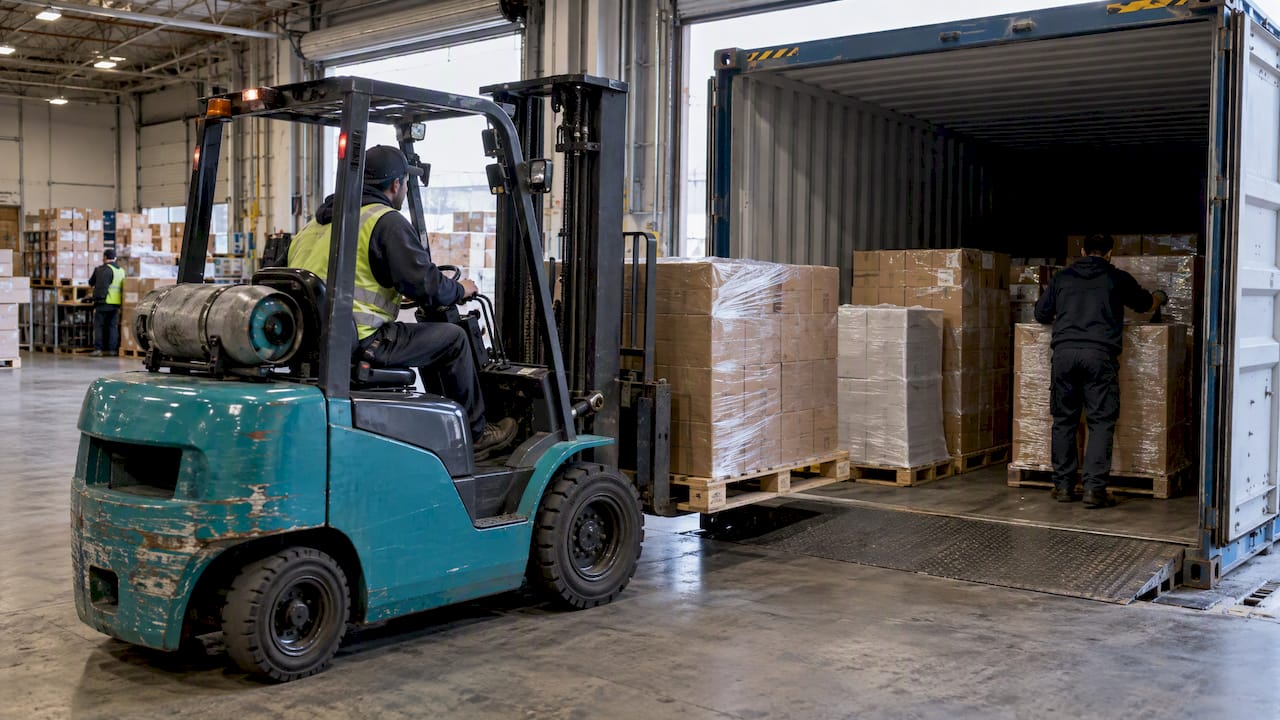
Before you book a single container, run this five-step check: confirm your inventory need date, calculate total landed cost (not just the freight rate), decide FCL vs. LCL based on volume and urgency, verify container availability on your target trade lane, and assign a single owner for tracking and escalation. That sequence, anchored to a tariff-date calendar that maps each shipment against duty exposure and warehouse headroom, is the core of sound ocean freight planning for manufacturers.
- Confirm inventory need date and work backward to booking cutoff
- Calculate total landed cost: freight + duties + demurrage risk + inventory carrying cost
- Decide FCL or LCL based on volume, urgency, and SKU fragility
- Verify container availability and schedule reliability on the target lane
- Assign one person as tracking and escalation owner before the booking is confirmed
Within 24 hours: pull your top five SKUs by import volume, run a landed-cost estimate for each, and flag any shipment where demurrage or storage risk exceeds 10% of the freight rate.
Table of Contents
- What ocean freight planning actually means for manufacturers
- Should you use FCL, LCL, or something in between?
- Who owns what: the responsibility map
- Documents you need and the compliance traps that cost you
- What actually drives your freight cost (and how to calculate landed cost)
- How to set reorder points and buffer stock around ocean transit
- How to choose a freight forwarder that won’t cost you more in exceptions
- Packing and container loading rules that reduce damage and detention
- Set up tracking milestones and an escalation playbook
- Common ocean freight risks and how to mitigate them
- Why total landed cost modeling changes which lanes and carriers you choose
- Key Takeaways
- What most manufacturers get wrong about ocean freight planning
- Or-ner gives manufacturers end-to-end freight visibility without the complexity
- Useful sources and templates to consult next
- FAQ
What ocean freight planning actually means for manufacturers
Ocean freight is not just a transportation decision. For manufacturers, it sits at the intersection of procurement, production scheduling, finance, and warehousing — and a misstep in any one of those dimensions shows up as a line stoppage or a cash flow problem.
The mode makes sense when you are moving large volumes of components or finished goods where cost per unit matters more than speed. Production replenishment from overseas suppliers, seasonal stock builds ahead of peak demand, and long-lead-time components (tooling, raw materials, specialty electronics) are the clearest use cases. Air freight is faster, but at three to five times the cost per kilogram, it is rarely defensible for high-volume moves.
Planning, in this context, means aligning purchase order release dates, supplier lead times, booking windows, transit estimates, customs clearance timelines, and warehouse receiving capacity into a single coherent schedule. When those elements are managed separately, you get the classic failure mode: cargo arrives at port, warehouse is full, demurrage clock starts ticking.
Should you use FCL, LCL, or something in between?
The choice between Full Container Load and Less than Container Load is primarily a volume and reliability question, not just a cost question.

| Dimension | FCL | LCL |
|---|---|---|
| Minimum volume | Typically a volume threshold is required to justify cost | Cost-effective below 15 CBM |
| Transit reliability | Higher — dedicated container | Lower — consolidation adds 3–7 days |
| Damage risk | Lower — no co-loading | Higher — multiple handlers |
| Customs clearance | Single entry per container | May share entry with co-loaders |
| Best for manufacturers | Production replenishment, full-pallet moves | Sample shipments, partial orders, new SKU trials |
Door-to-door service (where the forwarder manages inland pickup at origin and delivery at destination) reduces handoff risk but costs more. Port-to-port is cheaper and gives you direct control over drayage, which matters if you have a preferred inland carrier or a bonded warehouse relationship. For most manufacturers, door-to-port is the practical middle ground: the forwarder handles origin complexity, and you control the domestic leg.
Pro Tip: In volatile markets, split large bookings into lots under 2–4 TEUs across multiple bills of lading. Carriers are more likely to load smaller, manageable lots, and you insulate your production schedule from a single block-roll wiping out a month of components.
Who owns what: the responsibility map
Getting clear on roles before a shipment moves prevents the most expensive arguments — the ones that happen after something goes wrong.
| Participant | Primary role | Owns |
|---|---|---|
| Shipper (manufacturer) | Cargo owner and export compliance | Export docs, packing, Incoterms selection |
| Freight forwarder | Booking and coordination | Space booking, BL issuance, carrier liaison |
| Ocean carrier | Physical transport | Vessel schedule, container condition, transit |
| Customs broker | Regulatory clearance | HTS classification, duty payment, CBP entry |
| NVOCC | Consolidation and BL issuance | LCL consolidation, house BL, rate negotiation |
The handoffs manufacturers most often fail to formalize: who escalates when a vessel rolls a booking, who approves a reroute when a port is congested, and who has authority to release a customs hold. Write those three escalation owners into your forwarder SLA before the first shipment moves.
Documents you need and the compliance traps that cost you
A clean documentation package is the difference between a container that clears in hours and one that sits for days. Here is the core checklist:
- Commercial invoice: buyer/seller details, HS/HTS code per line item, unit price, total value, currency, Incoterms, country of origin
- Packing list: gross and net weight per carton, dimensions, number of packages, marks and numbers matching the BL
- Bill of lading (BL): issued by carrier or NVOCC; confirm consignee, notify party, and port of discharge match the invoice exactly
- Certificate of origin: required for preferential duty rates under trade agreements (USMCA, etc.); must be issued by an authorized body
- Export license: required for controlled commodities; check the Commerce Control List before booking
- Special certificates: phytosanitary, fumigation, or product-specific certificates depending on commodity and destination
The three compliance traps that generate the most delays and fines: mis-declared country of origin (especially for goods with components from multiple countries), wrong HTS code (a four-digit error can mean a 25% duty difference), and missing or mismatched signatures between documents.
Pro Tip: An estimated $7 billion in import duties goes unclaimed annually under U.S. duty drawback programs. If you export finished goods that incorporate imported components, have your trade compliance team evaluate drawback eligibility before the next fiscal year closes.
What actually drives your freight cost (and how to calculate landed cost)
The headline freight rate is the smallest part of the story. Here are the cost components that determine whether a shipment is actually profitable:
- Base ocean freight rate (per TEU or CBM/ton)
- Bunker Adjustment Factor (BAF) / Peak Season Surcharge (PSS) — can add 15–40% to base rate during demand spikes
- Terminal handling charges (THC) at origin and destination
- Drayage — inland truck move from factory to port or port to warehouse
- Customs duties and taxes — calculated on customs value, not freight value
- Demurrage and detention — charged when containers sit beyond free time at port or inland
- Storage — warehouse holding cost if cargo arrives before receiving window opens
- Cargo insurance — typically 0.1–0.5% of cargo value
- Inventory carrying cost — the capital tied up in goods while they are in transit
- Cost of capital — opportunity cost of cash committed to in-transit inventory
Total landed cost models that factor in all ten components are what separate manufacturers who win on margin from those who win on rate sheets. A carrier offering $200 less per TEU but with a 15% higher rolling rate can easily cost $800 more per shipment once you account for a single demurrage event.
Pro Tip: When evaluating carrier bids, add a line to your scorecard for “estimated demurrage exposure per shipment” based on the carrier’s historical on-time performance at your destination port. A $300 rate difference disappears after one four-day port hold.
How to set reorder points and buffer stock around ocean transit
Transit times vary significantly by trade lane, and the variance matters as much as the average. Use these ranges as planning inputs, not guarantees:
| Trade lane | Typical transit (port to port) | Planning buffer to add |
|---|---|---|
| China to U.S. West Coast | 14–20 days | 7–10 days |
| China to U.S. East Coast | 28–34 days | 10–14 days |
| Europe to U.S. East Coast | 10–15 days | 5–7 days |
| Southeast Asia to U.S. West Coast | 18–24 days | 7–10 days |
| India to U.S. East Coast | 22–29 days | 7–10 days |
Note that rerouting around chokepoints like the Cape of Good Hope adds roughly 10–14 days to schedules and tightens equipment cycles — factor that into your safety stock calculation when geopolitical risk is elevated on a lane.
Your reorder point should equal average daily usage multiplied by total lead time (supplier production + transit + customs + inland delivery + receiving). The transit-to-delivery gap is where most planners underestimate: port-to-warehouse can add 3–7 days beyond vessel arrival.
- Use a tariff-date calendar to map each shipment against duty regime, inventory need date, and warehouse capacity
- Align purchase order release dates with booking cutoff windows (typically 2–3 weeks before sailing)
- Coordinate warehouse receiving windows with expected arrival dates to avoid storage overflow
How to choose a freight forwarder that won’t cost you more in exceptions
The right forwarder saves you more in exception management than they ever will on headline rates. Evaluate on these criteria:
- Schedule reliability data: ask for their carrier on-time performance by trade lane, not just a general claim
- Customs expertise: do they have licensed customs brokers in-house, or do they outsource? Who handles a CBP hold at 5 PM on a Friday?
- Visibility tools: can they provide milestone tracking, predictive ETAs, and automated exception alerts? Providers investing in digital capabilities improve planning rather than just reporting status after the fact
- Claims performance: what is their average claims resolution time? Ask for a reference from a manufacturer in your industry
- Contracting flexibility: balanced contracting — part contracted volume, part spot access — hedges cost volatility while preserving capacity options
Red flags: a forwarder who cannot name their top three carriers by lane, who has no in-house customs capability, or who quotes only on rate without asking about your production schedule or warehouse constraints.
For a deeper look at ocean freight forwarding structures and what to expect from a U.S.-focused forwarder, Or-ner’s guide covers the service model in practical terms.
Packing and container loading rules that reduce damage and detention
How cargo is packed and loaded directly affects claims rates, stuffing speed, and how quickly a container can be released at destination.
- Unitize on standard pallets (GMA 48"×40" for U.S. domestic; ISO for export) and wrap with stretch film rated for ocean humidity
- Distribute weight evenly: heaviest cartons on the bottom, no single stack exceeding the pallet’s rated load
- Use dunnage bags or blocking to fill void space and prevent load shift during vessel roll
- Label every pallet with: PO number, SKU, carton count, gross weight, destination, and the BL number once issued
- Maximize cubic efficiency: a container that is 60% utilized costs the same as one at 90% — work with your forwarder on load planning before stuffing begins
- Pre-stuffing audit: have a supervisor sign off on the load plan and photograph the loaded container before sealing
- Record the container seal number on the packing list and verify it matches at destination
Pro Tip: Request a container inspection report (condition check) before stuffing begins. A damaged container floor or corroded walls discovered after loading creates a claims dispute that takes months to resolve.
Set up tracking milestones and an escalation playbook
Visibility is only useful if someone acts on it. Build a monitoring checklist with named owners for each milestone:
- Booking confirmed: forwarder sends booking confirmation with vessel name and voyage number
- Cargo received at CFS/CY: origin agent confirms cargo in at container freight station or container yard
- Bill of lading issued: review all fields before vessel departure; corrections after sailing are expensive
- Vessel departed: start the transit clock; flag any ETA deviation beyond 48 hours
- Vessel arrived at transshipment port (if applicable): confirm onward connection is booked
- Vessel arrived at destination port: trigger customs broker to file entry if not pre-filed
- Customs released: confirm free time start date and calculate demurrage deadline
- Cargo available for pickup / inland delivery confirmed: close the shipment record
Escalation thresholds: a 48-hour ETA deviation triggers a forwarder call; a customs hold beyond 24 hours triggers a direct call to the customs broker and a notification to production planning. Freight platforms using AI to predict port congestion and recommend reroutes give you that 48-hour window to act rather than react. A transportation management system (TMS), a carrier portal, or a digital freight platform like Or-ner’s freight booking platform can automate milestone alerts so the escalation playbook runs without manual checking.
Common ocean freight risks and how to mitigate them
| Risk | Mitigation |
|---|---|
| Demurrage / detention | Negotiate free time in contracts; assign a port agent to monitor container availability |
| Port congestion | Book on carriers with multiple port rotation options; monitor congestion indices weekly |
| Carrier rolling (bumped bookings) | Keep lots under 2–4 TEUs; split across multiple BLs; use a forwarder with guaranteed space contracts |
| Documentation errors | Use a pre-shipment document checklist with a dual-review step before cargo is tendered |
| Geopolitical disruption | Maintain at least one alternate routing option per lane; review contingency routes quarterly |
On contracting: fixed contracts without surcharge flexibility can reduce your space allocation priority when capacity tightens. Ask for a clause that preserves your booking priority during peak periods in exchange for volume commitments, rather than accepting a flat rate-only contract.
For a structured approach to supply chain risk management, Or-ner’s guide maps risk categories to specific mitigation steps manufacturers can implement across procurement and operations.
Why total landed cost modeling changes which lanes and carriers you choose
The research-backed competitive advantage in ocean freight is not finding the lowest rate. It is building a total landed cost model that includes inventory carrying cost and demurrage exposure alongside the freight rate — and using that model to score carriers and lanes.
Here is a simplified comparison of two service options on the same China-to-U.S. East Coast lane:
| Cost component | Option A (lower rate) | Option B (higher rate) |
|---|---|---|
| Base freight per TEU | $3,000 | $3,000 |
| BAF / surcharges | $300 | $300 |
| Estimated demurrage risk | $600 (rolling rate ~ 15%) | $150 (rolling rate ~ 4%) |
| Inventory carrying cost (30-day transit) | $300 | $0 |
| Total landed cost per TEU | $4,500 | $4,000 |
Option B costs $300 more on the rate sheet and $430 less in total. That gap widens with volume.
Pro Tip: Add a “total landed cost per TEU” column to your carrier scorecard and update it quarterly. Integrate the output into your procurement review so rate negotiations start from landed cost, not base rate.
Key Takeaways
Effective ocean freight planning for manufacturers requires total landed cost thinking, tariff-date calendars, and smaller-lot booking tactics that protect production schedules from carrier rollings and port delays.
| Point | Details |
|---|---|
| Run landed cost before booking | Include freight, duties, demurrage risk, and inventory carrying cost — not just the base rate. |
| Use a tariff-date calendar | Map each shipment against duty exposure, inventory need date, and warehouse capacity to avoid costly frontloading. |
| Split large lots | Keep bookings under 2–4 TEUs across multiple BLs to increase loading probability and reduce block-roll risk. |
| Assign escalation owners | Name a single owner for tracking and escalation before the booking is confirmed, with defined thresholds (48-hour ETA deviation, 24-hour customs hold). |
| Or-ner for integrated visibility | Or-ner’s platform connects freight booking, milestone tracking, customs workflows, and landed-cost tools in one place for manufacturers managing cross-border shipments. |
What most manufacturers get wrong about ocean freight planning
The conventional wisdom says the goal is to get the lowest freight rate. That framing causes more production outages than any carrier ever will.
The manufacturers who consistently avoid line stoppages are not the ones with the best rate contracts. They are the ones who treat ocean freight as a production input with a lead time, a variance, and a cost of failure — and plan accordingly. When a vessel rolls a booking, the question is not “why did the carrier do that?” It is “why did we have only one booking on that vessel for that component?”
The tariff-date calendar is the most underused tool in manufacturing logistics. Most teams know their sailing dates. Far fewer have mapped those dates against their duty regime, their warehouse receiving window, and their production line’s actual need date. That mapping is what turns a panic frontload into a deliberate decision — or reveals that the frontload is unnecessary and would just create a storage bill.
The other thing planners consistently underestimate is the transit-to-delivery gap. A vessel arriving at Long Beach on day 28 does not mean components are on the production floor on day 29. Customs clearance, drayage scheduling, and warehouse receiving can add additional days. Build that into your reorder point, not your safety stock.
Or-ner gives manufacturers end-to-end freight visibility without the complexity
Manufacturers applying the planning framework in this article need one thing most logistics setups do not provide: a single place where freight booking, milestone tracking, customs workflows, and landed-cost data live together. Coordinating those across separate tools, email threads, and carrier portals is where exceptions get missed and demurrage clocks run unnoticed.
Or-ner’s global logistics platform connects freight booking, real-time shipment tracking, customs clearance, and warehousing in one interface built for manufacturers and supply chain teams managing cross-border volume. You get milestone alerts, exception management, and the visibility data you need to run the escalation playbook described above — without stitching together five separate systems. For manufacturers ready to move from rate-focused procurement to total landed cost management, Or-ner’s reliable courier and logistics services are the practical next step. Request a platform walkthrough to see how it maps to your current trade lanes and shipment volume.
Useful sources and templates to consult next
The following resources support the recommendations in this article and are worth bookmarking for your trade compliance and logistics teams:
- U.S. Customs and Border Protection (CBP): cbp.gov — authoritative source for HTS classification, duty rates, and entry procedures
- U.S. Census Bureau AES (Automated Export System): required for export filings above $2,500 per Schedule B commodity; access via ACE portal
- USITC Harmonized Tariff Schedule: usitc.gov/tata/hts — use to verify HTS codes before every new product shipment
- Duty drawback programs: CBP’s drawback center handles manufacturing drawback, substitution drawback, and rejected merchandise claims; an estimated $7 billion in duties goes unclaimed annually — evaluate eligibility with a licensed customs broker
- Tariff-date calendar template: adapt the framework from the tariff-date calendar guide to map sailing dates, duty regimes, inventory need dates, and warehouse capacity for each active lane
- Or-ner ocean freight documentation guide: covers packing list fields, BL review checklist, and certificate of origin requirements for U.S. importers — available at or-ner.com/ocean-freight-documentation-guide-2025
- Or-ner freight procurement strategies guide: covers carrier scorecarding and landed-cost integration for procurement teams — at or-ner.com/freight-procurement-strategies-that-cut-costs-in-2026
Coordinate any template adaptations with your trade compliance officer before applying them to live shipments. Regulatory requirements change, and a template built for one commodity or trade lane may not transfer cleanly to another.
FAQ
What is the first step in ocean freight planning for manufacturers?
Confirm your inventory need date and work backward to the booking cutoff, then calculate total landed cost before selecting a carrier or service type. That sequence prevents the two most common errors: booking too late and choosing on rate alone.
When does FCL make more sense than LCL for a manufacturer?
FCL is generally more cost-effective and reliable above 15 CBM per shipment. Below that threshold, LCL consolidation is cheaper, but adds 3–7 days of transit time and higher damage risk from co-loading.
How much buffer time should manufacturers add to ocean transit estimates?
Add 7–14 days of planning buffer beyond the port-to-port transit time, depending on the trade lane. That buffer covers customs clearance, drayage, and warehouse receiving — the transit-to-delivery gap that most reorder point calculations miss.
What documents are required for a U.S. ocean import shipment?
At minimum: commercial invoice, packing list, bill of lading, and CBP entry filing. Depending on the commodity, you may also need a certificate of origin, export license, or product-specific certificates (phytosanitary, fumigation).
How does Or-ner support manufacturers with ocean freight planning?
Or-ner’s platform combines freight booking, real-time milestone tracking, customs clearance workflows, and warehousing in one interface, giving manufacturing teams the visibility and exception management they need to apply total landed cost thinking across active trade lanes.