Cross-border e-commerce logistics is the combined workflow of carriers, customs compliance, and technology that moves an order from a warehouse in one country to a customer’s door in another, at a landed cost you calculate correctly before checkout. The single operational imperative for 2026 is to build that as three separate layers, carrier, compliance, technology, before order volume forces the issue, and to show true landed cost at checkout rather than surprising the customer at the border. Skip this and you inherit duplicated costs, customs delays, and abandoned carts.
TL;DR:
- Most brands fail to treat cross-border logistics as three separate layers: carrier, compliance, and technology, which leads to duplicated costs and delays.
- Launching into new international markets requires evaluating demand, regulatory complexity, and carrier reliability before investing resources.
- Accurate landed cost calculation using DDP models and regular HS code audits are essential to prevent customs holds and reduce customer disputes.
- Building a multi-carrier network with performance thresholds and failover options ensures reliable, on-time delivery across diverse markets.
- Implementing integrated platforms that manage freight, customs, and inventory synchronization can prevent shipment issues before they impact customers.
Table of Contents
- What Is Cross-Border E-Commerce Logistics, Structurally?
- Which International Markets Should You Launch First?
- How Do You Calculate True Landed Cost?
- How Should You Structure Your Carrier Network?
- When Do You Need Distributed Warehousing or Bonded Storage?
- What Actually Lowers International Return Costs?
- Which Tools Make Cross-Border Logistics Actually Reliable?
- Which KPIs Signal It’s Time to Change Your Strategy?
- How Or-ner Supports Each Layer of the Model
- Ready to Pressure-Test Your Own Cross-Border Setup?
- The Real Bottleneck Isn’t Shipping, It’s Sequencing
- Sources
- FAQ
What Is Cross-Border E-Commerce Logistics, Structurally?
The mistake most growing brands make is treating international shipping as a bigger version of domestic shipping. It isn’t. It’s three distinct operational layers bolted together, and when a business collapses them into one team or one vendor, costs duplicate and errors multiply, according to Ecommerce Times’ analysis of scalable cross-border operations.
- Carrier layer: physical movement, from origin pickup through customs handoff to last-mile delivery.
- Compliance layer: customs entry, brokerage, VAT/GST filing, and deciding who holds Importer of Record (IOR) status for each shipment.
- Technology layer: landed-cost calculation, HS code classification, and syncing your order management system with your warehouse management system in real time.
Each layer needs its own owner, its own vendor relationships, and its own performance metrics. A brand under $10 million in revenue often outsources the compliance layer entirely to specialized vendors while keeping carrier routing and tech integration in house, a pattern that keeps overhead lean without sacrificing accuracy.
Which International Markets Should You Launch First?
Not every country deserves the same investment. Score each candidate market on three factors before committing budget:
- Demand signal. Organic traffic, existing orders shipped there manually, or paid ad response tells you more than population size ever will.
- Regulatory complexity. Some countries require local tax registration or import licenses before you ship a single unit; others let you sell under a simplified VAT scheme.
- Carrier quality. If no carrier in that lane can hit a reliable on-time rate, the market isn’t ready for you yet, regardless of demand.
Tier 1 markets have strong demand, manageable regulation, and mature carrier networks; think the countries where you already get organic orders. Tier 2 markets show promise but need a compliance vendor before you scale. Tier 3 markets get postponed until volume or strategic reasons justify the setup cost. Regulatory complexity and last-mile delivery gaps remain two of the biggest barriers cited in academic reviews of cross-border logistics, which is exactly why the scoring step matters more than enthusiasm.
How Do You Calculate True Landed Cost?
Landed cost is product cost plus freight plus duties plus import taxes (VAT or GST) plus brokerage fees plus the currency conversion spread. Most brands miscalculate it by leaving out one or two of those line items, usually the conversion spread or brokerage fees, and then get blind sided when the customer refuses a duty bill at the door.
- DDP (Delivered Duty Paid): you collect and remit duties upfront, showing the true total at checkout.
- DDU (Delivered Duty Unpaid): the customer pays duties on arrival, often as a surprise.
Showing landed cost at checkout under a DDP model measurably reduces cart abandonment, since customers hate an unexpected bill more than a higher sticker price, a finding backed by Ecommerce Times’ research on lean international shipping operations.
Pro Tip: Audit your HS codes twice a year. A misclassified product doesn’t just risk fines, it can trigger a customs hold that stalls an entire shipment while your customer waits and your support team fields the complaint. Bring in a customs broker once you’re clearing shipments in more than two or three regulatory zones, or once a single misclassification would cost you more than the broker’s retainer.
How Should You Structure Your Carrier Network?
Build a stack, not a single relationship. A primary carrier handles your highest-volume lanes, a secondary carrier absorbs overflow and gives you leverage in rate negotiations. Regional carriers step in for last-mile delivery in markets where global networks perform poorly.
- Primary carrier: your default for Tier 1 lanes, chosen for rate and consistency.
- Secondary carrier: activated during peak season or when the primary underperforms.
- Regional carrier: often outperforms global networks on last-mile speed in dense urban markets.
Set a minimum on-time delivery threshold, in the range of 88% or higher, for any lane before granting a carrier primary status on that route, an approach recommended in Ecommerce Times’ carrier strategy guidance. Negotiate contracts with volume tiers baked in so your rate improves automatically as you scale, and build routing logic that fails over to a secondary carrier automatically when the primary misses SLA two shipments in a row. A practical guide to freight booking can help you formalize that failover logic before you need it under pressure.
When Do You Need Distributed Warehousing or Bonded Storage?
Centralized shipping from one warehouse works until international orders hit a meaningful share of total volume. Past that point, transit time and returns cost start dragging on customer experience and margin both.
- Distributed 3PL nodes cut transit time dramatically once a single international market sustains enough order volume to justify local inventory.
- Bonded warehouses let you defer duty payment until goods actually sell or move onward, improving cash flow for high-duty categories.
- Regional returns hubs consolidate reverse shipments so you’re not paying international return freight on every single unit.
Practitioner benchmarks show distributed nodes, bonded storage, and regional hubs materially reduce both transit time and returns cost once a brand crosses that scale threshold, per Ecommerce Times’ fulfillment strategy research. If duty deferral matters to your category, a breakdown of bonded warehouse trade-offs is worth reading before you sign a lease.
What Actually Lowers International Return Costs?
International returns cost more than domestic ones for one obvious reason: freight distance, plus the customs paperwork required to send goods back across a border. Brands that ignore this until returns spike end up eating margin on every reversed sale.
- Virtual return addresses let customers “return” locally while goods consolidate in a regional facility before international freight.
- Returnless refunds make sense for low-value items where return shipping would cost more than the product itself.
- Localized return options, drop-off points or local carriers, cut the friction that otherwise drives customers to file a dispute instead of a return.
Regional consolidation hubs, the same infrastructure that helps fulfillment, do double duty here by batching returns into fewer international freight movements.
Which Tools Make Cross-Border Logistics Actually Reliable?
Manual landed-cost math and spreadsheet-based HS classification collapse the moment order volume climbs. The fix is integration, not more headcount.
- A landed-cost engine needs to calculate duties, taxes, and fees in real time at checkout, not as a post-purchase estimate.
- HS classification automation should keep an audit trail, since customs authorities can and do ask you to justify a code months after the shipment cleared.
- OMS/WMS sync in real time prevents overselling inventory that’s actually sitting in a bonded warehouse on the other side of the planet.
- Multi-carrier APIs let your routing logic switch carriers automatically without a developer rewriting integration code every time.
Tools like Zonos, Flexport Classify, and Avalara are commonly paired with Shopify and larger custom stacks specifically for landed-cost calculation and HS classification. Broader technology investment, including AI-assisted classification and IoT-based shipment visibility, ranks among the top opportunities identified in systematic reviews of cross-border e-commerce barriers. If your storefront is on Shopify, pairing these with ecommerce SEO work for each localized storefront helps make sure the checkout experience you just fixed actually gets found by international shoppers.
Which KPIs Signal It’s Time to Change Your Strategy?
Track four numbers on a monthly cadence, owned jointly by logistics and finance: on-time delivery percentage by lane, landed cost accuracy against actual customs assessments, the delta between domestic and international return rates, and transit time by lane against your published promise.
- On-time delivery slipping below your lane’s SLA threshold for two consecutive months.
- International orders crossing roughly 15% of total volume, a common signal to add regional inventory.
- Landed cost estimates missing actual customs assessments by a wide margin, a sign your compliance layer needs an upgrade.
Review these quarterly at minimum, monthly once international volume becomes material to revenue.
How Or-ner Supports Each Layer of the Model
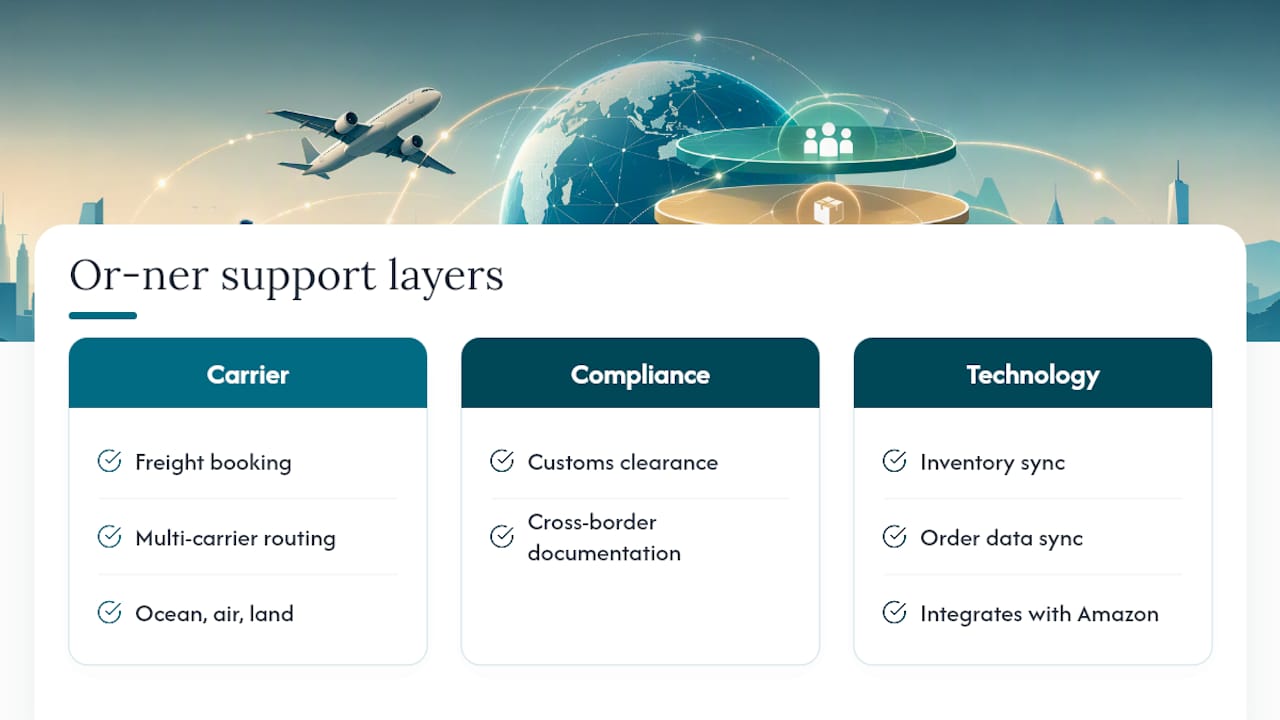
Or-ner’s platform lines up with the three-layer architecture directly. On the carrier layer, it handles freight booking and multi-carrier routing across ocean, air, and land. On the compliance layer, it manages customs clearance and cross-border documentation. On the technology layer, it syncs inventory and order data across warehouses and integrates with platforms like Amazon.
For a deeper walkthrough of how these pieces fit together operationally, Or-ner’s guide to cross-border ecommerce shipping strategies and its practical cross-border logistics guide both walk through implementation in more detail than a single article can cover.
Ready to Pressure-Test Your Own Cross-Border Setup?
If your compliance layer is still a spreadsheet and your carrier relationships were chosen by whoever answered the phone first, that’s the gap Or-ner exists to close. A platform that runs freight booking, customs clearance, and warehousing under one operational view instead of three disconnected vendors can catch a landed-cost miscalculation or a missed SLA before it reaches your customer, not after.
That’s the practical difference between reacting to cross-border problems and preventing them. If you’re shipping into the US or planning to, start with Or-ner’s reliable courier services in the USA page to see how the carrier and compliance layers come packaged together, and request a lane assessment before your next peak season hits.
The Real Bottleneck Isn’t Shipping, It’s Sequencing
The brands that struggle with cross-border logistics rarely have a carrier problem. They have a sequencing problem: they expand into five markets at once, bolt on a landed-cost tool after customers already complained about surprise duties, and hire a compliance consultant only after a shipment gets held at customs. Build the architecture in order, carrier relationships first, compliance second, technology layered on top, and most of the “logistics chaos” that brands describe simply never happens.
Run a two-week audit before your next expansion decision. First, pull your landed cost estimates from the last 20 international orders and compare them against actual customs assessments. Third, ask whether your returns process requires the customer to pay international freight, a sure sign your reverse logistics needs redesign. Or-ner’s team is a reasonable next call if any of the three comes back ugly.
— Maayan
Sources
- How to build a cross-border shipping operation that actually scales in 2026 – Ecommerce Times
- Challenges and Opportunities in Cross-Border E-Commerce Logistics: A Systematic Literature Review
FAQ
What Is Cross-Border E-Commerce Logistics?
It’s the combined system of carrier, compliance, and technology operations that moves orders across international borders while calculating the correct landed cost and meeting delivery expectations.
What’s the Difference Between DDP and DDU Shipping?
DDP (Delivered Duty Paid) collects duties upfront and shows the full cost at checkout, while DDU (Delivered Duty Unpaid) leaves the customer to pay duties on arrival, often triggering complaints or refused packages.
When Should an E-Commerce Business Use a Bonded Warehouse?
Bonded warehouses make sense once international order volume justifies deferring duty payment until goods sell, which typically becomes cost-effective after a market crosses a sustained volume threshold.
What KPIs Matter Most for Cross-Border Logistics?
On-time delivery percentage by lane, landed cost accuracy against customs assessments, the domestic-versus-international return rate delta, and transit time by lane are the four to track monthly.
How Does Or-ner Help With Cross-Border Logistics?
Or-ner combines freight booking, customs clearance, and warehousing into one platform, aligning with the carrier, compliance, and technology layers that scalable cross-border operations require.