

TL;DR:
- Freight booking platforms now serve as integrated digital procurement and management systems, not just rate aggregators.
- They significantly accelerate ecommerce shipping by reducing quote-to-book time, enabling instant confirmations, and enhancing visibility.
- Prioritizing verified carrier networks, high-quality API data, and seamless integration ensures operational efficiency and legal compliance.
Most ecommerce businesses and logistics teams treat freight booking platforms as glorified search engines for shipping rates. That framing is costing them time, money, and legal exposure. The role of freight booking platforms stretches far beyond price comparison. These tools now function as digital procurement systems, payment facilitators, risk management frameworks, and operations hubs, all in one. If you are managing shipping at any meaningful volume, understanding what these platforms actually do determines whether your logistics operation stays reactive or becomes genuinely competitive.
Table of Contents
- Key takeaways
- The role of freight booking platforms: what they actually are
- How platforms accelerate ecommerce shipping operations
- Carrier vetting, risk management, and legal defensibility
- Comparing platform features for ecommerce shipping decisions
- My take on where platforms fall short
- How Or-ner supports your freight and courier operations
- FAQ
Key takeaways
| Point | Details |
|---|---|
| More than rate search | Freight platforms handle quoting, booking, payment, and procurement governance in a single workflow. |
| Speed changes outcomes | Platforms can reduce quote-to-book time by up to 75%, preventing missed cutoffs in fast-moving ecommerce. |
| Risk lives in carrier selection | Using unvetted carriers from open load boards creates legal exposure; verified platforms offer defensible selection processes. |
| Integration is the real differentiator | Platforms connected to your TMS or ERP eliminate manual handoffs and reduce costly data entry errors. |
| Platform selection requires scrutiny | Evaluate network density, API data quality, and carrier vetting practices, not just price access. |
The role of freight booking platforms: what they actually are
The industry term for what most people call a “freight booking platform” is a digital freight marketplace or freight management system, depending on whether the tool skews toward transactional use or operational control. The distinction matters because each type serves a different set of problems.
At their core, these platforms give shippers, carriers, and freight forwarders a shared digital environment to price, tender, book, and manage cargo movement. But the scope has expanded significantly.
Here is what modern freight booking solutions actually include:
- Multimodal rate access. A single platform now covers air, ocean, and trucking quotes, so you are not toggling between three separate portals to compare your options.
- Digital RFQ and RFI automation. Tools like WebCargo Procure automate tendering workflows, letting teams design rate scenarios, benchmark against market rates, and push results directly into booking, all without a single spreadsheet.
- Payment facilitation. Platforms like Freightos connect airlines, forwarders, and importers with guaranteed digital payments, which removes the IATA accreditation requirement that previously blocked smaller forwarders from booking directly with airlines.
- Vendor-neutral carrier matching. The best platforms connect you to a broad network without favoring any single carrier, which keeps pricing competitive and gives you genuine options.
- Rate management and benchmarking. Rather than accepting a quote at face value, you can measure it against historical rates or market indexes to know whether you are paying fairly.
Pro Tip: Before evaluating any platform, ask specifically whether rate data is machine-readable, meaning it includes validity windows and space guarantee flags. Platforms that only show you a price without those fields cannot support automated booking reliably.
The shift from phone-and-email freight procurement to digital systems is not just a convenience upgrade. It restructures who has information, when they have it, and how fast decisions can be made. That restructuring changes outcomes at the operational level.

How platforms accelerate ecommerce shipping operations
Speed is where ecommerce businesses feel the gap between manual freight procurement and digital platforms most directly. In ecommerce, missing a carrier cutoff by a few hours can delay a shipment by days. Platforms that compress the quote-to-confirmation cycle directly reduce that risk.
Here is how the operational acceleration actually works in practice:
-
Faster quoting across modes. Freightos’s unified air and ocean platform cuts quote times by up to 75% compared to manual rate requests. For teams handling dozens of shipments weekly, that time saving compounds quickly.
-
Instant booking confirmation. Products like Condor’s Express cargo offering use major booking platforms to deliver guaranteed capacity with instant confirmation, which eliminates the back-and-forth that delays time-critical shipments.
-
Programmatic rate evaluation. The SeaRates API delivers quote data with fields like "validityFrom
,validityTo,totalTransitTime, andspaceGuarantee` flags, which means your system can evaluate and auto-book rates without human review for every single shipment. This is the backbone of any serious automation strategy. -
TMS and ERP integration. When platforms connect natively to your existing freight management systems, you eliminate context switching. Rate acceptance flows directly into booking confirmation, and booking confirmation flows into your shipment tracking and invoicing. No copy-pasting. No data entry errors.
-
Reduced repetitive task load. Algorithmic automation on freight platforms cuts the time logistics teams spend on repetitive order management tasks by up to 75%, freeing staff for exception handling and relationship management.
Pro Tip: If you are evaluating how freight booking works within your current tech stack, map exactly where rates are entered manually between systems. That map will show you precisely where a platform integration will save the most time and reduce errors.
For a deeper look at how this process applies specifically to ecommerce operations, the freight booking for ecommerce guide covers the full workflow with practical examples.
Carrier vetting, risk management, and legal defensibility
This is the section most articles skip entirely. And it is, arguably, the area where freight booking platforms create the most unrecognized value for logistics operations.
When a shipper or broker selects a carrier from an open load board without any prior relationship or verified credentials, they are exposed. Legal scrutiny of carrier selection practices has intensified, and using unvetted load board carriers without inspection records creates significant legal risk if cargo is lost, damaged, or involved in an incident.
Platforms that take this seriously offer several layers of protection:
- Verified identity models. Carriers must prove who they are before they can transact on the platform. This documentation trail matters in any dispute.
- Safety credential checks. Platforms vet carriers against safety ratings, licensing, and insurance status before adding them to their networks.
- Indemnification-backed selection. Some platforms back their carrier vetting with indemnification models, meaning the platform shares legal exposure if a vetted carrier fails. That is a meaningful commitment.
- Selection process traceability. Every carrier choice made through a platform generates a documented record. That record is your defense if a shipment goes wrong and the selection process is questioned legally.
Carrier selection is no longer just a cost decision. It is a compliance decision. Platforms that treat vetting as a checkbox feature rather than a core infrastructure component are shifting their legal risk onto you.
The importance of freight platforms in risk reduction is easy to underestimate until something goes wrong. For ecommerce businesses shipping at scale, one incident with an unvetted carrier can trigger chargebacks, customer loss, and legal costs that dwarf any savings achieved by choosing the cheapest option. A platform with genuine carrier governance is an insurance policy you pay for once through subscription or fees and benefit from continuously.
Proper procurement digitalization also strengthens vendor relationships over time. When your procurement process is transparent and data-driven, carriers and forwarders respond more competitively because they can see where they stand in your decision process.
Comparing platform features for ecommerce shipping decisions
Not all freight booking solutions are equal, and the gap between a basic rate aggregator and a full freight management system matters significantly at scale. The table below compares key capabilities to help you evaluate platforms against your actual operational needs.
| Capability | Basic rate aggregator | Full freight management system |
|---|---|---|
| Multimodal quoting (air + ocean + truck) | Partial | Yes |
| Instant booking confirmation | Rare | Yes, with carrier partners |
| TMS/ERP API integration | Limited | Native or robust API |
| Carrier vetting and credentialing | Minimal | Verified identity + safety checks |
| Digital RFQ/RFI procurement workflows | No | Yes |
| Rate benchmarking | No | Yes |
| Payment facilitation | Basic | Guaranteed digital payments |
| Shipment tracking post-booking | No | Yes, often real-time |
The benefits of freight booking systems become clearest when you map them against your current pain points. If your team is spending hours weekly on manual rate requests, a platform with automated RFQ workflows eliminates that almost immediately. If you have had carrier incidents that became legal headaches, verified-identity platforms pay for themselves in risk reduction alone.
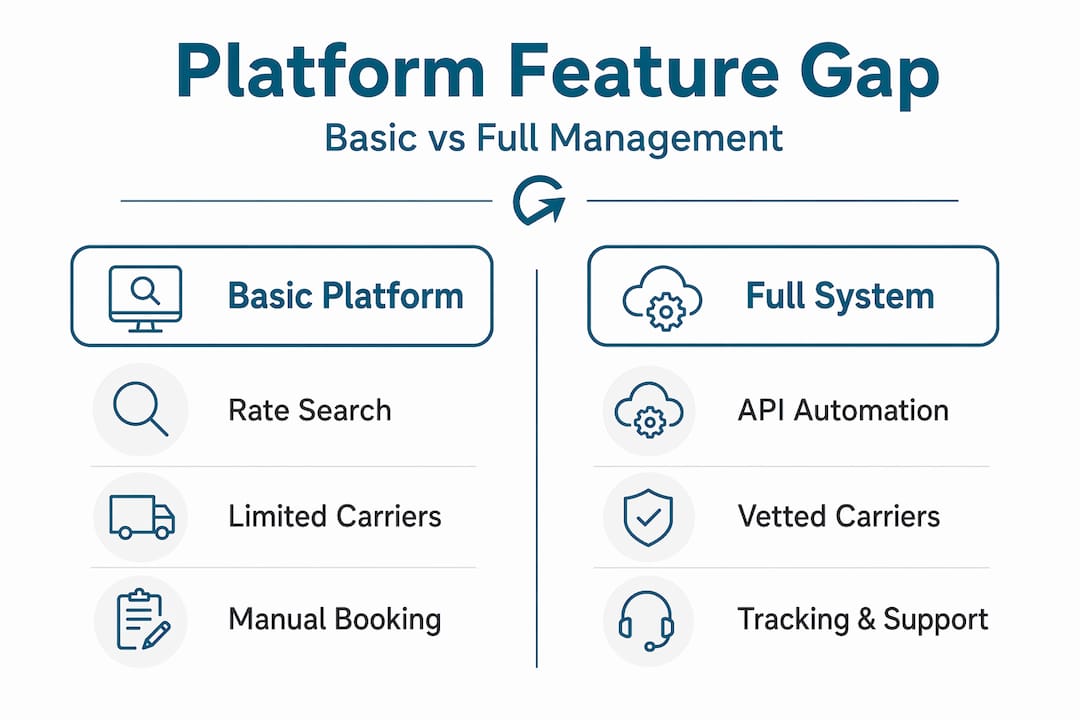
When selecting a platform, three factors matter more than any feature list:
Network density determines whether the carriers available to you are actually useful for your routes. A platform with 500 carriers concentrated in markets you do not serve is worth less than one with 80 carriers on your key lanes.
API data quality determines whether automation is genuinely reliable. Platforms that provide machine-readable rate data with validity windows and space guarantees support automated booking. Those that do not require manual review for every shipment, which negates most of the efficiency gains.
Support and dispute resolution matter the moment something goes wrong. A platform that disappears when a shipment is delayed or a carrier disputes a payment is not a logistics partner. It is a liability.
Pro Tip: Request a sample API response from any platform you are seriously evaluating. If the rate data does not include a space guarantee flag and a validity window, you cannot automate booking safely.
For a detailed comparison of current options, Or-ner’s freight booking platform comparison breaks down the market by functionality and ecommerce suitability.
My take on where platforms fall short
I have worked closely enough with freight booking solutions to know that the sales pitch and the operational reality are often different conversations.
The conventional advice is to prioritize platforms with the most carriers and the lowest rates. I think that framing is wrong. The platforms that create the most operational value are the ones with the deepest integrations and the most serious approach to carrier vetting. A platform with 2,000 unvetted carriers and manual booking workflows is slower and riskier than one with 400 vetted carriers and a native TMS connection.
What I have seen trip up ecommerce teams repeatedly is the assumption that booking speed is the main differentiator. It is not. The handoff from booking confirmation to shipment tracking is where most platforms fail. You book, you get a confirmation, and then the visibility disappears until a problem surfaces. That gap is where customers get missed deliveries and teams spend hours chasing updates.
The platforms worth investing in are the ones treating post-booking visibility as a first-class feature, not an afterthought. Real-time exception management, not just tracking pings, changes how a logistics team operates. It shifts the team from reactive firefighting to proactive problem solving.
My other observation is about procurement integration. Teams that connect their freight booking platform to their ERP or inventory system do not just save time. They make better decisions because the data they need is in one place. The platforms that genuinely support that integration, with well-documented APIs and responsive technical support, are the ones that get adopted and stick. The ones that require workarounds get abandoned inside six months.
The future of freight management systems is not more carriers or lower rates. It is tighter integration, better data, and platforms that take compliance seriously.
— Maayan
How Or-ner supports your freight and courier operations
If you are looking to put the operational principles in this article into practice, Or-ner is built specifically for ecommerce businesses that need freight and courier services to work reliably at scale. Or-ner combines booking, shipment tracking, customs clearance, and warehousing in a single platform, removing the fragmentation that slows most logistics teams down.
For businesses shipping domestically, Or-ner’s courier services in the USA give you access to vetted carriers with real-time tracking and consistent delivery performance. For smaller ecommerce operations scaling up, the courier services for small businesses offering is structured to grow with your volume without locking you into rigid contracts. Or-ner also supports cross-border logistics, air and ocean freight, and Amazon fulfillment integration, making it a practical next step for any ecommerce team ready to move beyond reactive shipping management.
FAQ
What does a freight booking platform actually do?
A freight booking platform gives shippers, carriers, and forwarders a shared digital environment to price, book, pay for, and manage cargo shipments. Modern platforms also handle procurement workflows, carrier vetting, and TMS or ERP integration.
How does freight booking improve ecommerce shipping speed?
Platforms reduce quote-to-confirmation time by up to 75% compared to manual procurement, which prevents missed carrier cutoffs and reduces shipment delays for ecommerce businesses operating on tight fulfillment timelines.
Why does carrier vetting matter on freight platforms?
Selecting carriers from unvetted sources creates legal exposure if cargo is lost or damaged. Platforms with verified identity models and safety credentialing provide a documented, defensible selection process that protects your business.
What should I look for when choosing a freight management system?
Prioritize network density on your actual shipping lanes, API data quality including space guarantee and validity fields, and the platform’s approach to carrier vetting. Feature lists matter less than integration depth and compliance infrastructure.
How does API integration improve freight booking?
When a freight platform connects natively to your TMS or ERP, rate acceptance flows directly into booking confirmation and shipment tracking without manual data entry. This eliminates errors and lets your team focus on exceptions rather than routine order processing.