
TL;DR:
- Ecommerce delivery expectations now prioritize speed, reliability, and proactive communication to build trust. Customers, especially younger shoppers and essential-product buyers, demand faster options, but accurate promises and transparency are equally vital. Major retailers like Amazon and Walmart are setting new standards with ultra-fast delivery and clear time commitments that smaller businesses must meet to remain competitive.
Ecommerce delivery expectations define the standards online shoppers hold for shipping speed, accuracy, and communication at every stage of the order process. These expectations have shifted from a nice-to-have into a direct driver of purchase decisions and brand loyalty. 74% of online shoppers now expect delivery within 2 days, and 56% of consumers aged 18–34 expect same-day delivery. Amazon now offers 1-hour delivery in hundreds of U.S. cities, and Walmart has rolled out 30-minute-or-less delivery across 33 markets. The bar is set. The question is whether your fulfillment strategy can clear it.
What are current ecommerce delivery expectations?
Consumer delivery expectations in 2026 center on four pillars: speed, reliability, communication, and convenience. Speed is the most visible, but reliability and communication are what actually determine whether a customer comes back.
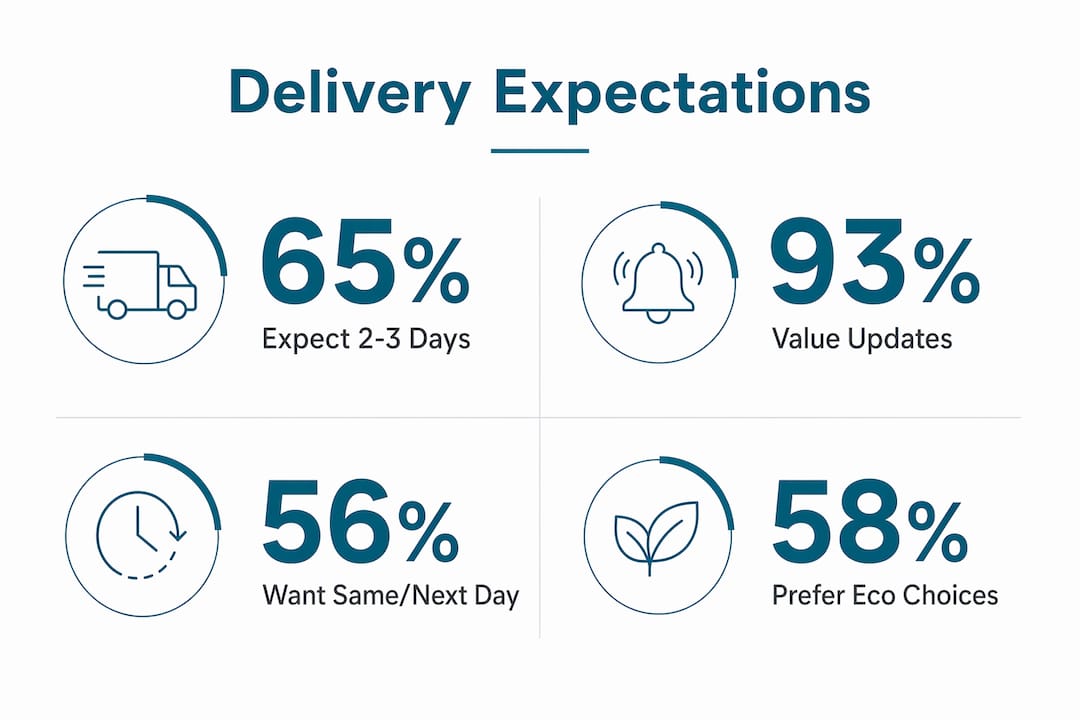
65% of U.S. consumers say 2–3 days should be the standard delivery window. That number sets the floor, not the ceiling. Only 9% of consumers believe retailers always meet fast or guaranteed delivery promises. That gap between expectation and execution is where customer trust erodes.
Cost is equally decisive. 66% of consumers expect free shipping, and 48% abandon their carts when shipping costs are too high. Free and fast shipping are no longer competitive advantages. They are table stakes.
- Speed: Most shoppers expect 2–3 day delivery as standard, with younger demographics pushing for same-day.
- Reliability: Accurate estimated delivery dates matter more than raw speed alone.
- Communication: Proactive updates before and during delivery reduce frustration significantly.
- Convenience: Options like store pickup, locker delivery, and package consolidation are gaining traction.
Pro Tip: Set estimated delivery windows you can consistently hit rather than promising the fastest option you can rarely deliver. Credibility beats speed in the long run.
Proactive updates help 93% of U.S. consumers offset the negative feeling of a late delivery. That statistic reframes the entire communication problem. You do not need a perfect delivery record. You need a transparent one.
How do delivery expectations vary by age and product type?
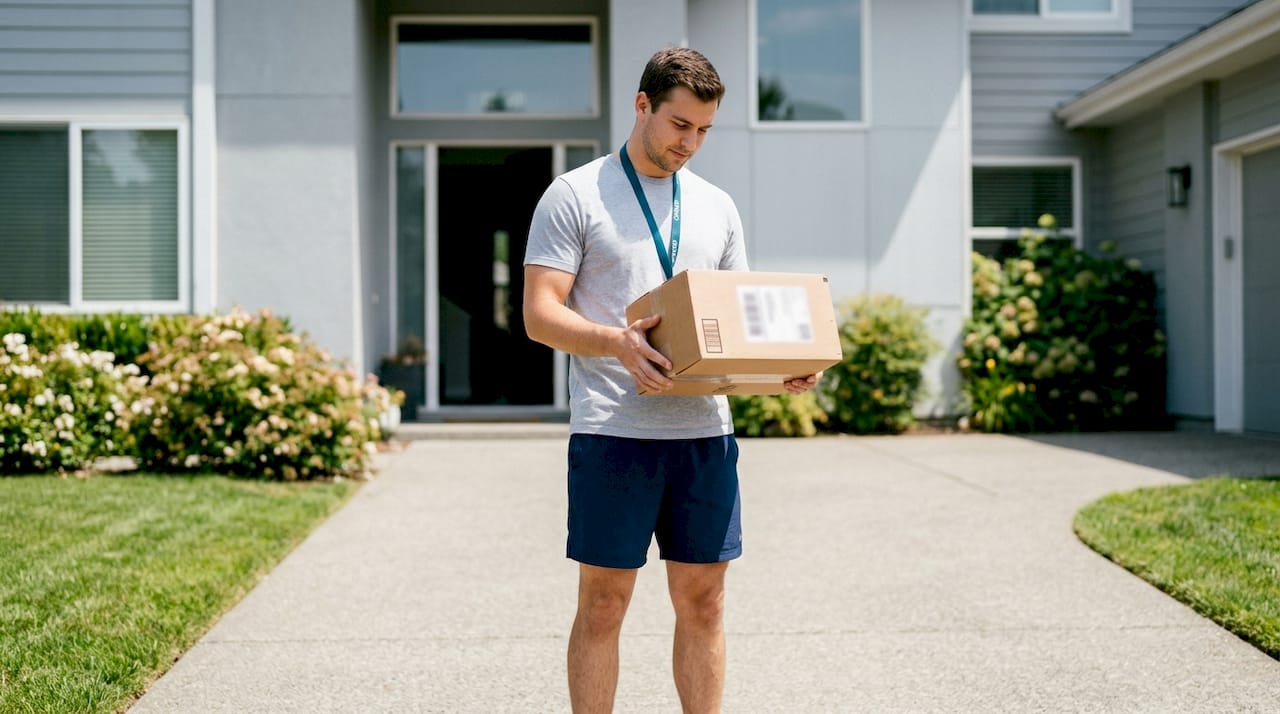
Not all shoppers expect the same thing, and not all products carry the same urgency. Segmenting your fulfillment strategy by customer demographic and product category is one of the most underused levers in ecommerce operations.
| Segment | Key expectation | Notable behavior |
|---|---|---|
| Ages 18–34 | Same-day or next-day delivery | 56% expect same-day delivery options |
| Ages 35–54 | 2–3 day standard delivery | Higher tolerance for scheduled windows |
| Ages 55+ | Reliability over speed | Prefer accurate dates over fast promises |
| Grocery / essentials | Immediate or same-day | Low tolerance for delays |
| General merchandise | 2–3 days acceptable | More flexible on timing |
Younger consumers, particularly Millennials and Gen Z, show the highest expectations for both speed and free shipping. They grew up with Amazon Prime and treat 2-day delivery as the baseline, not a premium. Older shoppers prioritize knowing exactly when a package will arrive over how fast it gets there.
Product category matters just as much as age. Grocery and essential items carry near-zero tolerance for delays. A missed delivery window on a grocery order is a lost customer. General merchandise buyers are more forgiving, especially when they receive clear communication about their order status.
Environmental trade-offs are also reshaping preferences in ways that surprise many operators. 58% of U.S. consumers say they would consolidate deliveries for a better or more eco-friendly experience. Another 40% accept slower delivery for that reason, and 22% prefer store or locker pickup. These numbers show that a meaningful share of your customer base will trade speed for convenience or sustainability if you give them the option.
What happens when you fail to meet delivery promises?
Failing to meet shipping expectations for ecommerce does not just frustrate customers. It breaks trust in ways that are hard to rebuild. The data on delivery failures is stark and worth taking seriously.
“94% of UK consumers rank false ‘delivered’ notifications as the most frustrating delivery experience.” — Locus consumer survey, 2026
That figure is not a minor complaint. A false delivery notification means a customer waited, planned their day around a package, and received nothing except a lie. The damage to brand perception from that single event is disproportionate to the operational error that caused it.
In the U.S., 21% of consumers report missed delivery windows as their top frustration. Missed windows and false notifications are both symptoms of the same root problem: a disconnect between what your logistics system reports and what actually happens at the customer’s door. Fixing that disconnect requires real-time visibility across your entire delivery chain, not just the warehouse.
Poor delivery experiences directly reduce repeat purchase rates. A customer who receives a false delivery notification or waits past a promised window is far less likely to return, regardless of how good the product was. The customer delivery experience is the last impression your brand makes, and last impressions stick.
The good news is that communication can recover much of the damage. Proactive updates, honest delay notifications, and easy-to-reach support channels all reduce the likelihood that a late delivery becomes a lost customer. The 93% figure on proactive updates is the most actionable number in this entire article.
How are Amazon and Walmart raising the delivery bar?
The delivery innovations at Amazon and Walmart are not just impressive logistics stories. They are recalibrating what every online shopper considers normal, which means every ecommerce business feels the pressure whether they sell on those platforms or not.
-
Amazon 1-hour delivery: Amazon now offers 1-hour delivery in hundreds of U.S. cities for select orders, with 3-hour delivery available in over 2,000 cities. This service covers everyday essentials, electronics, and household goods.
-
Walmart 30-minute delivery: Walmart expanded 30-minute-or-less delivery to 33 U.S. markets in may 2026. The service includes four tiers: 30-minute, express (1 hour), on-demand (3 hours), and scheduled delivery windows.
-
Tiered service models: Both retailers offer multiple speed tiers at different price points. This gives customers control and gives the retailer a way to match cost to willingness to pay.
-
Explicit time promises: The shift from “ships in 2–3 days” to “arrives by 3:00 PM today” is significant. Explicit time promises create accountability and set a new standard for what delivery communication should look like.
-
Technology as the backbone: Neither Amazon nor Walmart achieves these speeds through effort alone. Dense fulfillment center networks, real-time routing software, and tight carrier integrations make sub-hour delivery operationally possible.
Pro Tip: You do not need to match Amazon’s 1-hour window. You do need to match their communication clarity. Telling customers exactly when to expect their package is something any ecommerce business can do today.
The competitive implication is clear. When shoppers experience 30-minute delivery from Walmart on a Tuesday, their patience for a 5-day window from a smaller retailer shrinks. Understanding why delivery speed matters for your specific customer base helps you decide where to invest and where to hold the line.
What fulfillment strategies actually close the expectations gap?
Closing the gap between what customers expect and what your operation delivers requires changes in three areas: promise-setting, logistics infrastructure, and communication.
Set credible delivery windows, not aspirational ones. The Locus data shows only 9% of consumers believe retailers always meet their delivery promises. That credibility deficit starts with overpromising. Use real carrier performance data to set windows you can hit 95% of the time, then communicate those windows clearly at checkout.
Offer delivery tiers and pickup options. Not every customer needs the fastest option. Offering a free 3–5 day tier alongside a paid 1–2 day option lets customers self-select based on urgency. Adding store pickup or locker delivery addresses the 22% of shoppers who prefer those options. These choices also reduce your per-order shipping cost on non-urgent orders.
- Audit your current carrier mix and identify which routes consistently miss windows.
- Add real-time tracking notifications at key milestones: order confirmed, shipped, out for delivery, delivered.
- Build a delay communication protocol so customers hear from you before they have to ask.
- Test package consolidation options for multi-item orders to reduce cost and environmental impact.
- Review your ecommerce fulfillment practices at least quarterly against current consumer benchmarks.
Measure delivery performance consistently. You cannot fix what you do not track. Metrics like on-time delivery rate, delivery exception rate, and customer contact rate after delivery are the leading indicators of whether your operation is meeting or missing expectations. Or-ner’s platform provides the real-time visibility and exception management tools that make this kind of tracking practical for growing ecommerce businesses.
Balancing speed, cost, and sustainability is not a one-time decision. Consumer preferences shift, carrier performance changes, and new competitors raise the bar. Building a fulfillment strategy that can adapt is more valuable than one that is fast today but rigid tomorrow.
Key takeaways
Meeting ecommerce delivery expectations requires speed, reliable promises, and proactive communication working together, not any single factor alone.
| Point | Details |
|---|---|
| Speed is the floor, not the ceiling | 65% of U.S. consumers expect 2–3 day delivery as standard; younger shoppers push for same-day. |
| Credibility beats raw speed | Only 9% believe retailers always meet delivery promises; accurate windows build more trust than fast ones. |
| Communication recovers failures | Proactive updates help 93% of consumers offset the frustration of a late delivery. |
| Offer delivery options, not just speed | 58% of consumers consolidate deliveries for eco or convenience reasons; tiered options reduce cost and improve satisfaction. |
| Measure and adapt continuously | Track on-time rate and exception rate to catch gaps before they damage customer loyalty. |
The shift I keep watching in ecommerce delivery
What strikes me most about the 2026 delivery data is how decisively the conversation has moved away from pure speed. A few years ago, every logistics discussion started and ended with “how fast can you ship?” That framing missed the point entirely.
The retailers winning on delivery right now are not always the fastest. They are the most honest. Walmart’s tiered model is a good example. Offering a 30-minute option alongside a scheduled window is not just a logistics feat. It is a trust signal. It tells the customer: we know what we can do, and we will tell you exactly what to expect.
The false delivery notification problem is the clearest evidence of where the industry still falls short. Telling a customer their package arrived when it did not is not a minor glitch. It is a broken promise at the worst possible moment. Fixing that requires investment in last-mile visibility, not just faster trucks.
My honest view is that most mid-sized ecommerce businesses should stop chasing Amazon’s speed and start matching Amazon’s communication clarity. Real-time tracking, honest delay notifications, and accurate estimated delivery dates are achievable at any scale. They also happen to be what the data says customers actually value most. Speed without reliability is a liability. Speed with transparency is a competitive advantage.
— Maayan
Or-ner’s logistics platform for reliable ecommerce delivery
Or-ner gives ecommerce businesses the infrastructure to close the gap between what customers expect and what your operation delivers.
Or-ner’s global logistics platform connects you to reliable courier services, real-time shipment tracking, and fulfillment center networks built for cross-border and domestic ecommerce. The platform’s exception management tools flag delivery issues before they reach your customers, so you can communicate proactively instead of reactively. For businesses looking to reduce per-order costs, Or-ner’s cloud logistics solutions deliver documented cost savings through smarter carrier selection and consolidated fulfillment. If meeting 2026 delivery standards is the goal, Or-ner is built to get you there.
FAQ
What do most online shoppers expect for delivery speed?
65% of U.S. consumers say 2–3 days should be the standard delivery window, while 74% expect delivery within 2 days. Younger shoppers aged 18–34 push that expectation further, with 56% expecting same-day delivery options.
How does free shipping affect ecommerce purchase decisions?
66% of consumers expect free shipping, and 48% abandon their carts when shipping costs are too high. Offering a free standard tier is one of the most direct ways to reduce cart abandonment.
What delivery failures frustrate customers the most?
False “delivered” notifications frustrate 94% of UK consumers most, according to Locus research. In the U.S., 21% of consumers cite missed delivery windows as their top complaint.
Can proactive communication offset a late delivery?
Proactive updates help 93% of U.S. consumers offset the negative experience of a late delivery. Sending honest delay notifications before customers have to ask is one of the highest-return communication investments an ecommerce business can make.
How are Amazon and Walmart changing delivery expectations?
Amazon now offers 1-hour delivery in hundreds of U.S. cities and 3-hour delivery in over 2,000 cities. Walmart expanded 30-minute-or-less delivery to 33 U.S. markets in may 2026, with four service tiers. Both retailers are resetting what shoppers consider a normal delivery window.