TL;DR:
- Global freight solutions coordinate international cargo movement through multiple transportation modes, including customs and tracking.
- Digital marketplaces and specialized carriers enhance efficiency by managing exceptions and offering integrated services.
- Or-ner provides ecommerce businesses with an all-in-one platform for freight booking, compliance, warehousing, and real-time shipment alerts.
Global freight solutions are integrated logistics services that coordinate the international movement of cargo across sea, air, rail, and road. They cover the full chain: freight booking, forwarding, customs clearance, cargo insurance, and real-time shipment tracking. For US importers and exporters, a capable provider handles not just the physical move but the paperwork, compliance, and exception management that determine whether a shipment actually arrives on time.
Key components of a complete international freight service:
- Freight booking and forwarding: Securing space on vessels, aircraft, or rail cars and managing carrier relationships
- Customs clearance: Preparing and filing documentation with CBP and destination-country authorities
- Multimodal transport coordination: Combining sea, air, road, and rail legs into a single managed journey
- Cargo insurance: Covering loss, damage, or delay risk across the full transit
- Shipment visibility and tracking: Real-time status updates and proactive alerts for delays or customs holds
- Last-mile delivery: Connecting international freight to the final destination, often the most complex leg
- Warehousing and fulfillment: Intermediate storage and order processing within the supply chain
How the global freight transportation system actually works
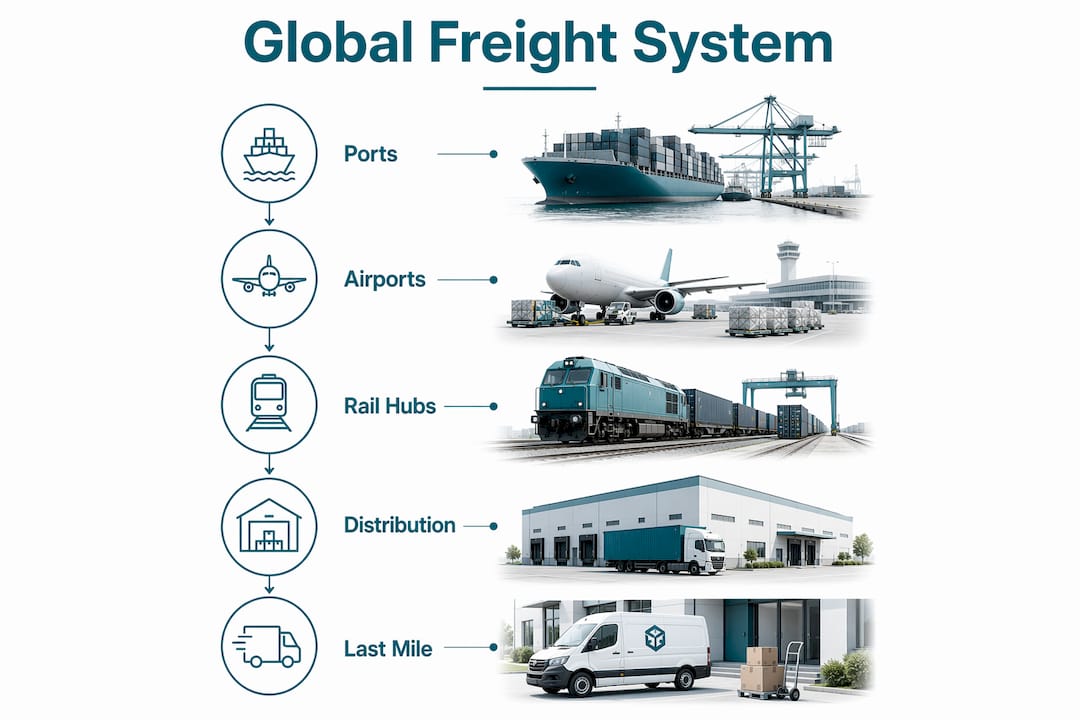
The global freight network is a multimodal system built around ports, airports, rail hubs, and distribution centers. Maritime transport handles the majority of world trade by volume, with sea accounting for the majority of global shipments, with smaller shares handled by road, rail, inland waterways, and air. Air freight moves a tiny fraction of volume but a disproportionate share of value, covering electronics, pharmaceuticals, and time-sensitive goods.
| Mode | Share of global volume | Typical use case |
|---|---|---|
| Sea | approximately 70% | Bulk commodities, containers, consumer goods |
| Road | approximately 18% | Regional distribution, last-mile |
| Rail | approximately 9% | Intermodal, continental corridors |
| Inland waterways | approximately 2% | Bulk cargo, river routes |
| Air | less than 0.25% | High-value, time-critical cargo |
Global value chains depend on this network functioning as a cohesive system, not a collection of separate services. Just-in-time manufacturing and door-to-door delivery strategies only work when transport is embedded into the supply chain from procurement through final distribution. Corporations increasingly subcontract freight operations to specialized carriers that provide more efficient and cost-effective services than in-house logistics teams can manage.
The practical challenges are real: port congestion, customs holds, carrier capacity swings, and last-mile complexity all require active management. Digital marketplaces are changing this, enabling small and medium-sized businesses to access international supply chains through Less than Container Load (LCL) options and multimodal combinations that were once available only to large industrial shippers. Understanding cross-border compliance is a prerequisite before booking any international shipment.
Pro Tip: When comparing freight providers, ask specifically how they handle exception management: what triggers an alert, who contacts you, and how fast. A provider that only reports problems after delivery is not managing your freight.
Cargo insurance is another area where businesses often underestimate risk. Fleet-level digital insurance options have expanded significantly, and understanding your coverage before a shipment departs is far cheaper than disputing a claim after a loss.
Or-ner gives ecommerce businesses a single platform for international shipping
Or-ner is built for ecommerce sellers and businesses that need freight booking, customs support, warehousing, and last-mile delivery managed in one place, without stitching together multiple vendors. The platform covers ocean, air, and land transport modes, integrates with Amazon and other major ecommerce operators, and provides real-time tracking with exception alerts so you know about a delay before your customer does.
Key capabilities Or-ner brings to international shipping:
- Freight booking across sea, air, and road with carrier management
- Customs clearance documentation and cross-border compliance support
- Warehousing and fulfillment through a global network of centers
- Real-time shipment visibility and proactive exception notifications
- Inventory management and catalog support for ecommerce growth
Start with Or-ner’s practical freight booking guide to see how the process works end to end.
FAQ
What is the global freight transportation system?
The global freight transportation system is an international network that moves cargo by sea, air, rail, and road, with maritime transport handling the largest share of trade volume worldwide.
What does a GFS parcel service do?
GFS (Global Freight Solutions Ltd) is a UK-based ecommerce logistics provider offering managed multi-carrier delivery services to online retailers, covering domestic and international shipping.
Who runs Global Freight Solutions Ltd?
Global Freight Solutions Ltd, which operates the GFS brand, has multiple directors rather than a single CEO.
How do I choose a global freight provider for US shipments?
Prioritize providers that offer multimodal options, real-time tracking, customs clearance support, and clear exception management protocols. Or-ner covers all of these for ecommerce businesses shipping internationally from the US.