TL;DR:
- Courier aggregation allows e-commerce sellers to access multiple courier services through one platform, reducing costs and streamlining operations. It uses dynamic routing, volume pooling, automation, and exception handling to optimize delivery success and expand geographic reach. This approach transforms logistics into a flexible, data-driven system that improves efficiency and customer experience for growing brands.
Courier aggregation is defined as the process of connecting e-commerce sellers to multiple courier services through a single technology platform, giving businesses unified access to carrier selection, rate negotiation, and shipment management. The role of courier aggregation has grown from a convenience into a core logistics strategy for direct-to-consumer brands competing on delivery speed and cost. Platforms like Shiprocket and OrderzUp have demonstrated that consolidating carrier relationships under one interface changes how businesses manage fulfillment at scale. This guide breaks down how aggregation works, what it delivers, and how to implement it effectively.
What is the role of courier aggregation in e-commerce?
Courier aggregation, also called multi-carrier shipping management, connects sellers to a network of courier partners through one software layer. Instead of signing separate contracts with FedEx, UPS, regional carriers, and last-mile providers, a business accesses all of them from a single dashboard. The aggregator handles rate comparison, label generation, tracking, and exception management across every carrier in its network.
The practical effect is significant. Courier aggregators negotiate bulk discounts that individual sellers cannot access on their own, lowering per-shipment costs even after platform fees are factored in. A small brand shipping 500 orders per month gains access to the same carrier pricing tiers that a large retailer shipping 50,000 orders per month would receive through direct contracts.
Aggregation also functions as a logistics operating system. Rather than treating shipping as a linear handoff from warehouse to carrier, the platform manages the entire post-purchase experience, including tracking updates, failed delivery workflows, cash-on-delivery reconciliation, and return processing. That shift from manual coordination to software-driven management is what separates aggregation from simply using multiple couriers.

How does courier aggregation work to optimize logistics operations?
The mechanics behind aggregator platforms are more sophisticated than most sellers realize. Four core systems drive the value:
-
Dynamic carrier routing. Aggregators assign each shipment to the best available carrier based on real-time performance data. Routing decisions factor in pin-code level delivery success rates, transit times, and cost, rather than defaulting to a fixed contract carrier. A shipment going to a rural zip code gets routed to the carrier with the highest historical success rate for that area.
-
Volume pooling for rate access. The aggregator combines shipment volumes from all its clients and presents that total volume to carriers during rate negotiations. Pooled volumes unlock discount tiers that no individual seller could reach alone. The savings pass through to each seller on the platform.
-
Automated fulfillment workflows. Order data flows directly from the seller’s store into the aggregator platform, triggering label creation, carrier assignment, and tracking activation without manual input. Automation covers order fulfillment, real-time tracking, return-to-origin management, non-delivery report handling, and COD processing.
-
Exception management at scale. When a delivery fails, the platform triggers recovery workflows through IVR calls, SMS, and WhatsApp messages to reattempt delivery before the shipment returns. This automated NDR management reduces the manual work that logistics teams previously handled call by call.
Pro Tip: Set up carrier performance benchmarks inside your aggregator dashboard from day one. Tracking delivery success rates by carrier and zip code lets you make data-backed routing adjustments rather than waiting for customer complaints to surface problems.
The result is that logistics transforms from a fixed-cost, manually managed function into a software-driven infrastructure that adjusts in real time. Founders and logistics managers stop reconciling COD remittances by hand and start focusing on growth decisions instead.
What are the key benefits of courier aggregation for e-commerce businesses?
The courier aggregation benefits that matter most to e-commerce operators fall into five categories:
-
Lower per-shipment costs. Bulk volume pooling gives sellers access to carrier discounts that were historically reserved for large enterprises. Smaller D2C brands no longer need to build massive shipping volumes before accessing competitive rates.
-
Reduced return-to-origin rates. Brands using multi-carrier allocation and automated NDR workflows report RTO reductions of 15–25%. For a seller processing 10,000 orders per month, a 10% drop in RTOs translates directly into recovered revenue and lower reverse logistics costs.
-
Wider geographic reach. Aggregator platforms connect to dozens of carriers covering domestic and international destinations, including tier-2 and tier-3 cities that single-carrier contracts often underserve. Expanding coverage no longer requires negotiating new contracts with regional providers.
-
Simplified operations. Consolidating multiple carrier relationships into one platform means one invoice, one support contact, and one dashboard. Centralized support coordinates between carriers through a single ticketing system, cutting the time sellers spend chasing down shipment issues.
-
Better customer experience. Consistent tracking updates, faster exception resolution, and higher delivery success rates all contribute to the post-purchase experience customers judge brands on. Delivery performance is now a brand differentiator, not just a logistics metric.
The importance of courier aggregators becomes clearest when you calculate the cumulative effect. Lower costs, fewer returns, broader reach, and less management overhead compound into a measurable improvement in unit economics. For small business shipping, that compounding effect is often the difference between a profitable and unprofitable fulfillment operation.
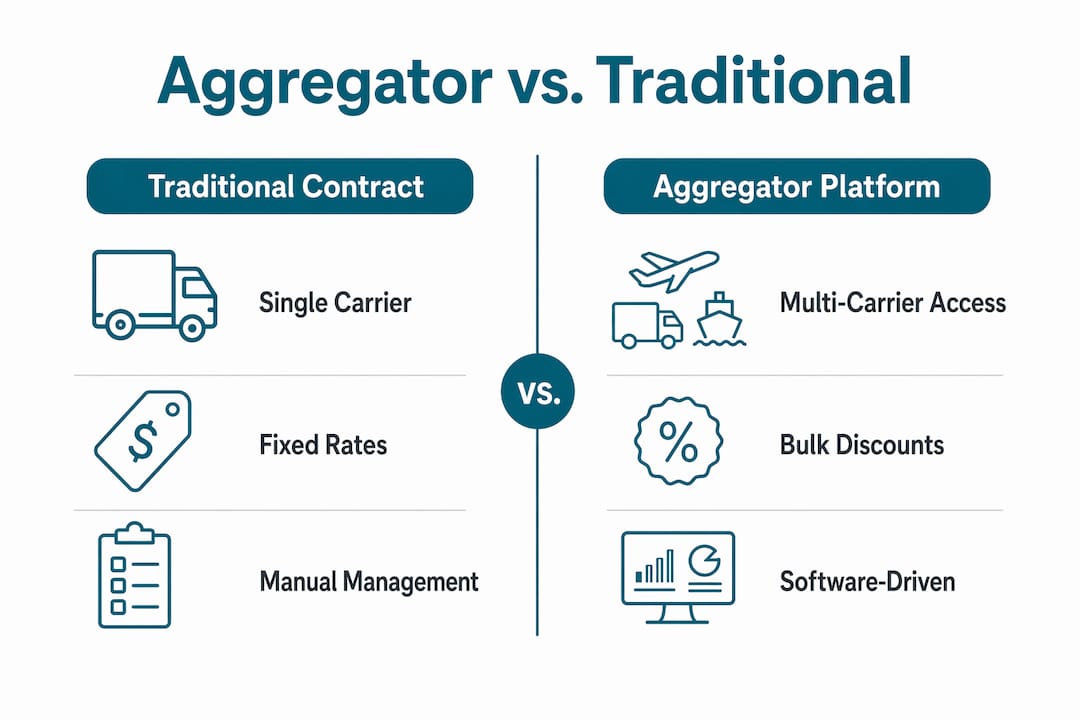
Courier aggregator platforms vs. traditional courier contracts: a comparison
Understanding the trade-offs between aggregator platforms and direct carrier contracts helps businesses choose the right model for their current stage.
| Factor | Traditional courier contract | Courier aggregator platform |
|---|---|---|
| Carrier access | Single carrier per contract | Multiple carriers, one interface |
| Rate negotiation | Based on individual volume | Pooled volume discounts across all clients |
| Geographic coverage | Limited to carrier’s network | Broad, multi-carrier coverage including regional providers |
| Management complexity | Separate invoices, contacts, and dashboards per carrier | Single invoice, single support contact, unified dashboard |
| Scalability | Requires renegotiating contracts as volume grows | Scales automatically with shipment volume |
| Exception handling | Manual coordination with each carrier | Automated NDR and RTO workflows |
| Best fit | Large enterprises with stable, high-volume routes | Small to mid-size e-commerce businesses and growing D2C brands |
Traditional contracts make sense for businesses with extremely high, predictable volumes on fixed routes where a direct carrier relationship delivers better rates than any aggregator can match. For most e-commerce businesses, that threshold is high. The aggregator model wins on flexibility, coverage, and operational simplicity at every stage below enterprise scale.
The shift from fixed-cost contracts to outcome-based carrier selection also changes how businesses think about logistics investment. Capital that previously went into building carrier relationships and logistics infrastructure gets redirected to product and marketing.
How can e-commerce businesses implement courier aggregation strategies effectively?
Adopting an aggregator platform is straightforward. Getting the most out of it requires deliberate setup and ongoing management. Follow these steps:
-
Assess your shipping profile first. Calculate your monthly order volume, average package weight, destination mix, and current per-shipment cost. This baseline tells you which aggregator features matter most and gives you a benchmark to measure improvement against.
-
Evaluate platform features before committing. Look for API integration with your order management system, NDR management workflows, COD reconciliation tools, and real-time carrier performance reporting. A platform missing any of these forces manual workarounds that eliminate the efficiency gains aggregation is supposed to deliver. Or-ner’s guide on choosing a courier partner covers the evaluation criteria in detail.
-
Monitor carrier performance by route. Set a review cadence, monthly at minimum, to compare delivery success rates, transit times, and costs by carrier and destination zone. Aggregators give you this data. Use it to adjust routing rules and phase out underperforming carriers.
-
Activate automated exception workflows immediately. NDR automation through IVR, SMS, and WhatsApp is one of the highest-return features on any aggregator platform. Turning it on from day one prevents RTOs from accumulating while you get familiar with the rest of the system.
-
Integrate aggregator data with your order management system. Pulling carrier performance and cost data into your OMS lets you connect logistics outcomes to customer lifetime value, product margins, and repeat purchase rates. That connection turns logistics from a cost center into a decision-making input.
Pro Tip: Run a 30-day parallel test when switching to an aggregator. Keep your existing carrier active for a portion of orders while routing the rest through the aggregator. The direct comparison removes guesswork from the ROI calculation.
The best courier service tips consistently point to one principle: treat the aggregator platform as a performance tool, not just a booking interface. The businesses that get the most out of aggregation are the ones that actively manage carrier allocation rather than leaving it on default settings.
Key Takeaways
Courier aggregation delivers the most value when businesses treat it as a performance management system, not just a multi-carrier booking tool.
| Point | Details |
|---|---|
| Core function | Aggregators connect sellers to multiple carriers through one platform, replacing separate contracts. |
| Cost mechanism | Pooled volume discounts lower per-shipment rates for sellers of all sizes. |
| RTO reduction | Automated NDR workflows cut return-to-origin rates by 15–25%, recovering significant revenue. |
| Operational gain | Centralized support and unified dashboards eliminate manual carrier coordination. |
| Implementation priority | Activate NDR automation and carrier performance monitoring from day one for maximum impact. |
Why aggregation is about more than just saving money
I’ve worked with enough e-commerce logistics operations to say this plainly: the businesses that treat courier aggregation purely as a cost-cutting tool miss most of its value. The real shift is operational. When your team stops manually triaging failed deliveries, reconciling COD payments, and chasing carrier support lines, they get hours back every week. Those hours go toward things that actually grow the business.
What I’ve also noticed is that aggregator dependency is a real risk that nobody talks about enough. If your entire logistics operation runs through one platform and that platform has an outage or changes its pricing structure, you feel it immediately. The mitigation is simple: maintain visibility into your carrier performance data independently, and keep your OMS integrated tightly enough that you could switch platforms without losing historical shipment data.
The AI-driven evolution of aggregator routing is the development worth watching closely. Platforms that currently route based on historical pin-code success rates will soon route based on predictive models that factor in weather, carrier capacity, and demand spikes in real time. That shift will make the gap between aggregator-powered logistics and traditional contract logistics even wider. Businesses that build the internal data habits now, tracking performance, connecting logistics to customer outcomes, and reviewing carrier allocation regularly, will be positioned to take full advantage when those capabilities arrive.
— Maayan
Or-ner’s courier solutions for e-commerce logistics
Or-ner gives e-commerce businesses access to reliable courier services built for the demands of modern online retail, from single-seller operations to high-volume brand fulfillment.
Or-ner’s platform covers multi-carrier access, real-time shipment tracking, customs clearance, and cross-border logistics under one roof. Whether you’re shipping domestically or expanding into international markets, Or-ner connects your operation to a global carrier network without requiring you to manage each relationship separately. Businesses looking to reduce per-shipment costs, improve delivery success rates, and free up operational bandwidth will find Or-ner’s end-to-end approach a practical fit. Explore Or-ner’s courier services for small businesses to see how the platform scales with your growth.
FAQ
What is courier aggregation?
Courier aggregation is the process of accessing multiple courier carriers through a single technology platform. It replaces separate carrier contracts with one interface for rate comparison, label generation, tracking, and exception management.
How does courier aggregation reduce shipping costs?
Aggregators pool shipment volumes from all their clients to negotiate bulk discounts with carriers. Individual sellers access those discounted rates regardless of their own shipping volume.
What is the difference between an aggregator and a traditional courier contract?
A traditional contract locks a business into one carrier at rates based on its own volume. An aggregator provides access to multiple carriers at pooled-volume rates, with unified management and automated workflows.
How do courier aggregators reduce return-to-origin rates?
Aggregator platforms use automated NDR workflows through IVR, SMS, and WhatsApp to recover failed delivery attempts before shipments return. Brands using these workflows report RTO reductions of 15–25%.
Which businesses benefit most from courier aggregation?
Small to mid-size e-commerce businesses and growing D2C brands benefit most. Aggregators give these sellers access to carrier rates, routing technology, and geographic coverage that previously required enterprise-level shipping volumes to unlock.