
TL;DR:
- Shipping rate calculation involves determining the higher of a package’s actual and dimensional weight to set accurate carrier charges. Factoring in zone distances, service levels, surcharges, and packaging helps optimize shipping costs and margins. Regular invoice reconciliation and data-driven negotiations improve overall shipping expense management for ecommerce businesses.
Shipping rate calculation is defined as the process of determining the billable weight of a package, then applying carrier-specific zone pricing, service tiers, and surcharges to arrive at a final charge. Every major carrier, including UPS, FedEx, and USPS, bills on the higher of actual weight or dimensional weight. Get that number wrong and you either overcharge your customers or absorb losses on every shipment. This guide covers the exact formulas, tools, and traps you need to know to calculate freight charges accurately and protect your margins.
How to calculate shipping rates: start with billable weight
Billable weight is the higher of a package’s actual weight and its dimensional (DIM) weight. Carriers use this rule because a large, light box takes up as much truck or plane space as a heavy one. Charging only on actual weight would let bulky, lightweight shipments ride for almost nothing, which carriers will not allow.

Actual weight is straightforward. Place the package on a scale and round up to the nearest whole pound. DIM weight requires a formula. The calculation is:
DIM Weight = (Length × Width × Height) ÷ DIM Divisor
Once you have both numbers, the billable weight is whichever is greater. That is the number you plug into any courier charges calculator or carrier rate table.
Why DIM divisors matter
DIM divisors differ by carrier and contract type. UPS and FedEx use a divisor of 139 for domestic contract rates. USPS uses 166 for retail-style calculations. A lower divisor produces a higher DIM weight, which means a higher bill. A 12 × 10 × 8 inch box weighs 960 cubic inches. Divide by 139 and you get a DIM weight of 6.9 pounds. Divide by 166 and you get 5.8 pounds. That difference adds up fast across hundreds of shipments.
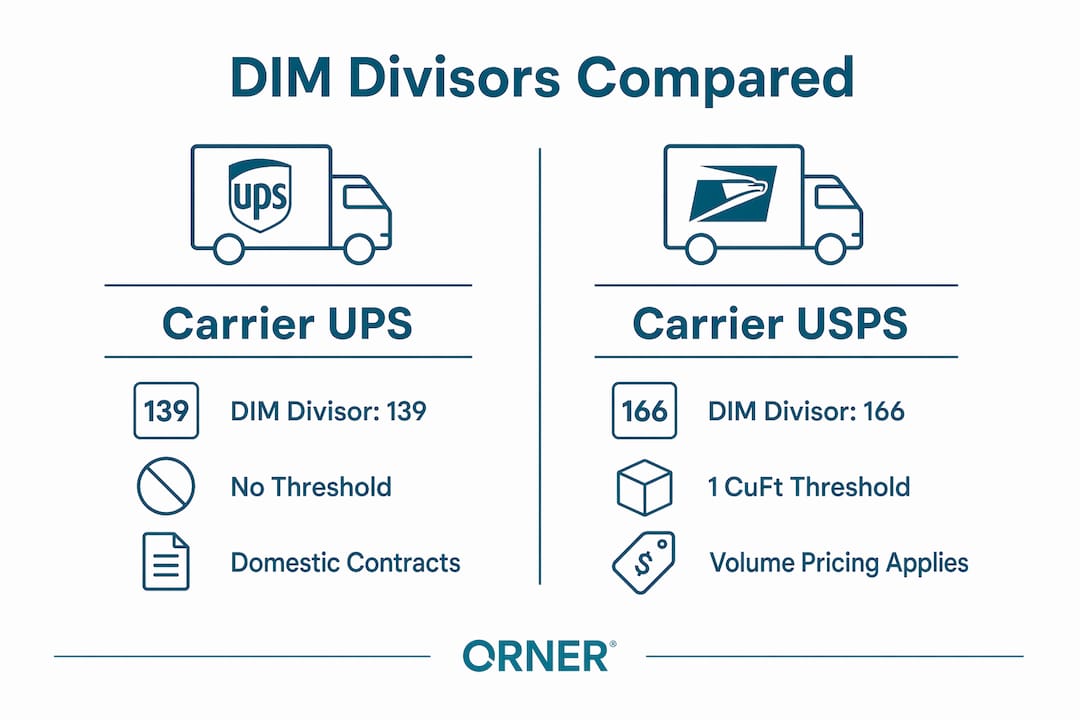
USPS applies DIM pricing only when a package exceeds 1 cubic foot, which equals 1,728 cubic inches. Keeping your package volume below that threshold avoids USPS DIM charges entirely. For sellers shipping small, lightweight products, this is one of the most underused cost controls available.
Pro Tip: Measure your packages after they are packed and sealed, not before. Padding, bubble wrap, and box walls add real inches that change your DIM weight calculation.
How do destination zones, service levels, and surcharges influence shipping rates?
Shipping zones are carrier-defined regions based on the distance between origin and destination ZIP codes. Zone 1 is the closest, Zone 8 is the farthest. The farther the zone, the higher the base rate. A package traveling from Los Angeles to a Zone 2 destination might cost $8. The same package going to Zone 8 could cost $18 or more, depending on the carrier and service.
Service level is the second major cost driver. Carriers offer three broad tiers:
- Economy (ground): Lowest cost, 3–7 business days. Best for non-urgent, heavy, or bulky items.
- Standard (2-day): Mid-range cost, 2 business days. Common for ecommerce customer expectations.
- Express (overnight): Highest cost, next-day delivery. Reserved for urgent or high-value shipments.
Choosing the wrong service level for a product type is one of the fastest ways to erode margin. A seller shipping apparel via overnight when ground would satisfy the customer is paying two to four times more than necessary.
Surcharges: the hidden cost multiplier
Common surcharges include residential delivery fees, fuel surcharges, address correction fees, and delivery area surcharges. These charges commonly add $4–$7 per package. That number compounds quickly when you ship hundreds of orders per week.
Residential delivery surcharges apply when a package goes to a home address rather than a commercial address. Carriers charge more because residential stops take longer and are less efficient. Address correction fees trigger when you submit an incorrect or incomplete address. Delivery area surcharges apply to remote ZIP codes that are expensive for carriers to service.
Pro Tip: Verify whether each shipping address is classified as residential or commercial before generating a label. Some fulfillment platforms let you flag this at checkout, which prevents surprise surcharges on your invoice.
What tools and formulas can ecommerce sellers use to calculate shipping costs accurately?
The full shipping cost formula is: Shipping Cost = Carrier Base Rate + Surcharges + Packaging + Handling + Insurance + Duties or Taxes. Most sellers focus only on the base rate and miss the rest. Surcharges alone can add 20–40% to a base rate for residential deliveries in remote zones.
Accurate rate calculation requires package dimensions, actual weight, origin ZIP code, destination ZIP code, and delivery speed. Feed all five inputs into a calculator and you get a reliable estimate. Miss one and the estimate drifts.
Step-by-step: how to figure out shipping cost for small business
- Measure and weigh the packed box. Record length, width, height in inches and actual weight in pounds.
- Calculate DIM weight. Use the formula (L × W × H) ÷ divisor. Apply the correct divisor for your carrier.
- Determine billable weight. Compare actual weight and DIM weight. Use the higher number.
- Look up the shipping zone. Enter origin and destination ZIP codes into the carrier’s zone chart or calculator.
- Select your service level. Choose economy, standard, or express based on your delivery promise.
- Add surcharges. Include residential fees, fuel surcharges, and any applicable area surcharges.
- Add packaging, handling, and insurance. These are real costs that belong in your rate calculation.
Carrier comparison: DIM divisors and thresholds
| Carrier | DIM Divisor | DIM Threshold | Notes |
|---|---|---|---|
| UPS | 139 (contract) | No threshold | Applies to all packages |
| FedEx | 139 (contract) | No threshold | Applies to all packages |
| USPS | 166 (retail) | 1,728 cubic inches | DIM applies only above threshold |
This table shows why the best carrier for one SKU may not be the best for another. A lightweight, bulky item ships cheaper via USPS if it stays under 1,728 cubic inches. A dense, heavy item may rate better with UPS or FedEx depending on zone.
Pro Tip: Use a cargo shipping cost calculator from ShipperHQ or a carrier’s own rate tool to cross-check your manual calculations. Discrepancies between your estimate and the carrier invoice usually trace back to a missed surcharge or wrong DIM divisor.
What are common mistakes in shipping rate calculations and how to avoid them?
Misclassifying package dimensions is the most frequent error. Sellers often use product dimensions instead of packed box dimensions. The packed box is always larger, and that difference directly raises DIM weight.
Invoice and estimate drift occurs when classification errors, missing surcharge flags, and unaccounted fees accumulate across shipments. Regular invoice reconciliation is the only way to catch and correct this drift before it becomes a significant cost. Compare your estimated rate against the actual carrier invoice for every shipment, at least weekly.
Other common mistakes include:
- Using the wrong DIM divisor. Applying 166 to a UPS shipment instead of 139 understates DIM weight and produces an inaccurate estimate.
- Ignoring zone changes. Moving a warehouse or fulfillment center changes your zone distribution and can shift rates significantly.
- Skipping address verification. Unverified addresses trigger correction fees and sometimes residential surcharges that were not in the original estimate.
- Overlooking packaging choices. Oversized boxes inflate DIM weight. Right-sizing packaging is one of the fastest ways to reduce DIM weight charges without changing carriers.
Pro Tip: Build a simple spreadsheet that logs estimated rate, actual invoice, and the difference for each shipment. Patterns in that variance column tell you exactly where your calculation process is breaking down.
How to negotiate and optimize your shipping rates after accurate calculation
Accurate calculation data is your strongest negotiating tool. When you can show a carrier your monthly volume, average package weight, zone distribution, and DIM weight profile, you are negotiating from facts rather than guesses. Carriers respond to data because it lets them model the revenue your account generates.
Negotiating a higher DIM divisor is one of the most effective contract improvements for high-volume shippers. Moving from a divisor of 139 to 166 reduces DIM weight on every bulky shipment. For sellers with a catalog heavy in home goods, apparel, or toys, that single change can lower shipping costs meaningfully across thousands of packages per month.
Additional tactics worth pursuing:
- Carrier selection by SKU profile. Run your top 20 SKUs through each carrier’s rate calculator. The cheapest carrier for a 2-pound apparel item may not be cheapest for a 15-pound home goods box.
- Multi-origin shipping. Shipping from a warehouse closer to your customer base reduces the zone number and the base rate. Or-ner’s global warehouse network supports this approach for cross-border and domestic sellers.
- Real-time rate display at checkout. Integrating a live shipping rate calculator into your checkout reduces rate surprises and improves margin accuracy on every order.
- Packaging audits. Review your top 10 box sizes quarterly. Eliminating one oversized box type can remove a DIM weight tier from your entire catalog.
When you compare shipping carriers using real calculated data rather than published list rates, you make decisions that actually reflect your business’s cost structure.
Key takeaways
Billable weight, not actual weight, is the number that determines what you pay, and every other cost factor builds on top of it.
| Point | Details |
|---|---|
| Billable weight is the foundation | Always use the higher of actual weight and DIM weight for any rate calculation. |
| DIM divisors vary by carrier | UPS and FedEx use 139; USPS uses 166 and only applies DIM above 1,728 cubic inches. |
| Surcharges add $4–$7 per package | Residential, fuel, and area surcharges compound fast and must be included in every estimate. |
| Invoice reconciliation catches drift | Compare estimated vs. actual charges weekly to identify and fix calculation errors before they scale. |
| Negotiation requires data | Use your DIM weight profile and zone distribution to negotiate better divisors and contract rates. |
The part most sellers skip until it costs them
Most ecommerce sellers treat shipping rate calculation as a one-time setup task. They configure their store’s shipping rules once, then move on. That approach works fine until carrier rates change, a new surcharge appears, or a packaging supplier ships a slightly different box size. Then the estimates drift, the invoices grow, and no one knows why.
What I have found actually works is treating rate calculation as a living process, not a fixed setting. Reviewing your top SKUs’ DIM weights quarterly takes about an hour. Reconciling invoices against estimates weekly takes 20 minutes. Those two habits catch the errors that silently drain margin for months before anyone notices.
Address verification is the one I see sellers skip most often. A residential surcharge on a commercial address, or a correction fee on a slightly wrong ZIP code, seems trivial per package. Across 500 shipments a week, it is a real number. Most ecommerce platforms let you validate addresses at checkout. Turn that feature on and leave it on.
The sellers who negotiate the best carrier contracts are not always the ones with the highest volume. They are the ones who show up to the conversation with clean data: zone distribution, average DIM weight, monthly package count by service level. That data is the output of doing the calculation correctly every time.
— Maayan
Or-ner’s freight booking tools for accurate shipping costs
Knowing the formula is one thing. Having a platform that applies it automatically across every shipment is another.

Or-ner gives ecommerce sellers real-time rate calculation across multiple carriers, with built-in DIM weight logic and surcharge visibility before you book. The freight booking process on Or-ner walks you through each input, from package dimensions to destination zone, so your rate estimate matches your invoice. For sellers managing cross-border shipments, Or-ner’s platform also surfaces duty and tax estimates alongside carrier rates. If you want to move from manual calculation to a system that catches errors before they become charges, Or-ner’s freight booking guide is the right starting point.
FAQ
What is billable weight in shipping?
Billable weight is the higher of a package’s actual weight and its dimensional weight. Carriers like UPS, FedEx, and USPS use this number, not actual weight alone, to determine the shipping charge.
How do I calculate dimensional weight?
Multiply the package’s length, width, and height in inches, then divide by the carrier’s DIM divisor. Use 139 for UPS and FedEx contract rates, or 166 for USPS retail calculations.
What surcharges should I include when I estimate freight shipping cost?
Include residential delivery fees, fuel surcharges, address correction fees, and delivery area surcharges. These commonly add $4–$7 per package and must be factored into every rate estimate.
How does USPS handle dimensional weight differently from UPS and FedEx?
USPS applies DIM pricing only when a package exceeds 1,728 cubic inches, which is 1 cubic foot. UPS and FedEx apply DIM weight to all packages regardless of size.
Can I negotiate my DIM divisor with a carrier?
Yes. High-volume shippers can negotiate a higher DIM divisor, such as moving from 139 to 166, which reduces the DIM weight on bulky packages and lowers the billable weight across the catalog.