
TL;DR:
- Selecting a reliable courier with technology, coverage, and accuracy minimizes customer dissatisfaction.
- Use structured RFPs and scorecards to objectively evaluate courier candidates based on key criteria.
- Continuous monitoring and multi-carrier strategies enhance resilience and optimize shipping performance.
Picking the wrong courier partner is one of the fastest ways to lose customers you worked hard to win. Late deliveries, damaged packages, and zero visibility into shipment status translate directly into negative reviews, refund requests, and churn. The stakes are real: a single peak season failure can erase months of brand-building. This guide walks you through a structured, evidence-based process for selecting reliable courier services that match your business model, protect your margins, and keep your customers coming back.
Table of Contents
- Define your shipping requirements and goals
- Shortlist courier candidates using structured evaluation
- Key criteria: reliability, coverage, technology, and cost
- Implement, monitor results, and adapt your strategy
- Strategies for multi-carrier resilience and common pitfalls
- What most ecommerce leaders miss about courier partnerships
- Take your next step toward shipping success
- Frequently asked questions
Key Takeaways
| Point | Details |
|---|---|
| Clarify your needs | Start with a precise list of your shipping requirements, delivery promises, and must-have features. |
| Evaluate with scorecards | Shortlist and compare courier candidates using structured RFPs, quantitative scorecards, and references. |
| Prioritize the right KPIs | Focus on reliability, coverage, cost transparency, and technology integration to avoid costly mistakes. |
| Monitor and adapt | Track courier performance post-launch and adjust strategies for ongoing shipping success. |
| Consider multi-carrier setups | Diversify partners to reduce risk and handle growth without capacity bottlenecks. |
Define your shipping requirements and goals
Before you contact a single courier, you need a clear picture of what your business actually demands. Skipping this step means you will evaluate partners against a vague checklist and end up with a contract that does not fit your real operations.
Start by documenting the basics:
- Average daily and monthly order volume, including peak season spikes
- Shipping destinations: domestic only, regional, or international
- Package profiles: dimensions, weight ranges, fragile or hazardous items
- Delivery promises: same-day, next-day, standard, or economy
- Must-have features: real-time tracking, API integration, returns handling, and cash-on-delivery support
Once you have these listed, translate them into a quick-reference requirements table:
| Requirement | Your target | Priority |
|---|---|---|
| On-time delivery rate | 98%+ | Critical |
| Order accuracy | 99%+ | Critical |
| Real-time tracking | Yes | High |
| API/system integration | Yes | High |
| Returns management | Yes | Medium |
| International coverage | Select regions | Medium |
When setting these targets, prioritize reliability criteria such as on-time delivery above 98%, broad coverage, technology integration, scalability, and full cost transparency. These benchmarks are not aspirational; they are table stakes for competitive ecommerce.
Pro Tip: Pull in your customer support and operations leads when building this list. Support teams know exactly which delivery complaints show up most often, and operations managers understand the workflow gaps that a courier partner could either solve or worsen.
Shortlist courier candidates using structured evaluation
With your requirements documented, you are ready to identify and evaluate potential courier partners systematically.
Here is a proven sequence to build your shortlist:
- Gather recommendations from your industry network, trade associations, and ecommerce forums.
- Research online using review platforms, logistics directories, and case studies.
- Draft a request for proposal (RFP) that covers your volume, destinations, service levels, technology needs, and pricing expectations. A sample RFP can give you a solid starting structure.
- Send the RFP to at least five candidates to ensure you have enough data points for a meaningful comparison.
- Request customer references from each candidate, specifically from businesses with similar order profiles.
A structured evaluation process that includes RFPs, scorecards, and reference checks consistently produces better long-term outcomes than informal conversations alone.
Once responses come in, use a comparison scorecard. Rate each courier on a 1 to 5 scale across your key criteria:
| Criteria | Courier A | Courier B | Courier C |
|---|---|---|---|
| On-time delivery rate | 5 | 4 | 3 |
| Cost transparency | 4 | 5 | 3 |
| Technology integration | 5 | 3 | 4 |
| Coverage reach | 4 | 4 | 5 |
| Reference quality | 5 | 4 | 3 |
A quantitative scorecard design with clear customer references and structured RFP data removes gut-feel bias and makes your final decision defensible to stakeholders. You can also explore shipping carrier evaluation frameworks and courier networking strategies for additional guidance.
Pro Tip: Weight your scorecard categories by priority. Reliability and technology integration should carry more weight than cost alone, especially if your brand promises fast, trackable delivery.
Key criteria: reliability, coverage, technology, and cost
Now dig deeper into the criteria that matter most when comparing your top candidates.
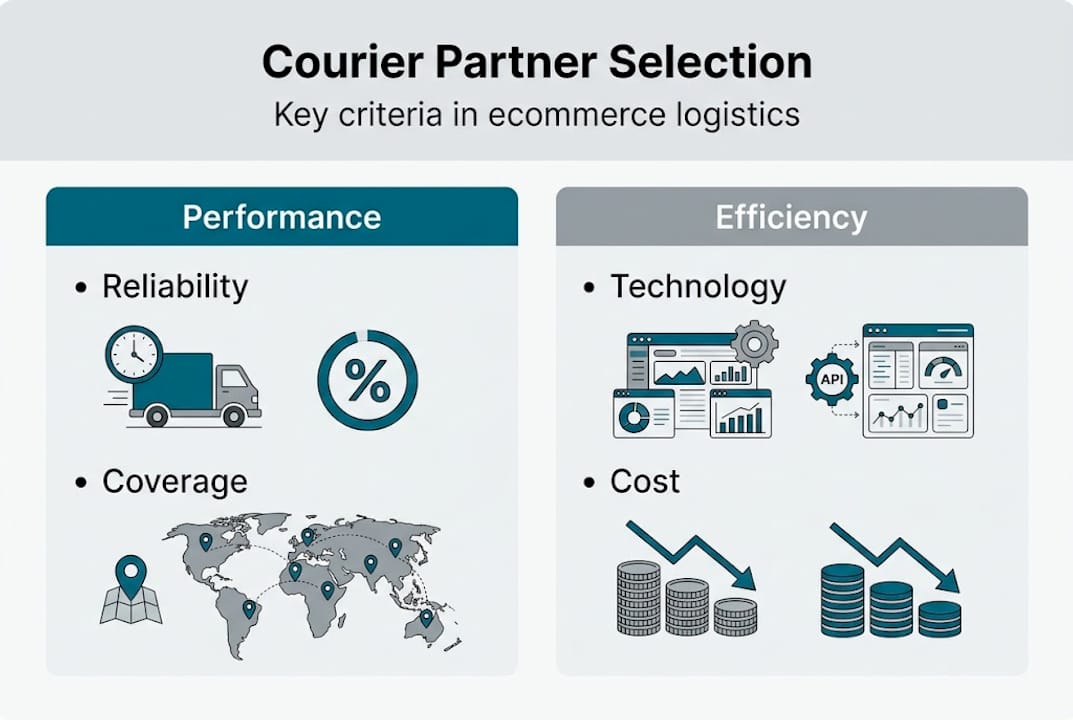
Reliability is the foundation. The on-time delivery benchmark for leading ecommerce operations sits at 98% or above, with order accuracy at 99% or better. Any courier falling short of these numbers will cost you in refunds, reshipments, and customer churn.
Coverage needs to match your actual shipping lanes. A courier with excellent domestic performance but no regional or international reach will become a bottleneck as you grow. Confirm service availability at the zip code or postal zone level, not just country level.

Technology is where many businesses underestimate the value. Real-time tracking, a merchant dashboard, and API integration are not nice-to-haves. They are the tools that let you catch problems before customers complain. Understanding the qualities of reliable courier services means recognizing that technology drives visibility, and visibility drives trust.
Cost requires a total landed cost view. The base rate is only part of the picture. Add in:
- Fuel surcharges and dimensional weight fees
- Failed delivery and redelivery charges
- Returns processing fees
- Peak season rate increases
Chasing the cheapest rate often leads to higher total costs through poor reliability, elevated return rates, and hidden surcharges. Balance rate with total cost of ownership. For practical frameworks on optimizing logistics processes, look beyond the invoice line items.
Industry fit rounds out your evaluation. A courier experienced with your product category, whether apparel, electronics, or fragile home goods, will handle exceptions more competently than a generalist.
Implement, monitor results, and adapt your strategy
With your partner chosen, focus on a clean launch and continuous improvement to protect your shipping performance.
Go-live checklist:
- Complete API or system integration testing before the first live shipment
- Train your warehouse and customer support teams on new workflows
- Define and document service level agreements (SLAs) covering delivery windows, exception handling, and escalation paths
- Run a controlled pilot with a subset of orders before full rollout
- Set up automated alerts for late scans or failed delivery attempts
Once live, track these KPIs weekly:
- On-time delivery rate: target 98%+
- Order accuracy rate: target 99%+
- Cost per shipment: compare against your baseline
- Return to origin (RTO) rate: high RTO signals address quality or delivery attempt issues
- Customer satisfaction scores: tied directly to delivery experience
Tracking KPIs post-selection including on-time delivery, accuracy, cost per shipment, and return rates gives you the data to act before problems escalate. Explore important logistics KPIs and measuring delivery performance to build a monitoring framework that works.
Continuous monitoring helps catch issues early and adapt before they escalate.
Schedule a formal quarterly review with your courier account manager. Bring data, not just complaints. Data-driven conversations lead to faster resolutions and better contract terms.
Strategies for multi-carrier resilience and common pitfalls
Finally, strengthen your courier strategy by understanding the power of multi-carrier setups and the mistakes that quietly drain performance.
Relying on a single courier is a concentration risk. Multi-carrier strategies protect against capacity limits, rate hikes, and regional disruptions by enabling zone-level and SKU-level optimization. In practice, this means routing orders through the carrier best suited to each destination or product type, rather than defaulting to one provider for everything.
Key benefits of a multi-carrier approach:
- Disruption protection: if one carrier has a service outage or strike, volume shifts automatically
- Seasonal surge management: secondary carriers absorb overflow during peak periods
- Rate leverage: competing carriers on performance keeps pricing honest
- Regional optimization: local carriers often outperform nationals in specific zones
Common pitfalls to avoid:
- Chasing unsustainably low rates that signal poor service quality
- Neglecting SLA enforcement after the honeymoon period ends
- Failing to renegotiate terms as your volume grows and your leverage increases
- Ignoring early warning signs: spikes in late deliveries, rising complaint volumes, or unexplained cost increases
For a deeper look at courier resilience strategies tailored to ecommerce growth in 2026, the picture becomes clear: flexibility is not optional, it is a competitive advantage.
Pro Tip: Review performance data every quarter and always maintain at least one backup carrier for your highest-volume shipping lanes. Do not wait for a crisis to build that relationship.
What most ecommerce leaders miss about courier partnerships
Here is the uncomfortable truth most logistics articles skip: the businesses that struggle most with courier performance are not the ones who picked a bad partner. They are the ones who picked based on rate alone and then stopped paying attention.
Conventional wisdom says to negotiate the lowest monthly rate and move on. But true cost is shaped by errors, missed SLAs, and the absence of technology that surfaces problems in real time. A courier charging slightly more but offering analytics dashboards, API-level visibility, and proactive exception management will almost always deliver a lower total cost of ownership.
The cost of fixing delivery failures, issuing refunds, and recovering lost customers far outweighs a small rate difference. Seasoned logistics managers know this. They treat shipping carrier decisions as living contracts, not one-time selections. They review, renegotiate, and update based on actual performance data, not just invoice amounts. The best courier partnerships are built on shared accountability, not just signed agreements.
Take your next step toward shipping success
Choosing the right courier partner is only the beginning. Keeping that partnership performing at its best requires the right tools, checklists, and visibility into every shipment.
At ORNER, we give ecommerce businesses the resources to act on every step in this guide. From streamline ecommerce shipping with smart freight booking to a practical shipping efficiency checklist for every fulfillment stage, and order tracking technology that keeps you and your customers informed in real time, our platform is built for ecommerce operators who take logistics seriously. Explore our guides and tools to turn your courier strategy into a genuine growth advantage.
Frequently asked questions
What are the top KPIs to track when evaluating a courier partner?
On-time delivery rate, order accuracy, cost per order, and customer satisfaction scores are the four metrics that give you the clearest picture of courier performance over time.
Why not choose the cheapest courier partner available?
Cheapest rates often cause poor reliability, higher return rates, and hidden surcharges that push total costs well above what a slightly more expensive but dependable partner would charge.
What if service quality drops after signing with a courier?
Monitor your KPIs weekly, enforce SLA terms in writing, and maintain backup carriers so you can shift volume quickly without disrupting your customers.
How do I compare courier partners objectively?
Build a weighted scorecard and send a structured RFP to each candidate. A structured evaluation process covering reliability, cost, coverage, and technology removes bias and gives you a defensible, data-backed decision.
Recommended
- How to Choose a Courier Partner for Ecommerce Success – ORNER
- Reliable courier services for ecommerce success in 2026 – ORNER
- 7 Best Courier Service Tips for Efficient Ecommerce Shipping – ORNER
- 6 Best Ways to Send a Parcel for Ecommerce Logistics Success – ORNER
- Creare magazin online optimizat pentru profit | Devrika