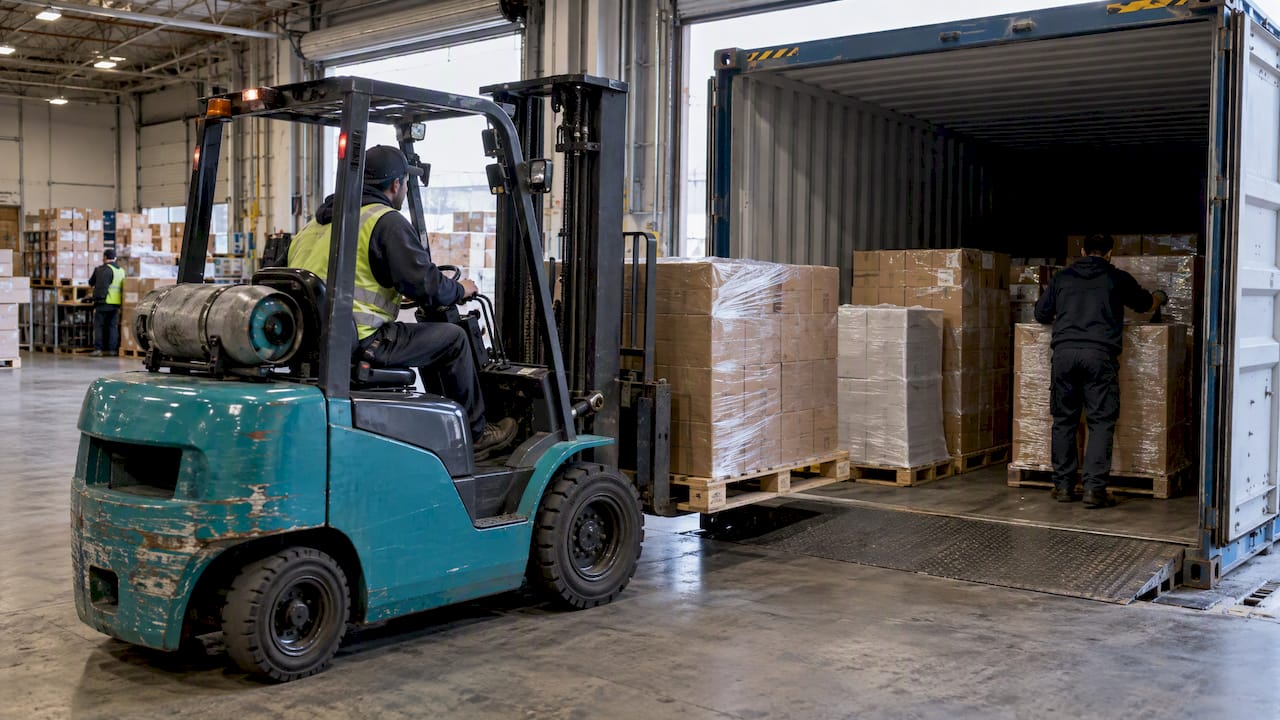
Global shipping and logistics solutions cover the full chain of services that move goods across borders: freight booking, customs clearance, warehousing, last-mile delivery, and the technology that ties them together. For U.S. shippers, the most reliable approach is partnering with an end-to-end provider that holds a vetted global agent network, real-time visibility tools, and licensed customs brokerage access aligned with U.S. Customs and Border Protection requirements and Incoterms 2020 obligations. Supply chain disruptions cost the global economy an estimated $4 trillion between 2020 and 2023, which reframes logistics from a back-office cost center to a core competitive asset. Or-ner offers exactly that end-to-end model for U.S. businesses. If you are ready to get a quote now, contact Or-ner directly at or-ner.com.
Table of Contents
- What services make up global shipping and logistics solutions?
- Why companies hire full-service global logistics partners
- How to evaluate and shortlist global logistics providers
- What does onboarding actually look like?
- Customs, trade compliance, and cross-border risk mitigation
- Which technology features actually move the needle?
- Which industries benefit most from global logistics providers?
- How Or-ner delivers global shipping and logistics solutions
- Key Takeaways
- The part most logistics managers underestimate
- Or-ner: a direct path to reliable global logistics
- Useful sources
- FAQ
What services make up global shipping and logistics solutions?
A full-service provider covers more ground than most buyers initially expect. The core building blocks, and when each one applies, break down like this:
- Ocean freight (FCL/LCL). Full-container-load for high-volume lanes; less-than-container-load when cargo does not fill a box. Best for non-urgent, high-weight, or bulky shipments crossing the Pacific or Atlantic. For a deeper look at multi-modal freight options, Or-ner’s freight guide covers the decision criteria U.S. shippers use most.
- Air freight. Fast, expensive, and weight-sensitive. Use it for time-critical goods, high-value electronics, or when ocean transit times would breach a customer SLA.
- Intermodal and rail. Combines ocean or air with domestic rail for cost-efficient inland moves, especially useful for transcontinental U.S. distribution after port arrival.
- Truckload (FTL) and less-than-truckload (LTL). Domestic ground for final distribution. LTL consolidates smaller shipments; FTL gives dedicated capacity for full loads.
- Last-mile and courier. The final leg to the end customer. Speed and address-level accuracy matter most here, particularly for e-commerce. Or-ner’s ecommerce fulfillment models break down the in-house vs. 3PL trade-offs in detail.
- Warehousing and fulfillment. Storage, pick-and-pack, kitting, and returns processing. Pairs naturally with ocean freight to buffer inventory near demand centers.
- Customs brokerage and trade compliance. Mandatory for U.S. imports. Covers HTS classification, ACE filings, Importer Security Filing (ISF), and partner government agency (PGA) requirements.
- Value-added services. Insurance, kitting, labeling, returns management. Often bundled by full-service providers to reduce the number of vendor relationships a shipper manages.
Pro Tip: For U.S. importers, customs brokerage is not optional. Any provider that cannot demonstrate licensed broker access or ACE portal integration is a gap you will feel at the port.
Why companies hire full-service global logistics partners
The case for outsourcing end-to-end logistics is not just about cost. It is about capacity access, compliance depth, and predictability that most in-house teams cannot replicate at scale.

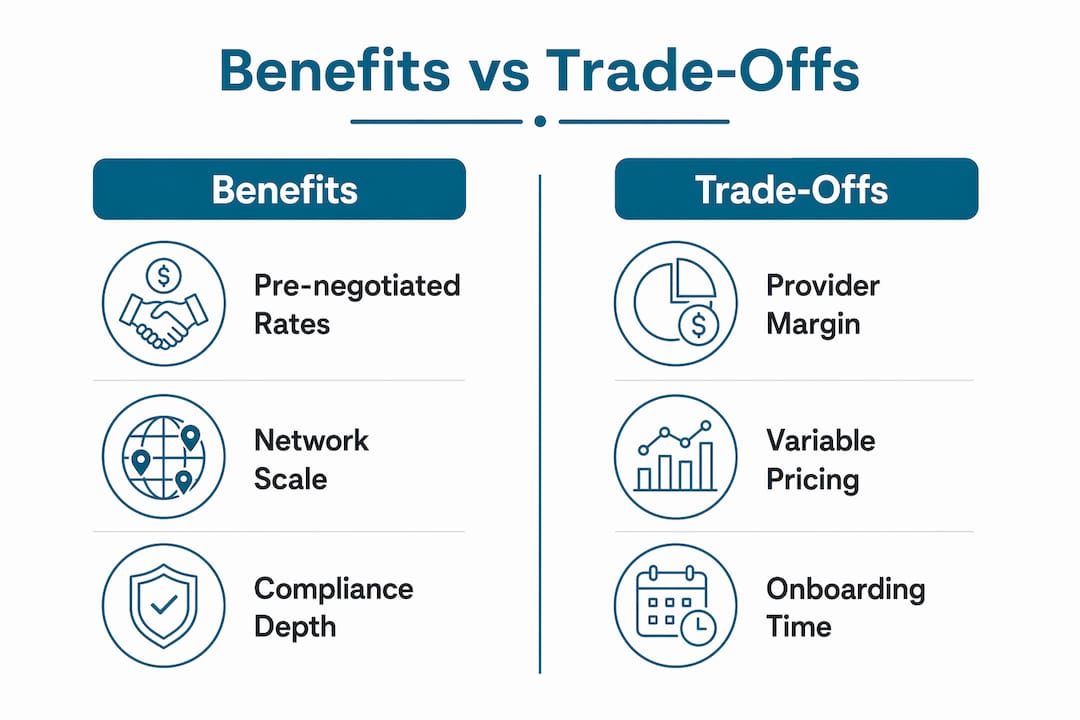
The main benefits are network scale (a global provider has pre-negotiated rates and carrier relationships across dozens of lanes), consolidated billing and claims handling, and compliance expertise that keeps pace with regulatory changes. A KPMG leadership survey found that 38% of supply chain leaders identify logistics and transportation costs as their greatest source of value leakage, 50% plan digital visibility as their top near-term investment, and 77% cite a talent gap in data analytics and technology integration as a top operational risk. A full-service partner addresses both simultaneously.
The trade-offs are real, though. Providers mark up carrier rates, and the margin varies by lane and mode. Onboarding takes time, especially for enterprise accounts with complex ERP integrations. And service-level consistency across lanes is not uniform: a provider that excels on trans-Pacific ocean freight may be weaker on European last-mile.
| Benefit | Trade-off |
|---|---|
| Pre-negotiated carrier rates and capacity | Provider margin on base freight rates |
| Single point of contact for claims and billing | Reduced direct carrier relationships |
| Licensed customs expertise and compliance | Onboarding effort and SOP alignment time |
| Scalable capacity during peak seasons | Service-level variability by lane or region |
| Real-time visibility across modes | Technology integration requirements |
How to evaluate and shortlist global logistics providers
Most shortlist processes fail because they focus on price first. Carrier scoring on on-time delivery, claims rates, and communication responsiveness consistently produces better outcomes than treating selection as a pure price auction, particularly for mid-size shippers.
The evaluation checklist
Run every candidate through five lenses: commercial terms, operational coverage, technology, compliance, and financial stability. For technology specifically, look for control tower visibility with execution authority. Providers with mature control towers have been shown to cut the impact of severe disruptions significantly compared to those with passive tracking only.
Ten questions to ask every provider
- Which lanes do you operate directly, and where do you rely on agent partners?
- What is your average customs clearance time for U.S. imports, and do you file through ACE?
- How do you handle ISF filings, and what is your process when a filing is late?
- What tracking granularity do you provide: milestone-only or continuous carrier EDI/API feeds?
- What is your claims filing process, and what is your average resolution time?
- Do you hold a C-TPAT certification or equivalent security program membership?
- What ERP and marketplace integrations do you support out of the box?
- How do you manage capacity during peak seasons or carrier disruptions?
- Can you provide lane-specific SLA history for the routes we need?
- What is your contingency plan if a primary carrier fails on a critical lane?
How pricing breaks down
Freight costs are only one line item. A realistic budget includes base freight, fuel surcharges, terminal handling charges, documentation fees, customs duties and taxes, and accessorial charges (liftgate, residential delivery, re-delivery). For timelines, air freight typically delivers in 3–7 days door-to-door internationally; ocean freight runs 14–35 days depending on origin and destination port. Domestic LTL adds 2–7 business days after port arrival.
Red flags that rule a vendor out
- No licensed customs broker on staff or on retainer
- Tracking data that updates only at milestones with no carrier-level feed
- Inability to provide lane-specific SLA history
- No documented contingency or rerouting protocol
- Opaque surcharge billing with no itemized breakdown
What does onboarding actually look like?
Onboarding with a full-service provider follows a predictable sequence, though the timeline compresses for smaller shippers and stretches for enterprise accounts.
For a small or mid-size shipper, expect two to four weeks: contract execution, account setup, system credentials, and a test shipment on your highest-volume lane. Enterprise customers with ERP integrations, multi-warehouse setups, and custom SOP requirements typically need eight to twelve weeks before steady-state operations.
The shipment lifecycle itself runs: quote → booking confirmation → pickup scheduling → origin handling → transit (ocean, air, or ground) → customs clearance → destination handling → last-mile delivery → exception management or claims. The customs clearance step is where most delays concentrate. Using CBP’s Automated Commercial Environment (ACE) and broker portals can cut routine clearance times from roughly 48 hours to roughly 12 hours, according to ISF customs broker guidance.
| Shipment stage | Typical SLA | Key documents required |
|---|---|---|
| Booking to pickup | 24–48 hours | Commercial invoice, packing list |
| Ocean transit (Asia–U.S.) | 14–35 days | Bill of lading, ISF filing |
| Air transit (international) | 3–7 days | Air waybill, shipper’s export declaration |
| Customs clearance (U.S. import) | 12–48 hours | Entry summary, HTS classification, PGA certs |
| Last-mile delivery | 1–5 business days | Proof of delivery |
Customs, trade compliance, and cross-border risk mitigation
Compliance is where providers differentiate most sharply, and where gaps cost the most. For U.S. importers, the non-negotiable capabilities to verify are:
- Licensed customs broker access with ACE filing authority
- HTS/HS classification expertise, including PGA handling for FDA, USDA, and FCC-regulated goods
- ISF filing at least 24 hours before vessel departure (the “10+2” rule)
- Continuous bond management to cover duty and tax obligations
- Restricted and prohibited goods screening against CBP and partner agency lists
- De minimis threshold awareness under Section 321 for low-value shipments
For risk mitigation, three levers matter most. First, cargo insurance: standard carrier liability is limited and rarely covers full commercial value, so a separate all-risk marine policy is worth the premium on high-value lanes. Second, bonded warehousing: storing goods in a bonded warehouse defers duty payment until goods enter commerce, which improves cash flow on large import volumes. Third, contractual liability caps: read the provider’s standard terms carefully and negotiate higher liability limits for high-value cargo before the first shipment, not after a loss.
Or-ner’s trade compliance guidance covers the specific documentation and filing requirements U.S. e-commerce shippers face most often.
Which technology features actually move the needle?
The technology gap between providers is wider than most buyers realize at the RFP stage. A tracking portal that shows milestone updates is not the same as a control tower. The features that materially improve operations are:

Control tower with execution authority. Visibility alone is passive. A control tower that can trigger rerouting, carrier swaps, or exception escalations without manual intervention is what Digital Network Assistants and proactive scenario simulation are designed to support. Passive dashboards show you a problem; execution-enabled control towers help you solve it before it becomes a delay.
TMS and WMS integration. A transportation management system handles rate shopping, booking, and carrier dispatch. A warehouse management system controls inventory accuracy and fulfillment throughput. When both connect to your ERP or order management system via API or EDI, manual data entry drops and error rates follow.
Carrier EDI/API feeds. Real-time carrier data, not just provider-generated milestone updates, is the difference between knowing a shipment is delayed and knowing it 18 hours earlier. Or-ner’s shipment tracking capabilities pull carrier-level data into a single dashboard.
The KPIs worth monitoring: on-time delivery rate by lane, dwell time at origin and destination, Perfect Order Recovery Rate, and claims frequency by carrier and mode. These four metrics, tracked monthly, will tell you more about provider performance than any SLA document.
Which industries benefit most from global logistics providers?
Most sectors that source or sell internationally can benefit, but the capability requirements differ sharply by vertical.
- E-commerce and retail. Needs fast last-mile, marketplace integrations (Amazon, Shopify), and returns management. Or-ner’s ecommerce supply chain platform is built specifically for this vertical.
- Manufacturing and automotive. Requires JIT delivery precision, LTL/FTL coordination, and supplier consolidation across multiple origin countries. A “China + One + Local” sourcing model balances cost and resilience better than single-source strategies.
- Perishables and food. Cold-chain compliance, refrigerated LCL/LTL, and USDA/FDA documentation are non-negotiable. Temperature excursion monitoring during transit is a must-have, not a nice-to-have.
- Heavy equipment and project cargo. Requires breakbulk or flat-rack ocean freight, heavy-lift coordination, and route surveys for oversized loads.
- Fashion and apparel. Seasonal velocity spikes, SKU proliferation, and returns volumes make flexible warehousing and fast air freight access critical. Or-ner serves this sector directly, including footwear and home goods.
- Electronics. FCC compliance for imports, ITAR controls for certain exports, and high-value cargo insurance requirements make provider compliance credentials especially important here. Check current shipping destinations for lane-level coverage when evaluating providers for specific markets.
How Or-ner delivers global shipping and logistics solutions
Or-ner operates as an end-to-end logistics platform built for U.S. e-commerce sellers, wholesalers, manufacturers, and global brands. The platform covers freight booking and management, courier and last-mile delivery, customs clearance and documentation, cross-border logistics, warehousing and fulfillment, and ecommerce integrations including Amazon.
| Buyer priority | Or-ner capability |
|---|---|
| Multi-modal coverage | Ocean, air, and ground freight booking |
| Real-time visibility | Carrier-level tracking and exception management |
| Customs compliance | Licensed broker access, ACE filings, HTS classification |
| E-commerce integrations | Amazon, major marketplace and WMS connections |
| Warehousing | Global fulfillment centers with inventory management |
| Onboarding speed | Structured onboarding for small and enterprise accounts |
Key proof points for U.S. shippers evaluating Or-ner:
- End-to-end freight booking across ocean, air, and ground modes
- Real-time shipment tracking with exception alerts and dashboard visibility
- Customs clearance support with documentation management
- Warehousing and fulfillment with inventory control tools
- Industry-specific logistics for apparel, home goods, footwear, toys, and electronics
- Amazon and ecommerce platform integrations for catalog and order management
Or-ner’s cross-border compliance guidance and freight booking tools are available to U.S. shippers across all major import and export lanes.
Key Takeaways
Choosing the right global logistics partner comes down to compliance depth, visibility technology, and carrier relationship quality, not price alone.
| Point | Details |
|---|---|
| Compliance is non-negotiable | Verify licensed customs broker access and ACE filing capability before signing any provider contract. |
| Control towers outperform passive tracking | Providers with execution-enabled control towers reduce disruption impact far more than milestone-only dashboards. |
| Pricing has multiple layers | Budget for freight, surcharges, documentation, duties, and accessorials, not just the base rate. |
| Carrier scoring beats price auctions | Score providers on on-time delivery, claims rates, and responsiveness for better long-term outcomes. |
| Or-ner covers the full chain | Or-ner offers freight booking, customs clearance, warehousing, and ecommerce integrations for U.S. shippers. |
The part most logistics managers underestimate
The biggest mistake I see in provider evaluations is treating technology as a differentiator when it should be a baseline requirement. Every serious freight forwarder now has a portal. What actually separates providers is whether their technology has execution authority, meaning whether it can act on a disruption, not just display one.
The KPMG survey data is blunt: 77% of supply chain leaders cite a talent gap in data analytics and technology integration as a top operational risk, alongside 38% who identify logistics and transportation costs as the greatest source of value leakage, and 50% who plan digital visibility as their top near-term investment. That gap is exactly why outsourcing to a provider with mature control tower capabilities matters more now than it did five years ago. Your internal team cannot build what takes a global provider years to develop.
The practical recommendation: within the next 60–90 days, score your current carriers on three metrics: on-time delivery rate, claims frequency, and average response time to exceptions. That exercise alone will tell you whether your current provider mix is performing or just surviving. If the scores are inconsistent across lanes, that is your signal to consolidate toward a provider with a stronger network and better visibility infrastructure. Building a resilient supply chain starts with knowing exactly where the weak points are.
Or-ner: a direct path to reliable global logistics
Businesses that need end-to-end freight coverage without building a logistics operation from scratch have a clear option in Or-ner. The platform handles everything from freight booking and customs clearance to last-mile delivery and warehouse fulfillment, with real-time tracking and ecommerce integrations built in. For U.S. shippers managing cross-border complexity, that means one point of contact across ocean, air, and ground modes, with compliance support that keeps pace with CBP requirements.
Whether you are moving your first international container or looking to consolidate a fragmented carrier mix, Or-ner’s reliable courier services and freight solutions are available now. Request a quote at or-ner.com and get a scoped proposal for your specific lanes and volumes.
Useful sources
- U.S. Customs and Border Protection: Basic Importing and Exporting — Primary regulatory reference for U.S. import obligations, de minimis rules, and port requirements.
- International Trade Administration: Navigate Shipping and Logistics — Government resource covering export documentation, AES Direct filing, and tariff tools.
- KPMG: The State of Next-Gen Supply Chain — Leadership survey on logistics cost leakage, digital investment priorities, and talent gaps.
- Modern Materials Handling: Supply Chain & Logistics Guide — Comprehensive operational guide covering carrier management, disruption costs, and logistics strategy.
- ISF Customs Broker: Step-by-Step U.S. Customs Clearance — Practical walkthrough of ACE filings, ISF timing, and clearance process steps.
- Or-ner: Global Logistics Solutions for E-Commerce — Or-ner’s platform overview covering freight, fulfillment, and customs capabilities for U.S. shippers.
- Supply Chain Management Best Practices: 2026 Guide — Covers control tower design, multi-nodal network planning, and resilience strategies.
FAQ
What do global shipping and logistics solutions include?
They cover the full movement of goods across borders: ocean and air freight, ground transport, customs clearance, warehousing, last-mile delivery, and the tracking technology that connects each stage.
How long does international freight take from the U.S.?
Air freight typically delivers in 3–7 days internationally; ocean freight runs 14–35 days depending on origin and destination, with domestic last-mile adding 1–5 business days after port arrival.
What compliance filings do U.S. importers need?
U.S. importers must file an Importer Security Filing (ISF) at least 24 hours before vessel departure and submit entry documentation through CBP’s ACE system, including HTS classification and any partner government agency certificates.
How does Or-ner support U.S. shippers?
Or-ner provides end-to-end freight booking, customs clearance, real-time tracking, warehousing, and ecommerce integrations across ocean, air, and ground modes, with coverage for U.S. import and export lanes.
How do I choose between air and ocean freight?
Use air freight for time-sensitive or high-value shipments where 3–7 day transit justifies the cost premium; use ocean freight for high-volume, non-urgent cargo where 14–35 day transit and lower per-unit cost are the priority.