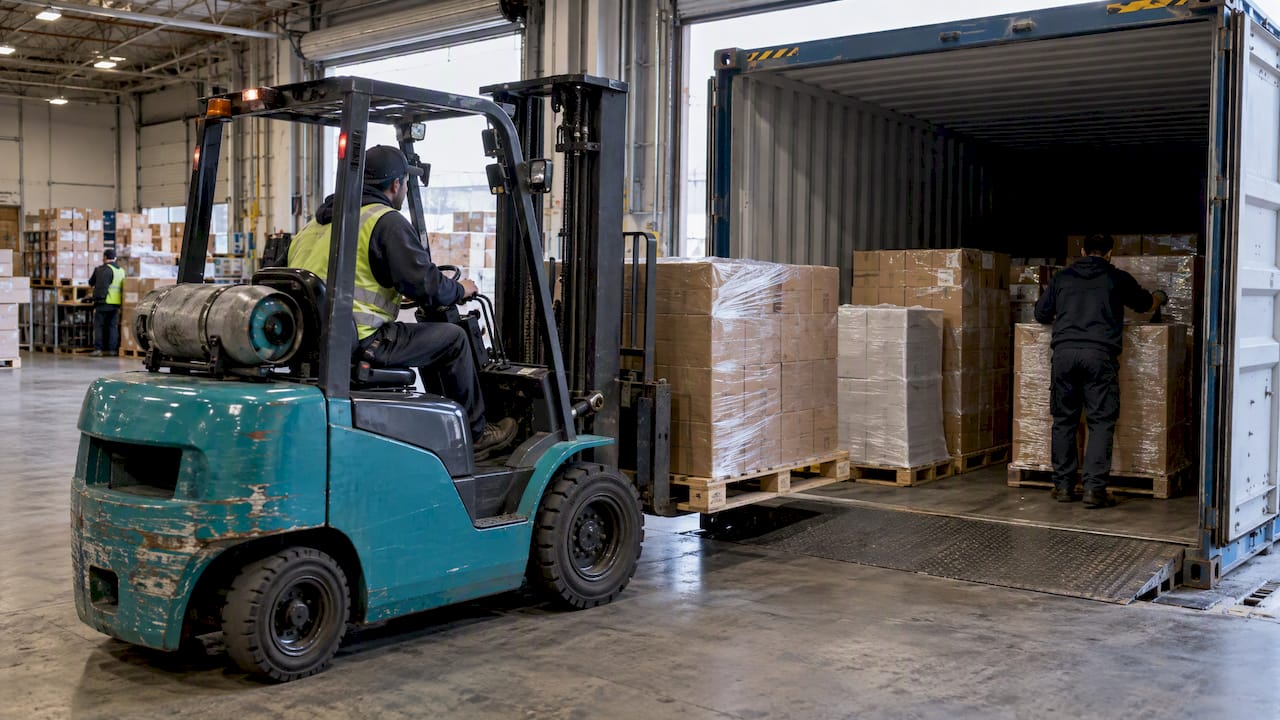
Yes — Or-ner delivers end-to-end integrated global logistics for US ecommerce sellers, covering freight booking, warehousing, fulfillment, last-mile courier, customs clearance, and real-time analytics through one coordinated platform.
Or-ner’s core service stack for US ecommerce: inbound freight booking (ocean, air, land), warehouse receiving and inventory placement, pick and pack, last-mile courier delivery, customs clearance and documentation, cross-border shipping, and shipment tracking with exception management. To start a pilot, visit Or-ner’s global logistics platform and submit your SKU list and weekly order volume.
- Freight booking and management across ocean, air, and land
- Warehousing, receiving, and inventory placement
- Pick, pack, and last-mile courier delivery
- Customs clearance, HS coding, and trade documentation
- Real-time shipment tracking and analytics
- Cross-border logistics for US-India and other international lanes
Key Takeaways
Integrated global logistics for US ecommerce sellers requires a unified operating model covering freight, warehousing, last-mile, customs, and data orchestration — and Or-ner delivers that through a single platform with a 4–6 week pilot path.
| Point | Details |
|---|---|
| Integration cuts cost-to-serve | Sellers typically spend 15%–20% of revenue on shipping; distributed fulfillment and multi-carrier routing reduce that figure. |
| Zone-skipping saves $2–$5 per parcel | Consolidating volume on a linehaul lane bypasses two to four carrier zones at $0.08–$0.14/lb linehaul cost. |
| OMS is the control point | Real-time inventory sync under five seconds and automated routing rules are the minimum spec for any orchestration layer. |
| Shopify stays as your order control plane | Or-ner connects via API without replatforming; inventory and tracking sync back to Shopify automatically. |
| Or-ner pilot takes 4–6 weeks | Start with one to three SKUs and one origin lane; submit your SKU list and weekly volume to begin. |
Table of Contents
- What does integrated logistics actually mean for ecommerce operators?
- Why integrated logistics cuts costs for US ecommerce sellers
- What tech stack and partner types do you actually need?
- Which fulfillment model fits your business right now?
- A 5-step rollout plan that keeps your current systems live
- How do you connect Or-ner to Shopify without rebuilding anything?
- Cross-border essentials: customs, duties, DDP vs. DDU, and returns
- Which KPIs should you track and what should your partner report?
- Common failure modes and how to catch them early
- How Or-ner delivers the capabilities described above
- Or-ner’s background and credibility as a global logistics provider
- US-India cross-border shipping options and transit times
- What does Or-ner’s pricing structure look like?
- How does the Or-ner onboarding process work?
- What is a realistic implementation timeline?
- What actually improves first when you run an Or-ner pilot
- Ready to run a pilot with Or-ner?
- Sources
- FAQ
What does integrated logistics actually mean for ecommerce operators?
Integrated logistics unifies inbound freight, warehousing, order fulfillment, last-mile delivery, and returns into a single coordinated operating model — rather than stitching together five separate vendor relationships that never talk to each other.
In practice, that means every function below runs from shared data:
- Inbound freight: ocean or air shipments from suppliers, booked and tracked centrally
- Warehousing and receiving: inventory checked in against purchase orders in a WMS
- Inventory placement: stock distributed across nodes based on demand signals
- Pick and pack: orders pulled and packed per carrier spec
- Carrier handoff and last-mile: routed to the right carrier based on zone, speed, and cost
- Returns processing: reverse logistics handled back into sellable inventory
- Data orchestration: a single feed connecting all of the above
| Component | Tool or partner type that controls it |
|---|---|
| Inbound freight | TMS or freight broker/forwarder |
| Warehousing and receiving | WMS (Warehouse Management System) |
| Order routing and exceptions | OMS (Order Management System) |
| ERP sync and financials | ERP (NetSuite, SAP, etc.) |
| Carrier handoff | Carrier APIs (UPS, FedEx, regional) |
| Analytics and visibility | Reporting layer or platform dashboard |
Why integrated logistics cuts costs for US ecommerce sellers
Fragmented logistics is expensive. Sellers who treat fulfillment and transportation as separate problems end up with split shipments, redundant carrier fees, and inventory sitting in the wrong warehouse when demand spikes on the coasts.
The business case for integration comes down to four outcomes:
- Lower cost-to-serve: coordinated inventory placement reduces the average shipping zone per order
- Fewer split shipments: a single routing layer prevents one order from shipping in three boxes from three locations
- Faster order-cycle times: automated handoffs between WMS and carrier APIs cut processing time
- Resilience: multi-node networks absorb a single-warehouse disruption without stopping fulfillment
Ecommerce sellers typically spend 15%–20% of revenue on shipping and fulfillment. Multi-carrier strategies and distributed fulfillment networks can reduce shipping expenses significantly. Zone-skipping — consolidating volume on a linehaul truck to bypass two to four carrier zones — saves roughly $2–$5 per parcel on qualifying lanes, at a linehaul cost of $0.08–$0.14/lb.
Cost signal to watch: if your split-shipment rate exceeds 15% of orders, you are almost certainly paying double the carrier fees you should be.
What tech stack and partner types do you actually need?
The orchestration layer is the control point. Everything else feeds into it or executes from it.
- OMS: routes orders, manages exceptions, holds routing rules — the operational backbone. Real-time inventory sync under five seconds, automated routing rules, and multi-warehouse visibility are the minimum spec.
- WMS: controls receiving, putaway, pick, pack, and cycle counts inside the warehouse
- TMS: manages carrier selection, rate-shopping, and freight booking
- ERP: syncs financials, purchase orders, and supplier data
- Carrier APIs: execute the last-mile handoff and return tracking events
- Analytics layer: surfaces cost-per-parcel, on-time rate, and exception trends
Ownership typically breaks down like this: a 3PL owns WMS and physical execution; the seller or an OMS vendor owns routing logic; a 4PL or platform like Or-ner can own the full orchestration layer including freight and customs.
Integration data-sync checklist — map these before go-live:
- Inventory levels (real-time, per node)
- Order status (created, picked, shipped, delivered)
- Tracking events (carrier scan data back to OMS and storefront)
- SKU master data (dimensions, weight, HS codes)
- Returns status (initiated, received, restocked)
Pro Tip: Small sellers most often miss event latency in their data mapping. A five-minute lag between a carrier scan and your OMS update sounds trivial until a customer service rep is looking at stale tracking data and issuing a refund on a package that delivered an hour ago.
Which fulfillment model fits your business right now?
Shopify’s shipping operations guide covers four models. Here is the honest version of when each one makes sense:
In-house fulfillment works below roughly 200 orders per month. You control everything, costs are predictable, and the operational complexity is manageable. The risk: you hit a volume spike and the wheels come off.
3PL becomes the right call when expedited shipments are eating margin, your split-shipment rate is climbing, or you are missing SLAs more than once a month. Expect a 4–8 week transition. See Or-ner’s 3PL guide for online retailers for a full breakdown of what to hand off and what to keep.
Hybrid suits sellers with a flagship SKU that moves fast enough to justify in-house pick-pack, plus a long tail that a 3PL handles more efficiently. It adds coordination overhead but protects margin on your core product.
Dropship removes inventory risk entirely but surrenders control over pack quality, transit time, and returns. Use it for product testing or low-velocity SKUs, not as a primary fulfillment strategy.
A 5-step rollout plan that keeps your current systems live
The goal is coordinated operations without ripping out what already works. Most sellers can reach a live pilot in 6–10 weeks following this sequence:
- Map your current network (weeks 1–2): document every warehouse node, carrier contract, and data feed. Identify where inventory data breaks down between systems.
- Define customer promises and SLAs (week 2–3): set delivery windows by region, carrier, and product type before touching any tech. Undefined SLAs are the single most common rollout failure.
- Build your inventory strategy (weeks 3–4): decide which SKUs go to which nodes based on velocity and geography. Use inventory placement best practices to reduce average shipping zone.
- Choose your orchestration layer (weeks 4–5): OMS, 4PL platform, or a unified logistics platform like Or-ner. This is the decision that determines how much integration work you do once vs. repeatedly.
- Integrate execution partners and run a pilot (weeks 5–10): connect carrier APIs, sync inventory feeds, and run 50–100 live orders before scaling. Define pilot success criteria upfront: on-time rate above 95%, zero split shipments on single-SKU orders, tracking sync latency under five minutes.
Risk mitigations for the first 90 days:
- Lock SLAs in writing before integration starts
- Run parallel inventory counts for the first two weeks to catch data drift
- Assign one owner per vendor relationship to prevent accountability gaps
How do you connect Or-ner to Shopify without rebuilding anything?
Shopify can stay as your order control plane while Or-ner handles orchestration and execution. No replatforming required.
The required data flows are:
- Orders out: Shopify pushes new orders to Or-ner or the 3PL via webhook or API
- Inventory in: Or-ner pushes available inventory counts back to Shopify in near-real time
- Tracking in: carrier scan events flow back to Shopify so customers see live status
- Returns out: return requests initiated in Shopify trigger a reverse-logistics workflow in Or-ner
Integration flow example:
- Customer places order on Shopify
- Shopify webhook fires to Or-ner’s OMS
- Or-ner routes to the nearest fulfillment node and carrier
- Carrier scan events sync back to Shopify order timeline
- Delivery confirmation closes the loop; return label generated on request
Pro Tip: *Keep Shopify as the single source of truth for inventory numbers the customer sees. Or-ner’s WMS holds the physical count; Shopify holds the sellable buffer.
Cross-border essentials: customs, duties, DDP vs. DDU, and returns
Three things determine whether a cross-border shipment clears smoothly or sits in a customs queue for a week: accurate paperwork, a clear duties decision at checkout, and a returns plan that does not require the buyer to pay to ship back internationally.
Required customs documents for every international shipment:
- Commercial invoice (declared value, seller and buyer details)
- HS (Harmonized System) codes for every SKU
- Country of origin declaration
- Packing list (weights, dimensions, quantities)
- Any applicable export/import licenses
DDP vs. DDU: Delivered Duty Paid means the seller collects duties at checkout and handles customs on the buyer’s behalf. Delivered Duty Unpaid pushes that cost and friction to the buyer at delivery. For consumer ecommerce, DDP almost always converts better and reduces delivery failure rates. Or-ner supports customs clearance workflows including DDP handling for cross-border lanes.
For returns, set a refund-without-return threshold for low-value items (typically under $20–$30) and establish regional return hubs for higher-value goods. Or-ner’s global fulfillment network supports regional return consolidation.

Pro Tip: Assign HS codes at the product-catalog level, not at shipment time. Codes assigned under time pressure at booking are the leading cause of customs delays and misdeclared-value penalties.
| Document | Who prepares it | Common error |
|---|---|---|
| Commercial invoice | Seller | Declared value too low |
| HS code | Seller/forwarder | Wrong 6-digit classification |
| Packing list | Warehouse | Weight mismatch with invoice |
| Country of origin | Seller | Missing or inconsistent |
Which KPIs should you track and what should your partner report?
| KPI | Target range | Reporting cadence |
|---|---|---|
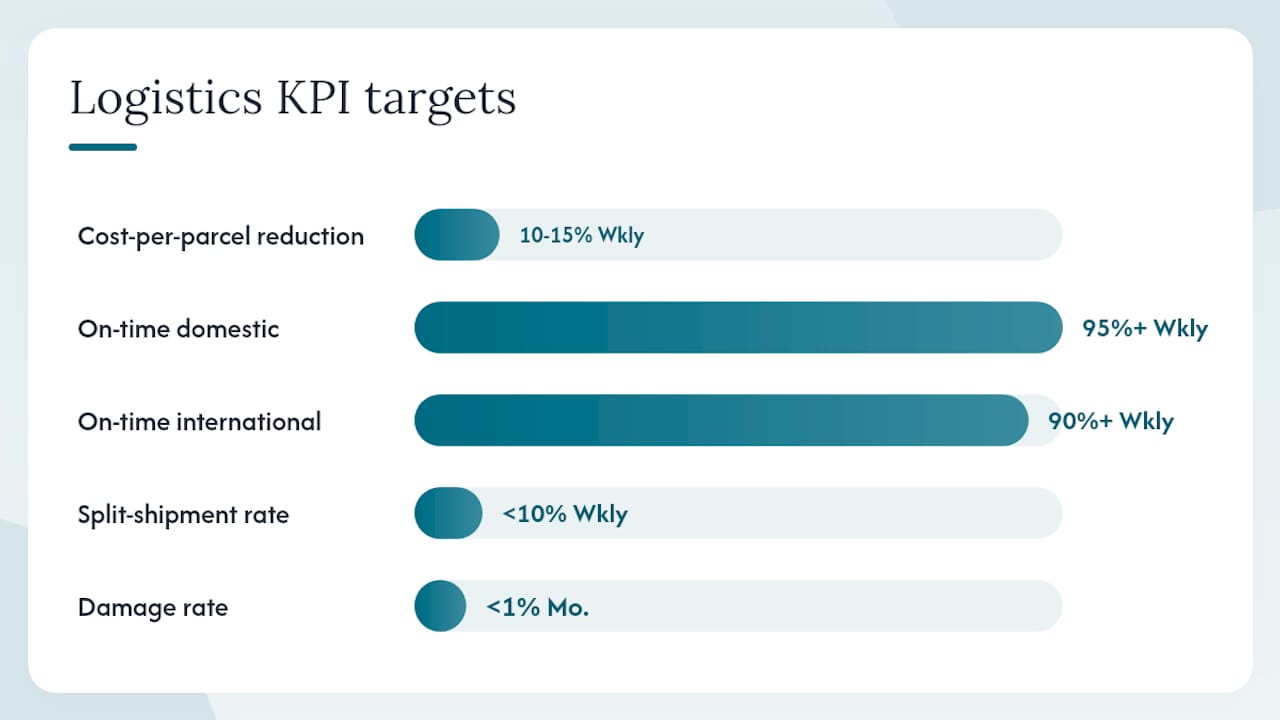
| Cost-per-parcel | Baseline minus 10%–15% after integration | Weekly |
| On-time delivery rate | 95%+ domestic, 90%+ international | Weekly |
| Split-shipment rate | Below 10% | Weekly |
| Returns rate | Category-dependent | Monthly |
| Damage rate | Below 1% | Monthly |
Require these from any logistics partner: near-real-time shipment visibility, a weekly freight spend breakdown by carrier and lane, and a monthly carrier performance scorecard. Or-ner’s platform supports analytics and exception management across all active shipments.
Common failure modes and how to catch them early
Vendor silos and stale inventory data cause most rollout failures. When your WMS, OMS, and carrier APIs are not sharing the same data in near-real time, every downstream decision is wrong by definition.
Red flags to watch during the first 90 days:
- Inventory counts in Shopify diverging from WMS by more than 2%
- Exception rate above 5% of orders (missing scans, address failures, carrier rejections)
- No carrier performance scorecard from your 3PL after 30 days
- All fulfillment running through a single warehouse node with no backup
Mitigation checklist:
- Require a data-sync SLA (inventory updates within five minutes of a warehouse event)
- Run weekly exception reviews with your 3PL for the first three months
- Test failover routing to a secondary node before going live at scale
- Negotiate carrier capacity commitments in writing, not verbally
The single most expensive mistake in logistics rollouts is skipping the SLA definition step. Teams that define delivery promises after integration starts spend the next six months renegotiating contracts and explaining delays to customers.
How Or-ner delivers the capabilities described above
Or-ner provides a unified logistics and supply chain platform covering freight booking, courier and last-mile delivery, warehousing, customs clearance, and analytics — purpose-built for ecommerce sellers.
Service ownership breakdown:
- Freight booking: Or-ner-managed across ocean, air, and land modes
- Warehousing and fulfillment: Or-ner’s global network of fulfillment centers
- Last-mile courier: Or-ner-coordinated carrier handoff with tracking sync
- Customs clearance: Or-ner-managed documentation and DDP/DDU handling
- Analytics and exceptions: Or-ner platform dashboard with real-time visibility
Onboarding steps:
- Submit SKU list, dimensions, weights, and weekly order volume
- Share origin and destination lanes (including US-India if applicable)
- Connect Shopify via API or webhook
- Define SLAs and inventory placement strategy with Or-ner’s team
- Run a pilot on 1–3 SKUs before scaling
Typical time to first live pilot: 4–6 weeks from initial intake.
Or-ner’s background and credibility as a global logistics provider
Or-ner operates as a full-service logistics and supply chain platform, serving ecommerce sellers, wholesalers, manufacturers, and global brands across sectors including apparel, home goods, footwear, toys, and musical instruments. The platform covers ocean, air, and land transport modes and integrates with major ecommerce operators including Amazon.
Or-ner’s infrastructure includes a global network of warehouses and fulfillment centers designed for cross-border trade, with dedicated support for customs clearance, trade documentation, and carrier management. The platform’s analytics layer provides exception management and real-time communication tools that give operations teams visibility across every active shipment. For sellers evaluating logistics services in India or US-India cross-border lanes specifically, Or-ner’s international freight capabilities cover both inbound and outbound flows.
US-India cross-border shipping options and transit times
For US ecommerce sellers sourcing from India or selling into the Indian market, Or-ner supports both inbound freight (India to US) and outbound ecommerce shipping (US to India buyers).
Inbound freight (India to US):
- Ocean freight (FCL/LCL): typically 18–30 days port-to-port depending on origin port (Mumbai, Chennai, JNPT) and US destination port
- Air freight: typically 3–7 days for standard air, 1–3 days for express, at a significantly higher cost per kilogram
Outbound ecommerce (US to India buyers):
- Express courier: 3–7 business days via international express services
- Economy air: 7–14 business days, lower cost per parcel
- Postal/economy: 14–30 days, lowest cost, higher variability
Or-ner’s customs clearance support covers both directions, including India’s import documentation requirements and US CBP export filings. Transit times vary by origin-destination pair, declared value, and customs processing speed at the destination port.
What does Or-ner’s pricing structure look like?
Or-ner does not publish a flat-rate price list publicly, which is standard for logistics platforms where cost depends on volume, lane, service level, and SKU characteristics. Total cost of an end-to-end engagement typically includes:
- Freight cost: based on weight, volume, mode, and lane
- Warehousing: per-pallet or per-cubic-foot storage fees plus receiving charges
- Pick and pack: per-order or per-unit handling fees
- Customs and documentation: per-shipment clearance fees
- Platform access: may be included or billed separately depending on volume tier
The most accurate way to evaluate total cost is to request a lane-by-lane quote with your actual SKU dimensions and weekly order volume. Or-ner’s team builds custom proposals based on that intake. For context on where cost savings typically appear, cloud logistics platforms can deliver meaningful efficiency gains for ecommerce sellers who consolidate freight and fulfillment under one provider.
How does the Or-ner onboarding process work?
Onboarding with Or-ner follows a structured intake process designed to get a pilot live without a lengthy procurement cycle.
What you need to provide:
- Complete SKU list with dimensions, weights, and HS codes
- Expected weekly order volume and peak-season projections
- Origin and destination lanes (domestic US, US-India, or other international)
- Shopify store access (read/write API credentials) or other platform credentials
- Current carrier contracts (for benchmarking and transition planning)
What Or-ner’s team does with that information:
- Proposes a fulfillment node strategy based on your demand geography
- Quotes freight and fulfillment costs by lane
- Designs the Shopify integration and data-sync architecture
- Defines pilot scope and success criteria
The process is iterative. Most sellers complete intake in one to two working sessions before moving to technical integration.
What is a realistic implementation timeline?
From first conversation to a live pilot, Or-ner’s typical timeline runs 4–6 weeks for straightforward setups (one to three SKUs, one origin, domestic US or US-India lanes). More complex configurations — multiple warehouse nodes, ERP integration, or high-SKU catalogs — run 8–12 weeks.
Week-by-week breakdown:
- Weeks 1–2: intake, SKU data collection, lane analysis, and commercial proposal
- Weeks 2–3: SLA definition, inventory placement strategy, and Shopify API connection
- Weeks 3–5: warehouse receiving, inventory setup, and test order runs
- Weeks 5–6: pilot go-live with 50–100 live orders, KPI monitoring, and exception review
- Weeks 6+: scale-up based on pilot results and carrier performance data
The 90-day mark is when most sellers have enough data to make a confident decision about full-scale transition.
What actually improves first when you run an Or-ner pilot
The first thing that gets better is visibility. Before integration, most sellers are stitching together carrier emails, WMS exports, and Shopify order notes to figure out where a shipment is. Within the first two weeks of a pilot, that collapses into one dashboard.
Cost improvements take longer. Zone-skipping savings and carrier renegotiation gains typically show up in weeks 6–10, once Or-ner’s team has enough lane data to optimize routing. The split-shipment rate usually drops within the first month once inventory placement is corrected.
Realistic expectations: a pilot covering 50–100 orders will surface your three biggest operational gaps. It will not fix all of them immediately. What it will do is give you a clear picture of where the money is leaking and a partner who can close those gaps systematically.
Ready to run a pilot with Or-ner?
Or-ner gives US ecommerce sellers a single platform for freight booking, warehousing, last-mile courier, customs clearance, and cross-border shipping — without requiring a full stack rebuild. The pilot scope is deliberately small: one to three SKUs, one origin, and your highest-volume destination lanes.
What Or-ner needs to start: your SKU list with dimensions and weights, weekly order volume, and Shopify API access. From that intake, the team builds a lane-by-lane cost proposal and a Shopify integration plan within five business days.
Visit Or-ner’s global logistics platform to submit your pilot request and get a custom freight and fulfillment quote.
Sources
Key references used in this guide:
- What is Integrated Logistics? A Practical Guide for Ecommerce Operators (2026) – Shopify
- How to Build a Domestic Freight Strategy That Cuts Shipping Costs in 2026 – Ecommerce Times
- Ecommerce and Supply Chain Management Guide (2026) – Nventory
FAQ
What is integrated logistics for ecommerce?
Integrated logistics unifies inbound freight, warehousing, fulfillment, last-mile delivery, and returns under one coordinated operating model, so inventory data, order routing, and carrier handoffs share a single data feed rather than running as separate systems.
Can Or-ner connect directly to Shopify?
Yes. Shopify stays as the order control plane while Or-ner handles orchestration and execution via API or webhook; orders, inventory counts, and tracking events sync automatically without requiring a platform rebuild.
How long does it take to go live with Or-ner?
A standard pilot covering one to three SKUs and one origin lane typically goes live in 4–6 weeks from intake; more complex multi-node or ERP-integrated setups run 8–12 weeks.
What documents are required for US-India cross-border shipping?
Every international shipment requires a commercial invoice, HS codes for each SKU, a country of origin declaration, and a packing list; Or-ner manages customs clearance and DDP handling for both inbound and outbound US-India lanes.