Manual freight forwarding creates bottlenecks that cost ecommerce businesses real money. A single incorrect invoice can delay shipments by days, triggering penalties and eroding customer trust. Electronic Data Interchange (EDI) replaces paper-based processes with secure, automated document exchange, cutting errors by up to 40% while accelerating every transaction. This guide shows you how EDI transforms freight forwarding operations, what standards matter most, and the measurable savings you can expect in 2026.
Table of Contents
- What Is EDI And How Does It Transform Freight Forwarding?
- Understanding EDI Standards In Freight Forwarding: X12 Vs. EDIFACT
- Key Benefits And Cost Savings Of EDI In Freight Forwarding
- How EDI Freight Forwarding Transactions Work From Start To Finish
- Enhance Your Ecommerce Freight Forwarding With Reliable Logistics Services
Key takeaways
| Point | Details |
|---|---|
| Error reduction | EDI automates freight documentation, reducing errors by up to 40% and eliminating manual data entry mistakes. |
| Cost savings | Implementing EDI can cut order processing costs by 30% while saving $1.50 to $4.00 per document. |
| Global standards | X12 dominates North America while EDIFACT leads in Europe and Asia, both enabling seamless international freight coordination. |
| Supply chain visibility | EDI improves supply chain visibility by 25%, enabling faster decision-making and proactive exception management. |
| Compliance benefits | Timely, accurate advance shipping notices (ASNs) reduce chargebacks and penalties from trading partners and carriers. |
What is EDI and how does it transform freight forwarding?
Electronic Data Interchange (EDI) is a secure communication standard that lets businesses exchange documents like purchase orders, invoices, and shipping notices electronically instead of through paper or email. For freight forwarding, this means automating workflows and streamlining operations across maritime shipping, trucking, air cargo, and multimodal transport. EDI eliminates the manual keying errors that plague traditional processes, ensuring data accuracy from origin to destination.
The EDI transaction process follows six core steps. First, you prepare business documents in your internal system. Next, EDI software maps your data fields to standardized formats. The system then translates mapped data into EDI syntax like X12 or EDIFACT. After translation, documents transmit securely to trading partners via direct connections or value-added networks (VANs). Your partner’s system receives and validates the incoming data against business rules. Finally, validated transactions integrate automatically into their ERP or warehouse management system, triggering fulfillment actions without human intervention.
Freight forwarding subindustries gain specific advantages from EDI adoption:
- Maritime carriers coordinate container bookings and bill of lading documents instantly with port authorities and customs
- Trucking companies transmit load tenders and delivery confirmations in real time, optimizing route planning
- Air cargo operators share weight manifests and hazardous materials declarations accurately, avoiding regulatory delays
- Third-party logistics providers synchronize inventory movements across multiple warehouses and clients seamlessly
The tangible benefits reshape your bottom line. EDI reduces manual data errors that cause shipment delays and financial disputes. Document exchange happens in seconds rather than hours or days, accelerating your entire supply chain cycle. Operational costs drop as staff shift from data entry to strategic tasks. You also gain audit trails that simplify compliance reporting and dispute resolution.
Pro Tip: Prioritize selecting EDI software supporting seamless integration with your existing ERP for maximum benefits. Native connectors eliminate middleware complexity and reduce implementation time by weeks.
Understanding how EDI works in modern logistics prepares you to choose the right standards and implementation approach for your freight operations.
Understanding EDI standards in freight forwarding: X12 vs. EDIFACT
Two primary EDI standards dominate global freight forwarding, and selecting the right one depends on your trading partners’ locations and industry conventions. ANSI ASC X12 organizes data into hierarchical segments with specific element delimiters, making it straightforward for developers familiar with structured programming. X12 is the predominant standard in North America, especially for retail, manufacturing, and transportation sectors. If your freight operations primarily serve US or Canadian markets, X12 transaction sets like 940 (warehouse shipping order) and 945 (warehouse shipping advice) become your daily language.
UN/EDIFACT uses a more compact syntax with fewer characters per transaction, reducing transmission costs and bandwidth requirements. EDIFACT is widely adopted internationally, particularly throughout Europe, Asia, and Latin America. The standard supports multilingual character sets, making it ideal for cross-border freight forwarding where documents must comply with diverse regulatory requirements. IFTMIN (freight booking instruction) and IFTSTA (freight status report) messages handle most international shipping scenarios efficiently.

| Feature | X12 | EDIFACT |
|---|---|---|
| Primary region | North America | Europe, Asia, global |
| Syntax style | Hierarchical segments | Compact, message-based |
| Character efficiency | Moderate | High |
| Multilingual support | Limited | Extensive |
| Best for | Domestic US logistics | International freight |
| Common transaction sets | 940, 945, 214, 210 | IFTMIN, IFTSTA, INVOIC |
Usage patterns vary by logistics sector and geographic focus. Maritime freight forwarders working transatlantic routes often maintain both X12 and EDIFACT capabilities to serve diverse customer bases. Air cargo operators flying US domestic routes standardize on X12, while those serving Asia-Pacific hubs implement EDIFACT exclusively. Trucking companies focused on North American cross-border trade typically support X12 for consistency with major retailers and manufacturers.
Common challenges in standards compliance include:
- Trading partners requiring different message versions within the same standard
- Custom data fields added by large retailers that fall outside standard specifications
- Validation rules varying between VANs and direct EDI connections
- Maintaining separate translation maps for each partner’s unique implementation
Adapting to trading partner preferences demands flexible EDI software with robust mapping tools. You need systems that store multiple partner profiles and automatically select the correct format based on recipient. Testing capabilities become critical when onboarding new partners, as their interpretation of standard segments may differ from yours. Successfully managing these variations determines whether EDI delivers promised efficiency gains or creates new bottlenecks.
Mastering freight forwarding documentation processes helps you identify which transactions need EDI automation most urgently.
Key benefits and cost savings of EDI in freight forwarding
Financial impact drives EDI adoption faster than any technical advantage. Aberdeen Group research shows EDI implementation reduces order processing costs by 30% while improving order accuracy by 20%, translating to measurable savings within months of deployment. For a mid-sized freight forwarder processing 500 shipments monthly, this means recovering $15,000 to $20,000 annually in labor costs alone. The accuracy improvement eliminates costly rework cycles where staff must correct and resubmit rejected documents.
Document handling economics shift dramatically with automation. Manual processing costs between $5 and $10 per document when you factor in data entry time, error correction, and filing. EDI reduces per-document costs to $1.50 to $4.00, depending on transaction complexity and volume. At 6,000 annual shipments, the savings reach $24,000 to $51,000 yearly. These figures exclude the hidden costs of delayed shipments and customer service calls triggered by manual errors.
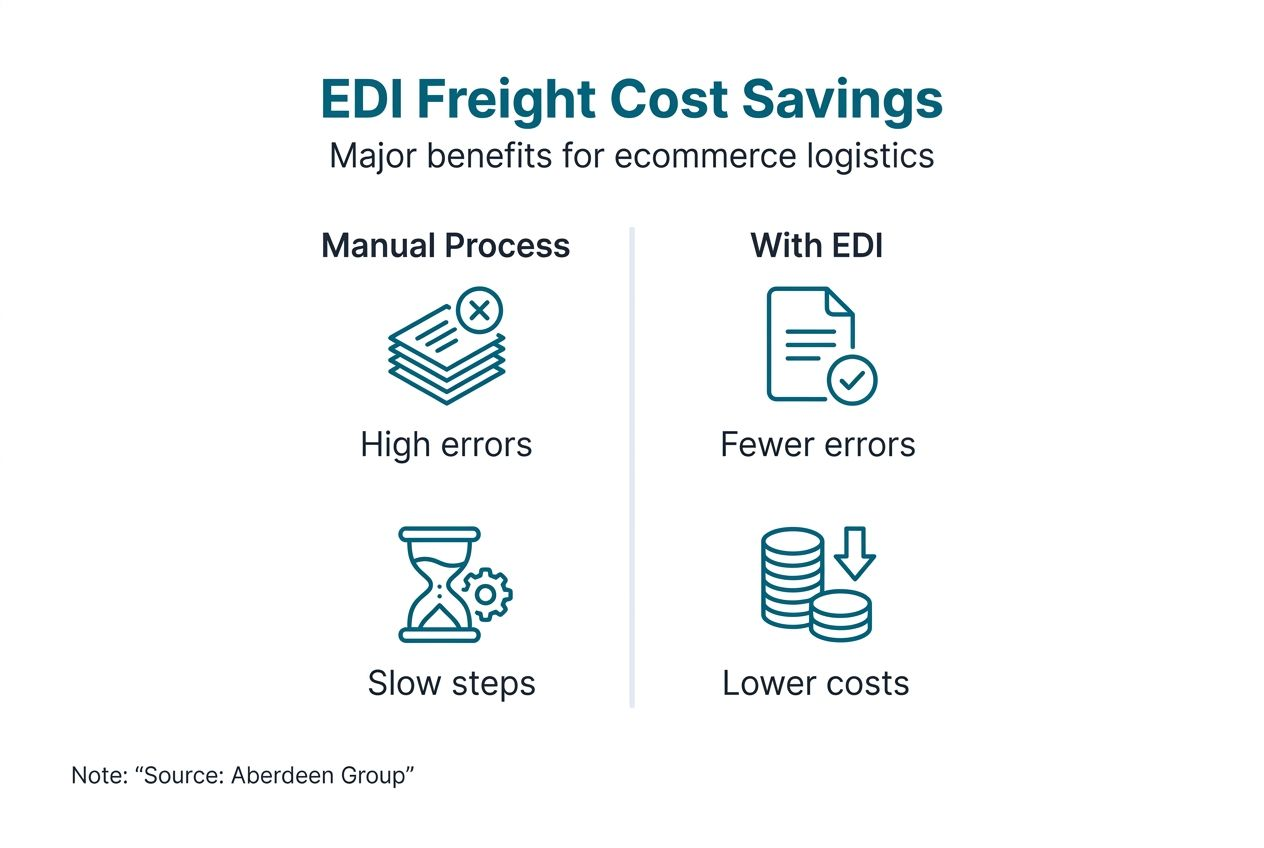
Commport case studies reveal processing costs drop 35% to 90% after EDI deployment, with error rates falling 30% to 40% simultaneously. Aviation freight forwarders see the highest gains because air cargo documentation demands exceptional accuracy for safety and customs compliance. A single digit error in a hazardous materials declaration can ground a shipment for days, costing thousands in demurrage fees and customer goodwill.
Productivity improvements compound cost savings:
- Invoice processing accelerates by 15%, freeing accounts payable staff for vendor negotiations and exception handling
- Supply chain visibility increases 25%, enabling proactive responses to delays before they cascade into customer service issues
- Shipment status updates reach customers automatically, reducing inquiry calls to your service desk by 40%
- Customs clearance documents submit instantly to border authorities, cutting crossing times and detention charges
Penalty avoidance delivers immediate ROI that executives notice. Major retailers impose chargebacks ranging from $50 to $500 per incorrect ASN or late invoice submission. Freight forwarders serving these customers face penalty exposure reaching tens of thousands monthly without EDI accuracy controls. Automated validation flags errors before transmission, preventing chargebacks entirely. Your trading partner relationships strengthen as you consistently meet their data quality standards.
Error reduction improves partner trust in ways that unlock new business opportunities. When carriers and warehouses receive clean data consistently, they prioritize your shipments during capacity crunches. You gain preferred status that translates to better rates and service levels. Customers refer you to peers because your accurate documentation makes their procurement teams look good to their executives.
Pro Tip: Use automated validation tools within EDI to flag errors before transmission, avoiding costly rejections. Configure rules that check weight calculations, address formatting, and required field completeness specific to each trading partner’s requirements.
Understanding what supply chain visibility means helps you leverage EDI data for strategic advantage beyond cost reduction.
How EDI freight forwarding transactions work from start to finish
EDI transactions follow a predictable seven-step path that converts internal data into standardized formats your trading partners can consume automatically. Understanding each stage helps you troubleshoot issues quickly and optimize system performance. Failures at any point can trigger shipment delays and partner disputes, making robust error handling essential.
-
Preparation: Your ERP or transportation management system generates a business document like a booking request or invoice. The system validates internal business rules, ensuring all required fields contain properly formatted data before EDI processing begins.
-
Mapping: EDI middleware extracts data from your internal document structure and maps each field to corresponding EDI segments. This translation layer accounts for differences between your database schema and standard EDI formats.
-
Translation: Mapped data converts into X12 or EDIFACT syntax with proper delimiters, segment identifiers, and control structures. The translator applies your trading partner’s specific requirements, adding or suppressing optional fields based on their profile.
-
Transmission: The formatted EDI document transmits to your partner via VAN, AS2 connection, or SFTP. Encryption and authentication protocols ensure document security and non-repudiation during transit.
-
Receipt: Your partner’s EDI system receives the transmission and generates a functional acknowledgment (997 in X12, CONTRL in EDIFACT) confirming the file arrived intact and passed syntax validation.
-
Validation: The partner’s system checks the document against their business rules, verifying product codes, delivery dates, quantities, and pricing match expected parameters. Failures at this stage trigger rejection messages identifying specific errors.
-
Integration: Validated transactions flow into your partner’s ERP, warehouse management, or accounting system, triggering automated fulfillment, inventory updates, or payment processing without manual intervention.
| Step | Function | Common Issues | Best Practice |
|---|---|---|---|
| Preparation | Generate source document | Missing required fields, invalid formats | Implement pre-validation in source system |
| Mapping | Convert internal to standard format | Field misalignment, data truncation | Maintain detailed mapping documentation |
| Translation | Apply EDI syntax | Wrong delimiters, segment order errors | Use certified translation software |
| Transmission | Secure delivery | Network timeouts, authentication failures | Monitor transmission logs proactively |
| Receipt | Confirm arrival | Lost acknowledgments, delayed responses | Set appropriate timeout thresholds |
| Validation | Check business rules | Partner-specific requirement mismatches | Test thoroughly during partner onboarding |
| Integration | Update partner systems | Data type conflicts, duplicate detection failures | Coordinate integration testing with partners |
Potential failure points exist at every stage. Transaction failures cause order delays and disputes when left unresolved. Your EDI software must include exception dashboards that highlight stuck transactions immediately, letting staff intervene before deadlines pass. Automated retry logic handles transient network issues, while alert routing ensures the right team member addresses business rule violations quickly.
Seamless ERP integration avoids data silos that undermine EDI benefits. When EDI operates as a separate system requiring manual data transfer, you recreate the inefficiencies EDI should eliminate. Native ERP connectors or robust API integrations ensure freight data flows bidirectionally without human touchpoints. Your warehouse team sees incoming ASNs instantly, procurement tracks shipment status in real time, and accounting reconciles invoices automatically against purchase orders.
Error handling sophistication separates effective EDI implementations from problematic ones. Your system needs configurable validation rules that catch issues before transmission, detailed error logs that pinpoint root causes quickly, and automated notifications that route problems to appropriate staff based on error type. When a partner rejects a document, your team should receive actionable information identifying which field failed validation and why, not generic error codes requiring hours of investigation.
Learning how ocean freight documentation works reveals specific EDI transactions critical for maritime logistics operations.
Enhance your ecommerce freight forwarding with reliable logistics services
EDI technology delivers maximum value when paired with logistics partners who understand ecommerce demands. ORNER combines automated freight forwarding with reliable courier services designed specifically for online sellers managing complex supply chains. Our platform integrates EDI capabilities with real-time shipment tracking, customs clearance, and warehouse management, creating a unified command center for your logistics operations.
Whether you ship domestically or internationally, our network of top freight forwarding services ensures your products reach customers on time and intact. We handle the technical complexity of EDI standards and partner requirements, so you focus on growing your business. Our team provides expert guidance on optimizing your courier service strategy to reduce costs while improving delivery speed.
Ecommerce logistics demands flexibility that traditional freight forwarders struggle to provide. ORNER’s platform scales with your business, supporting everything from individual merchant shipments to enterprise-level fulfillment across multiple warehouses. Discover how our reliable courier services in the USA complement your EDI investment, creating the seamless end-to-end logistics experience your customers expect in 2026.
Frequently asked questions
What is EDI in freight forwarding?
EDI (Electronic Data Interchange) is a standardized digital format for exchanging business documents like booking confirmations, invoices, and shipping notices between freight forwarders, carriers, and customers. It replaces manual paper processes and email attachments with secure, automated data transmission that integrates directly into business systems.
How much does EDI implementation cost for freight forwarding?
Initial EDI setup typically ranges from $3,000 to $15,000 depending on transaction volume, number of trading partners, and integration complexity. Ongoing costs include software subscriptions ($200 to $800 monthly), VAN fees (per-transaction charges of $0.05 to $0.50), and occasional mapping updates when partners change requirements.
Can small freight forwarders benefit from EDI?
Yes, small forwarders gain proportionally larger benefits because manual processes consume a higher percentage of their operational capacity. Cloud-based EDI solutions reduce upfront costs to under $5,000, making automation accessible for companies processing as few as 100 shipments monthly. The labor savings and error reduction often deliver positive ROI within six months.
What EDI transaction sets do freight forwarders use most?
X12 transaction set 204 (motor carrier load tender) initiates shipments with trucking companies. Set 214 (transportation carrier shipment status) provides tracking updates. Set 210 (freight invoice) handles billing. For international operations, EDIFACT messages IFTMIN (booking instruction) and IFTSTA (status report) serve similar functions across borders.
How does EDI improve supply chain visibility?
EDI transmits shipment status updates automatically as goods move through each checkpoint, eliminating the delays inherent in manual reporting. Real-time data flows into dashboards that show exactly where every shipment sits, enabling proactive exception management. This visibility reduces customer inquiries and helps you identify carrier performance issues before they escalate.
Do I need different EDI systems for domestic and international freight?
Not necessarily, though you need software supporting both X12 and EDIFACT standards if you serve North American and international markets. Modern EDI platforms handle multiple standards within a single system, automatically selecting the correct format based on trading partner location and preferences. This unified approach simplifies management and reduces training requirements.