Cloud-based logistics is the delivery of warehouse, transportation, and inventory management software over the internet instead of on servers you own, using SaaS, PaaS, or IaaS models depending on how much infrastructure control you need. The immediate payoff is real-time visibility into shipments and stock, the ability to scale capacity up or down without buying hardware, a shift from capital spending to operating expense, and faster access to new features than any on-premise system can match.
The numbers back this up. BCG’s research on digital twins found that cloud-enabled scenario simulation can cut inventory costs by up to 30% through better forecasting and right-sized safety stock. Or-ner’s own platform data shows a 24% cost savings for ecommerce customers from combined routing, inventory orchestration, and fulfillment improvements. Who benefits most?
- Ecommerce sellers juggling multi-warehouse inventory
- Manufacturers managing cross-border supply chains
- Wholesalers needing carrier flexibility without new infrastructure spend
- Logistics managers replacing fragmented, on-premise tracking tools
Key Takeaways
Cloud based logistics succeeds when teams treat it as an operations transformation with clear governance and a measurable pilot, not a software purchase alone.
| Point | Details |
|---|---|
| Choose the right service model | Match SaaS, PaaS, or IaaS to your actual customization needs rather than defaulting to the biggest platform. |
| Budget for integration risk | Legacy ERP and carrier API work commonly take longer than scoped; plan governance and data mapping up front. |
| Start with a 90-day pilot | Test one high-impact product line with clear KPIs before committing to full deployment. |
| Watch for hidden compliance costs | Data residency, customs documentation, and data ownership terms need explicit contract language. |
| Or-ner delivers proven results | Or-ner’s platform shows a 24% cost savings for ecommerce customers through routing, inventory, and fulfillment integration. |
Table of Contents
- What Is Cloud-Based Logistics and How Does It Work?
- Why Are Logistics Teams Moving Workloads to the Cloud?
- What Platform Capabilities Should You Actually Evaluate?
- How Do You Integrate Cloud Logistics With Legacy ERP Systems?
- What Does a Cloud Logistics Rollout Checklist Look Like?
- Where Does Cloud Logistics Deliver the Most Value?
- How Has Or-ner Delivered Measurable Cloud Logistics Results?
- What Do Market Trends Say About the Timing?
- What Regulatory Issues Come With Cloud Logistics Platforms?
- How Do You Manage Change When Rolling Out New Logistics Software?
- What Supply Chain Leaders Get Wrong About Cloud Adoption
- How Or-ner Supports Your Cloud Logistics Pilot
- Sources
- FAQ
What Is Cloud-Based Logistics and How Does It Work?
Every cloud logistics platform runs on one of three service models, and knowing the difference matters when you’re evaluating vendors or budgeting a rollout. SaaS (software as a service) gives you a ready-made application, think warehouse management or transportation management software you log into and use immediately, with the vendor handling servers, updates, and security patches. PaaS (platform as a service) hands you a development environment to build custom logistics tools on top of, useful if you have unique routing rules or integration needs no off-the-shelf product covers. IaaS (infrastructure as a service) gives you raw computing power, storage, and networking, and you build the logistics stack yourself. Most mid-size and enterprise logistics operations run on SaaS for core functions like warehouse management systems (WMS) and transportation management systems (TMS), layering in PaaS or IaaS only for specialized analytics or proprietary tools.
The distinction isn’t academic. A retailer choosing SaaS gets a control tower dashboard running within weeks. A manufacturer building a custom customs-clearance workflow on PaaS might spend months in development but end up with something no competitor can replicate. Knowing which model fits your actual problem, not just which one sales reps push hardest, is the first decision point in any cloud logistics evaluation.
Why Are Logistics Teams Moving Workloads to the Cloud?
The business case for cloud based logistics rests on four measurable levers, and none of them are hypothetical anymore.
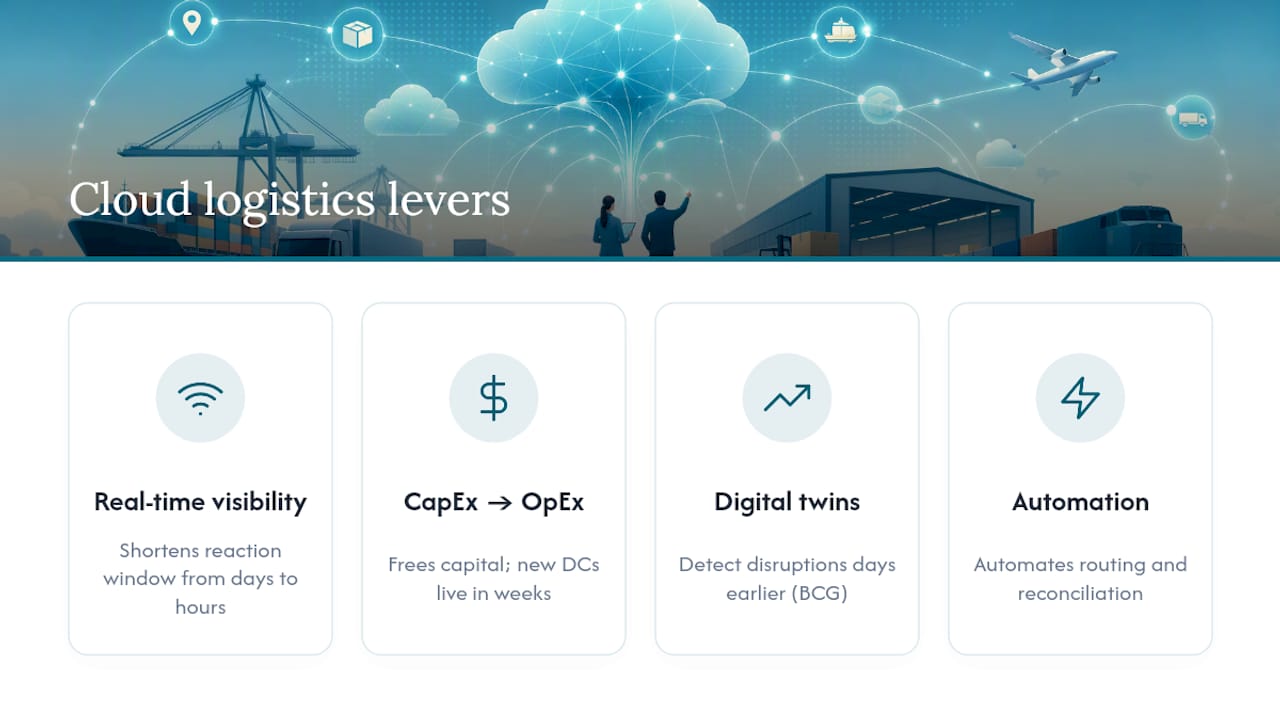
Real-time visibility cuts both stockouts and overstock. When your WMS and TMS share live data instead of syncing overnight, planners see demand shifts and carrier delays as they happen, not the next morning. That shortens the reaction window from days to hours.
The CapEx-to-OpEx shift changes how fast you can move. Instead of buying servers and licensing perpetual software, you pay a subscription tied to usage. That frees capital for warehouse expansion or fleet upgrades, and it means a new distribution center can go live on the platform in weeks rather than waiting on a hardware procurement cycle.
Digital twins turn planning into simulation. BCG’s analysis shows companies using cloud-scale digital twins detect potential disruptions days before they hit operations, because the AI-enabled models test “what if a port closes” or “what if demand spikes 20%” scenarios continuously rather than during a quarterly planning cycle.

Automation reduces manual exception handling. Order routing, inventory reconciliation, and carrier selection that used to eat hours of a planner’s day now run on rules engines, with humans stepping in only for genuine exceptions.
There’s a sustainability angle too. Cloud analytics increasingly support carbon-footprint tracking across transport modes, and hybrid cloud adoption reached 56% of executives in 2023, a sign that emissions reporting is becoming a board-level metric, not a compliance afterthought.
What Platform Capabilities Should You Actually Evaluate?
Vendor pitches blur together fast. Strip away the marketing language and every cloud logistics platform needs to deliver on a specific set of functions:
- Warehouse management (WMS): tracks inventory location, picking paths, and stock levels across one or many facilities in real time.
- Transportation management (TMS): handles carrier selection, rate shopping, load planning, and freight settlement.
- Control towers: aggregate data from WMS, TMS, and external carrier feeds into a single dashboard showing exceptions as they happen, not after the fact.
- Digital twins: simulate network changes, disruptions, or demand shocks before you commit real inventory or routing decisions.
- Integration and connectivity: carrier APIs, EDI connections, and webhooks that let the platform talk to your existing ERP and ecommerce systems.
- Analytics and forecasting: machine learning models that improve demand prediction and flag anomalies in transit times or fulfillment accuracy.
Combining AI with cloud control towers measurably speeds things up. AWS’s research on supply chain resilience found that ingesting multiple telemetry sources and using generative AI for data mapping cuts detection-to-resolution time from days to hours.
Pro Tip: Ask any vendor for a live demo of their exception-handling workflow, not their dashboard. Dashboards look identical in sales decks. What separates platforms is how fast the system flags a problem and how much manual work it takes to resolve it.
How Do You Integrate Cloud Logistics With Legacy ERP Systems?
This is where most projects stall, and the failure pattern is well documented. Teams underestimate legacy integration complexity, then discover mid-project that carrier API work and data mapping take three times longer than scoped. One migration guide documents how migrations commonly fail when governance and data readiness get treated as afterthoughts rather than prerequisites.
Four architecture approaches exist, each with different risk profiles:
- Lift-and-shift: move existing applications to cloud infrastructure with minimal changes. Fastest, but you inherit legacy limitations.
- Replatform: modify applications to use cloud-native features without a full rewrite. Balances speed and improvement.
- Refactor: rebuild for cloud-native architecture. Slowest and most expensive, but yields the best long-term performance.
- Pure SaaS adoption: replace legacy systems entirely with a subscription platform. Fastest to value, least customization.
Middleware and a canonical data model prevent the most common failure mode: “ghost inventory,” where your WMS and ERP disagree on stock counts because data mapping between systems is incomplete or delayed. A canonical model defines one standard format for product, order, and shipment data that every system translates into and out of, rather than building point-to-point mappings between every pair of systems.
Before go-live, size your infrastructure using real numbers: peak message rates, broker throughput, and end-to-end tracing so you can set service-level objectives (SLOs) you can actually measure against. On security, threat detection and identity controls should follow zero-trust principles, meaning no system or user is trusted by default, encryption is applied both in transit and at rest, and your contract explicitly states who owns the data.
| Architecture Approach | Speed to Value | Customization Level | Best Fit |
|---|---|---|---|
| Lift-and-shift | Fast | Low | Cost reduction with minimal disruption |
| Replatform | Moderate | Moderate | Teams needing some cloud-native gains |
| Refactor | Slow | High | Long-term strategic rebuilds |
| Pure SaaS | Fastest | Low | Teams prioritizing speed over control |
What Does a Cloud Logistics Rollout Checklist Look Like?
A structured rollout beats an ad hoc one every time, and the sequence matters as much as the individual steps.
- Assessment: build a machine-readable inventory of every system touching logistics data, tag datasets for PII and telemetry, and measure peak message rates before sizing any infrastructure.
- Pilot design: run a 90-day pilot on one high-impact product line or region, with clear success metrics for inventory accuracy, carrier API reliability, and order-to-delivery time.
- Governance: stand up a steering committee, a design authority for architecture decisions, and a regional deployment office if you’re rolling out across markets.
- Readiness gates: define go/no-go checkpoints between pilot, regional rollout, and full deployment, tied to the SLOs you set during assessment.
- Operational continuity: write runbooks for common failure scenarios, test fallback procedures before go-live, and confirm your team can execute them under pressure.
Pro Tip: Treat the 90-day pilot as a decision gate, not a formality. If carrier API reliability or inventory accuracy doesn’t hit your target during the pilot, fix that before expanding, expanding a broken process just multiplies the breakage.
Where Does Cloud Logistics Deliver the Most Value?
Four use cases consistently produce the clearest returns for supply chain teams making the jump:
- Ecommerce fulfillment orchestration: routing orders across distributed warehouses to the fastest, cheapest fulfillment point in real time, rather than defaulting to one central hub.
- Cross-border customs automation: cloud platforms can auto-generate customs documentation and flag compliance issues before a shipment reaches a border, cutting clearance delays.
- Control towers with disruption simulation: digital twins let planners test “what happens if this port closes” scenarios and pre-stage contingency plans instead of reacting after the fact.
- Sustainability and mode-shift optimization: cloud analytics track emissions per shipment and model shifting freight from air to ocean or rail where transit-time tradeoffs make sense.
Each of these maps to a specific operational pain point. Pick the one costing you the most money or the most customer complaints right now, and that’s your pilot candidate.
How Has Or-ner Delivered Measurable Cloud Logistics Results?
Or-ner’s platform combines freight booking, real-time tracking, customs clearance, and warehousing into one system built for ecommerce sellers, wholesalers, and manufacturers moving goods across borders. The 24% cost savings figure reported across ecommerce customers breaks down into three components:
- Optimized routing: matching shipments to the most cost-effective carrier and mode automatically
- Inventory orchestration: reducing safety stock through better visibility across warehouses
- Integrated fulfillment: cutting the manual handoffs between order, warehouse, and carrier systems
A realistic pilot scope looks like this: pick one product category, define KPIs around fulfillment cost per order and delivery time, and set a 90-day window with a decision gate at day 60 to confirm the metrics are trending the right direction. For teams comparing cloud logistics solutions built for ecommerce supply chains, that kind of staged commitment reduces risk without slowing down the timeline.
What Do Market Trends Say About the Timing?
Cloud logistics adoption isn’t a bet on future technology anymore, it’s catching up with where ecommerce volume already is. Post-pandemic online retail growth pushed transportation management systems toward cloud delivery as the default, not the exception, and market forecasts point to continued expansion through the 2030s.
Three trends worth budgeting around over the next 12 to 36 months:
- AI-driven digital twins and event-driven playbooks are moving from pilot projects to standard control tower features.
- Hybrid cloud deployments, already used by 56% of executives, will keep growing as companies balance cloud flexibility with data residency requirements.
- Typical ROI timelines run 12 to 18 months, but budget for hidden costs in data migration and staff retraining, they rarely show up in vendor pricing sheets.
What Regulatory Issues Come With Cloud Logistics Platforms?
Moving logistics data to the cloud introduces compliance questions that on-premise systems never had to answer. Data residency is the first one: if your cloud provider stores shipment and customer data in a different country than your business operates in, you may trigger data protection rules like the EU’s GDPR or similar regional frameworks, depending on where your customers and warehouses sit. Contracts should specify exactly where data lives and who can access it.
Customs and trade compliance add another layer. Cross-border shipments require accurate harmonized system (HS) codes, denied-party screening, and country-specific documentation, and your cloud platform needs to either automate these checks or integrate cleanly with systems that do. A platform that can’t produce an audit trail for customs decisions creates real liability if a shipment gets flagged.
Data ownership deserves explicit attention in any vendor contract. When you migrate to a SaaS logistics platform, clarify in writing who owns the historical shipment and inventory data, what happens to it if you switch providers, and how quickly you can export it. Vague contract language here has burned companies that later wanted to leave a platform and found their own data effectively held hostage.
Security compliance frameworks like SOC 2 or ISO 27001 certification are worth requiring from any vendor handling sensitive shipment or customer data, since they signal the provider has been independently audited on access controls and data handling. Ask for the certification directly rather than taking a sales deck’s word for it.
How Do You Manage Change When Rolling Out New Logistics Software?
The technical migration is often the easier half of a cloud logistics rollout. Getting warehouse staff, dispatchers, and planners to actually trust and use a new system is where projects quietly fail even after the software works perfectly.

Start training before go-live, not after. Staff who see the new control tower dashboard for the first time on launch day will default to their old spreadsheets and phone calls the moment something looks unfamiliar. Run parallel systems for at least two weeks where possible, letting teams cross-check the new platform against familiar processes before you switch off the old one entirely.
Identify power users on each shift early, and give them extra training and direct access to your implementation team. These are the people coworkers will ask for help, and if they’re confident, that confidence spreads faster than any formal training session.
Communicate the “why” before the “how.” Warehouse teams who understand that a new WMS reduces the manual inventory counts they’ve hated for years adopt faster than teams who are just told to use new software because leadership decided so.
Finally, build a feedback loop that actually closes. If dispatchers report a routing rule that doesn’t match real road conditions, that needs to reach whoever configures the system within days, not surface in a quarterly review after frustration has already calcified into resistance.
What Supply Chain Leaders Get Wrong About Cloud Adoption
The conventional advice on cloud logistics treats it like a technology purchase: pick the platform with the most features, sign the contract, migrate, done. That framing is backward. The research on migration failure rates makes clear that governance and data readiness, not software selection, determine whether a rollout succeeds.
What’s overrated is the feature checklist. Most enterprise platforms now offer WMS, TMS, control towers, and analytics in some form. What’s underrated is the boring stuff: canonical data models, readiness gates, and a 90-day pilot with a real decision point at the end. Companies that skip straight to full deployment because the pilot “looked fine” are the ones showing up in failure-rate statistics a year later.
If I had to name one priority for a team starting this process, it’s this: measure your current state honestly before you shop for vendors. Know your peak message rates, your actual inventory accuracy, your real carrier API reliability.
— Maayan
How Or-ner Supports Your Cloud Logistics Pilot
Running a 90-day pilot means you need a partner that already handles the pieces most rollouts stumble on, carrier integration, customs documentation, and warehouse visibility, without asking you to stitch together five different vendors. Or-ner’s global logistics platform combines freight booking, real-time tracking, and customs clearance in one system built specifically for ecommerce sellers and manufacturers managing cross-border volume.
If your team is evaluating cross-border expansion as part of a cloud logistics pilot, Or-ner’s cross-border logistics services are built to handle the customs and documentation complexity that trips up most migrations. For companies weighing whether to keep fulfillment in-house or shift it to a managed platform, what actually works in ecommerce courier partnerships breaks down the tradeoffs in practical terms. The next step is straightforward: request an operations review of your current logistics stack, and Or-ner’s team will map where a pilot could realistically move the needle within your first 90 days.
Sources
- Using digital twins to manage complex supply chains | BCG
- The European Shipper’s Cloud TMS Migration Guide — Transport Management
- Leveraging AI and Cloud for Supply Chain Resilience | AWS
FAQ
What Is Cloud-Based Logistics?
Cloud-based logistics delivers warehouse management, transportation management, and inventory tracking software over the internet instead of on servers a company owns, typically through a SaaS, PaaS, or IaaS model.
What Are the Four Types of Cloud Computing Services Used in Logistics?
The four main models are public cloud, private cloud, hybrid cloud, and multi-cloud, with logistics platforms typically running on public or hybrid cloud infrastructure to balance scalability with data control.
What Are the Three Main Types of Logistics?
Logistics is generally divided into inbound logistics (moving raw materials or goods into a business), outbound logistics (moving finished goods to customers), and reverse logistics (handling returns and reclaimed materials).
What Is Cloud-Based Delivery?
Cloud-based delivery refers to logistics services, tracking, routing, and fulfillment, that are managed and coordinated through cloud software rather than on-premise systems, giving real-time visibility into shipment status across carriers and warehouses.
How Long Does a Cloud Logistics Migration Typically Take?
A focused pilot can run 90 days, while full enterprise rollouts with regional deployment phases typically take 12 to 18 months to reach measurable ROI, depending on legacy system complexity.