TL;DR:
- Intermodal freight offers significant cost savings, faster restocking, and improved supply chain visibility for ecommerce businesses.
- Piloting on high-volume, bulky, non-urgent lanes of 500 miles or more allows sellers to measure benefits and optimize savings.
Intermodal freight delivers real cost and reliability gains for ecommerce businesses, and the numbers back it up. Or-ner’s global forwarding data shows a measurable reduction in delivery times on tracked lanes when sellers shift to integrated multi-modal networks. If you’re running high-volume replenishment or moving bulky SKUs across long distances, the practical move is to pilot intermodal on your non-urgent lanes first, measure landed cost per unit, and scale from there.
Table of Contents
- What are the core benefits of intermodal freight solutions for ecommerce?
- How do rail, ocean, and road combinations actually produce these results?
- What KPIs should you track, and what ROI can you expect?
- How to implement intermodal freight: a step-by-step checklist
- When intermodal freight is not the right choice
- Which ecommerce businesses should adopt intermodal now?
- Key Takeaways
- The case for intermodal is stronger than most ecommerce teams realize
- Or-ner connects your intermodal pilot to the full delivery chain
- Useful sources
- FAQ
What are the core benefits of intermodal freight solutions for ecommerce?
The advantages of intermodal shipping map directly to the metrics ecommerce operators care about most.
- Lower shipping cost per order. Rail and ocean linehaul cost far less per container-mile than over-the-road trucking. Multi-modal networks have cut average shipping costs by up to 68% for certain ecommerce models, especially on bulky items and flexible lead times.
- Faster restocking. Predictable rail and ocean schedules reduce inventory days of supply, which means less safety stock tying up working capital.
- Better supply chain visibility. Container-level tracking across every leg gives your operations team a single view of where inventory is, not just where it left.
- Sustainability gains. Freight railroads are 3–4 times more fuel-efficient than trucks, cutting greenhouse gas emissions by roughly 75% per ton-mile when rail replaces road on the linehaul leg.
- Capacity and scale. Rail intermodal removes capacity constraints tied to driver shortages and highway congestion, which matters when you’re scaling volume fast.
- Customs and documentation handling. Standardized containers work directly with customs facilitation tools, reducing border dwell time on cross-border lanes.
- Integrated warehousing and fulfillment. When intermodal connects to regional distribution centers, you can position inventory closer to end customers without paying for air freight to do it.
Pro Tip: Start with your slowest-moving, highest-weight SKUs. Bulky items like furniture, fitness equipment, or home goods see the sharpest cost-per-unit improvement because the weight-to-value ratio makes air freight prohibitively expensive and rail’s cost advantage is largest.
How do rail, ocean, and road combinations actually produce these results?
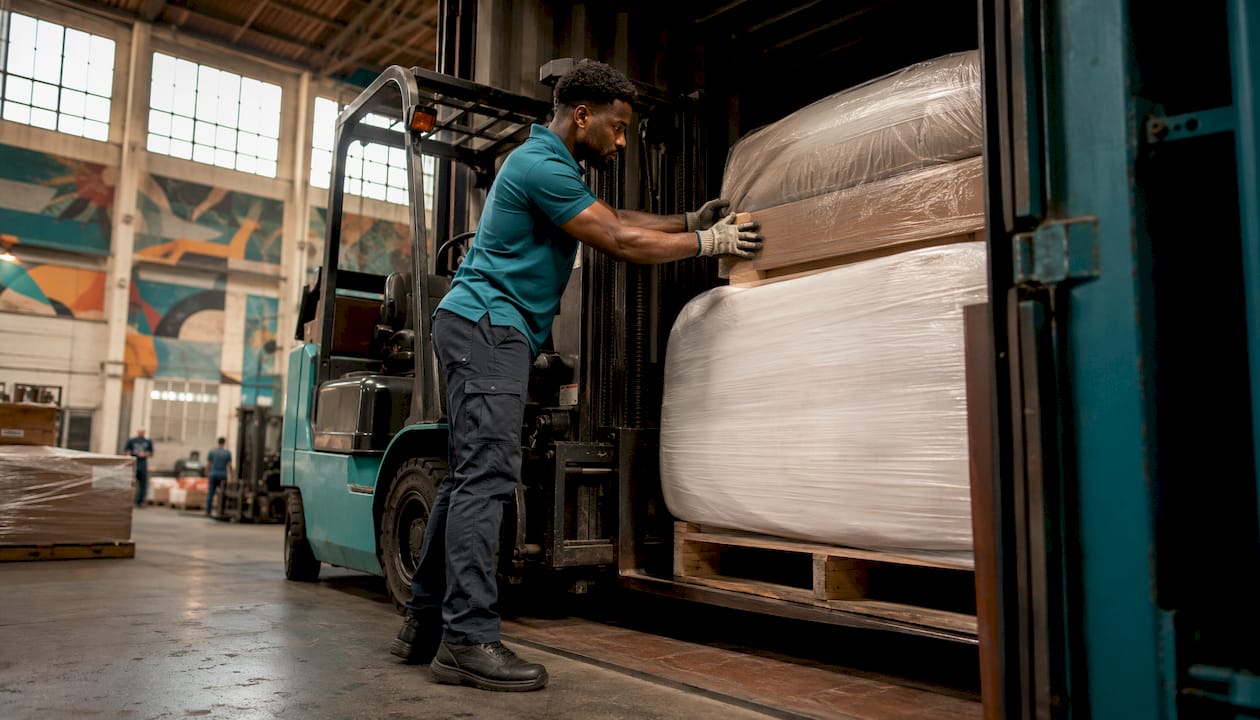
The core mechanic is simple: cargo stays inside a standardized container from origin to destination. No unloading between modes means fewer touchpoints, and fewer touchpoints directly lower damage rates and shrink. The container is the constant; the transport mode underneath it changes.
A typical U.S. ecommerce lane looks like this: factory pickup in Asia → ocean vessel to a West Coast port (Los Angeles or Long Beach) → double-stack rail to an inland distribution center (Chicago, Dallas, or Atlanta) → drayage to a regional hub → local courier for last-mile delivery. The ocean and rail legs do the heavy lifting on cost. The courier leg handles speed and customer experience. Together, they cover what neither mode could do alone.
Double-stack rail is the key efficiency driver on the North American linehaul. Stacking two containers per railcar roughly doubles throughput per train without adding track or crew, which keeps per-container costs low enough to compete with trucking even on mid-distance lanes. Railroads have invested billions in terminal infrastructure, GPS-enabled cranes, and optical scanning gates to make container transfers faster and more reliable.
The fuel math also works in your favor. Rail moves one ton of cargo significantly farther per gallon than trucks, which is why intermodal’s carbon footprint is so much lower than all-truck movements. For ecommerce sellers with sustainability commitments or ESG reporting requirements, that’s a concrete, measurable win.
What KPIs should you track, and what ROI can you expect?
The intermodal logistics benefits only show up in your P&L if you measure the right things. Track these:
| KPI | What intermodal changes |
|---|---|
| Landed cost per unit | Rail linehaul cuts cost per TEU; fewer handlings reduce damage write-offs |
| Cost per order | Lower linehaul + integrated last-mile reduces blended shipping cost |
| Transit time by leg | Ocean + rail is slower than air but faster than slow boat + truck for many lanes |
| On-time-in-full (OTIF) | Scheduled rail departures improve predictability vs. spot trucking |
| Damage rate | Sealed containers and fewer touchpoints reduce product loss |
| Inventory days of supply | Predictable lead times allow tighter safety stock targets |
| Port/terminal dwell | Measures where delays actually occur so you can address them |
For a practical example: an ecommerce seller moving 50 TEUs per month of home goods from Asia to U.S. Midwest distribution centers, switching from all-truck domestic linehaul to rail intermodal on the inland leg, can realistically expect linehaul cost reductions in the range the multi-modal research documents. Pair that with Or-ner’s freight forwarding benefits for visibility and customs, and the ROI case builds quickly. A 60–90 day pilot on two or three lanes gives you enough data to project full-program savings with confidence.
How to implement intermodal freight: a step-by-step checklist
- Select pilot SKUs. Choose high-volume, non-urgent, bulky items. Avoid time-sensitive customer-facing orders for the first pilot.
- Map origin-to-destination legs. Identify your factory location, port of entry, inland rail terminal, regional DC, and last-mile delivery zone.
- Estimate landed-cost scenarios. Compare current all-truck or air cost against projected intermodal cost using carrier rate cards and terminal fees.
- Choose carriers and terminals. Confirm rail terminal access at your origin and destination cities. Verify drayage partners for first and last mile.
- Prepare documentation. You’ll need commercial invoices, packing lists, bills of lading, and any required customs declarations. Or-ner’s freight booking guide walks through each document in sequence.
- Integrate tracking with your OMS/WMS. Connect freight booking APIs and EDI or JSON tracking feeds to your order management system. For Amazon sellers, verify Seller Central integration for shipment status updates.
- Run the pilot and measure KPIs. Track the seven metrics above for 60–90 days. Compare landed cost, OTIF, and damage rate against your baseline.
- Scale or adjust. Use pilot data to negotiate rates, expand lanes, or refine your modal mix.
Pro Tip: Run your pilot on replenishment lanes to your own distribution centers, not on customer-facing orders. That way, a delay affects your inventory buffer, not a customer’s delivery promise.
When intermodal freight is not the right choice
Intermodal is not a universal fix. Know where it falls short.
- Urgent orders. Rail and ocean transit takes days or weeks longer than air. For time-sensitive SKUs or peak-season emergency replenishment, air freight remains the right call.
- Port and terminal congestion. Dwell time at major U.S. ports can spike unpredictably. Build buffer days into your lead-time planning, and consider bonded warehousing near key ports for high-priority inventory.
- Customs complexity. Cross-border intermodal moves involve multiple jurisdictions. Pre-clearance documentation and working with a licensed customs broker reduces the risk of delays. Customs facilitation tools like TIR-style procedures measurably cut border dwell time when used correctly.
- Coordination across carriers. More parties means more communication points. A single logistics platform that consolidates booking, tracking, and exception management reduces this risk substantially.
- Customer communication. When using intermodal for customer-facing orders, set accurate delivery windows upfront and push real-time tracking updates at each modal handoff. Customers tolerate longer delivery times when they have visibility; they don’t tolerate surprises.
The Intermodal Association of North America notes that intermodal’s core advantage is reduced handling and faster transfers within a standardized container system. That advantage disappears if your operation can’t absorb the longer linehaul windows or manage the documentation load.
Which ecommerce businesses should adopt intermodal now?
The clearest candidates are sellers moving more than 20 TEUs per month on lanes of 500 miles or more, with SKUs that can absorb 5–15 additional transit days versus air. Think home goods, apparel, footwear, toys, and seasonal inventory. If your delivery windows are flexible and your margins are thin, intermodal’s cost advantage is hard to ignore.
The immediate next steps are straightforward: run a 60–90 day pilot on two replenishment lanes, track the seven KPIs above, and request a route-level landed-cost comparison from your logistics partner. That comparison is the business case. You don’t need to commit the full program to know whether the numbers work.
Pro Tip: Ask your logistics partner for a lane-by-lane cost breakdown that separates linehaul, drayage, terminal fees, and customs costs. Blended quotes hide where the savings actually come from.
Key Takeaways
Intermodal freight delivers measurable cost, speed, and visibility gains for ecommerce sellers willing to pilot it on the right lanes with the right SKUs.
| Point | Details |
|---|---|
| Cost savings are real | Multi-modal networks have cut shipping costs by up to 68% for certain ecommerce models, especially on bulky items and shipments with flexible lead times. |
| Rail cuts emissions sharply | Freight rail is 3–4 times more fuel-efficient than trucks, reducing greenhouse gas emissions by roughly 75% per ton-mile. |
| Delivery times improve | Or-ner’s tracked lanes show a 25% reduction in delivery times when integrated forwarding is applied. |
| Pilot the right lanes first | Start with high-volume, non-urgent, bulky replenishment SKUs on lanes of 500 miles or more. |
| Or-ner covers the full chain | Or-ner’s platform handles freight booking, real-time tracking, customs clearance, warehousing, and courier last-mile in one place. |
The case for intermodal is stronger than most ecommerce teams realize
The conventional wisdom treats intermodal as a “big shipper” tool. That’s outdated. The infrastructure investment railroads have made over the past decade, combined with platform-level visibility tools, has brought intermodal within reach of mid-market ecommerce sellers moving as few as 20 containers a month.
What most teams underestimate is the compounding effect. Lower linehaul cost reduces cost per order. Predictable schedules reduce safety stock. Less safety stock frees working capital. That capital can fund the next product launch or the next market expansion. The 25% delivery-time reduction Or-ner tracks on forwarding lanes isn’t just a logistics metric. It’s a cash-flow metric.
The sellers who wait for a “perfect” intermodal setup before piloting are the ones still paying air freight rates for cargo that could move by rail. The pilot is the answer. Run it, measure it, and let the data make the case.
What Or-ner’s platform makes possible is running that pilot without building a new operations team. Real-time tracking, customs clearance, warehousing, and freight booking in one place means the complexity stays manageable even when you’re testing something new.
Or-ner connects your intermodal pilot to the full delivery chain
Switching to intermodal freight creates a gap most platforms can’t fill: the handoff between long-haul rail or ocean and the last-mile courier. Or-ner closes that gap. The platform covers freight booking, real-time shipment tracking, customs clearance, warehousing, and courier last-mile delivery in a single integrated workflow, so your team isn’t stitching together five different vendor portals to manage one shipment.
For ecommerce sellers ready to test intermodal on replenishment lanes, Or-ner’s logistics platform gives you the freight booking, tracking APIs, and customs support to run a clean pilot without operational chaos. The freight booking checklist is a practical starting point. Request a route-level cost comparison through Or-ner and see exactly where intermodal saves you money on your specific lanes.
Useful sources
- What Is Intermodal? (Intermodal Association of North America) — definition, container standardization, and reduced-handling benefits
- Freight Rail Intermodal (Association of American Railroads) — fuel efficiency, emissions data, double-stack rail, and terminal investment
- Intermodal Freight Transport (Wikipedia) — double-stack rail history and North American modal mix
- Intermodal Freight Transport: Meaning, How It Works (IRU) — customs facilitation and cross-border transit tools
- Multi-Modal Shipping Networks Cut E-Commerce Delivery Costs by 68% (Ecommerce Times) — cost-savings ranges and ecommerce use cases
- What Is Intermodal Freight Transport and How Does It Work (Jusda Global) — operational mechanics, fuel efficiency, and damage reduction
- Global Forwarding Solutions Cut Delivery Times 25% (Or-ner) — Or-ner’s tracked 25% delivery-time reduction on forwarding lanes
- Benefits of Freight Forwarding (Or-ner) — platform-level benefit summary for ecommerce operators
- Freight Forwarder Benefits for Ecommerce Shipping Success (Or-ner) — seven forwarder benefits mapped to ecommerce outcomes
FAQ
What are the main benefits of intermodal freight for ecommerce?
The primary benefits are lower shipping cost per order, faster restocking through predictable schedules, better supply chain visibility, and significantly lower carbon emissions compared to all-truck movements.
How much can intermodal freight reduce shipping costs?
Multi-modal networks have cut average shipping costs by up to 68% for certain ecommerce models, with the largest savings on bulky items and shipments with flexible lead times.
Is intermodal freight slower than air or trucking?
Rail and ocean linehaul takes longer than air freight, but Or-ner’s forwarding data shows a 25% reduction in delivery times when integrated multi-modal networks replace fragmented single-mode approaches.
Which SKUs are best suited for intermodal shipping?
High-volume, non-urgent, bulky items such as home goods, furniture, apparel, and seasonal inventory benefit most, especially on lanes of 500 miles or more where rail’s cost advantage is largest.
How does Or-ner support an intermodal freight pilot?
Or-ner provides freight booking, real-time tracking, customs clearance, warehousing, and courier last-mile delivery in one platform, covering every leg of the intermodal chain from origin to end customer.