For sellers, the fastest delivery to Amazon customers comes from Fulfillment by Amazon with inventory pre-positioned across multiple fulfillment centers. The fastest path to restocking those FCs is Amazon SEND or Amazon Warehousing and Distribution with auto-replenishment. The tradeoff is real: speed costs more per unit, and the operational complexity of managing inventory placement, labeling compliance, and carrier cutoffs is higher than that of simply shipping reactively.
Here is the short version of where each workflow wins:
- Fastest to customer: FBA with inventory spread across regional FCs, or Seller Fulfilled Prime with an integrated courier network for seller-controlled last-mile.
- Fastest FC restock: Amazon SEND (air) for cross-border urgency; AWD with auto-replenishment for steady-state speed; SPD for small, fast domestic batches.
- Fastest overall system: Combining AWD bulk storage with FBA distribution, managed proactively, so replenishment is routine rather than reactive. Amazon’s Supply Chain Services data shows sellers using end-to-end inventory placement average roughly a 15% lift in unit sales from improved availability.
- The core tradeoff: Air freight and SPD are fast but expensive per unit. LTL and ocean are cheaper but slower. Proactive inventory placement is the structural fix that reduces how often you need the expensive options.
Key Takeaways
Inventory positioned across Amazon FCs before orders arrive is the single most reliable driver of fast customer delivery, and AWD with auto-replenishment is the most practical way to maintain that positioning at scale.
| Point | Details |
|---|---|
| FBA placement drives customer speed | Inventory pre-positioned in regional FCs delivers fastest to customers; Prime eligibility follows automatically. |
| AWD + auto-replenishment for restocking | Bulk inventory in AWD with auto-replenishment keeps FBA levels stable without manual reorder triggers. |
| SEND for cross-border inbound | Air via SEND cuts cross-border origin-to-FC lead time to roughly 5–10 days; ocean runs 20–35 days. |
| SPD threshold at 150–200 lbs | Below that weight, SPD checks in faster and skips dock appointments; above it, LTL is generally more cost-effective and scalable. |
| Or-ner reduces manual coordination | Or-ner automates freight booking, customs paperwork, and exception alerts to keep inbound pipelines moving. |
Table of Contents
- What are the fastest fulfillment workflows for Amazon sellers?
- What actually determines whether a workflow is fast in practice?
- How to build a step-by-step playbook for fastest delivery
- How do time and cost compare across shipping modes?
- Which KPIs should you track to measure delivery speed?
- What mistakes commonly destroy delivery speed?
- Why inventory-first thinking beats constant expediting
- Or-ner cuts the manual overhead of running an inventory-first system
- Sources
- FAQ
What are the fastest fulfillment workflows for Amazon sellers?
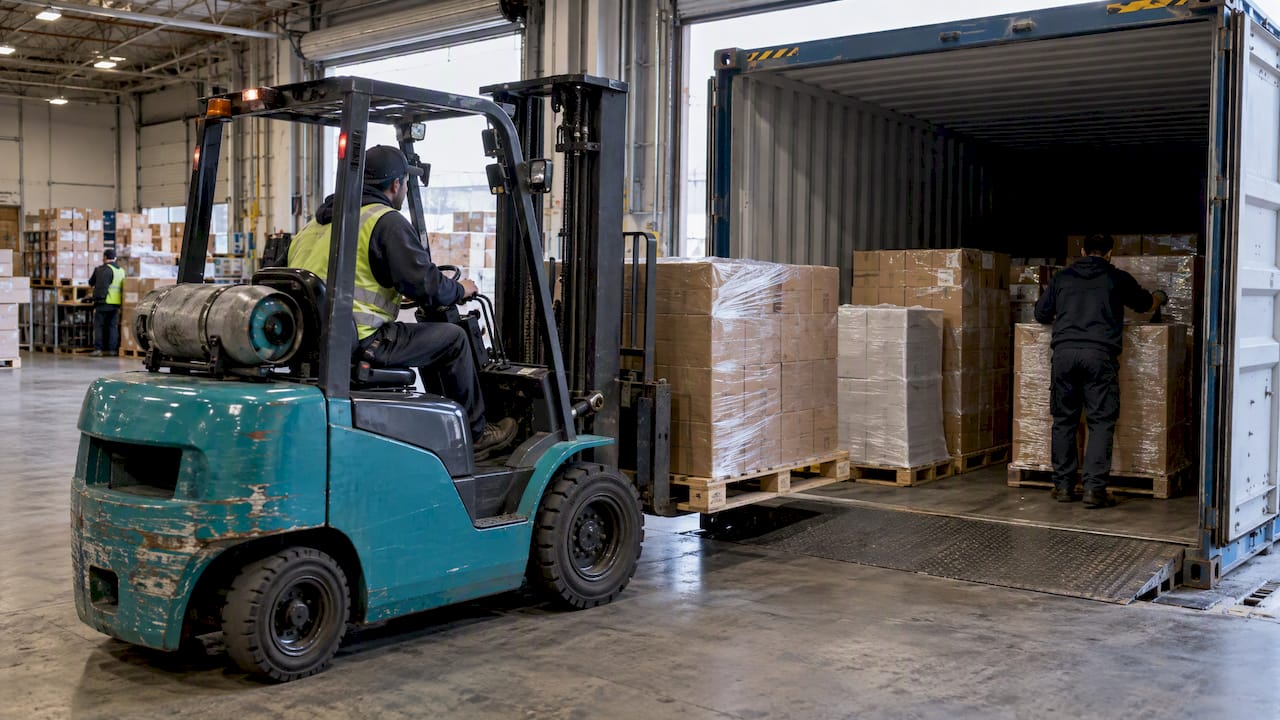
Fulfillment by Amazon (FBA) is the baseline for fastest customer delivery. Once inventory is checked in at an FC, Amazon picks, packs, and ships it, and products become Prime-eligible. The speed advantage is entirely upstream: how quickly you get inventory into the right FCs determines how fast customers receive orders.
Amazon Warehousing and Distribution (AWD) solves the bulk storage problem. You ship large volumes into AWD, and Amazon’s auto-replenishment pushes stock to FBA FCs as needed. This keeps FBA inventory levels healthy without constant manual intervention.
Amazon SEND (Seller Export and Delivery) handles cross-border inbound. Sellers book air or ocean shipments directly in Seller Central, with carrier pickup, customs clearance, and tracking all managed in one place. For international sellers, SEND cuts the origin-to-FC friction that typically adds weeks to lead times.
Seller Fulfilled Prime (SFP) gives sellers who want to control their own fulfillment a path to Prime badges. It requires meeting Amazon’s strict delivery speed and reliability standards using your own warehouse and carrier network. The fastest SFP operations run integrated courier partnerships with same-day or next-day pickup cutoffs.
Hybrid approach: Keep your top-velocity SKUs in FBA for customer speed. Use AWD or third-party bonded warehousing for bulk storage and quick replenishment. This structure reduces both stockout risk and the cost of holding excess inventory inside FBA.
What actually determines whether a workflow is fast in practice?
Mode choice matters less than most sellers expect. The real speed determinants are operational.
- Inventory placement is the single biggest lever. Stock sitting in one FC on the wrong coast adds days to customer delivery. Spreading inventory across regional FCs, or letting Amazon’s Supply Chain Services distribute it, cuts transit time to the customer to near zero.
- Inbound lead time includes carrier transit, origin handling, and customs clearance, not just last-mile. A fast carrier choice means nothing if customs documentation is incomplete.
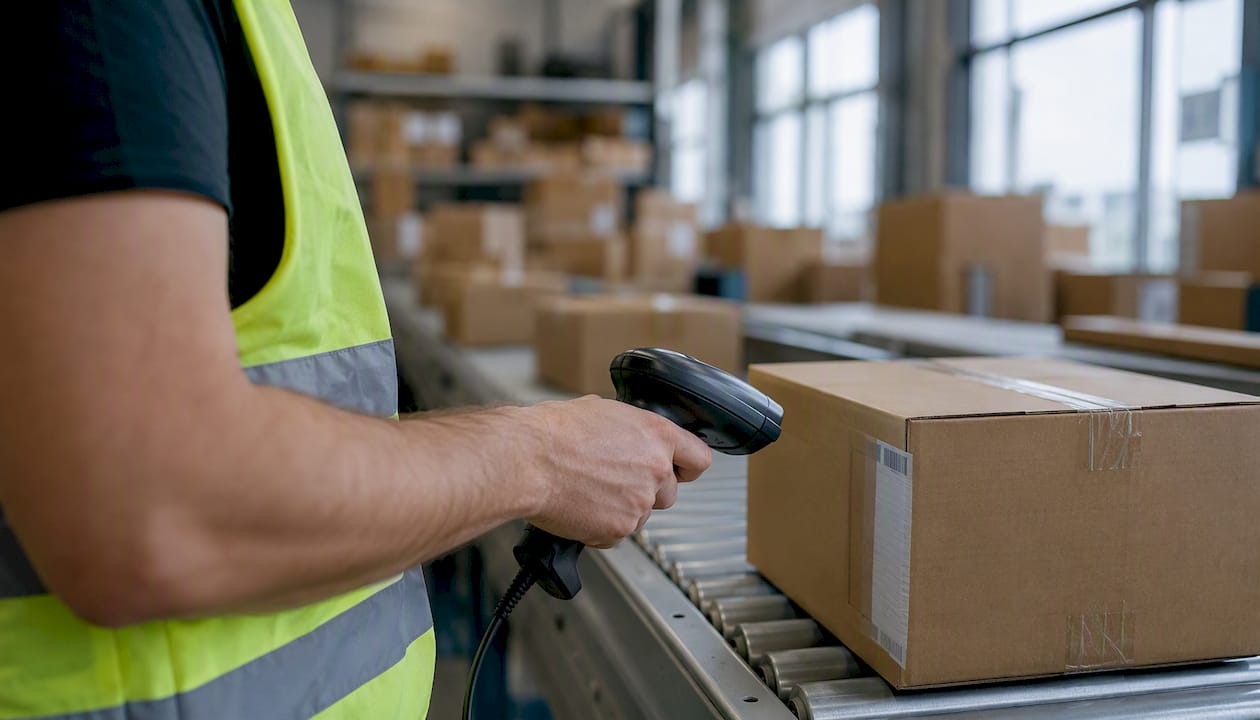
- FC receiving compliance is where most delays actually happen. Incorrect labels, non-standard pallet dimensions, or missing documentation send shipments to a manual exception queue that can add days or weeks.
- Carrier cutoffs and FC appointment windows are easy to miss and expensive when you do. A missed LTL appointment means rescheduling, which can push availability by a full week.
- SPD vs. LTL handling: Small Parcel Delivery shipments typically check in faster than LTL because they skip the appointment requirement. LTL and FTL need scheduled dock appointments, which adds coordination overhead.
Pro Tip: Label every box and pallet to Amazon’s exact spec before it leaves your warehouse or prep center. A single non-compliant label at the FC is enough to hold an entire shipment in a receiving exception queue.
How to build a step-by-step playbook for fastest delivery
A. Getting inventory to Amazon customers fastest
- Audit your SKU velocity. Rank SKUs by weekly units sold. Your top 20% by velocity belong in FBA, positioned across multiple FCs.
- Enroll core SKUs in FBA via Seller Central. Use Amazon’s Inventory Placement Service to distribute stock across FCs automatically rather than shipping everything to one location.
- Set up AWD for bulk storage. Ship large volumes to AWD and enable auto-replenishment. This keeps FBA levels stable without manual reorder triggers.
- Standardize your prep and labeling. Every unit needs an FNSKU label; every pallet needs to meet Amazon’s dimension and weight standards. Build a checklist your prep team runs before every shipment leaves.
- Choose SPD for small, fast batches (typically under 150–200 lbs). Use LTL for palletized volumes above that threshold. Practical seller guides note that consolidated middle-mile workflows can cut FC check-in to 2–4 days versus multi-week standard LTL.
B. Restocking FCs fastest (cross-border)
- Open SEND workflows in Seller Central for cross-border inbound. Book air for urgent restocks; ocean for planned bulk replenishment. Customs handling and tracking stay inside Seller Central.
- Pre-clear customs documentation. Commercial invoice, packing list, and HS codes must be accurate before the shipment moves. Errors here cause clearance holds that dwarf any transit time savings.
- Book FC appointments early. LTL and FTL shipments need dock appointments. Book as soon as the shipment is confirmed, not after it arrives at the destination city.
- Track exceptions in real time. Use your TMS, WMS, or Or-ner’s platform to flag holds, customs delays, and appointment rejections the moment they appear, not after a stockout surfaces.
| Playbook step | Expected time-to-availability | Owner |
|---|---|---|
| FBA enrollment + placement | 1–3 days post-check-in | Seller / account manager |
| AWD bulk inbound (domestic) | 3–7 days door-to-AWD | Logistics team |
| SEND air (cross-border) | 5–10 days origin-to-FC | Freight / customs team |
| SEND ocean (cross-border) | 20–35 days origin-to-FC | Freight / customs team |
| SPD domestic restock | 2–5 days door-to-check-in | Warehouse / carrier |
How do time and cost compare across shipping modes?
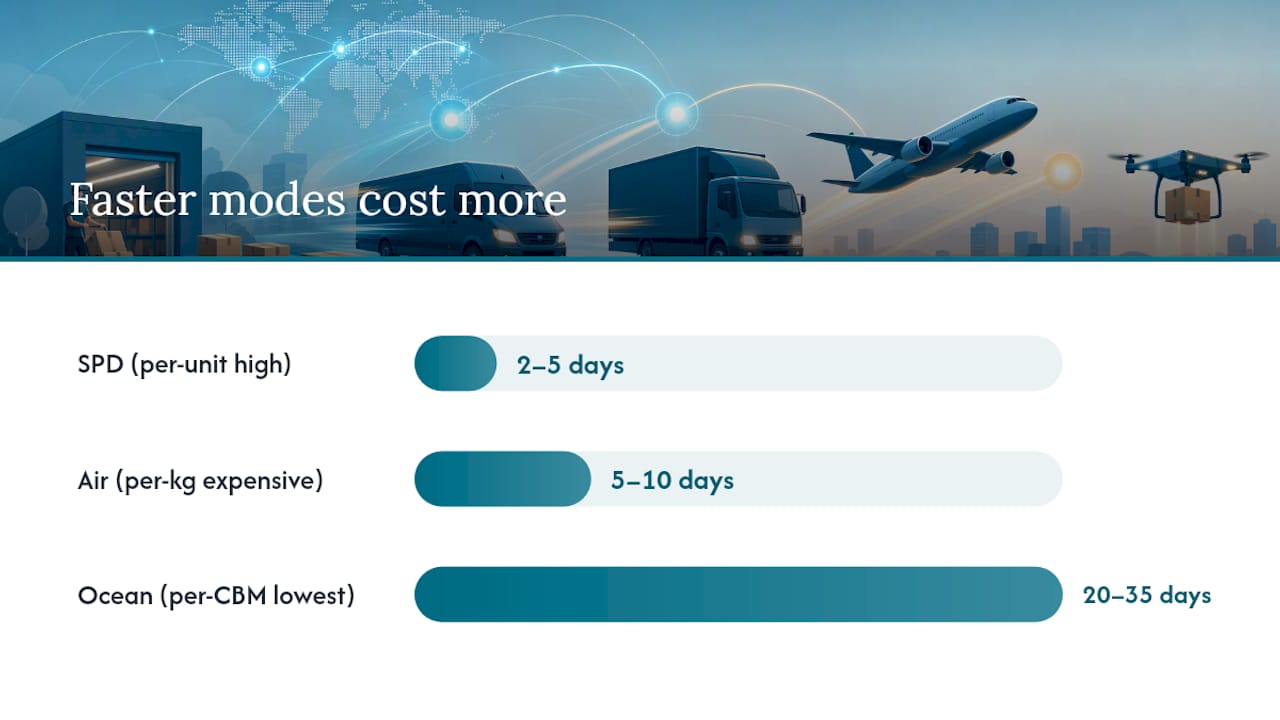
Speed and cost move in opposite directions. The table below maps the main inbound modes sellers use.
| Mode | Typical origin-to-FC range | Cost shape | Operational complexity |
|---|---|---|---|
| SPD (domestic) | 2–5 days | Per-unit; higher at volume | Low; no appointment needed |
| LTL (domestic) | 5–10 days | Per-pallet; economical at scale | Medium; dock appointment required |
| FTL (domestic) | 4–8 days | Per-load; best for full trucks | Medium-high; appointment + coordination |
| Air freight (cross-border) | 5–10 days | Per-kg; expensive | High; customs docs, broker coordination |
| Ocean freight (cross-border) | 20–35 days | Per-CBM; lowest per-unit cost | High; customs, port handling, longer lead |
| AWD + FBA auto-replenishment | Ongoing; 1–3 days FC-to-FC | Storage + transfer fees | Low once set up; mostly automated |
A few structural points worth knowing:
- SPD per-unit costs scale badly at volume. Sellers who ship SPD for palletized quantities often pay two to three times what LTL would cost for the same goods.
- Air freight makes sense for new product launches, stockout recovery, or market-testing small SKUs. Running air freight as your default inbound mode is rarely sustainable.
- AWD with auto-replenishment is often cheaper than repeated expedited air shipments once you account for the stockout cost and the premium freight spend. The inventory-first approach turns expensive reactive expediting into routine replenishment.
Which KPIs should you track to measure delivery speed?
Tracking the right metrics is what separates sellers who improve systematically from those who react to stockouts. The core set:
- Origin-to-FC lead time: Total days from shipment booking to FC check-in. A meaningful improvement is cutting this from 21+ days to 7–10 days for cross-border air.
- FC check-in time: Days between FC receipt and inventory showing as available for sale. Compliance issues show up here first.
- Available-for-sale lead time: The combined upstream metric. Reducing this is the operational goal.
- Order-to-delivery time: For FBA and SFP orders. Track by FC region to identify placement gaps.
- In-transit variance: Standard deviation of lead time across shipments. High variance signals carrier or customs reliability problems, not just average speed.
Pull origin-to-FC and check-in data from Seller Central shipping reports. Layer in real-time tracking from your TMS or Or-ner’s shipment tracking dashboard to catch exceptions before they become stockouts. Tie KPIs to commercial outcomes: a reduction in available-for-sale lead time directly reduces lost sales from stockouts and improves Prime eligibility rates.
What mistakes commonly destroy delivery speed?
Most speed failures trace back to a handful of recurring errors.
- Non-compliant labeling or palletization. Amazon’s FC receiving requirements are specific. A misplaced label or an overweight pallet triggers a manual exception that can hold inventory for days.
- Assuming carrier mode alone guarantees speed. Booking air freight and then submitting incomplete customs paperwork produces a slower outcome than ocean freight with clean documentation.
- Using SPD for large volumes. Past the 150–200 lb threshold, SPD becomes expensive and can actually slow check-in at high volumes because individual parcels process differently than palletized LTL.
- Ignoring in-transit variance. Tracking average lead time without watching variance means stockouts arrive as surprises. Watch the outliers.
- Red flags to watch: Large unexplained holds at FC receiving (check labeling and documentation first); frequent appointment rejections (book earlier and confirm carrier compliance); repeated customs rejections (audit HS codes and commercial invoice accuracy).
Why inventory-first thinking beats constant expediting
The conventional wisdom in seller logistics is to fix speed problems by upgrading the shipping mode. Book air instead of ocean. Use SPD instead of LTL. That logic is not wrong, but it treats the symptom rather than the cause.
The sellers with consistently fast delivery times are not the ones with the fastest carriers. They are the ones with inventory already positioned near demand before an order arrives. When stock is distributed across regional FCs, customer delivery is fast by default, regardless of inbound mode. Amazon’s ASCS framework is built around exactly this logic: bring freight, distribution, and forecasting together so inventory placement is proactive, not reactive.

Expedited air still has a role. New product launches, stockout recovery, and market-testing small SKUs all justify the premium. But running air freight as a structural solution to a placement problem is expensive and fragile. One customs delay or missed appointment and the speed advantage evaporates.
The smarter sequence: invest in AWD setup and FBA distribution first, use stockout prevention as a KPI, and reserve expedited freight for genuine exceptions. The result is lower average lead time, lower variance, and a lower total freight spend.
Or-ner cuts the manual overhead of running an inventory-first system
Getting inventory-first logistics right requires coordinating freight booking, customs documentation, FC appointments, and replenishment triggers across multiple workflows simultaneously. That coordination is where most operations teams lose time.
Or-ner’s platform handles freight booking automation, SEND and air freight integrations, AWD and FBA pipeline management, and automated customs paperwork in one place. Real-time tracking and exception management mean your team sees a customs hold or a missed appointment immediately, not after a stockout. The result is faster inbound lead times, fewer FC receiving delays, and less manual overhead per shipment.
If you want to see how Or-ner fits into your specific Amazon inbound workflow, the global logistics platform page walks through the full capability set. For a hands-on look at freight booking inside the platform, the freight booking step-by-step guide is a practical starting point. Request a demo or get a quote directly from either page.
Sources
- Amazon launches Supply Chain Services for businesses of all sizes
- Fulfillment by Amazon
- Shipping to Amazon FBA: Step-by-Step Guide for Sellers
FAQ
What is the fastest delivery method for Amazon sellers?
FBA with inventory pre-positioned across multiple regional fulfillment centers is the fastest path to customer delivery. Once inventory is checked in and available for sale, Amazon handles picking, packing, and shipping, typically within one to two days.
How fast can sellers restock Amazon fulfillment centers?
Domestic SPD shipments typically check in within 2–5 days. Cross-border air via Amazon SEND runs roughly 5–10 days origin-to-FC; ocean freight takes 20–35 days. AWD with auto-replenishment keeps FBA levels topped up on an ongoing basis.
Does Seller Fulfilled Prime deliver as fast as FBA?
SFP can match FBA delivery speeds if the seller’s warehouse and carrier network meet Amazon’s strict cutoff and reliability requirements. It gives sellers more control but requires more operational discipline to maintain Prime eligibility.
Why does my inventory sit at the FC for days before it shows as available?
FC check-in delays almost always trace to labeling errors, non-standard palletization, or missing documentation. Reviewing Amazon’s prep requirements and running a compliance checklist before shipments leave your warehouse is the fastest fix.
How does Or-ner help sellers reduce Amazon inbound lead times?
Or-ner automates freight booking, customs documentation, and exception alerts across SEND, air, and ocean workflows, reducing the manual coordination that typically adds days to inbound lead times.