TL;DR:
- End-to-end logistics manages all supply chain functions through a unified system, improving efficiency and control. It replaces fragmented workflows with real-time data sharing, reducing delays, errors, and costs across industries. Small businesses can implement these principles to enhance delivery reliability and scale operations effectively.
End-to-end logistics is defined as the integrated management of all supply chain functions, from raw material procurement through final delivery and returns, under a single coordinated system. Unlike traditional freight arrangements that treat each stage separately, this approach unifies procurement, warehousing, transportation, order fulfillment, customs compliance, reverse logistics, and data management into one adaptive workflow. The industry term you will encounter most often is “integrated supply chain management,” and understanding what is end-to-end logistics means understanding how these functions depend on each other. Businesses that master this integration gain faster decision-making, lower costs, and measurably better customer satisfaction.
What is end-to-end logistics and how does it work?
End-to-end logistics is the integrated management of at least 8 core supply chain functions, unifying fragmented stages into a cohesive workflow from origin to delivery. Those functions are procurement, inbound flow, warehousing and inventory management, order fulfillment, transportation, customs and trade compliance, reverse logistics, and visibility and data management. Each function feeds the next. A delay in customs, for example, immediately affects warehouse scheduling and order fulfillment timelines downstream.
The logistics management definition that matters most here is operational: it is the active coordination of people, systems, and physical assets across every node in a supply chain. Digital infrastructure sits at the center of this coordination. Without real-time data connecting each function, you do not have end-to-end logistics. You have a series of handoffs with gaps between them.
This model applies across industries. An apparel brand shipping from a factory in Vietnam to a fulfillment center in Ohio and then to a customer in Texas runs through every one of these eight functions. So does a home goods wholesaler moving freight by ocean to an Amazon warehouse. The scale changes, but the structure does not.
What are the core components of an end-to-end supply chain?
The eight core functions each carry a distinct role. The table below summarizes each one and its primary contribution to the overall system.
| Function | Description | Key Benefit |
|---|---|---|
| Procurement | Sourcing and purchasing goods from suppliers | Controls input costs and supplier reliability |
| Inbound flow | Moving goods from supplier to warehouse | Sets the pace for all downstream activity |
| Warehousing and inventory | Storing and managing stock levels | Reduces overstock, prevents stockouts |
| Order fulfillment | Picking, packing, and shipping customer orders | Directly affects delivery speed and accuracy |
| Transportation | Moving goods via truck, rail, ocean, or air | Balances cost against delivery time |
| Customs and trade compliance | Documentation and customs clearance for cross-border shipments | Prevents border delays and regulatory penalties |
| Reverse logistics | Managing returns and product recovery | Protects margins and customer trust |
| Visibility and data management | Real-time tracking and reporting across all nodes | Enables fast, informed decisions |
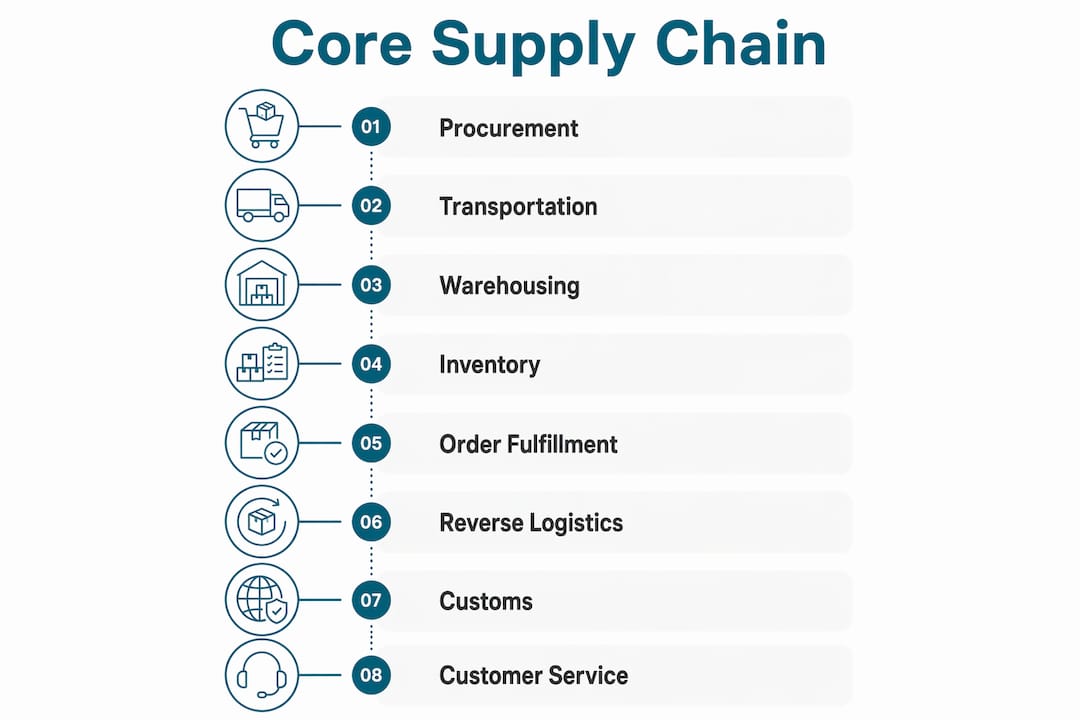
Transportation alone spans multiple modes. Trucks, trains, maritime shipping, and air freight each serve different cost and speed profiles. Coordinating between these modes without gaps is one of the hardest operational challenges in supply chain logistics.
Reverse logistics is the function most businesses underinvest in. A well-designed returns management process recovers product value, reduces waste, and keeps customers from churning after a bad return experience. Treating returns as an afterthought is one of the most common and costly mistakes in ecommerce logistics.
Pro Tip: Map your current workflow against these eight functions before evaluating any logistics platform. Gaps between functions, not the functions themselves, are where costs and delays accumulate.
How does integrated logistics improve efficiency and control?
Centralized digital infrastructure enables real-time monitoring and coordination across procurement, production, inventory, fulfillment, and returns. This integration reduces handoff errors, increases responsiveness, and improves control over service levels and costs. The mechanism is straightforward: when every function shares the same data layer, a problem in one area triggers an automatic alert in every connected area.

Supply chain visibility is the practical output of this integration. Without it, businesses react to problems after they have already affected customers. With it, they can reroute a shipment before a delay becomes a missed delivery. The difference between reactive and proactive logistics is almost entirely a data problem.
Key efficiency and control benefits from end-to-end integration include:
- Fewer handoff errors between carriers, warehouses, and fulfillment teams
- Faster response to disruptions such as port congestion or supplier delays
- Lower inventory carrying costs through accurate demand visibility
- Consistent service levels across multiple sales channels and geographies
- Reduced compliance risk through centralized documentation management
Strategic scheduling, route optimization, and real-time shipment tracking are the operational tools that make these benefits concrete. Intelligent technology handles the data processing. Human teams focus on exceptions and decisions that require judgment.
Pro Tip: The most common integration failure is connecting systems without standardizing data formats first. Two platforms that cannot read each other’s timestamps or SKU codes create more confusion than separate systems did.
End-to-end logistics vs. traditional logistics: what is the difference?
Traditional logistics management is fragmented, siloed, and characterized by disconnected workflows, which leads to inefficiencies and reduced visibility. Each function operates independently, often managed by different vendors with different systems and reporting formats. The result is a supply chain where no single party has a complete picture.
The comparison table below shows the major distinctions between the two approaches.
| Dimension | Traditional logistics | End-to-end logistics |
|---|---|---|
| Scope | Individual functions managed separately | All functions managed as one system |
| Visibility | Limited, often delayed reporting | Real-time data across all nodes |
| Responsiveness | Slow, reactive to problems | Fast, proactive through early alerts |
| Error rate | Higher due to manual handoffs | Lower through automated data transfer |
| Cost control | Difficult across multiple vendors | Centralized with full cost visibility |
| Scalability | Constrained by vendor contracts | Flexible as volume and geography grow |
Businesses transitioning from traditional to integrated logistics often underestimate the change management involved. Technology is the easier part. Aligning internal teams, third-party carriers, and warehouse operators around shared data standards and performance metrics is the harder work. Starting with two or three connected functions and expanding from there is a more reliable path than attempting a full system overhaul at once.
The order fulfillment process is usually the best starting point for integration. It sits at the intersection of warehousing, transportation, and customer experience, so improvements there produce visible results quickly.
How can businesses implement end-to-end logistics solutions?
Adopting end-to-end logistics solutions starts with an honest audit of your current workflow. Identify which of the eight core functions you manage directly, which you outsource, and where the handoffs between them break down. That gap analysis tells you where integration will deliver the fastest return.
The next step is selecting a technology platform that connects your existing systems. Warehouse management systems, transportation management systems, and order management systems each handle different functions. The goal is a single data layer that all three can read and write to. Platforms that integrate with major ecommerce operators like Amazon reduce the custom development work significantly.
Warehouse layout planning directly affects how fast you can fulfill orders once integration is in place. A warehouse designed for the right pick paths and storage zones can cut fulfillment time without adding headcount. Physical layout and digital systems must be designed together, not separately.
The measurable benefits of end-to-end logistics solutions include:
- Cost reduction: Consolidated vendor relationships and shared data eliminate duplicate handling fees and reduce freight spend.
- Improved customer satisfaction: Companies adopting integrated logistics frameworks report better service levels and higher customer retention.
- Faster decision-making: A unified supply chain system reduces operational risk and increases agility when market conditions shift.
- Compliance confidence: Centralized documentation management reduces the risk of customs delays on cross-border shipments.
- Growth capacity: An integrated system scales with volume without requiring proportional increases in staff or vendor contracts.
Small and mid-sized businesses often assume end-to-end logistics is only for large enterprises. The reality is that the eight-function framework applies at any scale. A small business shipping 500 orders per month benefits from the same integration principles as a brand shipping 50,000. The tools differ, but the logic does not.
Key Takeaways
End-to-end logistics is the most effective way to reduce supply chain costs, improve delivery reliability, and scale operations without proportional increases in complexity.
| Point | Details |
|---|---|
| Eight core functions | End-to-end logistics integrates procurement, warehousing, fulfillment, transport, compliance, and returns into one system. |
| Integration drives efficiency | Centralized data reduces handoff errors, speeds up decisions, and improves service level control. |
| Traditional logistics falls short | Siloed, fragmented approaches create visibility gaps and higher error rates across vendor handoffs. |
| Start with fulfillment | Connecting order fulfillment first produces visible results quickly and builds momentum for broader integration. |
| Benefits are measurable | Integrated logistics delivers lower costs, better customer satisfaction, and faster response to disruptions. |
Why most businesses get end-to-end logistics wrong
I have watched businesses invest heavily in logistics technology and still end up with the same problems they had before. The technology was not the issue. The issue was that they connected systems without first agreeing on what success looked like across every function. Procurement measured cost per unit. Warehousing measured pick accuracy. Transportation measured on-time delivery. Nobody measured the handoffs between them, and that is exactly where the money was leaking.
The businesses that get integrated logistics right treat it as an operating model, not a software project. They define shared metrics before they buy anything. They involve warehouse operators in platform decisions. They run pilots on one product line or one lane before rolling out across the network. That discipline is unglamorous, but it is what separates a functioning end-to-end supply chain from an expensive collection of connected dashboards.
Digital transformation and data-driven decisions are genuinely the key success drivers here. But data only helps if the people reading it have the authority and the context to act on it. Build that organizational capability first. The technology will work better because of it.
— Maayan
Or-ner’s logistics services for end-to-end supply chain needs
Or-ner is built for businesses that need reliable, connected logistics across the full supply chain, from freight booking and customs clearance to warehousing and final delivery.
Or-ner’s reliable courier services cover domestic and cross-border shipments with real-time tracking, flexible delivery options, and returns management built in. The platform integrates with Amazon and other major ecommerce operators, giving businesses a single point of control across ocean, air, and land transport modes. Whether you are a small business shipping hundreds of orders or a global brand managing thousands, Or-ner provides the visibility and carrier network to keep your supply chain moving. Explore Or-ner’s ecommerce logistics solutions to find the right fit for your operation.
FAQ
What is end-to-end logistics in simple terms?
End-to-end logistics is the management of every supply chain step, from sourcing raw materials to delivering the final product and handling returns, under one coordinated system. It replaces fragmented, vendor-by-vendor management with a unified workflow.
What are the main benefits of end-to-end logistics?
The main benefits include lower costs, faster delivery, better visibility across all supply chain functions, and improved customer satisfaction. Companies that adopt integrated logistics frameworks report stronger competitiveness and fewer operational disruptions.
How is end-to-end logistics different from traditional logistics?
Traditional logistics manages each supply chain function separately, which creates visibility gaps and handoff errors. End-to-end logistics connects all functions through shared data, enabling real-time monitoring and faster response to problems.
What does customs compliance have to do with end-to-end logistics?
Customs documentation and trade compliance are critical to cross-border shipments. Proper paperwork keeps goods moving through international borders without delays, making compliance a core function within any end-to-end logistics system.
Can small businesses use end-to-end logistics solutions?
Yes. The eight-function framework applies at any business size. Small businesses benefit from the same integration principles as large enterprises, with tools and platforms scaled to match their order volume and geographic reach.