Supply chain management shapes how products make their journey from raw materials to your doorstep, touching nearly every industry along the way. And yet, despite its importance, nearly 57 percent of companies have little to no visibility across their supply chain. Most people think advanced technology is the answer to every supply issue. That assumption misses the mark, because real success actually starts with building stronger supplier relationships and smarter planning long before any software enters the scene.
Table of Contents
- Understanding The Supply Chain Process
- Core Components Of Supply Chain Management
- Best Practices For Efficient Supply Chains
- Overcoming Common Supply Chain Challenges
Quick Summary
| Takeaway | Explanation |
|---|---|
| Effective sourcing reduces risks. | Identify reliable suppliers for quality materials and competitive pricing to secure supply chain stability. |
| Integrate technology for visibility. | Utilize real-time data sharing and advanced analytics to enhance decision-making and operational efficiency. |
| Strategic planning is crucial. | Develop dynamic frameworks for demand forecasting to adapt quickly to market changes and customer needs. |
| Collaborate with suppliers. | Foster strong partnerships through transparent communication and joint innovations for mutual resilience. |
| Invest in workforce development. | Prioritize training and upskilling to bridge skill gaps and enhance operational capabilities. |
Understanding the Supply Chain Process
Supply chain management represents a comprehensive approach to coordinating and optimizing the movement of goods, services, and information from raw material sourcing to final product delivery. At its core, the supply chain process involves multiple interconnected stages that transform initial resources into finished products ready for consumer consumption.
Key Components of Supply Chain Operations
The supply chain process encompasses several critical components that work together to ensure efficient product flow. According to Western Governors University, these components include planning, sourcing, manufacturing, delivery, and returns. Each stage requires meticulous coordination and strategic decision making to minimize disruptions and maximize operational efficiency.
To clarify the sequential stages involved in managing a supply chain, here is a breakdown of the key components and their main focus areas:
| Stage | Main Focus | Key Activities |
|---|---|---|
| Planning | Forecast demand, set strategy | Market analysis, demand forecasting, framework setup |
| Sourcing | Select and evaluate suppliers | Supplier assessment, contract negotiation |
| Manufacturing | Transform materials into finished products | Production, quality assurance, process management |
| Delivery | Distribute products to customers | Logistics, transportation, fulfillment |
| Returns | Manage product returns and feedback | Reverse logistics, customer support, remediation |
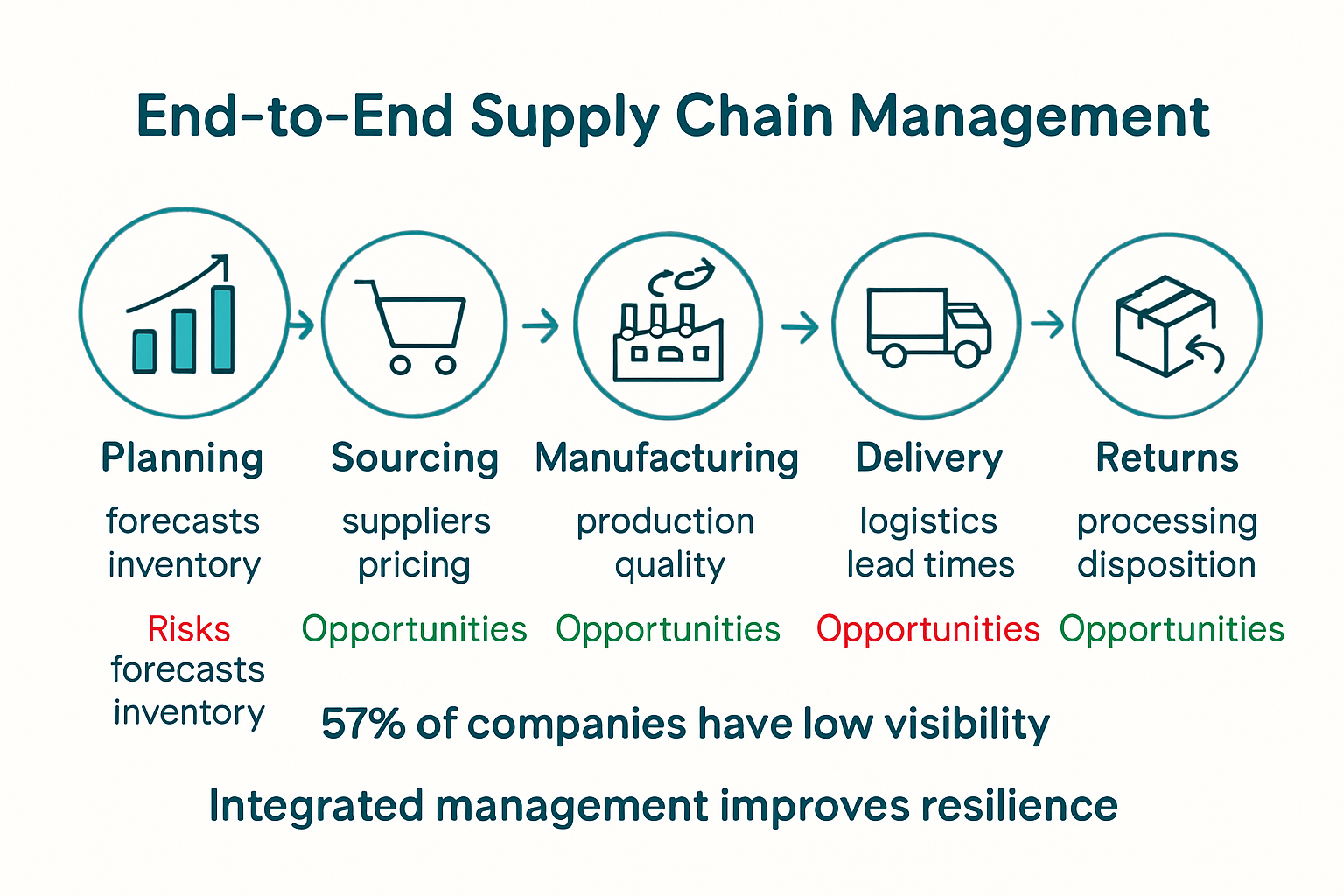
Planning serves as the foundational element where businesses forecast demand, analyze market trends, and develop comprehensive strategies. This phase involves understanding customer requirements, predicting potential challenges, and creating robust frameworks that guide subsequent supply chain activities. Organizations must develop flexible approaches that can adapt to changing market conditions and unexpected disruptions.
Strategic Sourcing and Procurement
Strategic sourcing represents a critical phase in the supply chain process. American Military University emphasizes that effective sourcing involves identifying and selecting suppliers who can provide high-quality materials at competitive prices while maintaining reliability. This process goes beyond simple price comparison and requires comprehensive evaluation of potential partners based on multiple criteria such as:
- Supplier Reliability: Consistent performance and ability to meet delivery schedules
- Quality Standards: Adherence to predetermined product specifications
- Cost Efficiency: Competitive pricing without compromising product quality
- Technological Capabilities: Advanced manufacturing and logistics infrastructure
By implementing rigorous sourcing strategies, businesses can reduce procurement risks and establish long-term partnerships that contribute to overall supply chain resilience.
Integrated Supply Chain Management
Modern supply chain management transcends traditional linear approaches. According to Wikipedia’s comprehensive overview, successful supply chains integrate multiple functions including procurement, operations management, logistics, and marketing channels. This holistic approach ensures seamless information and material flow across different organizational departments.
Effective integration requires advanced technological solutions and real-time communication platforms that enable immediate data sharing and collaborative decision making. Companies must invest in robust digital infrastructure that supports end-to-end visibility and enables proactive management of potential bottlenecks.
Businesses seeking to optimize their supply chain processes can explore advanced logistics solutions that enhance operational efficiency and drive competitive advantage. By understanding and implementing comprehensive supply chain strategies, organizations can create resilient, adaptable systems capable of navigating complex global markets.
Core Components of Supply Chain Management
Supply chain management represents a complex ecosystem of interconnected activities that drive organizational performance and customer satisfaction. Beyond basic operational tasks, these core components form the strategic foundation that enables businesses to navigate increasingly competitive global markets.
Strategic Planning and Demand Forecasting
According to Michigan State University, strategic planning constitutes a fundamental component of supply chain management. This critical phase involves comprehensive demand forecasting, analyzing market trends, and designing supply chain architectures that can efficiently meet customer needs. Organizations must develop dynamic planning frameworks that enable rapid adaptation to changing market conditions.
Effective strategic planning requires robust data analytics capabilities and predictive modeling techniques. Businesses must leverage advanced technologies that can process complex market signals and generate accurate demand projections. These insights help organizations optimize inventory levels, reduce waste, and maintain competitive pricing strategies.
Supplier Relationship Management
Loyola University Chicago emphasizes the critical importance of Supplier Relationship Management (SRM) as a core supply chain component. SRM goes beyond transactional interactions, focusing on building strategic partnerships that create mutual value and operational resilience.
Successful supplier relationships are characterized by:
- Transparent Communication: Regular dialogues about performance expectations
To better visualize what sets apart successful supplier relationships, the table below summarizes key SRM practices and their corresponding benefits:
| SRM Practice | Description | Benefit |
|---|---|---|
| Transparent Communication | Open, honest dialogue about expectations | Fewer misunderstandings, better alignment |
| Performance Metrics | Defined KPIs to track supplier performance | Clear evaluation, accountability |
| Collaborative Innovation | Joint development of new processes or products | Shared growth, process improvement |
| Risk Mitigation | Shared strategies to address disruptions | Increased reliability, resilience |
- Performance Metrics: Clear key performance indicators (KPIs) for evaluation
- Collaborative Innovation: Joint development of improved processes and products
- Risk Mitigation: Shared strategies for addressing potential supply chain disruptions
By cultivating strong supplier relationships, organizations can secure more reliable supply chains, negotiate better terms, and create collaborative environments that drive continuous improvement.
Risk Management and Technological Integration
The International Institute for Management Development highlights risk management as a crucial component in modern supply chain strategies. With increasing global complexity, businesses must develop comprehensive approaches to identify, assess, and mitigate potential disruptions.
Risk management strategies include:
- Diversifying supplier networks
- Developing robust contingency plans
- Implementing advanced tracking and monitoring technologies
- Creating flexible logistics frameworks
Technological integration plays a pivotal role in effective risk management. Companies can explore advanced logistics solutions that provide real-time visibility, predictive analytics, and automated response mechanisms. These technologies enable organizations to proactively address potential challenges before they escalate into significant operational problems.
By understanding and implementing these core components, businesses can develop supply chain management systems that are not just efficient, but strategically adaptive to the dynamic global marketplace.
Best Practices for Efficient Supply Chains
Creating an efficient supply chain requires strategic planning, continuous improvement, and a holistic approach to managing complex operational networks. Organizations must develop comprehensive strategies that balance cost-effectiveness, reliability, and adaptability to maintain competitive advantage in dynamic global markets.
Technology and Data-Driven Decision Making
U.S. Government Accountability Office emphasizes the critical role of technology and advanced analytics in modern supply chain management. Businesses must invest in robust digital infrastructure that enables real-time tracking, predictive analysis, and intelligent decision making.
Key technological considerations include:
- Advanced Analytics: Utilizing machine learning and artificial intelligence to forecast demand
- Real-Time Tracking: Implementing systems that provide end-to-end visibility
- Automated Inventory Management: Deploying smart technologies that optimize stock levels
- Cloud-Based Collaboration: Creating platforms that enable seamless communication across organizational boundaries
By embracing technological solutions, companies can transform traditional supply chain models into dynamic, responsive systems that quickly adapt to market changes.
Strategic Inventory and Logistics Optimization
Effective inventory management represents a cornerstone of supply chain efficiency. Organizations must develop nuanced approaches that balance inventory levels with operational flexibility. Just-in-time delivery strategies can help businesses minimize holding costs while maintaining product availability.
Optimization strategies include:
- Implementing lean inventory management principles
- Developing accurate demand forecasting models
- Creating flexible procurement strategies
- Establishing strategic buffer stocks for critical components
Businesses that master inventory optimization can significantly reduce operational expenses and improve overall supply chain responsiveness.

Collaborative Partnership and Risk Management
Modern supply chain success depends on building strong collaborative partnerships and developing comprehensive risk management frameworks. Organizations must move beyond transactional relationships and create integrated ecosystems that prioritize shared goals and mutual resilience.
Key collaborative practices include:
- Developing transparent communication channels with suppliers
- Creating joint performance improvement initiatives
- Establishing shared risk assessment and mitigation strategies
- Investing in supplier development and training programs
Effective risk management requires a proactive approach that anticipates potential disruptions and develops flexible contingency plans. Companies can explore advanced logistics solutions that provide comprehensive risk monitoring and rapid response capabilities.
By implementing these best practices, organizations can transform their supply chains from traditional operational models into strategic assets that drive competitive advantage and sustainable growth. The most successful businesses will be those that continuously innovate, leverage technology, and maintain flexibility in an increasingly complex global marketplace.
Overcoming Common Supply Chain Challenges
Supply chain management presents numerous complex challenges that require strategic thinking, innovative solutions, and proactive approaches. Organizations must develop robust strategies to navigate increasingly volatile global markets and technological disruptions.
Workforce and Talent Management
American Military University emphasizes the critical importance of addressing labor challenges in supply chain operations. Workforce shortages and skill gaps represent significant obstacles that can dramatically impact operational efficiency.
Effective workforce strategies include:
- Upskilling Existing Employees: Developing comprehensive training programs
- Digital Workforce Preparation: Investing in technology skills and digital literacy
- Internal Promotion: Creating clear career development pathways
- Competitive Compensation: Offering attractive wages and comprehensive benefits packages
By prioritizing talent development, organizations can build resilient teams capable of adapting to rapidly changing technological and operational landscapes.
Technological Disruption and Integration
Modern supply chains face unprecedented technological challenges that require continuous adaptation and strategic investment. Companies must develop flexible technological infrastructures that can quickly integrate emerging technologies and respond to market shifts.
Key technological integration strategies include:
- Implementing advanced analytics and artificial intelligence
- Developing cloud-based collaboration platforms
- Creating interoperable digital systems
- Investing in cybersecurity and data protection mechanisms
Logistics risk management strategies play a crucial role in mitigating potential technological disruptions and ensuring smooth operational continuity.
Market Competition and Strategic Resilience
The Brookings Institution highlights the importance of addressing anti-competitive practices and developing strategic market resilience. Organizations must create comprehensive approaches that go beyond traditional operational models.
Strategic resilience tactics include:
- Diversifying supplier networks
- Developing flexible procurement strategies
- Creating robust contingency planning
- Establishing transparent communication channels
- Monitoring market dynamics and potential disruptions
Successful supply chain management requires a holistic approach that balances technological innovation, workforce development, and strategic flexibility. Organizations that can effectively navigate these challenges will create competitive advantages that extend far beyond traditional operational boundaries.
By understanding and proactively addressing these common supply chain challenges, businesses can transform potential obstacles into opportunities for growth and innovation. The most successful organizations will be those that maintain adaptability, invest in continuous learning, and develop comprehensive strategies that anticipate and respond to emerging market dynamics.
Frequently Asked Questions
What are the key components of supply chain management?
The key components of supply chain management include planning, sourcing, manufacturing, delivery, and returns. Each component plays a crucial role in ensuring efficient product flow and minimizing disruptions.
How can companies improve supplier relationships?
Companies can improve supplier relationships by fostering transparent communication, setting clear performance metrics, engaging in collaborative innovation, and developing shared risk mitigation strategies to create mutual value and resilience.
What role does technology play in modern supply chain management?
Technology plays a critical role in modern supply chain management by enabling real-time tracking, advanced data analytics, and automated decision-making. These technological solutions enhance visibility, operational efficiency, and adaptability to market changes.
How can organizations achieve better demand forecasting?
Organizations can achieve better demand forecasting by leveraging advanced analytics, utilizing machine learning techniques, and developing dynamic planning frameworks that adapt to changing market conditions.
Power Up Your Supply Chain with Reliable Courier Services for Every Step
Struggling to gain visibility and control over your growing supply chain? The article highlights how challenges in supplier relationships, tracking, and risk management can slow down your business and increase costs. If changing market demands, logistics disruptions, or inefficient fulfillment are stopping your ecommerce growth, you deserve a solution designed for real-time results and long-term resilience.

Make every stage of your product journey seamless and secure. Discover how our reliable courier services give you end-to-end support, from freight booking and customs clearance to automated inventory and fast doorstep delivery. Gain instant shipment tracking, integrated warehousing, and live analytics for smarter decisions. Take the next step toward a supply chain that adapts as fast as you do. Visit or-ner.com now for a logistics partner built for your ecommerce goals.
Recommended
- Why Logistics Is Important: Key Benefits for 2025 Success – ORNER
- Logistics Risk Management Strategies for 2025 Success – ORNER
- What Is Logistics Management? A 2025 Guide for Retailers – ORNER
- Top Sustainable Logistics Solutions for 2025: Guide for Retailers and Brands – ORNER
- Odoo Supply Chain Management. Supply chain management ERP
- What Is Operational Excellence? 2025 Guide for Agencies – Business Coach For Digital Marketing Companies, SEO, Social Media Agencies