Retailers are always searching for ways to cut costs and deliver faster service, and supply chain integration promises big rewards. But most people overlook just how much money is at stake. Studies show that integrating supply chains can slash inventory by 30 percent and reduce transaction costs from $150 to just a few dollars per exchange. This sounds like a dream, yet the real victory is not the technology or the savings. The biggest win comes from instant responsiveness and happier customers, which is quietly reshaping the entire retail industry.
Table of Contents
- What Is Supply Chain Integration?
- Key Benefits For Retailers And Brands
- Effective Strategies For Seamless Integration
- Common Challenges And Best Practices
Quick Summary
| Takeaway | Explanation |
|---|---|
| Embrace Supply Chain Integration | Integrating supply chains enhances operational efficiency and reduces costs significantly. |
| Build Strong Collaborative Relationships | Foster partnerships with suppliers and stakeholders to improve responsiveness and innovation. |
| Invest in Advanced Technologies | Implement digital tools for real-time communication and tracking to optimize supply chains. |
| Maintain Supply Chain Flexibility | Adapt quickly to market changes and disruptions for sustained competitive advantage. |
| Prioritize Continuous Training | Ensure all employees are proficient in integrated systems for effective supply chain execution. |
What Is Supply Chain Integration?
Supply chain integration represents a strategic approach that transforms how modern businesses coordinate and manage their operational processes. At its core, supply chain integration is about creating seamless connections between different components of the supply chain to enhance efficiency, reduce costs, and improve overall performance.
The Fundamental Definition
Supply chain integration is a comprehensive alignment of organizational processes, technologies, and strategies across multiple business functions and external partners. It goes beyond traditional operational boundaries, focusing on creating a unified system where information, materials, and resources flow smoothly and transparently.
The primary goal of supply chain integration is to eliminate silos and create a holistic approach to managing logistics, inventory, procurement, and distribution. By breaking down internal barriers and establishing robust communication channels, businesses can respond more quickly to market changes, customer demands, and operational challenges.
Types of Supply Chain Integration
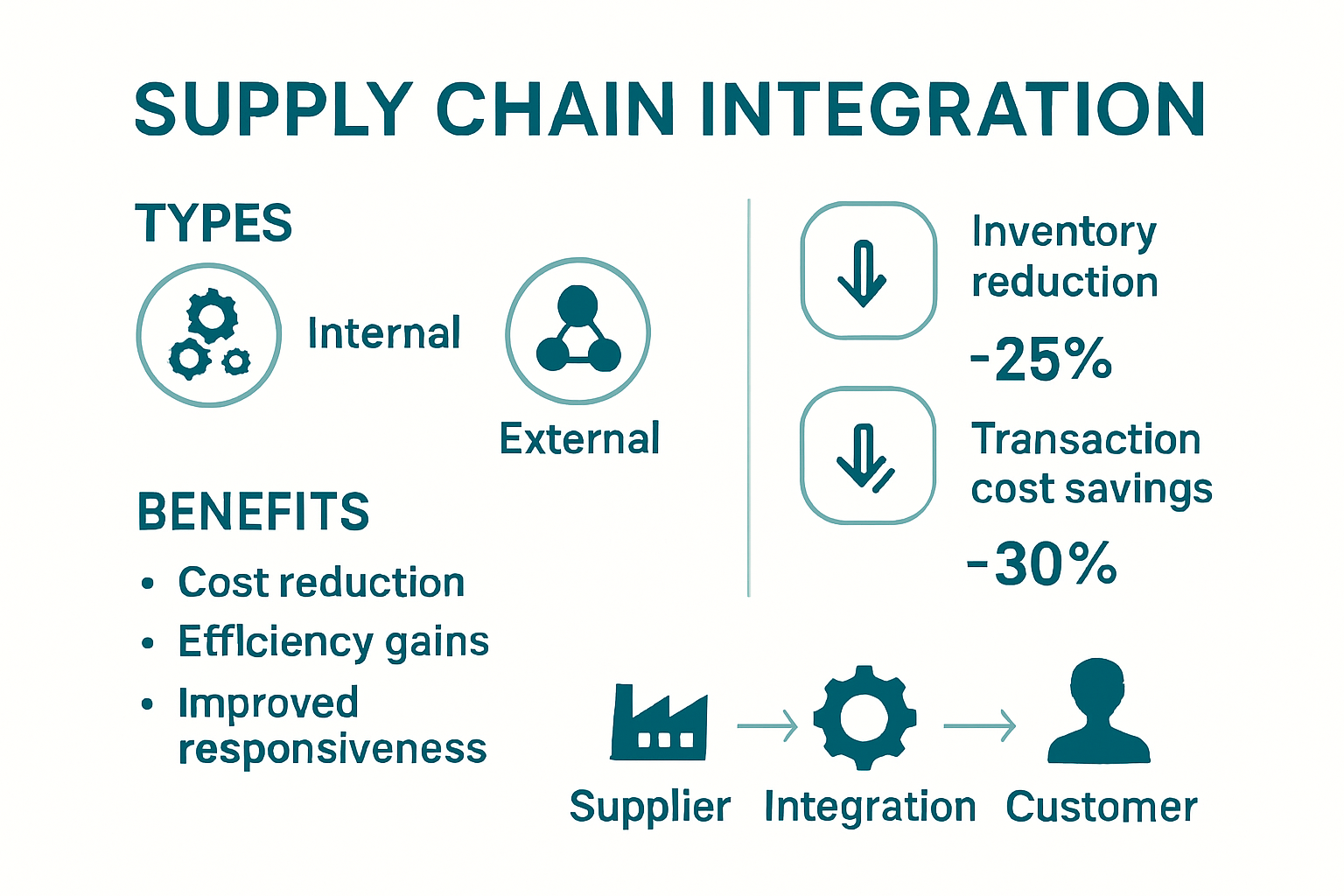
To clarify the distinct roles and focus areas within supply chain integration, the following table compares Internal and External Integration based on definitions and characteristics discussed in the article.
| Type of Integration | Focus Areas | Description |
|---|---|---|
| Internal Integration | Departments (procurement, manufacturing, etc.) | Synchronizes organizational practices and procedures within a company; eliminates silos and aligns processes |
| External Integration | Customers, suppliers, external stakeholders | Coordinates logistics and operations with external partners; emphasizes collaboration and information sharing |
According to research, supply chain integration can be categorized into two primary dimensions: internal and external integration. External integration involves coordinating logistics activities with customers and suppliers across organizational boundaries. This means establishing strong collaborative relationships with external stakeholders to streamline processes and share critical information.
Internal integration, on the other hand, focuses on synchronizing organizational practices, procedures, and behaviors within a company. This includes aligning departments like procurement, manufacturing, warehousing, and distribution to create a cohesive and efficient operational ecosystem. By implementing integrated systems and shared technologies, businesses can reduce redundancies, minimize errors, and optimize resource allocation.
Strategic Benefits of Supply Chain Integration
Modern retailers and businesses recognize that supply chain integration is not just a technological upgrade but a strategic imperative. The benefits extend far beyond operational efficiency. Integrated supply chains enable real time visibility into inventory levels, production status, and shipping conditions. This transparency allows businesses to make data driven decisions, predict potential disruptions, and proactively manage risks.
Moreover, supply chain integration supports enhanced customer experiences. By creating more responsive and adaptable logistics networks, companies can offer faster delivery times, more accurate order tracking, and personalized service options. Learn more about our integrated logistics solutions that can help transform your supply chain management approach.
As global markets become increasingly complex and competitive, supply chain integration emerges as a critical strategy for businesses seeking sustainable growth and operational excellence. It represents a holistic approach that combines technology, strategic planning, and collaborative partnerships to create more resilient and efficient supply chain ecosystems.
Key Benefits for Retailers and Brands
Supply chain integration offers transformative advantages for modern retailers and brands, providing strategic capabilities that extend far beyond traditional operational improvements. By embracing comprehensive integration strategies, businesses can unlock significant competitive advantages and drive sustainable growth.
Cost Optimization and Financial Performance
Research from the National Academies Press reveals that supply chain integration can lead to remarkable cost savings. By strategically reducing inventory levels and minimizing transaction costs, retailers can achieve substantial financial benefits. The study indicates that decreasing inventory by 30% can generate significant savings shared across supply chain participants.
Moreover, electronic integration systems dramatically reduce transaction costs. Traditional manual transactions typically cost around $150 per interaction, but integrated digital systems can reduce these expenses dramatically. This cost efficiency translates directly into improved profit margins and more competitive pricing strategies for retailers.

Enhanced Operational Efficiency and Innovation
Deloitte emphasizes that integrating merchandising and supply chain capabilities unlocks unprecedented opportunities for retailers. The integration enables businesses to optimize product flow, implement smarter inventory management, and improve overall capital performance.
By fostering long-term collaborative relationships, supply chain integration encourages suppliers to actively participate in joint product development and innovation efforts. Learn more about optimizing logistics management to understand how these strategic partnerships can drive continuous improvement and competitive advantage.
Customer Experience and Strategic Responsiveness
Supply chain integration directly impacts customer experience by creating more responsive and transparent operational networks. Retailers can offer enhanced tracking, faster delivery times, and more personalized service options. The ability to quickly adapt to market changes and customer preferences becomes a significant competitive differentiator.
Integrated supply chains provide real-time visibility into inventory levels, production status, and shipping conditions. This transparency enables businesses to make data-driven decisions, predict potential disruptions, and proactively manage risks. Brands can respond more rapidly to market demands, adjust inventory in real-time, and maintain optimal stock levels.
The strategic benefits of supply chain integration extend beyond immediate operational improvements. By creating more resilient and efficient supply chain ecosystems, retailers can build stronger relationships with suppliers, optimize resource allocation, and position themselves for sustainable growth in an increasingly complex global marketplace.
As competition intensifies and customer expectations continue to evolve, supply chain integration emerges as a critical strategy for retailers seeking to differentiate themselves and drive long-term success.
Effective Strategies for Seamless Integration
Implementing successful supply chain integration requires a comprehensive and strategic approach that addresses technological, organizational, and collaborative challenges. Modern retailers must develop sophisticated strategies that go beyond traditional operational methods to create truly seamless and responsive supply chain ecosystems.
Technological Infrastructure and Digital Transformation
Research from Deloitte emphasizes the critical importance of digitizing supply chain networks. This involves implementing advanced technological solutions that enable real-time communication, data sharing, and collaborative planning across multiple business functions and external partners.
Enterprise resource planning (ERP) systems, integrated dashboards, and cross-functional project management software play a pivotal role in bridging communication gaps. Learn more about digital logistics solutions that can transform your supply chain management approach. These technological tools create transparency, facilitate data-driven decision-making, and enable businesses to track and optimize every aspect of their supply chain operations.
Collaborative Relationship Management
A study published in Discover Sustainability highlights the significance of top management commitment in driving supply chain integration initiatives. Successful integration is not just about implementing technology but also about creating a culture of collaboration, shared values, and mutual accountability.
Building strong relationships with suppliers, logistics partners, and other stakeholders is crucial. This involves developing clear communication protocols, establishing shared performance metrics, and creating mechanisms for continuous feedback and improvement. By fostering a collaborative environment, businesses can create more agile and responsive supply chain networks that can quickly adapt to changing market conditions.
Advanced Technologies and Innovation
Research on IoT solutions demonstrates the transformative potential of emerging technologies in supply chain management. Internet of Things (IoT) devices can solve distributed system challenges by creating trustful relationships among supply chain actors. These technologies address critical issues such as security, tracking, traceability, and warehouse management.
IoT sensors and advanced analytics enable businesses to monitor inventory levels, track shipments in real-time, predict potential disruptions, and optimize routing and logistics. By integrating these technologies, retailers can create more transparent, efficient, and resilient supply chain ecosystems.
Effective supply chain integration is an ongoing process that requires continuous investment in technology, people, and collaborative strategies. Retailers must remain adaptable, embracing new technologies and methodologies that enhance operational efficiency, reduce costs, and improve overall customer experience.
As global markets become increasingly complex and competitive, those who successfully implement comprehensive supply chain integration strategies will gain significant competitive advantages. The key lies in developing a holistic approach that combines technological innovation, strategic planning, and collaborative partnerships.
Common Challenges and Best Practices
Supply chain integration presents numerous challenges for modern retailers, requiring strategic approaches and proactive management to overcome complex operational barriers. Understanding these challenges and implementing best practices is crucial for successful supply chain transformation.
Technological and Resource Constraints
Research from the National Academies Press reveals that smaller businesses face significant hurdles in supply chain integration. Substantial investments in capital equipment and training are necessary to remain competitive, creating substantial barriers for small and medium-sized enterprises (SMEs) with limited financial resources.
Small businesses often struggle with technological limitations, lacking the sophisticated infrastructure required for comprehensive supply chain integration. This digital divide can prevent them from achieving the same level of operational efficiency as larger competitors. Learn more about risk management strategies to understand how businesses can mitigate these technological challenges and build more resilient supply chain networks.
Supply Chain Visibility and Disruption Management
The National Institute of Standards and Technology highlights critical challenges that businesses encounter in supply chain management. Key issues include:
- Fluctuating material costs
- Unpredictable supply chain disruptions
- Limited supplier diversification
- Insufficient operational visibility
Addressing these challenges requires a multifaceted approach. Businesses must develop robust risk management strategies, create flexible sourcing mechanisms, and implement advanced tracking technologies to enhance real-time visibility and responsiveness.
Best Practices for Effective Integration
To summarize the core challenges mentioned, as well as relevant best practice approaches, the table below organizes the main integration obstacles for retailers and associated mitigation strategies described in the article.
| Key Challenge | Description | Related Best Practice |
|---|---|---|
| Technological Constraints | Limited capital equipment or advanced tools, esp. for SMEs | Invest in technology; continuous upgrades |
| Resource Limitations | Lack of funding and training for smaller businesses | Implement continuous training; flexible adaptation |
| Supply Chain Disruptions | Unpredictable disruptions and fluctuating material costs | Create flexible adaptation mechanisms; robust RM |
| Limited Visibility | Insufficient real-time operational information | Develop robust communication protocols; tracking |
| Supplier Diversification Issues | Inability to access diverse suppliers | Foster collaborative relationships |
Successful supply chain integration demands a comprehensive strategy that addresses technological, operational, and human factors. Best practices include:
-
Develop Robust Communication Protocols: Establish clear, standardized communication channels between all supply chain participants.
-
Invest in Technology: Continuously upgrade technological infrastructure to support seamless information exchange and real-time tracking.
-
Foster Collaborative Relationships: Build strong, transparent relationships with suppliers, logistics partners, and other stakeholders.
-
Implement Continuous Training: Ensure that employees at all levels understand and can effectively utilize integrated supply chain technologies and processes.
-
Create Flexible Adaptation Mechanisms: Design supply chain systems that can quickly respond to market changes, disruptions, and emerging challenges.
Companies must recognize that supply chain integration is an ongoing journey requiring continuous investment, learning, and adaptation. The most successful organizations view integration not as a one-time project but as a dynamic, evolving strategy that demands constant attention and refinement.
By understanding common challenges and implementing strategic best practices, retailers can transform potential obstacles into opportunities for innovation, efficiency, and competitive advantage. The key lies in maintaining a holistic, flexible approach that balances technological capabilities with human expertise and collaborative partnerships.
Frequently Asked Questions
What is supply chain integration?
Supply chain integration is the strategic alignment of processes, technologies, and strategies across various business functions and external partners to enhance efficiency, reduce costs, and improve overall performance in the supply chain.
What are the key benefits of supply chain integration for retailers?
The key benefits include cost optimization by reducing inventory and transaction costs, enhanced operational efficiency through improved product flow and smarter inventory management, and better customer experience via quicker delivery times and more accurate order tracking.
What are the challenges retailers face in achieving supply chain integration?
Retailers often encounter technological constraints, resource limitations, supply chain disruptions, and limited visibility into their operations, which can hinder effective integration.
How can retailers effectively implement supply chain integration strategies?
Retailers can implement effective integration strategies by investing in advanced technologies, fostering collaborative relationships with partners, ensuring continuous employee training, and creating flexible adaptation mechanisms to quickly respond to market changes.
Take Charge of Your Supply Chain Transformation Today
If supply chain integration feels overwhelming and you are struggling with high costs, slow response times, or visibility gaps, you are not alone. The article lays out how real integration means instant information flow, reduced inventory, and real value for both your team and your customers. Yet, moving away from fragmented systems and patchwork logistics is not easy for most modern retailers. Many brands feel frustrated when operational inefficiencies lead to missed sales and unhappy buyers.
You deserve a logistics partner that not only understands these pain points but solves them with technology and real support. or-ner.com was built to power seamless supply chain integration for ecommerce sellers and brands of every size. Our platform brings everything under one roof:
- Real-time shipment tracking and reliable courier services for complete visibility
- Automated workflows and inventory management that save you time and reduce errors
- Integrated solutions from freight booking to warehousing designed for your unique business challenges
Make this the year you move past hidden costs and unreliable workflows. Visit or-ner.com to connect with our experts or explore our reliable courier services. Take the first step toward a stronger, more responsive supply chain now.
Recommended
- Why Logistics Is Important: Key Benefits for 2025 Success – ORNER
- Just in Time Delivery: Essential Guide for 2025 Success – ORNER
- Warehouse Management Systems 2025: Boost Retail and Supply Chain – ORNER
- What Is Logistics Management? A 2025 Guide for Retailers – ORNER
- Estrategia omnicanal: Claves para crecer en ecommerce 2025
- Ecommerce Conversion Rate Optimization Strategies for 2025