

TL;DR:
- Shipping rates include base charges and surcharges related to package characteristics, distance, and service level. Understanding dimensional weight, zone distribution, and surcharges is crucial for accurate cost management and effective pricing strategies. Regular invoice audits and precise threshold modeling help ecommerce sellers protect margins and optimize shipping expenses.
Shipping rates are the total fees carriers charge to move a package from origin to destination, calculated by combining a base transportation rate with a stack of surcharges tied to package characteristics, distance, and service level. USPS, UPS, and FedEx each publish rate tables built on weight, dimensions, and geographic zones, but the number on your invoice rarely matches the base rate alone. For ecommerce sellers managing margins, understanding shipping costs at the component level is the difference between profitable pricing and quietly losing money on every order. This guide breaks down every variable so you can calculate shipping prices accurately, compare carriers with confidence, and build a cost model that holds up in practice.
What determines shipping rates and how carriers calculate them
Major carriers like USPS, UPS, and FedEx price parcels using a three-variable matrix: billable weight, shipping zone, and service level. Each variable multiplies the cost in a different way, and misunderstanding any one of them leads to budget surprises.

Billable weight is not always the number on your scale. Dimensional weight is calculated as length times width times height, divided by a carrier-specific divisor (commonly 139 for domestic US shipments). Carriers bill whichever is greater, actual or dimensional weight. A lightweight but bulky product like a throw pillow or a foam yoga block can cost two to three times more to ship than its scale weight suggests. This is one of the most common sources of unexpected cost for new ecommerce sellers.
Shipping zones measure the distance between origin and destination ZIP codes, not in miles but in carrier-defined bands numbered 1 through 8. A shipment from Portland, Maine to Boston sits in Zone 1 or 2. The same package shipped from Portland to Los Angeles reaches Zone 8, and the cost increase is not linear. Zone 8 rates can be three to four times higher than Zone 2 rates for the same package. Sellers with a single warehouse on one coast pay a steep zone penalty on every order shipped to the other coast.
Service level is the largest single lever for changing price. Ground service is the cheapest option across all major carriers, while UPS and FedEx express services cost two to four times more depending on delivery speed and guarantees. Overnight and two-day services carry premium pricing that most ecommerce orders cannot justify unless the product margin is high or the customer is paying for speed explicitly.
- Billable weight: Always calculate dimensional weight before printing a label. If DIM weight exceeds actual weight, that is what you pay.
- Zone distribution: Analyze your order geography. If 60% of orders ship to Zones 6 through 8, a second fulfillment location cuts your average zone and your average rate.
- Service mix: Default to ground for standard orders. Reserve express for high-margin products or paid expedited options at checkout.
Pro Tip: Run a zone distribution report on your last 90 days of orders. Most sellers are surprised to find that one or two zones account for the majority of their shipping spend, which makes the case for a second warehouse far more concrete.
How surcharges inflate your actual shipping cost
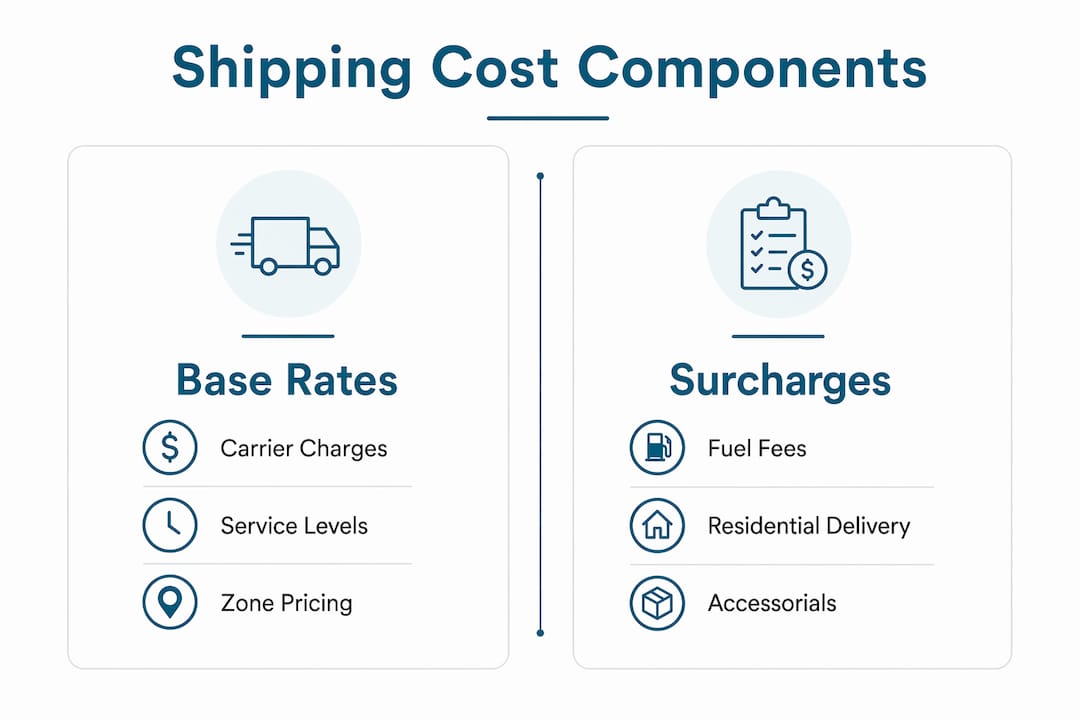
Surcharges are the line items that turn a quoted base rate into a much larger invoice total. Fuel surcharges are dynamic percentage-based fees updated weekly or monthly, tied to diesel price indexes published by the U.S. Department of Energy. When diesel prices spike, fuel surcharges follow within days. This means your effective shipping cost can rise even when your negotiated base rate stays fixed.
The most common surcharges ecommerce sellers encounter include:
- Residential delivery surcharge: Applied when the destination is a home address rather than a commercial dock. UPS and FedEx both charge this on the majority of B2C ecommerce orders.
- Delivery area surcharge (DAS): Triggered when the destination ZIP code falls outside a carrier’s dense service area. Rural and remote addresses carry higher DAS fees, sometimes adding several dollars per package.
- Signature required: Optional but adds cost per package. Necessary for high-value goods but often applied by default on some carrier accounts.
- Peak season surcharges: UPS and FedEx both add temporary surcharges during Q4 holiday periods, typically October through January. These are announced in advance but easy to miss in budget planning.
- Oversized and additional handling fees: Triggered by packages exceeding specific dimensions or weight thresholds. These fees can exceed the base rate on large items.
A 40% carrier discount applied only to the base linehaul rate does not reduce your fuel surcharge by 40%. Carrier discounts frequently exclude fuel surcharges, which are applied post-discount and charged at full rate. This is one of the most misunderstood elements of negotiated carrier contracts.
Auditing shipping invoices line by line is the only reliable way to catch misapplied surcharges, delayed rate changes, and billing errors. Many ecommerce businesses audit only total invoice amounts and miss individual surcharge errors that compound across thousands of shipments.
Pro Tip: When negotiating a carrier contract, ask specifically which surcharges are included in your discount tier. Get the answer in writing. A 35% base rate discount with full fuel surcharges applied post-discount can deliver less savings than a 20% discount that includes fuel.
Separating shipping costs from handling costs
Shipping and handling are often quoted together as a single line item, but they scale by completely different variables. Separating them produces more accurate cost models and better pricing decisions.
Shipping costs scale with package characteristics and geography: weight, dimensions, zone, and service level. A 2-pound package shipped to Zone 4 costs the same to ship whether it contains one item or five, as long as the box size and weight stay constant.
Handling costs scale with order complexity. Handling includes labor time for picking and packing, materials like boxes, tape, and inserts, and overhead allocations for warehouse space and equipment. A five-item order with custom tissue paper and a branded insert costs significantly more to handle than a single-item order in a plain poly mailer, even if both ship in the same box at the same rate.
Here is a sample cost breakdown for two typical ecommerce orders:
| Cost component | Single-item order | Five-item order |
|---|---|---|
| Carrier base rate (Zone 4, 1 lb) | $7.50 | $8.20 |
| Fuel surcharge (approx. 18%) | $1.35 | $1.48 |
| Residential surcharge | $4.65 | $4.65 |
| Labor (pick and pack) | $1.20 | $3.80 |
| Packing materials | $0.60 | $1.40 |
| Total cost | $15.30 | $19.53 |
When you bundle shipping and handling into a single “shipping fee” charged to the customer, you lose visibility into which component is driving cost increases. Splitting them in your cost model lets you identify whether a margin problem is a carrier rate issue or an internal efficiency issue.
To build a clean separation, follow these steps:
- Record actual carrier charges per shipment from invoice data.
- Track labor minutes per order type and multiply by loaded hourly wage.
- Calculate average material cost per order category (poly mailer, small box, large box).
- Allocate a fixed overhead rate per order based on warehouse cost divided by monthly order volume.
Pricing strategies based on a solid shipping cost model
Once you understand how shipping rates work at the component level, you can build a pricing strategy that protects margin without alienating customers. The three main approaches are pass-through pricing, flat-rate pricing, and free shipping with a threshold.
Pass-through pricing charges the customer the exact carrier rate at checkout. This is accurate but creates friction. Customers see variable shipping costs that change by address, and cart abandonment rates rise when shipping fees feel unpredictable.
Flat-rate pricing charges a fixed fee regardless of destination or weight within a defined range. It simplifies the customer experience and is easy to communicate, but it requires careful modeling. If your flat rate is set too low, heavy or long-distance orders erode margin. If it is set too high, you lose price-sensitive customers.
Free shipping with a threshold is the most effective conversion tool, but it requires precise modeling. Free shipping thresholds should be set 10 to 30% above your average order value to balance customer incentives with margin protection. For a store with a $38 average order value and $6 average shipping cost, a $50 threshold covers the shipping subsidy on most orders while nudging customers to add one more item. Setting the threshold too low increases order volume but can reduce overall margin if customers add low-margin products to qualify.
Multi-carrier rate shopping compares live rates across USPS, UPS, and FedEx at the moment of fulfillment and selects the cheapest option that meets the delivery promise. For sellers shipping more than 200 orders per month, rate shopping typically reduces average shipping cost by 8 to 15% without changing the customer experience.
Pro Tip: Build your free shipping threshold model using your actual zone distribution, not a national average. If most of your customers are in high zones, your average shipping cost is higher than industry benchmarks suggest, and your threshold needs to reflect that.
Key takeaways
Shipping rates are the sum of base carrier charges, surcharges, and service-level premiums, and each component must be tracked separately to protect ecommerce margins.
| Point | Details |
|---|---|
| Dimensional weight drives cost | Always calculate DIM weight before shipping; light but bulky items often cost far more than scale weight implies. |
| Surcharges are post-discount | Negotiated carrier discounts frequently exclude fuel surcharges, so track them independently to measure true savings. |
| Separate shipping from handling | Shipping scales with package and zone; handling scales with order complexity. Split them in your cost model. |
| Free shipping needs a threshold | Set your free shipping threshold 10 to 30% above average order value to cover the subsidy without margin loss. |
| Invoice audits catch overcharges | Line-item reconciliation of carrier invoices regularly uncovers misapplied surcharges and billing errors. |
Why most sellers underestimate their real shipping cost
I have worked with ecommerce businesses across apparel, home goods, and consumer electronics, and the pattern is consistent. Sellers look at their base carrier rate, add a rough estimate for fuel, and call it their shipping cost. They are usually off by 20 to 40% once residential surcharges, DAS fees, and peak season charges are factored in.
The deeper problem is that most sellers negotiate a carrier contract once and then stop paying attention. A 40% discount on base rates sounds significant. But if fuel surcharges, residential fees, and accessorial charges are applied at full rate after the discount, the effective savings on total invoice cost can be closer to 15%. I have seen sellers genuinely shocked when we ran the actual math on their invoices.
The other pitfall I see constantly is treating free shipping as a marketing decision rather than a financial one. Offering free shipping to compete with larger retailers is understandable. But setting the threshold based on gut feel rather than actual zone-weighted shipping cost data is how sellers quietly lose margin on their best-performing months. November and December look great on revenue and terrible on net margin, and the culprit is usually a free shipping threshold that was never modeled properly.
My honest recommendation: audit your last three months of carrier invoices at the line-item level before you negotiate your next contract or change your shipping policy. The data will tell you exactly where the money is going, and that is the only foundation worth building a pricing strategy on. Or-ner’s cross-border shipping guide covers additional cost factors for sellers expanding internationally, which adds another layer of complexity worth understanding early.
— Maayan
How Or-ner helps ecommerce sellers control shipping costs
Or-ner gives ecommerce sellers access to reliable courier services across multiple carriers, with rate comparison built into the fulfillment workflow so you always ship at the best available price. The platform handles the complexity of surcharge tracking, zone optimization, and carrier selection so you are not manually reconciling invoices or guessing at your true cost per shipment. Or-ner’s logistics network covers domestic and cross-border routes, with flexible pricing models including negotiated volume discounts and flat-rate options for sellers who need pricing consistency. If you are ready to stop estimating your shipping costs and start managing them with real data, Or-ner’s team can build a solution around your order volume, product mix, and delivery requirements. Explore courier options for small businesses or contact Or-ner directly for a tailored rate analysis.
FAQ
What are shipping rates made up of?
Shipping rates consist of a base transportation charge plus surcharges including fuel, residential delivery, delivery area, and peak season fees. Carriers like UPS, FedEx, and USPS calculate the base rate using billable weight, shipping zone, and service level.
How is dimensional weight calculated?
Dimensional weight equals length times width times height divided by the carrier’s divisor, commonly 139 for US domestic shipments. Carriers bill whichever is greater, actual weight or dimensional weight, so bulky light packages often cost significantly more than their scale weight implies.
Why do surcharges matter more than base rates?
Carrier discounts typically apply only to base linehaul rates, while fuel surcharges and accessorial fees are charged at full rate after the discount. This means a large base rate discount can deliver far less total savings than it appears on paper.
What is the right free shipping threshold for my store?
Set your free shipping threshold 10 to 30% above your average order value to cover the shipping subsidy without reducing margin. For a store with a $38 average order value and $6 average shipping cost, a $50 threshold is a practical starting point based on margin coverage.
How often should I audit my carrier invoices?
Audit carrier invoices monthly at the line-item level to catch misapplied surcharges, billing errors, and rate changes. Many ecommerce businesses only review total invoice amounts and miss individual surcharge errors that accumulate into significant overcharges over time.