TL;DR:
- Ecommerce logistics faces complex operational challenges like inventory imbalances, high last-mile costs, and costly returns in 2026. Building a unified data infrastructure, diversifying carriers, and strategic inventory positioning are essential to overcoming these obstacles. Implementing integrated systems and proactive supply chain strategies improves efficiency, reduces costs, and enhances customer experience.
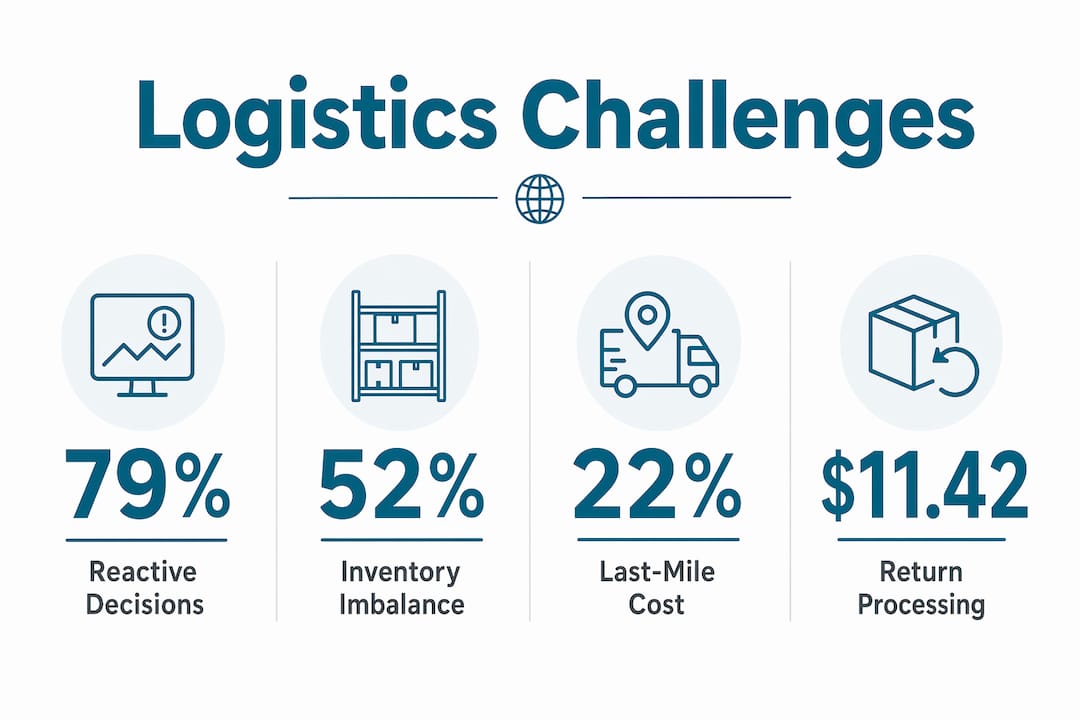
Ecommerce logistics challenges are the operational and strategic obstacles online retailers face when managing inventory, shipping, delivery, and returns at the speed and cost customers now expect. These hurdles have intensified in 2026: last-mile expenses surged 22% since Q1 2025, returns processing at U.S. third-party fulfillment centers now averages $11.42 per unit, and supply chain management has become a top strategic priority for 68% of trade professionals, up from 35% the prior year. The formal industry term for this domain is fulfillment operations management, but most practitioners simply call it what it is: the daily fight to get the right product to the right customer at a cost that keeps the business alive.
What are the primary ecommerce logistics challenges in 2026?
The core problem is not a single failure point. It is a chain of interdependent decisions where one weak link collapses the entire customer experience. Inventory imbalance, carrier rate volatility, returns volume, and cross-border compliance all compound each other. Solving one in isolation rarely moves the needle.
The most telling data point: 79% of logistics leaders expect to make reactive decisions during demand surges despite early planning. That figure tells you planning alone is not the answer. The gap between a forecast and a fulfilled order is where most ecommerce businesses lose money and customers.
Three named forces drive the majority of these ecommerce fulfillment obstacles. First, data fragmentation across sales channels creates inventory blind spots. Second, carrier capacity tightening squeezes margin on every outbound shipment. Third, reverse logistics costs have grown from a rounding error to a line item that can break a 3PL contract. Each of these deserves a direct look.
What causes inventory management challenges in ecommerce?
Inventory imbalance is the top operational fear for 52% of fulfillment leaders, according to the same Kase survey of 328 retail and ecommerce professionals. The root cause is almost always data lag, not demand unpredictability. When your warehouse management system, storefront, and carrier platform do not share a single source of truth, you get phantom stock, misdirected orders, and the worst customer experience in retail: an “in stock” confirmation followed by a cancellation email.
28% of supply chain leaders are currently upgrading fulfillment systems specifically to close data silos and fix synchronization errors. Many brands attempt to automate before achieving unified data, which produces operational errors like incorrect “out of stock” notifications on items that are physically available. Automation applied to bad data does not fix the problem. It accelerates it.
The two competing inventory strategies are buffering and precision placement. Buffering means holding safety stock at a central location to absorb demand spikes. Precision placement means distributing inventory closer to demand clusters to cut ground shipping costs. Positioning inventory near demand can reduce ground shipping costs by 35 to 45%, which makes precision placement the stronger long-term play for brands with predictable regional demand patterns.
Pro Tip: Integrate your storefront, WMS, and carrier platform into a single data layer before adding any automation layer. Tools like NetSuite WMS, Linnworks, or a unified 3PL portal give you the real-time inventory picture that makes every downstream decision more accurate.
Key inventory management failure modes to watch for:
- Siloed sales channel data causing incorrect stock messaging to customers
- Replenishment lag creating warehouse bottlenecks that look like packing problems but are actually upstream flow issues
- Split-fulfillment backlogs from routing rules that trap orders at locations lacking capacity
- Manual reconciliation cycles that introduce 24 to 48-hour data delays during peak periods
How does last-mile delivery create cost pressure for online merchants?
Last-mile delivery is the most expensive segment of the fulfillment chain, and it is getting worse. The 22% surge in last-mile costs since Q1 2025 is driven by three converging forces: fuel surcharges, regional carrier capacity tightening, and consumer expectations for two-day or same-day delivery that show no sign of softening. For mid-size direct-to-consumer brands processing between 500 and 10,000 orders monthly, this cost increase is not abstract. It is a direct margin compression on every shipment.
Carrier rate shopping at the order level is the most immediate tactical response. Platforms like ShipStation, EasyPost, and Shippo allow you to compare rates across multiple carriers in real time and select the best combination of cost and transit time per shipment. Tightening regional carrier capacity has reduced the arbitrage benefits that made single-carrier contracts attractive two years ago, so carrier diversification is now a structural necessity, not a backup plan.
Here is a practical four-step approach to managing last-mile delivery costs:
- Audit your carrier mix quarterly. Rate structures change faster than annual contract cycles. A quarterly review catches surcharge additions before they compound.
- Segment orders by zone and weight. Regional carriers often beat national carriers on zones 1 through 4. Identify which SKUs ship most frequently to which zones and route accordingly.
- Reposition inventory closer to demand. Warehouse placement is a shipping cost decision. Moving inventory to a fulfillment center in the Midwest or Southeast can cut zone-based surcharges significantly for brands shipping nationally.
- Negotiate dimensional weight thresholds. Carriers calculate billable weight using dimensional formulas. Packaging optimization alone can reduce your effective shipping cost per unit by 8 to 15%.
Pro Tip: Run a dimensional weight audit every quarter. Pull your top 20 SKUs by shipment volume, measure actual versus billed weight, and identify packaging reductions. This single exercise often uncovers 10% or more in recoverable shipping cost.
For a deeper look at last-mile logistics costs and capacity constraints, Or-ner’s dedicated resource covers current carrier dynamics and regional optimization strategies.
What logistics challenges do ecommerce returns pose?
Returns are no longer an afterthought in fulfillment planning. Leading brands now treat reverse logistics as a priced, capacity-constrained operation with tiered labor rates and pre-return deflection strategies built into the customer journey. The average cost to process a returned unit at U.S. third-party fulfillment centers reached $11.42 by Q1 2026. For apparel brands, where return rates regularly hit 25 to 35%, that figure can exceed the original fulfillment cost of the order.
The operational impact goes beyond the per-unit fee. Returns create inbound volume spikes that compete with outbound fulfillment for labor and dock space. When a 3PL’s returns processing capacity is overwhelmed, outbound orders slow down. The two problems feed each other.
Effective responses include:
- Tiered returns fees by SKU category. Charge higher return fees on low-margin or high-return-rate items to deflect unnecessary returns before they enter the reverse logistics pipeline.
- Pre-return deflection tools. Offer exchanges, store credit, or virtual try-on experiences at the return initiation point. Brands using deflection tools report 15 to 25% reductions in physical return volume.
- Regional returns hubs. Consolidating returns at regional processing centers before routing to a central DC reduces international freight costs and speeds restocking cycles.
- SKU-level returns cost audits. Calculate the true cost of returns per SKU including inspection, repackaging, and restocking. Items with negative net margin after returns should be repriced or discontinued.
Pro Tip: Conduct a returns cost audit by SKU every six months. Identify your top 10 return-rate items and calculate the fully loaded cost including 3PL fees, freight, and restocking labor. The results almost always change your pricing and product decisions.
Or-ner’s guide on managing reverse logistics covers tiered fee structures and deflection strategies in detail.
How do supply chain disruptions and trade complexity affect ecommerce logistics?
Supply chain issues driven by tariff volatility have reshaped fulfillment strategy at the macro level. Supply chain management became a top priority for 68% of trade professionals in 2026, nearly doubling from 35% the prior year. That shift reflects a real change in operating conditions, not just heightened awareness.
The table below maps the primary disruption types to their operational impact and the most common mitigation strategies in use today:
| Disruption type | Operational impact | Mitigation strategy |
|---|---|---|
| Tariff volatility | Landed cost unpredictability, margin erosion | Contract renegotiation, sourcing diversification |
| Customs documentation gaps | Shipment holds, compliance penalties | Automated customs filing, broker partnerships |
| Single-source supplier risk | Stockouts during supplier disruptions | Dual-sourcing, safety stock increases |
| Carrier capacity tightening | Rate surcharges, transit time extensions | Multi-carrier contracts, regional 3PL networks |
| Cross-border regulatory changes | Delayed clearance, unexpected duties | Real-time compliance monitoring tools |
The three most widely adopted mitigation strategies among trade professionals are changing sourcing patterns (65%), renegotiating supplier contracts (57%), and nearshoring production (51%). Nearshoring in particular reduces transit time and customs exposure simultaneously, which makes it a high-leverage move for brands with the supplier relationships to execute it. Or-ner’s resource on managing supply chain disruptions covers tariff impact scenarios and nearshoring frameworks in practical detail.
What strategies and technologies overcome ecommerce logistics challenges?
The most effective approach to overcoming logistics barriers is building a unified data infrastructure before layering in automation or carrier optimization. 93% of logistics leaders identify automation and integration as mission-critical for peak fulfillment planning. That consensus reflects hard experience: brands that automate fragmented systems get faster errors, not faster fulfillment.
The comparison below shows how fragmented versus unified logistics approaches perform across key operational dimensions:
| Dimension | Fragmented approach | Unified approach |
|---|---|---|
| Inventory visibility | Channel-specific, delayed updates | Real-time across all channels and locations |
| Order routing | Manual or rule-based with blind spots | Smart routing based on live inventory and carrier data |
| Returns processing | Handled separately, high labor cost | Integrated into fulfillment workflow, lower per-unit cost |
| Carrier management | Single or dual carrier, limited rate options | Multi-carrier with real-time rate shopping |
| Compliance and customs | Manual documentation, high error rate | Automated filing with exception alerts |
84% of ecommerce logistics leaders now treat carrier diversification and integrated 3PL partnerships as non-negotiable for handling demand surges and capacity constraints. Vendor relationships are shifting from transactional to embedded, strategic partnerships where the 3PL has visibility into your demand forecast and can pre-position inventory accordingly. Supply chain automation trends in 2026 show AI-driven order routing and real-time shipment tracking as the two highest-ROI technology investments for mid-market ecommerce brands.
Key takeaways
Solving ecommerce logistics challenges requires unified data infrastructure, carrier diversification, and proactive returns management working together, not as isolated fixes.
| Point | Details |
|---|---|
| Unify data before automating | Fix data silos across your WMS, storefront, and carriers before adding automation to avoid amplifying errors. |
| Diversify carriers now | 84% of logistics leaders treat multi-carrier strategies as essential; single-carrier dependency increases cost and risk. |
| Treat returns as a cost center | At $11.42 per unit average, returns require SKU-level audits and pre-return deflection to protect margins. |
| Position inventory strategically | Placing inventory near demand clusters cuts ground shipping costs by 35 to 45% and reduces last-mile exposure. |
| Monitor trade compliance actively | Tariff volatility has doubled supply chain management as a priority; real-time compliance tools reduce customs delays and penalties. |
What I’ve learned about fixing logistics the hard way
The most common mistake I see ecommerce businesses make is treating logistics as a series of separate vendor relationships rather than a single integrated system. They hire a 3PL for fulfillment, a separate carrier for last-mile, a returns platform, and a customs broker, and then wonder why their data never lines up. Each vendor optimizes for their own piece. Nobody optimizes for the whole.
The brands that consistently outperform on fulfillment share one trait: they have a single operational view of inventory, orders, and shipments. Not a dashboard that aggregates data after the fact, but a live system where a routing decision in the warehouse reflects current carrier rates and current inventory positions simultaneously. That level of integration is not a luxury. It is the baseline for competing in 2026.
I have also watched brands invest heavily in automation before solving their data problems. The result is always the same: faster wrong answers. A smart order routing system built on stale inventory data will confidently route orders to a location that cannot fulfill them. Fix the data layer first. Automate second.
Finally, the shift from transactional to strategic carrier relationships is real and worth prioritizing. Carriers that understand your volume patterns, your peak seasons, and your geographic distribution will give you better rates and better capacity access than a brand they see only at contract renewal time. That relationship takes 12 to 18 months to build. Start now.
— Maayan
How Or-ner helps you solve ecommerce logistics challenges
Or-ner’s global logistics platform is built specifically for ecommerce sellers who need reliable courier services, real-time shipment visibility, and cross-border fulfillment under one roof. The platform connects freight booking, customs clearance, warehousing, and inventory management into a single operational view, which is exactly the unified infrastructure this article describes as the foundation for solving fulfillment problems. Or-ner supports ocean, air, and land transport modes and integrates with Amazon and other major ecommerce operators. For businesses looking to reduce costs further, Or-ner’s cloud logistics platform delivers documented cost savings for ecommerce operations at scale.
FAQ
What are the biggest ecommerce logistics challenges in 2026?
The top challenges are inventory imbalance, last-mile cost inflation, returns processing costs, and supply chain disruptions from tariff volatility. Last-mile expenses alone have surged 22% since Q1 2025, compressing margins for mid-size direct-to-consumer brands.
How can ecommerce businesses reduce last-mile delivery costs?
Multi-carrier rate shopping at the order level, inventory positioning closer to demand clusters, and quarterly dimensional weight audits are the three highest-impact tactics. Positioning inventory near regional demand can cut ground shipping costs by 35 to 45%.
Why are ecommerce returns so expensive to process?
The average cost to process a returned unit at U.S. third-party fulfillment centers reached $11.42 in Q1 2026, driven by tiered inspection, repackaging, and freight coordination fees. Apparel return rates of 25 to 35% make this a significant margin risk for fashion-focused brands.
What is the best way to handle supply chain disruptions in ecommerce?
The most widely adopted strategies are diversifying sourcing patterns (65% of trade professionals), renegotiating supplier contracts (57%), and nearshoring production (51%). Real-time compliance monitoring tools reduce customs delays and protect against tariff-driven cost spikes.
How does unified supply chain technology improve ecommerce fulfillment?
Unified systems enable smart order routing, real-time inventory visibility, and automated carrier selection, which together reduce transit times and transportation costs. 93% of logistics leaders identify automation and integration as mission-critical for peak season fulfillment performance.