

TL;DR:
- Bulk shipping offers significant cost savings by maximizing cargo capacity and reducing handling and packaging expenses. It also streamlines logistics workflows and improves operational efficiency through fewer customs entries and simplified tracking. However, mastering bulk shipping requires careful planning around charter constraints, cargo readiness, and terminal coordination to realize its full benefits.
Bulk shipping is defined as the practice of transporting large quantities of goods in a single consolidated movement to reduce per-unit freight costs, minimize handling, and simplify logistics management. For businesses and e-commerce sellers, the bulk freight advantages go well beyond a lower rate per box. They reshape how you plan inventory, negotiate contracts, and compete on price. This article breaks down the real cost drivers, the operational efficiencies, the hidden friction points, and the practical steps to capture bulk shipping savings in 2026.
What are the core bulk shipping advantages for businesses?
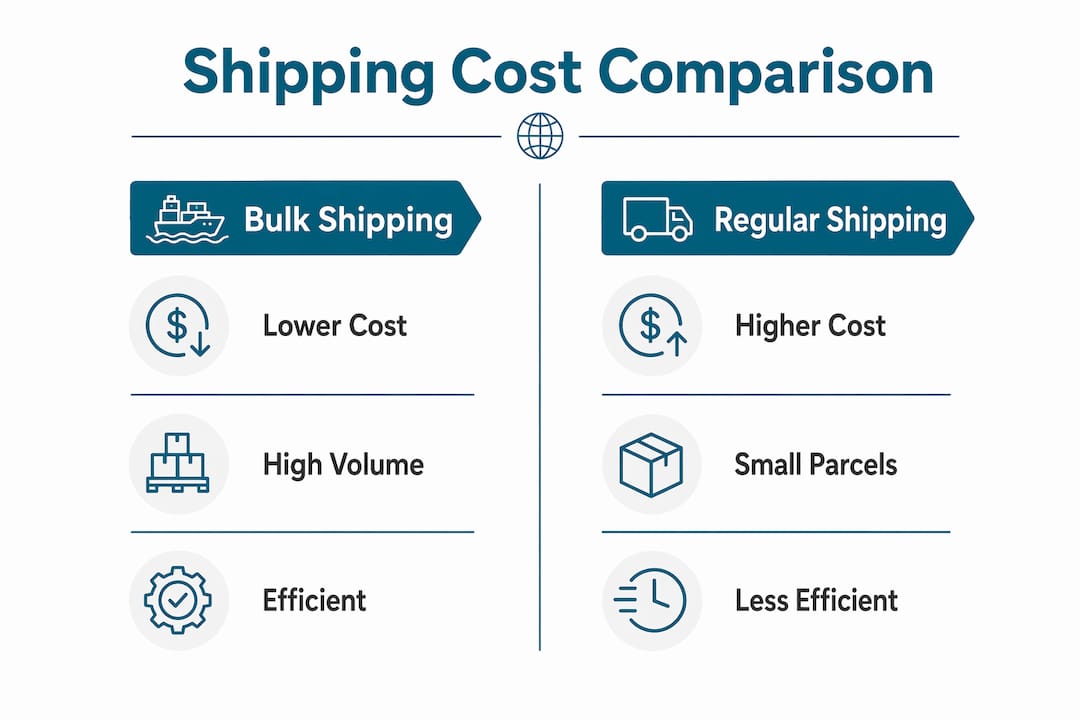
Bulk shipping’s primary advantage is cost reduction through economies of scale. Per-unit costs drop because a single large shipment fully utilizes cargo space and eliminates the per-parcel handling fees that accumulate with individual orders. That cost gap widens when you factor in packaging: bulk moves require far less protective material per unit than individually boxed shipments. For an e-commerce seller shipping 5,000 units of a home goods product, the difference between parcel-rate and bulk-rate freight can represent a meaningful share of gross margin.
The benefits of bulk shipping also extend to procurement. Buying shipping supplies in volume, such as boxes and pallets, reduces unit cost at the supply level too. Eagle Country’s analysis of small seller logistics confirms that aligning box sizes to demand and planning reorder timing dramatically improves cash flow and reduces costly replenishment gaps. That means bulk shipping savings compound: lower freight rates plus lower packaging costs plus fewer emergency reorders.
The industry term for this consolidated approach in maritime and overland freight is “bulk cargo logistics,” and it applies whether you are moving dry goods by ocean container, truckload, or intermodal rail. Understanding both the informal phrase and the standard term matters because contracts, carrier rate cards, and customs documentation use the formal terminology.
How does bulk shipping reduce costs compared to regular shipping?
The cost mechanics of bulk freight advantages operate on three levers: capacity utilization, packaging consolidation, and handling fee reduction.
- Capacity utilization. A full container load (FCL) or a full truckload (FTL) spreads the fixed carrier cost across the maximum number of units. A less-than-container load (LCL) shipment pays a proportionally higher rate per cubic meter because the carrier must fill the remaining space with other cargo.
- Packaging consolidation. Individual e-commerce parcels require branded boxes, void fill, labels, and dimensional weight calculations. Bulk palletized shipments skip most of that. The material cost per unit falls, and so does the labor cost of packing.
- Handling fee reduction. Every time a package changes hands, a fee applies. Bulk shipments move through fewer touch points between origin and destination, which cuts both cost and damage risk.
The practical implication is that a seller moving apparel from a manufacturer in Vietnam to a fulfillment center in Los Angeles will pay a materially lower per-unit freight cost on a 20-foot FCL than on a series of LCL bookings spread across several weeks.
Pro Tip: Negotiate bulk freight contracts with carriers before your peak season, not during it. Carriers offer better rates when capacity is available, and locking in a rate card three to four months ahead protects your margin when demand spikes.

What operational efficiencies does bulk shipping provide?
Consolidated shipments simplify the entire logistics workflow. Instead of tracking dozens of individual parcels across multiple carriers, your team monitors one shipment with one tracking number, one customs entry, and one delivery appointment. That reduction in administrative overhead is a genuine bulk freight advantage that rarely appears in rate comparisons but shows up clearly in labor hours.
“Terminal interface design often determines bulk shipping efficiency more than the ocean leg itself. Optimized loading and unloading rates and berth coordination are the real levers.” — MDPI maritime logistics research, 2026
The operational gains, however, depend heavily on port and terminal conditions. Bulk flows rely on terminal interface design, including loading and discharge rates, to avoid demurrage charges and maintain schedule integrity. When berth windows are unpredictable, the efficiency of the ocean leg erodes quickly at the port gate.
INTERCARGO addressed this directly by publishing the first dedicated STS guidelines for dry bulk carriers, covering risk assessment, cargo handling, and emergency response. These standards reduce inconsistency in ship-to-ship transfers where ports cannot berth vessels directly. For businesses sourcing from regions where direct berthing is limited, knowing that your carrier follows INTERCARGO STS protocols is a meaningful reliability signal.
Key operational efficiencies bulk shipping delivers:
- Fewer customs entries and broker fees per unit shipped
- Reduced carrier coordination time across the supply chain
- Lower damage rates from fewer handling events
- Simplified reconciliation between purchase orders and received inventory
- Better visibility because one shipment is easier to monitor than twenty
What are the practical challenges in bulk shipping operations?
Bulk shipping is not without friction, and understanding those friction points is what separates businesses that capture the savings from those that absorb unexpected costs.
- Charter party constraints. In maritime bulk logistics, charter party constraints are the dominant bottleneck for coordinated arrival optimization. A 2026 MDPI study assigns a 9-out-of-10 influence score to charter constraints affecting bulk shipping efficiency. This means that even well-planned shipments can miss their arrival windows because contract terms limit the flexibility to adjust vessel speed or routing.
- Cargo readiness variability. If your goods are not ready when the vessel arrives, you face demurrage charges. Controlling cargo readiness and berth windows is critical to realizing bulk shipping cost benefits consistently.
- Cargo incompatibility. Incompatible cargo grades or moisture can require extra handling or repacking, which offsets the economies of scale that make bulk shipping attractive in the first place. This is especially relevant for food-grade products, chemicals, and moisture-sensitive goods.
- Inventory carrying costs. Bulk shipments mean larger quantities arrive at once. If your warehouse cannot absorb that volume efficiently, storage costs rise and can erode the freight savings. Treating bulk moves as working-capital tradeoffs is important because inventory held longer to enable bulk shipments may reduce net freight cost savings.
Pro Tip: Before committing to a bulk shipment size, calculate your inventory carrying cost per unit per week. If the freight saving per unit is smaller than the carrying cost over your average sell-through period, a smaller shipment may produce a better net result.
How can businesses leverage bulk shipping advantages effectively?
Applying bulk freight advantages in practice requires matching shipment size to both your freight economics and your inventory capacity. The table below compares key decision factors across different shipping approaches.
| Factor | Bulk shipping | Regular parcel shipping |
|---|---|---|
| Per-unit freight cost | Lower due to capacity utilization | Higher due to individual handling |
| Packaging cost | Minimal per unit | Significant per unit |
| Inventory risk | Higher (larger quantities) | Lower (smaller, frequent orders) |
| Admin overhead | Low (single shipment) | High (multiple tracking events) |
| Flexibility | Lower (fixed vessel schedules) | Higher (daily carrier options) |
| Sustainability | Better per unit emissions | Higher per unit emissions |
Nordic Bulkers demonstrates what advanced bulk supply chain optimization looks like in practice. Their model applies clean, data-driven logistics that improve reliability and traceability across Scandinavian and European markets, using engineered containers, enhanced terminal services, and intermodal routing to reduce costs, contamination, and emissions simultaneously. For e-commerce sellers, the lesson is that bulk shipping savings scale with the sophistication of your logistics setup, not just your shipment volume.
Slow steaming is another lever worth understanding. Research shows up to 25.7% emission reductions from slow steaming on ocean routes, though Just-In-Time arrival strategies work better in liner shipping than in dry bulk because of the cargo readiness and berth constraints discussed above. If your product category allows for longer lead times, slow steaming on bulk ocean freight can reduce both cost and carbon footprint.
For e-commerce sellers specifically, the most practical path to capturing bulk shipping savings involves three steps. First, consolidate your purchase orders to align with full container or full truckload thresholds. Second, coordinate with your freight forwarder on laycan windows so your cargo is ready before the vessel arrives. Third, use bulk shipment strategies tailored to your product category, since apparel, footwear, and home goods each have different weight-to-volume ratios that affect which container type delivers the best rate.
Key takeaways
Bulk shipping advantages are most fully captured when freight savings, inventory carrying costs, and terminal efficiency are managed together rather than optimized in isolation.
| Point | Details |
|---|---|
| Per-unit cost drops with volume | Bulk shipping fully utilizes cargo space, cutting handling fees and packaging costs per unit. |
| Terminal efficiency drives outcomes | Loading rates and berth coordination matter more than ocean speed for overall bulk shipping efficiency. |
| Charter constraints limit JIT | Contract structures dominate arrival timing in dry bulk, making cargo readiness planning non-negotiable. |
| Inventory tradeoffs are real | Larger bulk shipments lower freight costs but raise carrying costs; calculate net savings before committing. |
| Advanced logistics multiply gains | Engineered containers, intermodal routing, and data-driven tracking compound the base cost savings of bulk freight. |
Why I think most businesses underestimate bulk shipping friction
Most articles on the benefits of bulk shipping stop at the rate card. They show you the per-unit cost comparison, declare bulk shipping the winner, and move on. That framing is incomplete, and it leads businesses to commit to bulk volumes they cannot absorb efficiently.
The real cost of bulk shipping is not just the freight rate. It is the freight rate plus the demurrage risk, plus the inventory carrying cost, plus the administrative load of managing charter constraints you did not fully read in the contract. I have seen sellers lock in what looked like a 15% freight saving on paper, only to give it back in demurrage charges because their warehouse was not ready to receive on the vessel’s arrival window.
The INTERCARGO STS guidelines and Nordic Bulkers’ data-driven approach point toward where the industry is heading: standardized handling protocols and real-time traceability that reduce the friction between the ocean leg and the terminal. Businesses that invest in understanding those systems, not just the rate per container, are the ones that actually keep the savings. The freight cost optimization conversation has to include port coordination and contract review, not just carrier rate shopping.
My honest recommendation: treat your first bulk shipment as a test run with a volume you can afford to hold if the timing slips. Use that run to measure your actual carrying cost, your real cargo readiness lead time, and your terminal’s discharge rate. Then scale from there with real numbers, not projected ones.
— Maayan
How Or-ner supports your bulk freight strategy
Or-ner gives businesses and e-commerce sellers the logistics infrastructure to act on bulk shipping advantages without building it from scratch.
Or-ner’s platform covers freight booking, real-time shipment tracking, customs clearance, and warehousing across a global network of fulfillment centers. Whether you are moving apparel from Asia, home goods from Europe, or footwear across North America, Or-ner connects you to reliable courier services and freight options sized to your volume. The step-by-step freight booking guide walks you through the entire process, from selecting the right container type to coordinating laycan windows, so your bulk shipments arrive on schedule and within budget.
FAQ
What is the main advantage of bulk shipping?
Bulk shipping reduces per-unit freight cost by maximizing cargo space utilization and eliminating individual packaging and handling fees. The savings compound when you also reduce customs entries and administrative overhead per shipment.
How does bulk shipping differ from regular parcel shipping?
Bulk shipping consolidates large quantities into a single movement, such as a full container load or full truckload, while regular parcel shipping sends individual packages through carrier networks. Bulk freight produces lower per-unit costs but requires larger upfront inventory commitments.
What are the biggest risks in bulk shipping operations?
Charter party constraints and cargo readiness variability are the top operational risks. A 2026 MDPI study rates charter constraints at a 9-out-of-10 influence score on bulk shipping efficiency, meaning contract terms can override even well-planned arrival strategies.
Can e-commerce sellers realistically use bulk shipping?
Yes. E-commerce sellers who consolidate purchase orders to full container load thresholds and align fulfillment cycles with vessel schedules capture the same cost-effective shipping options available to large importers. Or-ner’s bulk shipping solutions are specifically designed for sellers at this scale.
Does bulk shipping reduce environmental impact?
Bulk shipping produces lower emissions per unit than parcel shipping because it moves more goods per fuel unit consumed. Slow steaming on ocean bulk routes can deliver up to 25.7% emission reductions compared to standard vessel speeds, making it a cost and sustainability lever simultaneously.