
TL;DR:
- Effective logistics contract negotiation hinges on detailed invoice data, clear terms, and strategic timing to maximize savings.
- Building performance scorecards and leveraging invoice audits enable bargaining from a position of fact-based authority, often yielding 8-18% reductions.
Logistics contract negotiation is the process of establishing binding agreements with freight carriers, 3PL providers, and courier networks that define cost, service quality, and operational responsibilities across your supply chain. With U.S. logistics spending hitting $2.58 trillion in 2024, the financial stakes of every contract decision are enormous. Yet most procurement teams leave 5 to 20% in potential savings unused, largely because carrier representatives receive three to six months of rate defense training while shippers typically negotiate without any formal preparation. Getting this right is not optional. It is the difference between a supply chain that performs and one that quietly bleeds margin.
What are the critical elements in a logistics contract?
Every logistics contract negotiation starts with understanding what you are actually agreeing to. Vague or incomplete contracts are the single most common source of billing disputes, service failures, and unexpected cost increases. Before you sit across from any carrier or 3PL, you need to know exactly which terms carry the most financial and operational weight.
The core components of any freight contract fall into four categories:
- Scope and role clarity: Which services are included, which are excluded, and who is responsible for each handoff. This covers modes (truckload, LTL, parcel), geographic coverage, and any subcontracting rights the carrier holds.
- Pricing architecture: Linehaul rates by lane, fuel surcharge (FSC) structures, and accessorial fees for services like liftgate, residential delivery, and inside delivery. Negotiated FSC caps at 20 to 22% are standard in well-structured contracts and prevent runaway cost surges during fuel spikes.
- Performance metrics: On-time delivery (OTD) targets, claims ratios, and billing accuracy thresholds. These must be written as measurable numbers, not aspirational language.
- Contract duration and volume commitments: Term length, renewal windows, minimum volume guarantees, and rate adjustment triggers tied to index benchmarks like the DAT Freight Index or Cass Freight Index.
The table below shows how these elements interact and what a weak versus strong contract looks like in practice:
| Contract element | Weak version | Strong version |
|---|---|---|
| Fuel surcharge | “Subject to market rates” | FSC capped at 22%, indexed to EIA weekly diesel |
| Accessorial fees | Carrier tariff applies | Named fees waived or fixed for contract term |
| Performance remedy | “Carrier will use best efforts” | 2% credit on invoice for each OTD miss below 95% |
| Volume commitment | None stated | Minimum 500 shipments/month with rate adjustment clause |

Getting these terms right before signing protects you from the most common sources of margin erosion in logistics agreement terms.
How can data-driven strategies improve logistics contract negotiations?
The most powerful shift in freight contract negotiation over the past decade is the move from market-rate requests to performance accountability. Carriers are trained to deflect requests for lower rates by citing market conditions. They cannot, however, dispute their own billing records.
Invoice-level audit data is more effective negotiation leverage than any market index because it forces the conversation onto ground the carrier cannot contest. When you walk into a negotiation with 18 months of invoice data showing a 4.3% billing error rate, 12 accessorial charges applied outside contract terms, and an OTD rate of 88% against a contracted 95%, the carrier’s rate defense script becomes irrelevant. You are no longer asking for a favor. You are presenting a documented case for correction.
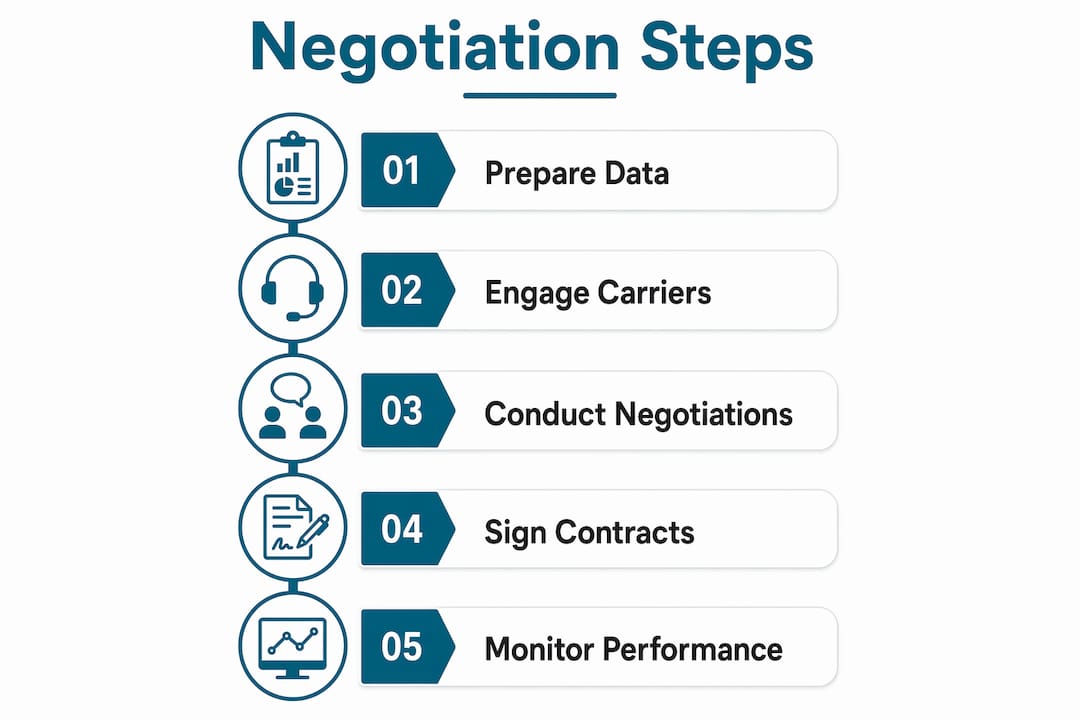
Here is how to build that data package before any negotiation:
- Pull 12 to 18 months of invoice-level data. Line-item detail matters. Summary reports hide the errors that give you leverage.
- Build a carrier performance scorecard. Track billing accuracy, SLA compliance, claims frequency, and accessorial application rates by carrier and lane.
- Identify SLA failures and overcharges. Quantify the dollar value of each failure. This becomes your opening position.
- Benchmark your rates against current market data. Tools like Whipshipper provide instant rate comparisons that let you validate whether your current contract rates are competitive.
- Separate linehaul from accessorials in your analysis. Bundling these two cost categories allows carriers to offer a headline rate reduction while quietly increasing accessorial fees, leaving your total cost unchanged or higher.
Pro Tip: Build your scorecard in a shareable format. Presenting it as a formal document rather than a verbal complaint signals that you are a sophisticated buyer and shifts the negotiation dynamic immediately.
Data-driven negotiation strategies consistently produce 8 to 18% freight rate reductions for mid-market shippers. That range is wide because the outcome depends directly on the quality of data you bring. Shippers who arrive with invoice audits and performance scorecards land closer to 18%. Those who rely on market comparisons alone land closer to 8%, if they land savings at all.
What negotiation tactics and timing maximize contract benefits?
Knowing what to ask for is only half the equation. When and how you ask determines whether you get it.
Timing is the most underused variable in supply chain contract strategies. Optimal negotiation windows fall in Q1, specifically January through March, when carriers are finalizing annual rate adjustments and are most receptive to locking in volume commitments. Out-of-cycle negotiations, attempted in Q3 or Q4, have a significantly lower success rate because carriers have already allocated capacity and have less incentive to move on price.
Market conditions also determine your tactical approach. Soft freight markets favor full RFPs where you solicit competitive bids across multiple carriers and use the spread to drive down rates. Tight markets shift the priority from price cuts to capacity security and service continuity. Trying to run an aggressive RFP during a capacity crunch typically produces worse outcomes than a targeted renegotiation with your incumbent carrier.
The most effective tactics for how to negotiate logistics contracts include:
- Competitive bidding with selective disclosure: Run a formal RFP with three to five carriers on your highest-volume lanes. Share enough of your data package to signal sophistication, but do not reveal your current rates until you have received initial bids.
- Separate rate and service discussions: Negotiate linehaul rates in one session and accessorial terms in another. Carriers who feel pressure on rates will often concede on accessorials if the conversations are linked, and vice versa.
- Volume commitment as currency: Carriers value predictable volume more than high per-shipment rates. Offering a 12-month volume commitment on a core lane in exchange for a rate reduction is a trade most carriers will accept.
- Escalation clause precision: Any multi-year contract needs a rate adjustment mechanism tied to a specific published index, not carrier discretion.
Pro Tip: Never negotiate your most important lane first. Start with a secondary lane to establish the carrier’s concession pattern before moving to the lanes where the dollars are largest.
Common pitfalls to avoid in logistics contract negotiation
Even experienced procurement teams make mistakes that undermine months of preparation. These are the four most costly errors in logistics agreement terms:
-
Bundling complex fees. When linehaul rates and accessorial fees are negotiated as a single package, carriers control the allocation between them. A carrier can reduce your linehaul rate by 5% while increasing residential delivery and fuel surcharge fees enough to net a cost increase. Treating linehaul and accessorials as independent items is the only way to maintain true cost visibility.
-
Accepting vague contract language. Phrases like “carrier will use commercially reasonable efforts” or “rates subject to market adjustment” are not contract terms. They are escape clauses. Every performance obligation and pricing mechanism must be expressed as a specific, measurable number.
-
Ignoring invoice audit data. Shippers who skip the audit step before negotiating are leaving their strongest leverage on the table. Audit-backed negotiations shift the conversation from market rate requests to performance accountability, where carriers are far more likely to concede.
-
Overemphasizing headline rates. A 10% reduction in linehaul rates means nothing if accessorial fees, fuel surcharges, and claims costs are rising. Total landed cost per shipment is the only metric that matters. Build your negotiation target around that number, not the rate card.
For a deeper look at how these principles apply to specific freight modes, the Or-ner guide on freight shipping cost optimization covers lane-level tactics in detail.
How to apply negotiation insights to your supply chain contracts
Knowing the theory is useful. Having a repeatable process is what actually moves the needle on your contracts.
The table below maps each preparation step to its negotiation outcome:
| Preparation step | What it produces in negotiation |
|---|---|
| 12 to 18 months of invoice data | Specific billing error claims carriers cannot dispute |
| Carrier performance scorecard | Shifts conversation from price to accountability |
| Competitive RFP on key lanes | Market-validated rate benchmarks and backup options |
| Defined volume commitment | Leverage for rate concessions and capacity priority |
| Explicit escalation clauses | Protection against mid-term rate increases |
Start by building your data package at least 90 days before your contract renewal date. Sixty days is the minimum to run a meaningful RFP and still have time to negotiate. Anything shorter puts you in a reactive position where the carrier knows your timeline and uses it against you.
Engage at least three carriers on your top five lanes before finalizing any agreement. Even if you intend to stay with your incumbent, competitive quotes from alternatives give you documented benchmarks that are far more persuasive than market indexes. Or-ner’s resource on managing logistics partners covers how to structure these multi-carrier conversations without damaging incumbent relationships.
Once the contract is signed, enforcement matters as much as the terms themselves. Set up monthly performance reviews against your contracted SLAs and run quarterly invoice audits. Contracts that are never enforced become the baseline for the next negotiation, and that baseline will not favor you.
Pro Tip: Build a contract summary document that lists every negotiated term, the carrier contact responsible for each, and the remedy for non-compliance. Share it with your carrier account manager at signing. It signals that you will enforce the contract and prevents the slow drift toward non-compliance that erodes most logistics agreements within 12 months.
Key takeaways
Effective logistics contract negotiation requires invoice-level data, separated cost categories, and precisely worded terms to produce measurable, defensible savings.
| Point | Details |
|---|---|
| Data is your primary leverage | Build 12 to 18 months of invoice audit data before any negotiation begins. |
| Separate linehaul from accessorials | Bundling these two categories allows carriers to hide true cost increases. |
| Time negotiations for Q1 | January through March is when carriers are most receptive to rate adjustments. |
| Enforce what you sign | Monthly SLA reviews and quarterly audits prevent contract drift and protect savings. |
| Total landed cost is the target | Headline rate reductions mean nothing if accessorial and fuel costs rise to compensate. |
The case for treating contracts as living documents
Most logistics professionals I have worked with treat contract negotiation as a one-time event. They prepare intensively for the renewal, sign the agreement, and then file it away until the next cycle. That approach is exactly why so many contracts underperform within six months.
The carriers who serve you best are the ones who know you are paying attention. When you run quarterly audits, share performance scorecards, and flag billing discrepancies within 30 days, you create a relationship dynamic where the carrier treats your freight differently. Not because of goodwill, but because the operational cost of managing a sophisticated, data-aware customer is lower than managing disputes and churn.
I have also seen procurement teams over-rotate in the other direction, treating every negotiation as adversarial and squeezing carriers on every term until the relationship is purely transactional. That approach tends to produce short-term rate wins and long-term service failures. The carriers who feel like partners rather than vendors will prioritize your freight during capacity crunches, flag potential delays proactively, and work with you on exception management in ways that a purely price-driven relationship never produces.
The most effective supply chain contract strategies I have seen blend hard data with genuine relationship investment. You bring the invoice audit. You also bring a clear picture of where you want to grow and how the carrier fits into that growth. That combination produces better contracts than either approach alone.
— Maayan
Reliable courier services built for businesses that negotiate smart
Or-ner gives logistics managers and procurement teams the operational foundation to execute the contracts they negotiate. From reliable courier services across the USA to real-time shipment tracking, customs clearance, and multi-mode freight booking, Or-ner connects ecommerce sellers and businesses to a global fulfillment network built for scale. Whether you are locking in new freight agreements or enforcing existing SLAs, Or-ner’s platform provides the visibility and data you need to hold carriers accountable and keep your supply chain performing to contract. Explore Or-ner’s courier services for small businesses to find the right fit for your logistics agreements.
FAQ
What is logistics contract negotiation?
Logistics contract negotiation is the process of establishing formal agreements with freight carriers, 3PL providers, or courier networks that define pricing, service levels, and operational responsibilities. Effective negotiation uses invoice data and competitive benchmarks to secure measurable cost and service commitments.
When is the best time to negotiate a freight contract?
The optimal window for freight contract negotiation is Q1, specifically January through March, when carriers are finalizing annual rate cycles and are most open to volume-based commitments. Out-of-cycle negotiations have significantly lower success rates.
How much can I save through logistics contract negotiation?
Data-driven negotiation strategies produce 8 to 18% freight rate reductions for mid-market shippers. Shippers who arrive with invoice audits and performance scorecards consistently land at the higher end of that range.
Should I run a full RFP or renegotiate with my current carrier?
The decision depends on market conditions. Soft freight markets favor full RFPs for maximum cost reduction, while tight markets make incumbent renegotiation the smarter choice for protecting capacity and service continuity.
What is the biggest mistake in logistics contract negotiation?
Bundling linehaul rates and accessorial fees into a single negotiation is the most costly mistake. It allows carriers to reduce headline rates while increasing accessorial charges, leaving your total landed cost unchanged or higher.