
TL;DR:
- Effective order tracking improves customer experience by providing centralized visibility, proactive notifications, and branded self-service portals. Implementing real-time carrier API integration and automated alerts reduces support inquiries, builds trust, and enhances operational efficiency. Prioritizing clear communication and data accuracy minimizes WISMO calls and boosts ecommerce performance across all fulfillment channels.
Order tracking best practices are the strategies and technologies ecommerce businesses use to deliver clear, real-time visibility of order status to customers, reducing uncertainty and cutting support costs. The industry term for this discipline is shipment visibility management, and it sits at the intersection of logistics operations and customer experience. Done right, it eliminates the single most common post-purchase complaint: “Where is my order?” Known in the industry as WISMO, this question drives a disproportionate share of support tickets for online retailers. Centralized dashboards, carrier API integrations, automated notifications, and branded self-service portals are the four pillars that separate high-performing ecommerce operations from those drowning in reactive customer service.
What are the essential components of an effective order tracking system?
An effective order tracking system starts with a centralized dashboard that gives both your operations team and your customer support staff a single source of truth for every shipment in motion. Without this, support agents answer WISMO calls by logging into multiple carrier portals, wasting time and delivering inconsistent answers. Platforms like ShipStation update tracking automatically from carriers and surface real-time status to every team simultaneously. That consistency is what prevents the mismatch between what a customer sees and what your agent tells them.
The second pillar is carrier API integration. Automation via carrier APIs pushes real-time updates without manual work, meaning your system reflects the carrier’s latest scan within minutes rather than hours. Customers treat carrier data as authoritative, so your ecommerce tracking portal must stay synchronized with it. Any gap between what the carrier shows and what your site shows destroys trust immediately.
The remaining components work together to complete the system:
- Automated notifications triggered by actual shipping events, not just scheduled time intervals
- Branded tracking portals hosted on your own domain, not the carrier’s generic page
- Plain-language status updates that translate technical carrier codes into customer-friendly milestones
- Alignment between internal and customer-facing data so support agents and customers always see the same information
Pro Tip: Set up your tracking system to flag any shipment that has not received a new carrier scan in 24 hours. That silence is the primary trigger for WISMO calls, and catching it before the customer does lets you send a proactive alert instead of fielding an angry inquiry.
How does proactive notification reduce customer inquiries and improve satisfaction?
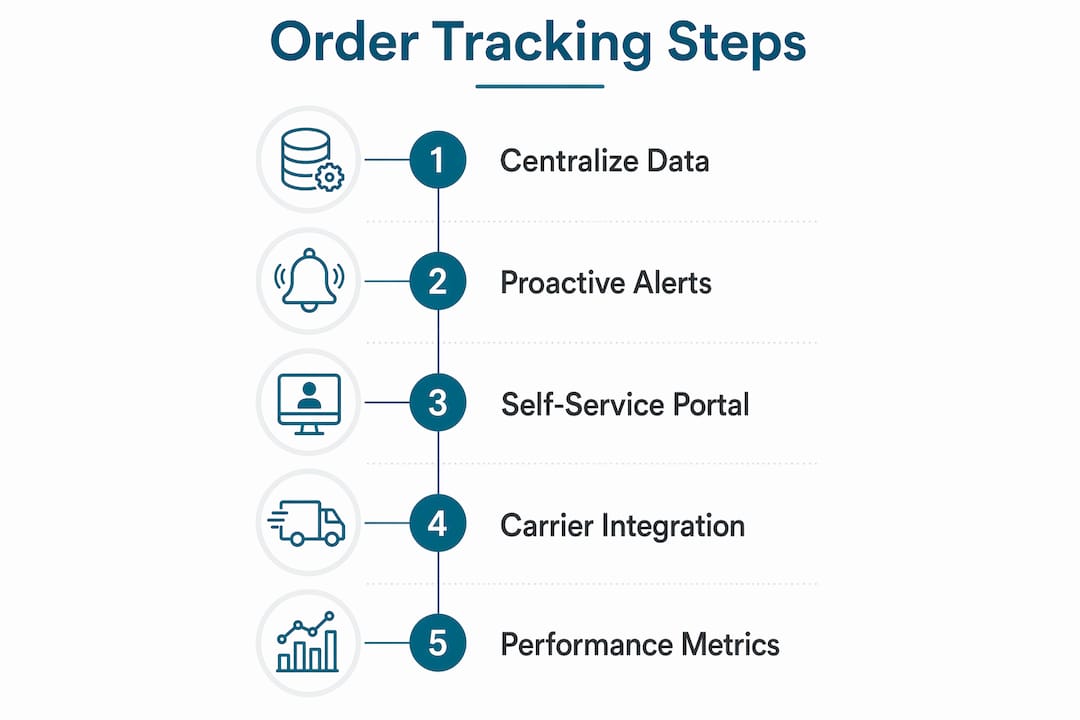
WISMO calls exist because customers fill information vacuums with anxiety. When a package disappears into the carrier network with no updates for two days, the natural response is to contact the retailer. Transparent, automated updates reduce this behavior more effectively than faster shipping, because the problem is uncertainty, not speed.
Proactive notification works by removing the need for customers to ask. The sequence looks like this:
- Order confirmed: send an immediate confirmation with a clickable tracking link, not a tracking number that requires copy-pasting.
- Shipment picked up: trigger a notification the moment the carrier scans the package, not when your system processes the label.
- Out for delivery: send a same-day alert with an estimated delivery window.
- Delivery exception detected: alert the customer within hours if a delay, address issue, or failed delivery attempt occurs, before they notice the silence.
- Delivered: confirm delivery with a prompt for feedback or a review request.
“Customers don’t need to know every carrier scan event. They need to know when something changes that affects their expectation. Filter the noise, amplify the signal.”
WISMOlabs’ playbook emphasizes detecting delayed scans and suppressing minor carrier notifications that add no customer value. Translating a carrier event like “DEPARTURE_SCAN” into “Your package left the Chicago facility and is on its way” is the difference between a tracking update and a tracking experience. Salesforce recommends proactive exception alerts for any shipment stalled over 24 hours. That single rule, applied consistently, eliminates a large share of inbound support volume.
Communication channels matter too. Email covers the baseline, but SMS open rates far exceed email for time-sensitive delivery alerts. App push notifications work for brands with a mobile presence, and AI chatbots connected to your Order Management System can answer WISMO questions in milliseconds, handling simple inquiries autonomously while escalating complex cases to human agents.
What makes a self-service tracking portal worth building?
A self-service tracking portal is a branded web page, hosted on your own domain, where customers can check order status without contacting support. The difference between hosting tracking on your domain versus sending customers to a carrier’s generic page is significant. Branded portals improve conversion by controlling messaging, design, and offering relevant product recommendations. A customer checking their order status on your site is a marketing opportunity. A customer on FedEx’s tracking page is not.
The features that make a portal genuinely useful include:
- Live maps or visual progress indicators showing where a package is in transit
- Estimated delivery windows calculated from carrier performance data, not generic ranges
- Intelligent order lookup that accepts order number, email, or phone without requiring a tracking number
- AI chatbot integration for instant answers when the page status alone is not enough
- Cross-sell recommendations relevant to what the customer already purchased
| Feature | Generic carrier page | Branded self-service portal |
|---|---|---|
| Brand control | None | Full |
| Marketing opportunity | None | Cross-sell, UGC, reviews |
| Estimated delivery accuracy | Carrier standard | Customizable with your data |
| Customer lookup method | Tracking number only | Order number, email, phone |
| Support deflection | Low | High |
Translating technical carrier events into plain milestones is not optional. A customer who sees “INBOUND_OUT_OF_NETWORK” on a carrier page calls support. A customer who sees “Your package is being rerouted and will arrive by Thursday” does not. Shopify advises making tracking information impossible to miss across all customer touchpoints, and that principle extends to the portal itself. Every element should reduce effort, not add it.
Pro Tip: Add a product review request or a “customers also bought” module to your tracking portal’s delivered state. Customers checking a delivered order are in a positive mindset. That moment converts better than a post-purchase email sent three days later.
Which tools optimize logistics visibility and operational efficiency?
The right technology stack for improving order tracking combines an Order Management System, carrier API integrations, and a centralized tracking dashboard. Each layer serves a distinct function, and gaps between them create the data mismatches that frustrate both customers and support teams.

| Tool category | Primary function | Example capability |
|---|---|---|
| Order Management System (OMS) | Centralize order and inventory data | Real-time inventory location tied to order status |
| Carrier API integration layer | Pull live tracking events | Automatic status sync without manual refresh |
| Centralized tracking dashboard | Unified view for operations and support | Bulk tracking, exception flagging, carrier performance metrics |
| Customer-facing tracking portal | Self-service order lookup | Branded page with estimated delivery and chatbot |
| Analytics and reporting module | Carrier performance evaluation | On-time delivery rates, exception frequency by carrier |
ShipStation’s centralized shipment tracking approach treats tracking as a system of record for sales, support, and operations simultaneously. That framing matters. When tracking data is siloed in a shipping tool that support agents cannot access, every WISMO call requires manual lookup. When it is centralized, support resolution time drops to seconds.
Automation features to prioritize include bulk tracking updates, manual refresh fallback for carriers with unreliable APIs, and exception alerts routed to the responsible team. Metrics monitoring at the carrier level reveals which carriers generate the most exceptions, which fulfillment centers ship slowest, and where your estimated delivery dates are consistently wrong. That data feeds directly into carrier selection decisions and reducing delivery times across your network.
How to implement order tracking best practices to boost ecommerce performance
Implementing effective order status updates is a process, not a one-time configuration. These steps give ecommerce and supply chain teams a structured path from fragmented tracking to a system that runs itself.
- Audit your current tracking gaps. Map every point between order placement and delivery where customers currently receive no update. Those gaps are your WISMO risk zones.
- Validate delivery addresses at checkout. Address errors are a leading cause of delivery exceptions. Use address validation tools at the point of entry, not after the label is printed.
- Set data-driven estimated delivery dates. Transparent delivery promises at checkout prevent customer assumptions. Base your estimates on actual carrier performance data by route, not carrier-published averages.
- Train support teams on the tracking dashboard. A centralized dashboard only reduces support workload if agents know how to use it. Run structured training so every agent can pull full shipment history in under 30 seconds.
- Collect feedback from your tracking portal. A simple post-delivery survey on the tracking page generates data on customer satisfaction tied directly to the shipping experience, not the product.
- Review carrier performance monthly. Use your tracking data to evaluate on-time rates, exception frequency, and scan gap patterns by carrier. Rotate or renegotiate with underperformers.
Pro Tip: When you analyze your tracking data, segment WISMO inquiry volume by carrier and fulfillment center. You will almost always find that 20% of your shipping lanes generate 80% of your support tickets. Fix those lanes first.
Key takeaways
Effective order tracking requires centralized data, proactive automated communication, and branded self-service portals that translate logistics events into clear customer updates.
| Point | Details |
|---|---|
| Centralize tracking data | Use a unified dashboard so operations and support teams always see the same shipment status. |
| Automate proactive notifications | Trigger alerts on actual shipping events, including exceptions, before customers ask. |
| Build a branded tracking portal | Host tracking on your domain to control messaging, reduce support volume, and enable cross-selling. |
| Integrate carrier APIs | Sync carrier data automatically to keep customer-facing status accurate and eliminate manual updates. |
| Analyze carrier performance | Review on-time rates and exception patterns monthly to improve carrier selection and delivery estimates. |
Why most tracking problems are really communication problems
After working closely with ecommerce operations across multiple fulfillment models, the pattern I keep seeing is this: most businesses invest heavily in shipping speed and almost nothing in shipping communication. They negotiate carrier rates, optimize warehouse layouts, and cut fulfillment times, then send a single “your order has shipped” email and consider the job done. That is where the WISMO calls come from.
The counterintuitive truth is that a package taking five days with three proactive updates generates fewer complaints than a package taking three days with no updates after the initial confirmation. Customers are not primarily measuring speed. They are measuring certainty. When you remove uncertainty, you remove the anxiety that drives support contacts.
I have also seen too many businesses run fragmented tech stacks where the OMS, the shipping platform, and the customer portal are not talking to each other in real time. The result is a support agent telling a customer their package is “in transit” while the carrier portal already shows a delivery exception from the previous day. That mismatch is more damaging to trust than the exception itself.
The future of this space is AI-driven exception management. Systems that detect a scan gap, predict the likely cause based on historical patterns, generate a customer notification, and route the exception to the right internal team without human intervention. That is not a distant concept. The tools to build it exist today, and the parcel tracking systems that incorporate this logic are already separating the best-performing ecommerce operations from the rest.
— Maayan
Take your order tracking further with Or-ner
Or-ner’s logistics platform gives ecommerce sellers and supply chain teams the multi-carrier tracking visibility, automated notification tools, and branded portal capabilities covered in this guide. The platform integrates with major carriers and ecommerce operators, centralizing shipment data across ocean, air, and land transport into a single operational view. Whether you are managing cross-border fulfillment or last-mile delivery for a growing catalog, Or-ner’s global logistics platform connects every stage of the shipment lifecycle. For teams evaluating software options, Or-ner’s guide to the best shipment tracking software breaks down the top platforms by capability and use case.
FAQ
What is WISMO and why does it matter for ecommerce?
WISMO stands for “Where Is My Order?” and refers to the category of customer support inquiries generated by a lack of post-purchase tracking visibility. It is one of the highest-volume and most preventable support ticket types for online retailers.
How does real-time order tracking reduce support costs?
Real-time order tracking eliminates the information gaps that prompt customers to contact support. Self-service tracking with expected delivery dates and proactive exception alerts for stalled shipments significantly cut inbound WISMO inquiry volume.
What is the difference between a branded tracking portal and a carrier tracking page?
A branded tracking portal is hosted on the merchant’s own domain and displays order status in the merchant’s design and language. A carrier tracking page is generic, offers no marketing capability, and removes the customer from the merchant’s environment entirely.
Which metrics should I track to evaluate order tracking performance?
The most useful metrics are WISMO inquiry rate as a percentage of total orders, on-time delivery rate by carrier, exception frequency by shipping lane, and customer satisfaction scores collected at the point of delivery.
How often should estimated delivery dates be updated?
Estimated delivery dates should update automatically whenever a new carrier scan event changes the projected arrival. Carrier API integrations make this continuous without manual intervention, keeping customer expectations accurate throughout transit.