

TL;DR:
- Effective freight procurement relies on balancing contractual flexibility and ongoing performance feedback to manage costs and capacity. Implementing continuous sourcing, carrier diversification, and data-driven negotiations reduces risks and enhances savings. Transitioning from annual contracts to a real-time, integrated procurement cycle improves market responsiveness and operational resilience.
Freight procurement strategies are the systematic methods supply chain professionals use to secure cost-effective, reliable transportation capacity while controlling total logistics spend. The most effective approach combines the 70/20/10 volume split model, freight audit and payment (FAP) data integration, and carrier scorecards to build a procurement framework that performs under pressure. Known formally as transportation sourcing strategy, this discipline goes far beyond negotiating the lowest rate. It requires balancing contract design, carrier portfolio management, and continuous performance feedback to protect margins in a market where capacity and rates shift without warning.
What are the core components of an effective freight procurement strategy?
An effective freight procurement strategy rests on four interconnected pillars: contract structure, carrier diversification, surcharge governance, and performance measurement. Miss any one of them and cost overruns follow.
Contract structure: the 70/20/10 model
The 70/20/10 volume split is the most widely validated framework for balancing capacity security with market flexibility. Seventy percent of volume goes to fixed annual contracts with primary carriers, locking in predictable rates and guaranteed capacity. Twenty percent sits in short-term or index-linked contracts that adjust with market conditions. The remaining ten percent stays open for spot market procurement, giving you a release valve when demand spikes or a primary carrier underperforms. This structure prevents the two most common procurement failures: over-reliance on spot markets during tight capacity and over-commitment to fixed contracts when rates fall.
Carrier portfolio diversification
A balanced carrier portfolio typically includes two to three primary carriers, two to three secondary carriers, and one to two niche or regional specialists. Primary carriers handle your core volume and receive your best rate commitments in return. Secondary carriers provide competitive pressure and backup capacity. Regional specialists cover lanes where the majors lack density or service quality. This structure spreads concentration risk without fragmenting your volume so thin that no carrier takes you seriously as a customer.

Surcharge governance and contract terms
Base rates are only part of the cost picture. Contracts with clear surcharge definitions, caps, and penalty clauses protect margins far more effectively than chasing the lowest headline rate. Fuel surcharges, peak season premiums, and accessorial fees can add 20 to 40 percent on top of base rates if left undefined. Every contract should specify which surcharges are included, which are excluded, and what adjustment mechanisms apply when fuel indexes or capacity conditions change.
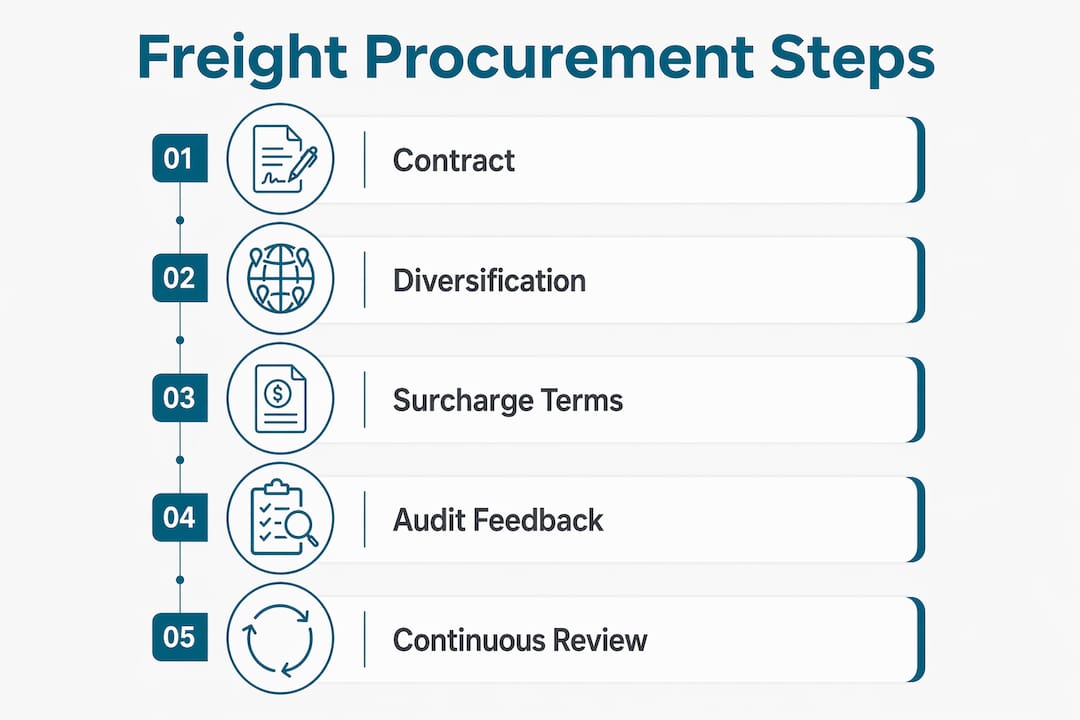
Carrier scorecards
Carrier scorecards track rate competitiveness, on-time performance, claims ratios, and contract compliance in a single view. They create an objective basis for allocation decisions and give you documented leverage in renegotiations. Without scorecards, procurement conversations rely on anecdote rather than data, and carriers know it.
- Define scorecard metrics before contract signing, not after
- Review scorecards quarterly, not just at annual renewal
- Tie allocation percentages directly to scorecard outcomes
- Share scorecard results with carriers to drive accountability
Pro Tip: Link your carrier scorecard directly to your freight audit system so billing accuracy becomes a scored metric. Carriers that overbill consistently should see their allocation reduced at the next review cycle.
How does continuous freight procurement improve cost control?
The annual RFP cycle made sense when freight markets moved slowly. In 2026, it is a liability. Rates on major trade lanes can shift 15 to 30 percent within a single quarter, and a contract negotiated in January may be significantly out of market by April. Continuous freight procurement replaces the single annual event with an ongoing cycle of benchmarking, mini-RFPs, and audit feedback.
The core mechanism is the closed-loop system. Freight audit and payment (FAP) integration provides invoice-level compliance data that feeds directly back into procurement decisions. When your audit system flags a pattern of accessorial overcharges on a specific lane, that data becomes negotiation ammunition at the next contract review. You are no longer guessing at cost leakage. You are measuring it precisely and correcting it systematically.
Here is how to build a continuous procurement cycle:
- Establish a rate benchmark database. Pull contracted rates, spot market quotes, and invoice actuals into a single repository updated monthly. This gives you a real-time view of where your contracted rates stand relative to the market.
- Set trigger conditions for mini-RFPs. Define the market rate deviation or carrier performance threshold that automatically initiates a targeted re-bid on specific lanes. A 10 percent rate gap or three consecutive months of missed service levels are reasonable triggers.
- Run closed-bid panel tenders for triggered lanes. Closed-bid tendering prevents informal bid signaling between carriers and generates genuine competitive pressure. This approach typically reduces freight rates by 3 to 5 percent compared to open email tenders.
- Feed audit data back into the next negotiation cycle. Hidden cost savings come from auditing carrier accessorial billing post-contract and using that data to identify overcharges before the next negotiation starts. This is where most procurement teams leave money on the table.
- Automate backup procurement triggers. Technology tools like TMS platforms with marketplace connectivity reduce procurement cycle times by up to 89 percent, enabling rapid response when a primary carrier fails to cover a load.
Pro Tip: Do not wait for contract renewal to share audit findings with carriers. A mid-year review meeting that presents billing discrepancy data signals that you are paying close attention and often produces voluntary rate corrections without a formal renegotiation.
What are the common pitfalls in freight procurement?
Even experienced procurement teams repeat the same mistakes. Knowing where the traps are is the first step to avoiding them.
- Chasing the lowest bid. 76% of logistics transformations fail when procurement focuses exclusively on rate optimization without backup capacity planning. The carrier with the lowest rate often has the thinnest network, and when capacity tightens, your freight sits at the bottom of their priority list.
- Carrier concentration risk. Awarding 80 percent or more of volume to a single carrier creates a dependency that eliminates your negotiating leverage and exposes you to catastrophic service failure if that carrier faces financial or operational problems.
- Ignoring accessorial variability. Fuel surcharges, residential delivery fees, liftgate charges, and peak season premiums are frequently left undefined in contracts. Carriers exploit this ambiguity, and the cost accumulates invisibly until an audit surfaces it.
- Skipping invoice verification. Not integrating freight audit and payment data into your procurement cycle means you are negotiating future rates without knowing whether current contracted rates are actually being honored. Billing errors and unauthorized surcharges are common across all carrier types.
- No contingency plan for capacity disruptions. Seasonal peaks, port congestion, and weather events are predictable in their unpredictability. Procurement teams that have not pre-qualified backup carriers and defined escalation protocols scramble at premium spot rates when disruptions hit.
Traditional vs. modern freight procurement: which approach wins?
The contrast between traditional and modern transportation sourcing strategies is stark, and the performance gap is measurable.
| Dimension | Traditional approach | Modern data-driven approach |
|---|---|---|
| Sourcing cycle | Annual RFP via email | Continuous mini-RFPs with closed-bid tendering |
| Rate negotiation | Based on volume estimates | Backed by audit data and real-time benchmarks |
| Carrier selection | Lowest bid wins | Scorecard-weighted allocation |
| Surcharge management | Informal or undefined | Contractually capped with adjustment mechanisms |
| Performance monitoring | Quarterly or annual review | Real-time dashboards with automated alerts |
| Cost savings mechanism | One-time rate reduction | Ongoing audit feedback and competitive re-bidding |
Closed-bid panel tendering alone generates 3 to 5 percent rate reductions by eliminating the informal bid signaling that occurs in open email tenders. That figure compounds when combined with audit-driven renegotiations and scorecard-based allocation. Transportation procurement success depends on connecting freight sourcing, contracting, and performance monitoring in a continuous feedback loop rather than treating each as a separate annual event. Modern platforms make this connection technically feasible for procurement teams of any size.
Strategic procurement also means evaluating carrier financial health and reliability, not just their rate sheet. A carrier offering rates 8 percent below market but carrying significant debt or operating aging equipment is a risk, not a bargain.
Practical tactics to implement freight procurement strategies in 2026
Translating strategy into execution requires specific, sequenced steps. Here is a practical framework for procurement professionals working in the current market environment.
- Audit your baseline before negotiating anything. Pull 12 months of invoice data and map actual spend by lane, carrier, and charge type. You cannot negotiate effectively without knowing where your money is actually going. Use freight booking process data to identify lanes with the highest rate variability.
- Set minimum volume commitments based on historical actuals, not projections. Carriers price commitments they believe you will honor. Overstating volume to get a better rate backfires when you miss the commitment threshold and lose the contracted rate.
- Build a tiered carrier allocation framework. Assign primary, secondary, and spot market roles to each carrier before the contract year begins. Define the conditions under which loads escalate from primary to secondary to spot. This prevents ad hoc decisions under pressure.
- Integrate freight audit data into every negotiation cycle. Vendor management in logistics improves significantly when audit findings are presented as part of the carrier review process. Carriers respond differently when they know you have line-item billing data.
- Adopt digital procurement platforms for closed-bid tendering. Manual email-based tenders create audit trails that are difficult to manage and easy for carriers to game. Digital platforms with timestamped bid records improve rate accuracy and competitive pressure simultaneously.
- Develop a written contingency plan for capacity disruptions. Identify which lanes are highest risk, pre-qualify at least one backup carrier per lane, and define the rate ceiling you are willing to pay on spot before a disruption forces the decision under pressure.
Pro Tip: Run a shadow RFP on your top five lanes every six months, even if you do not intend to switch carriers. The market intelligence alone is worth the effort, and it keeps your incumbent carriers aware that you are actively monitoring the market.
Key takeaways
Effective freight procurement combines contract discipline, carrier diversification, and continuous audit feedback to reduce costs and protect capacity across market cycles.
| Point | Details |
|---|---|
| Use the 70/20/10 model | Split volume into fixed, index-linked, and spot contracts to balance cost certainty with flexibility. |
| Diversify your carrier portfolio | Maintain two to three primary, two to three secondary, and one to two regional carriers to reduce dependency risk. |
| Govern surcharges contractually | Define caps and adjustment mechanisms for fuel and accessorial charges to prevent cost leakage. |
| Integrate freight audit data | Feed invoice-level compliance data back into negotiation cycles to identify overcharges before they compound. |
| Switch to closed-bid tendering | Replace open email tenders with sealed digital bids to generate genuine carrier competition and reduce rates by 3 to 5 percent. |
Why I think most freight procurement teams are solving the wrong problem
After working closely with procurement teams across manufacturing, retail, and ecommerce, I keep seeing the same pattern. Teams spend enormous energy optimizing the rate they pay at contract signing and almost no energy verifying whether that rate is actually honored over the following 12 months. The gap between contracted rates and invoiced rates is where the real money disappears, and most organizations do not measure it systematically.
The second problem is what I call the “single carrier comfort trap.” Consolidating volume with one or two carriers feels efficient. It simplifies relationships and reduces administrative overhead. But it also hands your carrier the negotiating leverage at renewal time. I have watched procurement teams accept 12 to 15 percent rate increases because they had no credible alternative ready. Building a genuine secondary carrier relationship costs time upfront. It saves significantly more at renewal.
The shift I find most underappreciated is moving from procurement as an annual event to procurement as a continuous discipline. The teams that do this well treat their freight spend the way a treasury function treats currency exposure: monitored daily, hedged appropriately, and adjusted when conditions change. They use wholesale logistics best practices as a baseline and build from there with data specific to their lanes and carriers.
Technology is accelerating this shift, but the mindset change matters more than the software. The best procurement professionals I have worked with are not the ones with the most sophisticated tools. They are the ones who ask the most uncomfortable questions of their carrier data.
— Maayan
How Or-ner supports smarter freight procurement
Or-ner’s global logistics platform gives supply chain managers the freight booking, real-time tracking, and audit integration tools needed to execute modern transportation sourcing strategies without building a custom tech stack from scratch.
The platform supports closed-bid tendering workflows, carrier performance monitoring, and invoice verification across ocean, air, and land modes. For ecommerce sellers managing cross-border freight, Or-ner’s global logistics platform connects procurement decisions directly to fulfillment outcomes, reducing the gap between contracted rates and actual landed costs. Teams using cloud logistics platforms report up to 24 percent cost savings compared to manual procurement processes. If you are ready to move beyond annual RFPs and build a continuous procurement cycle, Or-ner provides the infrastructure to make it work at scale.
FAQ
What is a freight procurement strategy?
A freight procurement strategy is the structured process a company uses to source, contract, and manage transportation capacity to control costs and maintain service reliability. It typically includes carrier selection, contract design, performance monitoring, and ongoing rate benchmarking.
How does the 70/20/10 model work in freight procurement?
The 70/20/10 model allocates 70 percent of freight volume to fixed annual contracts, 20 percent to short-term or index-linked agreements, and 10 percent to spot market capacity. This split balances rate predictability with the flexibility to respond to market changes.
Why is freight audit data important for procurement?
Freight audit and payment data reveals whether carriers are billing at contracted rates and flags unauthorized surcharges. Feeding this data back into procurement cycles reduces cost leakage and strengthens negotiating leverage at renewal.
What is the difference between open and closed-bid tendering?
Open email tenders allow carriers to informally signal bids to each other, reducing competitive pressure. Closed-bid panel tenders use sealed, timestamped submissions that prevent signaling and typically reduce freight rates by 3 to 5 percent.
How many carriers should be in a balanced freight portfolio?
A balanced portfolio includes two to three primary carriers for core volume, two to three secondary carriers for backup and competitive pressure, and one to two regional or niche specialists for specific lanes or service requirements.