An international freight forwarding service moves cargo across borders by air, ocean, road, or rail while handling booking, consolidation, customs filing, and exception management under one contract. It solves the coordination problem that kills margins: chasing five carriers, three customs brokers, and a warehouse manager for one shipment. The right forwarder delivers landed, duty-cleared cargo with a single point of accountability.
This fits ecommerce logistics managers running multi-carrier, multi-mode volume across several lanes at once, not a one-off importer shipping a single container.
Three moves to make this week:
- Draft a line-item RFQ specifying origin, destination, Incoterm, HS code, and volume.
- Run 2 to 3 pilot shipments before committing to full volume.
- Contact Or-ner or a comparable provider to request a quote and a dedicated operations contact.
TL;DR:
- Running a pilot shipment of 2 to 3 loads across your priority lanes is essential to test service quality before fully switching providers.
- A comprehensive quote should break down all costs, including terminal handling charges, surcharges, documentation fees, and insurance, with no hidden categories.
- Verifying licenses such as FMC/OTI for ocean and IATA for air is crucial to ensure the forwarder is properly authorized before engaging.
- Choosing a forwarder with a dedicated account contact and native ecommerce integrations can significantly improve communication speed and operational transparency.
- For high-risk cargo like hazardous materials or sensitive electronics, confirming specialized handling capabilities and appropriate certifications helps prevent costly shipment delays.
Table of Contents
- What Does an International Freight Forwarding Service Actually Do?
- How Does the Freight Forwarding Process Work Start to Finish?
- How Do You Choose a Reliable International Freight Forwarding Company?
- What Should an All-In Freight Quote Include?
- What Licenses and Certifications Should a Forwarder Have?
- Why ORNER Fits Ecommerce-Scale Freight Needs
- Handling Hazardous and Special Cargo
- Sustainability Practices and Green Logistics in Freight Forwarding
- Compliance With International Trade Regulations and Sanctions
- Risk Management and Cargo Insurance Options
- The Real Gap Between Forwarder Marketing and Forwarder Performance
- Get a Quote and Start Your Pilot Shipment
- Key Takeaways
- Sources
- FAQ
What Does an International Freight Forwarding Service Actually Do?
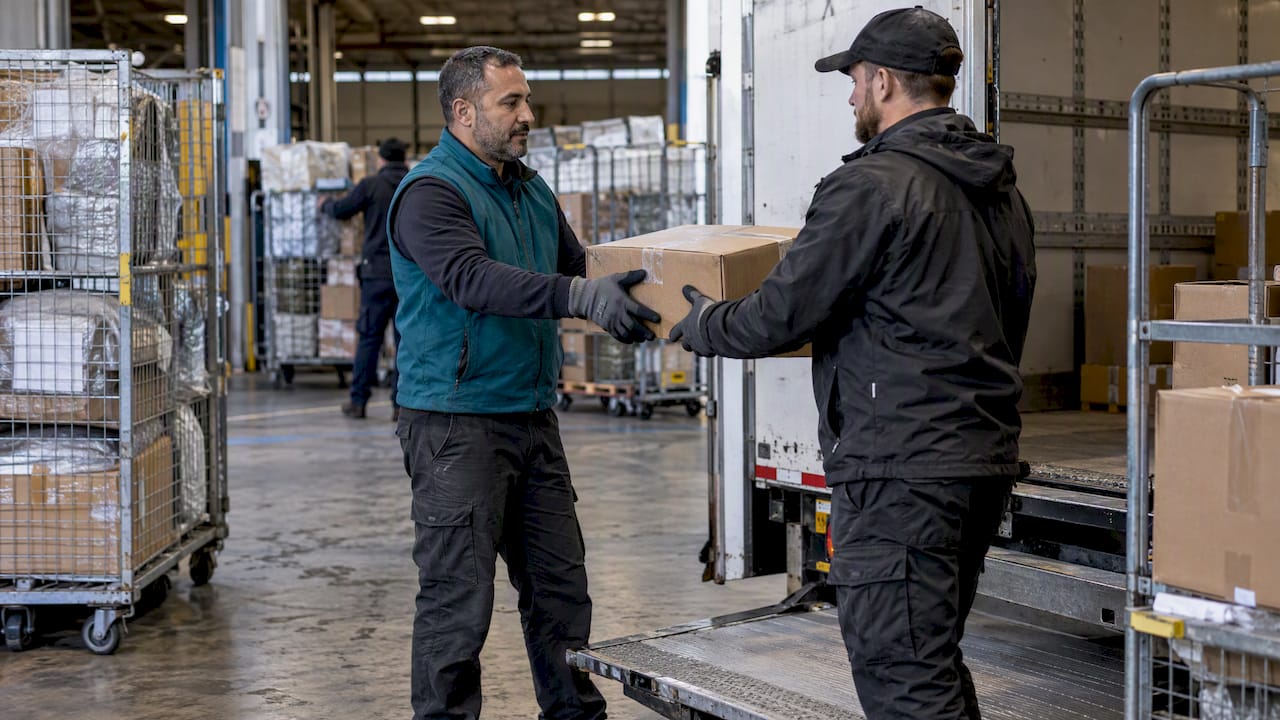
A forwarder’s core job is matching your shipment to the right transport mode, then handling everything that mode requires. Air freight wins on speed and fits high-value, time-sensitive, or low-volume cargo like electronics or seasonal apparel drops. Ocean freight costs a fraction per unit but usually takes several weeks depending on the lane, making it the default for bulky, low-urgency goods like furniture or footwear. Road and rail fill regional gaps, cross-border moves within North America or Europe, or the final inland leg after an ocean or air shipment clears port.
Beyond mode selection, a competent forwarder handles:
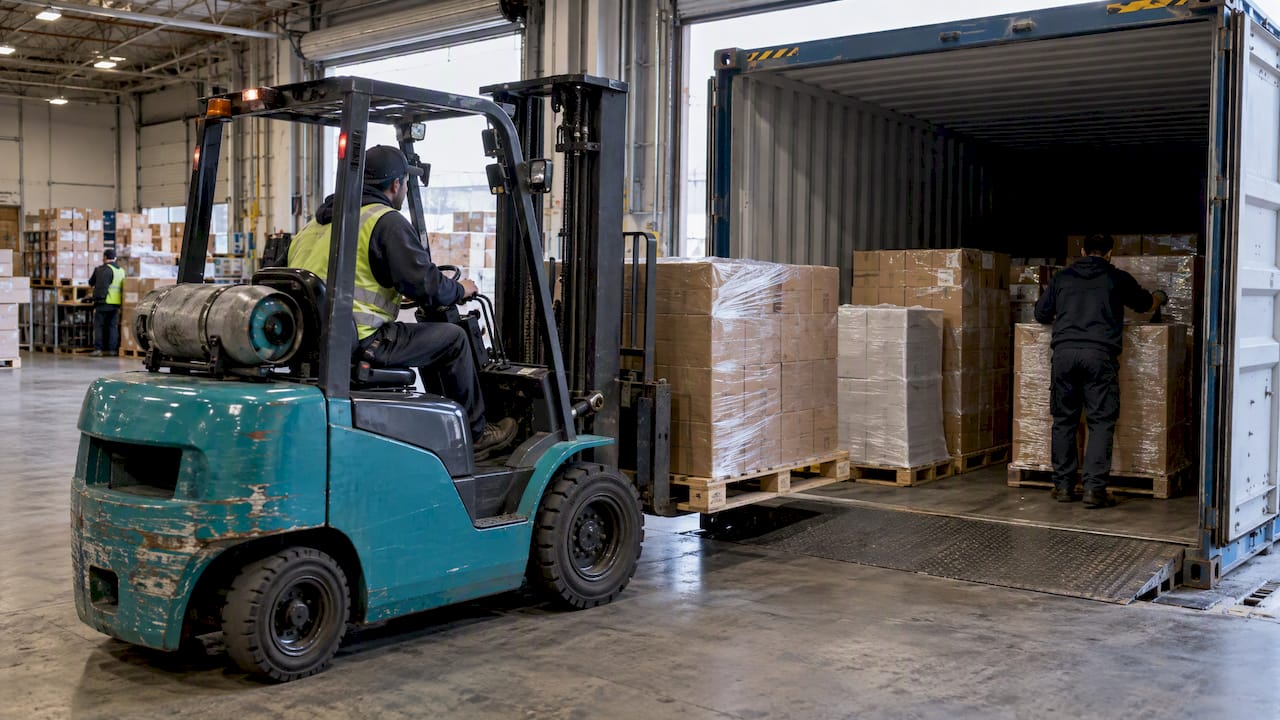
- Booking and consolidation — combining your freight into LCL (less than container load) or full FCL/FTL shipments depending on volume.
- Documentation and customs filing — commercial invoices, packing lists, and import/export entries.
- Cargo insurance — coverage options tied to declared value, not just carrier liability limits.
- Last-mile delivery — drayage from port or airport to your warehouse or fulfillment center.
The service scope worth paying for sits in the add-ons: bonded warehousing, order-level tracking down to the SKU, and a portal or API that plugs into your TMS or ecommerce platform. Modern forwarders increasingly run quoting, booking, customs filing, and tracking inside cloud-based freight management systems, which cuts the email-and-spreadsheet chase that used to eat a coordinator’s week. If you’re weighing ocean versus air for a specific lane, cost per unit and required lead time should decide it, not habit.
How Does the Freight Forwarding Process Work Start to Finish?
Every international shipment moves through the same three phases, and knowing them helps you spot where a forwarder is cutting corners.
- Origin. The forwarder arranges pickup from your supplier or warehouse, consolidates your freight with other shipments if you’re using LCL, and prepares export documents: commercial invoice, packing list, and an export license if your goods are controlled.
- Main haul. The forwarder books space with an ocean or air carrier and issues a House Bill of Lading or House Air Waybill, referencing the carrier’s Master Bill or Master Air Waybill. This is where container handling, vessel transfers, and tracking events happen, and where visibility tools matter most.
- Destination. Your forwarder or broker classifies goods under the correct HS code, files the import entry, and pays duties and taxes on your behalf or yours, depending on your Incoterm. Once customs releases the cargo, drayage carries it to your final delivery point.
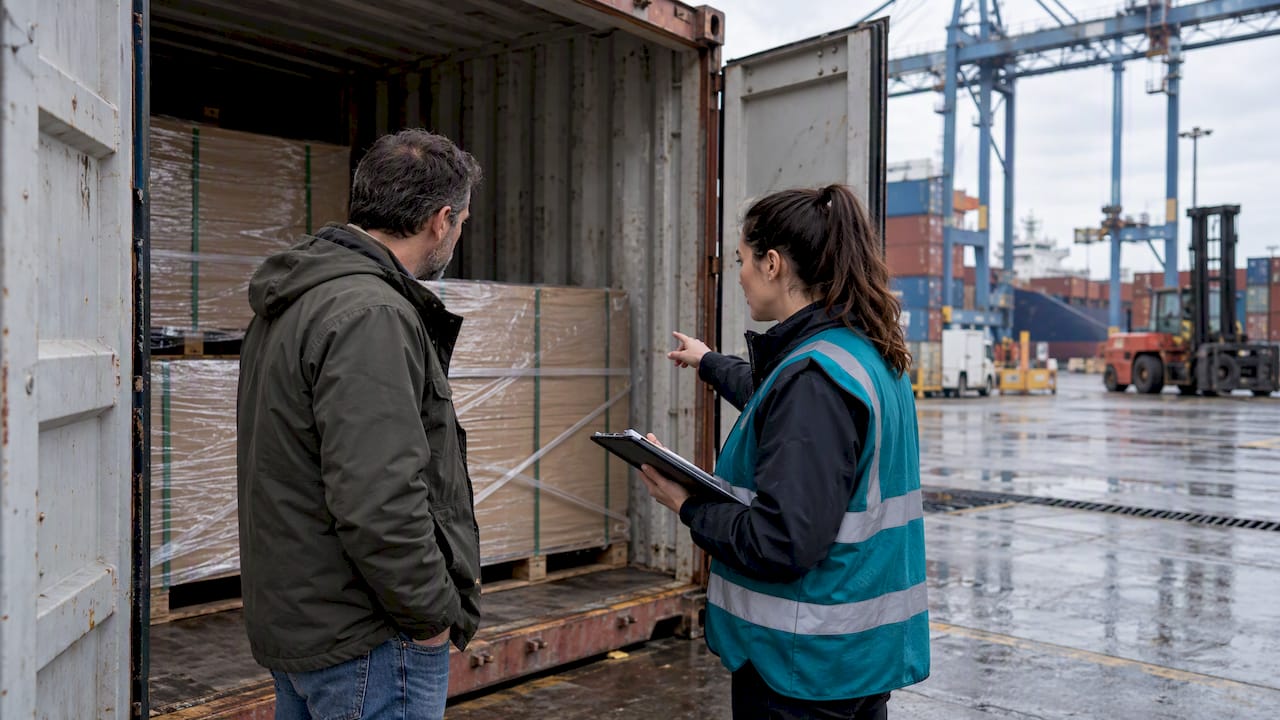
Exceptions happen on nearly every lane eventually: port holds for missing documentation, demurrage charges when containers sit too long, or damaged cargo requiring a claim. Ask upfront how a forwarder handles reconsignment and what their claims turnaround looks like, because this is where cheap forwarders quietly cost you the most.
Pro Tip: Ask for a sample exception report from an actual past shipment, not a template. If a forwarder can’t produce one, they probably don’t track exceptions systematically, which means you’ll find out about problems after they’ve already cost you money.
For a full walkthrough of the freight forwarding procedure from pickup to final delivery, the document flow at each stage matters as much as the transit time.
How Do You Choose a Reliable International Freight Forwarding Company?
Vetting a forwarder is less about gut feel and more about a short list of hard checks most buyers skip.
Verify licensing first. Ocean forwarders operating in the U.S. need an FMC/OTI license and bond, checkable on the Federal Maritime Commission’s public database. Air forwarders should carry IATA cargo agent accreditation. If a provider can’t produce a license or bond number on request, that’s disqualifying, not a minor gap.
Demand a real quote, not a ballpark. Ask for every line item, then ask directly how long the rate is locked and what triggers a surcharge change mid-shipment.
Ask the operational questions that predict day-to-day service quality:
- Who is my named contact, and what’s their average response time?
- Which lanes does your team handle daily versus occasionally?
- Do you own warehouse or consolidation space, or do you broker it out?
- Can I see two client references in my industry, ideally on my lanes?
That last point matters more than it sounds. A 15-question vetting script covering licensing, brokerage model, and claims history catches most of the providers who look fine on a sales call but fall apart on shipment three.
Before signing anything, run a structured pilot:
- Select 2 to 3 test shipments across your priority lanes.
- Run them in parallel with your current provider if possible, so you’re comparing real performance, not promises.
- Score documentation accuracy, communication speed, and billing transparency against what was quoted.
- Build in a quarterly review clause and the option to split volume across providers once trust is established.
What Should an All-In Freight Quote Include?
A trustworthy quote itemizes every cost, not just the base rate. Insist on seeing base freight, origin and destination Terminal Handling Charges (THC), documentation fees, Automated Manifest System (AMS) and Importer Security Filing (ISF) fees, seal and chassis charges, demurrage terms, fuel surcharge, and cargo insurance, all broken out separately.
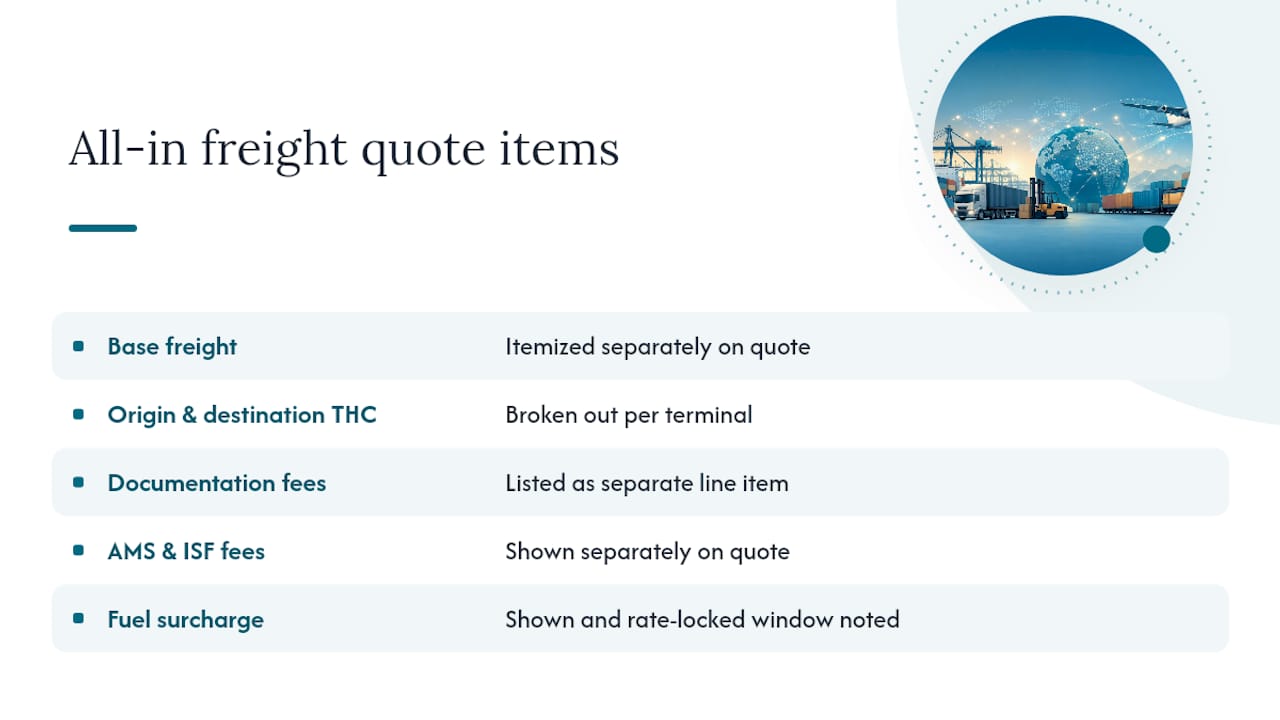
Rate-lock windows typically run 30 to 90 days. Ask exactly what happens if a shipment slips past that window, since fuel and peak-season surcharges are where quotes quietly balloon.
Watch for the gap between an eye-catching low quote and what actually lands on your invoice. A quote without line-item surcharges correlates directly with surprise billing later, and that pattern shows up often enough that it should change how you read a lowball number.
The fix is simple: build one RFQ template and send it, unchanged, to every forwarder you’re evaluating. Comparing quotes line-by-line against an identical template is the only way to see who’s actually cheaper and who’s just hiding costs in categories they didn’t itemize.
What Licenses and Certifications Should a Forwarder Have?
Requirements shift by mode and jurisdiction, so match the credential to the shipment. Ocean forwarders serving U.S. trade need FMC/OTI registration; air forwarders need IATA cargo agent status. If your goods qualify for expedited handling, ask whether the forwarder holds AEO (EU) or C-TPAT (U.S.) certification, since both speed customs clearance for vetted supply chains.
Incoterm selection decides who files customs and pays duty, and getting it wrong is a leading cause of delivery disputes and refused shipments. Confirm HS classification accuracy, denied-party screening on your buyers and suppliers, and whether an export license applies to your product category before your first shipment, not after a hold.
Verify credentials directly: the FMC’s database for ocean licenses, IATA’s directory for air agents, and your destination country’s customs portal for import requirements. For documentation specifics, Or-ner’s guide to freight forwarding documentation walks through what each filing actually requires.
Why ORNER Fits Ecommerce-Scale Freight Needs
Or-ner runs freight booking, real-time tracking, customs clearance, and warehousing on one platform built for ecommerce sellers, wholesalers, and manufacturers moving cross-border volume.
A forwarder that can turn around a line-item quote in days rather than weeks, assign a named operations contact from day one, and plug directly into your Amazon or ecommerce catalog, removes the coordination tax that usually falls on your logistics team.
What that looks like in practice:
- Fast RFQ turnaround with fully itemized quotes, not ballpark ranges.
- A dedicated contact assigned per account, not a rotating support queue.
- Native integration with major ecommerce platforms, including Amazon, for catalog and order-level visibility.
- Support for pilot programs before committing to full-volume contracts.
This article was reviewed by Maayan, an editorial contributor focused on cross-border logistics and supply chain operations for ecommerce brands.
Handling Hazardous and Special Cargo
Hazardous materials add a compliance layer that most standard freight processes don’t cover, and getting it wrong can ground a shipment entirely. Lithium batteries, aerosols, flammable liquids, and certain chemicals all fall under dangerous goods regulations that vary by mode and by carrier, not just by country.

For air freight specifically, the FAA sets strict packaging, labeling, and declaration requirements for hazmat shipments, and these rules apply regardless of which forwarder you use. Confirm with both your forwarder and the operating carrier before booking, because packaging that passes for ocean freight often fails air carrier requirements outright.
Special cargo beyond hazmat, oversized machinery, temperature-controlled pharmaceuticals, high-value electronics, or fragile musical instruments, needs its own handling protocol. Ask a forwarder directly whether they’ve moved your specific cargo type before, and ask for a reference shipment, not a general capability claim. A forwarder that handles standard apparel containers daily may have never touched a temperature-controlled load, and that gap surfaces at the worst possible moment, mid-transit.
Build hazmat and special-cargo questions into your RFQ from the start rather than discovering the gap after booking. Ask what documentation the forwarder prepares versus what you’re expected to supply, since dangerous goods declarations typically require shipper certification that can’t be delegated entirely.
Sustainability Practices and Green Logistics in Freight Forwarding
Freight accounts for a meaningful share of a typical ecommerce brand’s carbon footprint, and forwarders increasingly compete on emissions data, not just transit time. Ocean freight already produces a fraction of the per-ton emissions of air freight, so shifting non-urgent volume from air to ocean is often the single biggest lever a logistics team controls directly.

Ask a forwarder whether they report shipment-level carbon estimates, since this is becoming a standard request from ecommerce brands managing their own sustainability disclosures. Consolidation also plays a direct role: combining partial loads into full containers reduces the number of trips needed per unit shipped, cutting emissions and cost simultaneously.
Route optimization matters too. A forwarder with strong carrier relationships can often find a more direct routing that avoids unnecessary transshipment stops, each of which adds fuel burn and handling emissions. Some ocean carriers now offer slow-steaming options that cut fuel consumption meaningfully in exchange for a few extra transit days, a trade worth making on non-urgent lanes.
None of this replaces the basics of good freight management, but a forwarder that treats sustainability as an afterthought usually treats documentation accuracy and communication the same way. Ask about it during vetting, not after your first sustainability report is due.
Compliance With International Trade Regulations and Sanctions
Sanctions and trade compliance failures carry real financial and legal exposure, and they’re rarely intentional; they happen because nobody checked a denied-party list before shipping to a new customer. A competent forwarder screens buyers, consignees, and even intermediate parties against restricted-party lists before booking, not after a shipment is already in transit.
Export control classification matters here too. Certain goods, particularly dual-use technology, encryption-capable electronics, or specialized machinery, require an export license depending on destination country, and misclassifying a product can trigger fines regardless of intent. Ask your forwarder directly whether they run denied-party screening as a standard step or only on request.
Sanctioned countries and entities change without much public notice, and a forwarder actively tracking these updates protects you from shipments that get frozen mid-transit or seized outright. This is one area where paying more for a forwarder with dedicated trade compliance staff is worth it; the cost of a seized shipment or a regulatory fine dwarfs the savings from a cheaper, less careful provider.
Build compliance verification into your vendor questions the same way you’d ask about licensing. A forwarder who can explain their screening process specifically, rather than gesturing at “we handle that,” is the one worth trusting with regulated cargo.
Risk Management and Cargo Insurance Options
Carrier liability limits rarely cover the actual value of your cargo, which surprises a lot of first-time shippers when a claim comes back for a fraction of what was lost. Ocean carrier liability, for instance, is typically capped per package or per kilogram under international convention limits, far below the replacement cost of most ecommerce goods.
Cargo insurance closes that gap, and it’s worth buying separately rather than assuming a forwarder’s default coverage protects you fully. Ask specifically what’s covered: total loss, partial damage, theft, and general average, a maritime rule where all cargo owners on a vessel share the cost of loss if part of the cargo is sacrificed to save the ship.
Beyond insurance, risk management means building redundancy into your forwarder relationship itself. Relying on a single provider for a critical lane means a single point of failure if they lose a carrier contract or hit a service disruption. Splitting volume across two qualified forwarders, even at a 80/20 or 70/30 ratio, gives you a working backup without doubling your management overhead.
Ask your forwarder how they handle claims start to finish, and ask for an actual turnaround time, not a vague commitment. A forwarder that settles claims in two weeks operates very differently from one that takes two months, and that difference only shows up when something actually goes wrong.
The Real Gap Between Forwarder Marketing and Forwarder Performance
Most forwarder websites promise the same things: reliability, global reach, seamless service. None of that tells you anything useful, and the industry’s own sales language has made buyers numb to real differentiators when they actually appear.
What the research behind this guide keeps pointing back to is unglamorous: licensing verification, itemized quotes, and named contacts predict performance far better than any marketing claim. A forwarder’s rate-lock policy tells you more about how they’ll treat you mid-contract than any case study on their homepage.
The conventional advice to “check reviews and get three quotes” undersells the work. Reviews rarely mention documentation accuracy or claims turnaround, the two things that actually determine whether a shipment nightmare becomes a two-day delay or a three-week standoff with customs. Three quotes without an identical RFQ template just produce three incomparable numbers.
If you take one thing from this guide, make it the pilot. Two or three real shipments, scored against explicit criteria, tell you more in six weeks than any sales call will in six months. Procurement teams that skip this step and go straight to full volume are the ones who end up back on this page a year later, searching for a replacement forwarder.
— Maayan
Get a Quote and Start Your Pilot Shipment
Ready to move past comparing forwarder websites? Send an RFQ with your origin and destination, the Incoterm you’re using, the HS code for your commodity, expected volume, and your ready dates, and a serious forwarder should return a line-item quote within days, not weeks.
Or-ner turns that RFQ into a full quote covering base freight, surcharges, and proposed routing, paired with a suggested service-level commitment and a dedicated operations contact assigned to your account from the start. That contact structure is the difference most ecommerce logistics managers notice first: no support queue, no re-explaining your shipment history every time you email.
If you’re ready to test that against your current provider, start with Or-ner’s freight booking guide to see exactly what information speeds up your first quote, or head straight to freight booking to request pricing on your priority lane today.
Key Takeaways
Reliable international freight forwarding comes down to verified licensing, itemized pricing, and a structured pilot before committing volume.
| Point | Details |
|---|---|
| Verify licenses first | Confirm FMC/OTI registration for ocean and IATA accreditation for air before signing anything. |
| Demand line-item quotes | Insist on base freight, THC, AMS/ISF fees, and fuel surcharge broken out separately, not bundled. |
| Run a real pilot | Test 2 to 3 shipments across priority lanes before shifting full volume to one provider. |
| Match certifications to risk | Confirm AEO or C-TPAT status if your cargo needs expedited or high-security handling. |
| Consider ORNER for ecommerce lanes | ORNER pairs fast, itemized quoting with a dedicated contact and native Amazon and ecommerce integrations for pilot-ready onboarding. |
Sources
- How to Evaluate a Freight Forwarder: 15 Questions to Ask Before You Sign (2026) | Freight Surcharge Decoder Blog
- The Ultimate Guide to Freight Forwarders 2026: Roles, Services, and How Modern Forwarders Operate | GoFreight
- Freight Forwarder: 2026 Complete Guide | Freightos
- FAA — How to ship hazardous materials safely
FAQ
What Is an International Freight Forwarding Service?
It’s a third-party provider that arranges cross-border shipping, booking carriers, filing customs documentation, and coordinating delivery across air, ocean, road, or rail on your behalf.
How Much Does International Freight Forwarding Cost?
Costs vary widely by mode, lane, and volume, but the line items to expect always include base freight, terminal handling charges, documentation fees, and fuel surcharge. Always compare quotes using an identical RFQ template.
How Do I Verify a Freight Forwarder’s License?
Check FMC/OTI registration for ocean forwarders on the Federal Maritime Commission’s public database, and confirm IATA cargo agent status for air forwarders directly with IATA.
What’s the Difference Between an Asset-Based and Non-Asset Forwarder?
Asset-based forwarders own trucks and warehouses and control consolidation timing directly, while non-asset forwarders broker carrier space; both models work, but the right choice depends on your shipment volume and need for warehouse control.
Can ORNER Handle Ecommerce-Specific Freight Needs?
Yes. Or-ner integrates with ecommerce platforms including Amazon and pairs freight booking with real-time tracking, customs clearance, and warehousing built for online sellers scaling cross-border volume.