
Disorganization in ecommerce logistics costs you more than you realize. Inefficient picking routes, misplaced inventory, and unclear workflows translate directly into higher labor costs, delayed shipments, and frustrated customers. For ecommerce business owners and logistics managers, workplace organization isn’t about tidy shelves, it’s about building systematic processes that boost productivity and supply chain accuracy. This guide delivers proven strategies to transform chaotic operations into streamlined, profitable workflows that scale with your business growth.
Table of Contents
- Understanding The Impact Of Disorganization In Ecommerce Logistics
- Preparing Your Workspace: Essential Tools And Metrics For Organization
- Executing Effective Organization Strategies For Ecommerce Logistics
- Verifying Organizational Success And Continuous Improvement
- Enhance Your Ecommerce Logistics With ORNER Services
Key takeaways
| Point | Details |
|---|---|
| Organization cuts costs | Reducing picking inefficiencies and labor waste directly improves your bottom line |
| Standardization speeds operations | Clear processes improve accuracy and make onboarding new staff faster |
| Metrics drive improvement | Data-driven performance tracking identifies bottlenecks and guides continuous optimization |
| Inventory accuracy matters | Proper management prevents costly delays, errors, and customer dissatisfaction |
| Technology enhances workflow | Adopting the right tools increases inventory accuracy and operational efficiency |
Understanding the impact of disorganization in ecommerce logistics
Disorganization creates a ripple effect across your entire operation. When pickers navigate chaotic warehouse layouts without optimized routes, they waste valuable time and energy. Inefficient picking paths increase travel distances by 30% compared to optimized routes, directly inflating labor costs and reducing throughput. Every extra minute spent searching for items or backtracking through aisles eats into profitability.
Two common but flawed approaches worsen these problems. Expertise-based picking relies on individual worker knowledge, creating bottlenecks when experienced staff are unavailable and making training inconsistent. One-size-fits-all methodologies ignore the unique characteristics of your inventory, order profiles, and facility layout, leading to suboptimal performance. Both approaches fail to address the root causes of inefficiency.
Inaccurate inventory management compounds these issues. When stock locations are unclear or outdated, pickers spend excessive time hunting for items. This uncertainty causes order delays, increases the likelihood of shipping wrong products, and damages customer trust. Frustrated customers return items or leave negative reviews, directly impacting your revenue and reputation.
“Inefficiencies in order picking often indicate deeper issues like poor inventory management or inefficient labor use.”
Underlying problems like outdated picking methods, inadequate technology, and lack of standardized processes create operational chaos. Without clear systems, every shift becomes a firefighting exercise rather than a smooth production flow. Identifying these root causes is the first step toward improving warehouse efficiency and building sustainable organizational practices.
Key disorganization symptoms to watch for:
- Pickers frequently asking for item locations
- High error rates in order fulfillment
- Excessive overtime to meet shipping deadlines
- Inventory discrepancies during cycle counts
- Customer complaints about wrong or delayed orders
Preparing your workspace: essential tools and metrics for organization
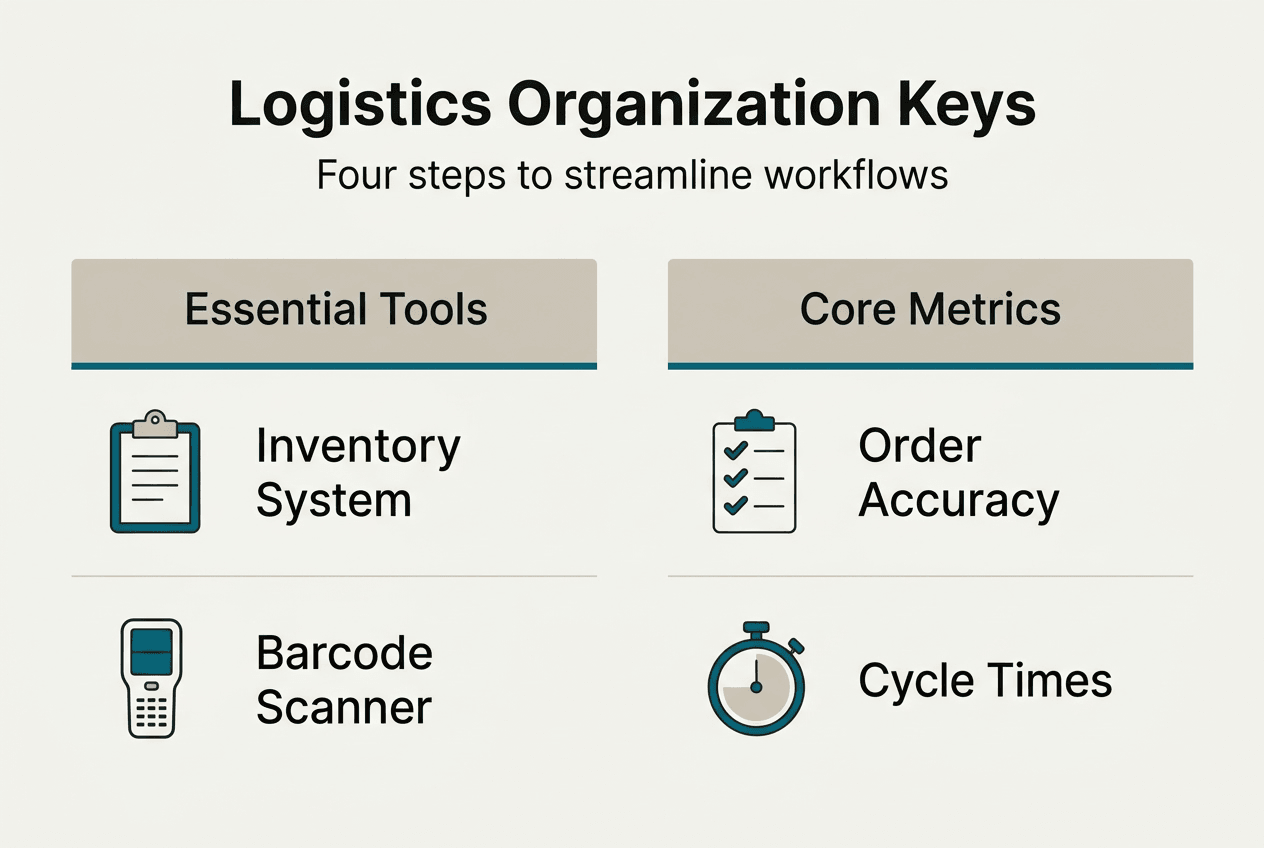
Before implementing organizational changes, you need the right foundation. Data-driven metrics provide the visibility to measure current performance and track improvements. The 2025 WERC Report identified 12 critical metrics that warehouse professionals prioritize, including order-picking accuracy and capacity utilization. These benchmarks help you understand where you stand and where to focus efforts.
Essential tools for effective organization include inventory control systems that track stock in real time, barcode scanners or RFID technology for accurate data capture, and layout planning software to optimize space utilization. Investing in these technologies pays dividends through reduced errors and faster processing times. Even basic tools like clearly labeled bins, color-coded zones, and standardized storage protocols dramatically improve daily operations.

| Metric | Purpose | Target Benchmark |
|---|---|---|
| Order-picking accuracy | Measures fulfillment correctness | 99.5% or higher |
| Cycle time | Tracks order processing speed | Industry-specific |
| Capacity used | Monitors space efficiency | 85-90% peak |
| Damage-free shipments | Evaluates handling quality | 99% or higher |
Establishing clear workflows reduces picking errors and delays. Document standard operating procedures for receiving, putaway, picking, packing, and shipping. When everyone follows the same process, training becomes easier and performance becomes predictable. New hires reach productivity faster because they’re learning proven systems, not individual interpretations.
Pro Tip: Track your peak capacity usage to optimize staffing levels and space allocation. Knowing when you hit maximum utilization helps you plan expansions, adjust shift schedules, and prevent bottlenecks before they impact customer orders.
Critical preparation steps:
- Audit current inventory accuracy and identify discrepancies
- Map existing workflows to spot inefficiencies
- Select appropriate technology for your operation size
- Train staff on warehouse inventory control basics
- Establish baseline metrics before implementing changes
Understanding your starting point through comprehensive measurement enables you to apply warehouse management strategies that deliver measurable results rather than hoping for improvement.
Executing effective organization strategies for ecommerce logistics
Implementing practical organization strategies requires systematic execution. Follow these steps to transform your workspace from chaotic to streamlined.
-
Analyze and optimize picking routes to reduce travel time. Map your current picking patterns and identify unnecessary movements. Use ABC analysis to position fast-moving items in easily accessible locations. Reorganize your layout so high-velocity products require minimal travel distance. This single change can cut picking time by 20-30%.
-
Implement standardized picking methodologies tailored to your workflow. Choose between discrete picking for low-volume operations, batch picking for similar orders, zone picking to divide warehouse areas, or wave picking to optimize timing. Match the methodology to your order profiles rather than forcing a generic approach. Document the chosen process and train every picker consistently.
-
Organize inventory logically and label clearly to minimize errors. Group similar products together and use intuitive location naming conventions. Implement clear, durable labels that include item numbers, descriptions, and bin locations. Poor inventory management causes order delays and accuracy problems, so invest time in creating a logical system that anyone can navigate.
-
Design workspace layout to enhance flow and reduce clutter. Create dedicated zones for receiving, quality control, storage, picking, packing, and shipping. Ensure smooth traffic flow with wide aisles and clear pathways. Remove obstacles, excess packaging materials, and obsolete inventory that create visual noise and physical barriers.
| Approach | Strengths | Weaknesses | Best For |
|---|---|---|---|
| Expertise-based picking | Leverages worker knowledge | Creates dependency on individuals | Very small operations |
| One-size-fits-all methods | Simple to implement | Ignores unique requirements | Rarely optimal |
| Customized hybrid approach | Optimizes for specific needs | Requires upfront analysis | Growing ecommerce businesses |
Pro Tip: Start with one area or process rather than overhauling everything simultaneously. Prove the concept in a pilot zone, refine based on results, then roll out successful changes across your facility. This reduces disruption and builds staff confidence.
Applying proven warehouse picking methods and thoughtful warehouse layout planning creates the foundation for sustained operational excellence. The key is matching strategies to your specific business needs rather than copying generic templates.
Verifying organizational success and continuous improvement
Implementing organizational changes is only half the battle. Verifying their effectiveness and maintaining improvements requires ongoing monitoring and adjustment. Track key performance metrics regularly to confirm your strategies deliver expected results. Monitor order accuracy rates, cycle times from order receipt to shipment, capacity utilization during peak periods, and percentage of damage-free deliveries.
Increased order picking accuracy reduces mistakes and lowers costs from wasted time and customer returns. When accuracy improves, you spend less on expedited shipping to correct errors, process fewer returns, and maintain stronger customer relationships. These savings compound over time, making accuracy investments highly profitable.
Troubleshoot issues quickly when they arise. If error rates suddenly increase, investigate whether new staff need additional training, inventory locations have drifted from your system, or process shortcuts have crept in. When fulfillment delays occur, check for bottlenecks in specific zones or shifts. Fast problem identification prevents small issues from becoming systemic failures.
Maintain organizational efforts through regular staff training and periodic audits. Schedule quarterly reviews of your layout efficiency, monthly spot checks of inventory accuracy, and weekly team huddles to address emerging challenges. Documentation ensures knowledge transfers when staff changes occur. Create visual aids, checklists, and quick-reference guides that reinforce proper procedures.
“Continuous improvement isn’t a one-time project, it’s an ongoing commitment to operational excellence that adapts as your business evolves.”
Pro Tip: Use feedback loops to adapt processes to changing business demands. Survey your picking staff quarterly about pain points they encounter. Analyze customer feedback for patterns indicating fulfillment issues. Review seasonal demand shifts and adjust your organization accordingly. The businesses that thrive are those that treat organization as a dynamic practice, not a static achievement.
Critical verification activities:
- Compare current metrics against baseline measurements
- Conduct monthly inventory accuracy audits
- Review exception reports for recurring problems
- Solicit frontline worker input on process improvements
- Benchmark performance against industry standards
Sustaining improvements requires integrating organizational practices into your company culture. When you combine systematic monitoring with responsive adjustments, you create resilient operations that support growth. Leverage resources on improving warehouse efficiency and inventory management tips to stay current with evolving best practices.
Enhance your ecommerce logistics with ORNER services
Organizing your workspace delivers immediate operational benefits, but partnering with specialized logistics providers amplifies these gains. ORNER offers comprehensive warehousing and courier solutions designed specifically for ecommerce businesses seeking to scale efficiently. Our network of strategically located fulfillment centers and reliable courier services eliminates the organizational burden of managing multiple logistics partners.
Implementing expert services reduces delays and increases accuracy across your supply chain. ORNER’s integrated platform provides real-time visibility into inventory levels, shipment status, and performance metrics, giving you the data needed to make informed decisions. Our technology seamlessly connects with major ecommerce platforms, automating workflows that previously required manual intervention. When you focus on growing your business, we handle the complex logistics that support that growth. Explore our warehousing best practices and discover how reliable courier services combined with proven inventory management strategies create the foundation for ecommerce success.
FAQ
How can I reduce picking errors in my warehouse?
Standardize picking methods and leverage technology like barcode scanning to reduce errors. Implement clear labeling systems and organize inventory logically so items are easy to locate. Regular staff training on proper procedures enhances accuracy and builds consistency across shifts. Review warehouse picking methods to identify approaches that match your operation’s specific needs.
What key metrics should I track to maintain organization in ecommerce logistics?
Track order accuracy, cycle times, capacity usage, and damage-free shipment percentages as your core metrics. These measurements reveal whether your organizational efforts translate into operational improvements. Regular measurement aids continuous improvement by highlighting trends before they become problems. Establish baseline numbers, then monitor weekly or monthly to catch deviations quickly. Strong warehouse inventory control practices make tracking these metrics easier and more accurate.
How often should I review and update my warehouse layout for best organization?
Review your layout annually or after major process changes like adding new product lines or expanding capacity. Continuous small refinements improve workflow and reduce delays more effectively than infrequent major overhauls. Monitor traffic patterns, picking heat maps, and staff feedback to identify optimization opportunities. Seasonal demand shifts may require temporary layout adjustments to maintain efficiency. Thoughtful warehouse layout planning ensures your space evolves with your business rather than constraining growth.
What common mistakes should I avoid when trying to organize ecommerce logistics workflows?
Avoid one-size-fits-all approaches without customization to your specific inventory and order profiles. Don’t neglect staff training or ignore performance data when making organizational decisions. Underestimating the impact of inventory mismanagement leads to cascading problems across your entire operation. Trying to change everything simultaneously creates chaos rather than improvement. Focus on improving warehouse efficiency through incremental, measured changes that build on proven successes.
Recommended
- Time management best practices for ecommerce logistics 2026 – ORNER
- Warehousing Best Practices for Efficient Ecommerce Operations – ORNER
- 7 Warehouse Management System Best Practices for Ecommerce – ORNER
- Inventory Management Tips for Efficient Ecommerce Success – ORNER
- 6 Top Advertising Tips to Boost ROI for E-Commerce Brands – Palmador Blog
- Home Office Setup Guide 2026: Create Your Perfect Workspace | Expert Tips – OnlineStore24 EU