
Calculate true shipping cost per order by adding carrier label cost (billable weight × service rate) to packaging, pick-and-pack labor, insurance, and averaged surcharges. Before you run this formula, gather three numbers: packed weight, packed dimensions, and destination zone. Skip any one of them and your per-order cost will be wrong, usually by underestimating what shipping actually eats from your margin.
TL;DR:
- Accurate shipping cost calculation requires measuring packed weight, dimensions, and destination zone to avoid underestimating expenses.
- Dimensional weight often exceeds actual weight, especially for bulky but lightweight items, leading to higher carrier charges.
- Surcharges like residential, fuel, peak season, and oversized fees can significantly increase costs beyond the label price if not account for.
- Using live carrier rates based on zone, service level, and surcharges provides the most precise pricing, but thresholds for free or flat-rate shipping must be carefully tested to protect margins.
- Regular monthly audits of invoices and packaging practices can reveal hidden costs and help optimize shipping margins effectively.
Table of Contents
- How to Calculate Shipping for Small Business: Inputs and Billing Traps
- Step-by-Step: The Formula and a Worked Example
- What Goes Into Your Full Per-Order Cost Breakdown
- Dimensional Weight: The Formula That Surprises Most Sellers
- How Zones, Service Levels, and Surcharges Set Your Label Cost
- Pricing Shipping for Customers: Free, Flat, or Live Rates
- Cutting Shipping Costs Without Hurting the Customer Experience
- International Shipping: Duties, Customs, and Landed Cost
- Monthly Shipping Audit: A Repeatable Checklist
- Or-ner’s Practitioner Checklist for Every Shipment
- The Mistake That Costs Small Sellers the Most
- When to Let Or-ner Handle Your Shipping Instead
- Sources
- FAQ
How to Calculate Shipping for Small Business: Inputs and Billing Traps
Before you touch a calculator, collect seven pieces of data for a single order. Miss one and your number will look clean but be wrong.
- Packed weight: the box’s total weight after everything is inside, not the product spec sheet weight.
- Packed dimensions: length, width, and height of the sealed box, measured to the nearest inch.
- Origin and destination zip codes: these determine the carrier zone, which drives most of the rate variance.
- Service level: ground, two-day, overnight — each carries a different multiplier.
- Declared value: needed to calculate insurance cost if you’re covering loss or damage.
- Packaging cost: the box, mailer, tape, and void fill, priced per unit.
- Labor time: minutes spent picking, packing, and labeling that order.
Here’s where most sellers trip up: they quote the “shipping rate” they see at checkout as their cost, when that number is often a marked-up retail rate, not the discounted carrier label cost you actually pay through a business account. The two are not the same, and confusing them inflates your perceived margin.
Then there are the fees nobody budgets for until the invoice arrives. Residential delivery surcharges add cost automatically once the carrier detects a home address. Fuel surcharges shift monthly based on oil prices. Peak season surcharges hit hardest from October through January. Oversized package fees kick in once a box crosses a size threshold, and address correction fees appear when a customer typos their own zip code. None of these show up on the sticker rate you check when you print a label. They show up on the bill three weeks later, and by then you’ve already shipped hundreds of orders at a price you thought was final.
Step-by-Step: The Formula and a Worked Example
Here’s the full calculation sequence, in order:
- Measure the packed box. Weigh it on a shipping scale, then measure length, width, and height to the nearest inch.
- Compute dimensional (DIM) weight. Multiply length × width × height, then divide by the carrier’s DIM divisor.
- Determine billable weight. Take the greater of actual weight or DIM weight. This is what the carrier charges you for.
- Look up the carrier rate for your zone and chosen service level, using billable weight.
- Calculate carrier label cost (billable weight × zone/service rate).
- Add packaging, labor, insurance, and averaged surcharges to get your full landed shipping cost per order.
The DIM formula is straightforward: (Length × Width × Height) ÷ DIM divisor = DIM weight in pounds. FedEx and UPS typically use a divisor of 139 for most domestic services, while USPS often applies 166 for larger packages. Billable weight is always the greater of actual weight or DIM weight, so a light, bulky box can cost far more than its scale weight suggests.
Worked example: Say you sell a 5-pound product that ships in a 12×9×4 inch box to a Zone 4 destination via ground service.
DIM weight = (12 × 9 × 4) ÷ 139 = 432 ÷ 139 = 3.1 pounds, rounded up to 4 pounds.
Since actual weight (5 pounds) is higher than DIM weight (4 pounds) here, billable weight is 5 pounds. At a typical Zone 4 ground rate, that lands the carrier label cost around $9.00.
Pro Tip: Always calculate DIM weight even when your product feels heavy for its size. Carriers bill whichever number is higher, and a box just a couple inches larger than it needs to be can flip the math against you.
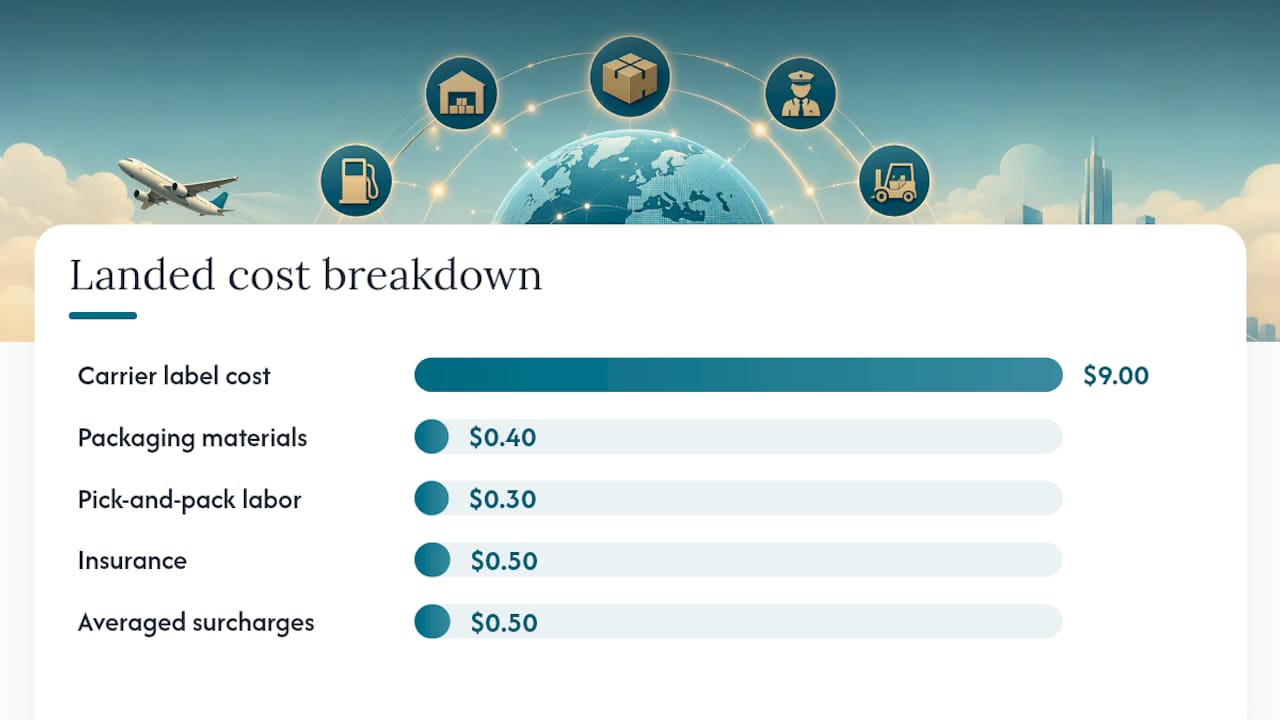
Now add the rest of the landed cost. Here’s how the full order breaks down:
| Cost component | Example amount |
|---|---|
| Carrier label cost (billable weight × rate) | $9.00 |
| Packaging materials (box, tape, void fill) | $0.40 |
| Pick-and-pack labor (3 minutes × $18/hr) | $0.30 |
| Insurance (declared value coverage) | $0.50 |
| Averaged surcharges (fuel, residential) | $0.50 |
| Total landed shipping cost | $12.70 |
That $12.70 is the number that belongs in your margin calculation, not the $9.00 label price alone. A full per-order shipping cost typically ranges from $5 to $24.50 depending on weight, distance, and service level, and most of that spread comes from carrier rate and surcharges rather than packaging or labor.
For a spreadsheet version, set up these columns: Actual Weight, DIM Weight (formula: =(L*W*H)/139), Billable Weight (formula: =MAX(Actual,DIM)), Zone Rate, Label Cost, Packaging, Labor, Insurance, Surcharge Average, and Total Landed Cost as a sum of the last five columns. Once built, you can drag it down for every SKU you sell and see your true margin per order instead of guessing.
What Goes Into Your Full Per-Order Cost Breakdown
The carrier label is rarely the only expense. Here’s what a complete per-order calculation should include, with typical ranges pulled from actual ecommerce cost breakdowns:
- Poly mailers: $0.15 to $0.40 each, suited to soft goods like apparel.
- Corrugated boxes: $0.50 to $1.50 depending on size and wall thickness.
- Void fill (paper, air pillows, bubble wrap): $0.10 to $0.30 per order.
- Tape and labels: $0.10 to $0.20 combined.
- Carrier rate: $3.50 to $12.00 depending on zone, weight, and service.
- Insurance: $0 to $2.00, scaling with declared value.
- Surcharges: $0 to $5.00, averaged across your shipping volume.
Pick-and-pack labor is the piece most small sellers skip entirely, and it’s often the most misleading omission. Calculate it as minutes per order multiplied by your hourly labor rate, divided by orders per hour. For example, labor cost per order can be estimated based on packing speed and hourly wage. Multiply that by a few thousand monthly orders and it adds up to real money that never shows up on a carrier invoice.
Refine these numbers once you have 30 days of actual invoices to check against.
Dimensional Weight: The Formula That Surprises Most Sellers
Dimensional weight, or DIM weight, is calculated as (Length × Width × Height) ÷ DIM divisor, and it exists because carriers charge for the space a package occupies on a truck or plane, not just its weight on a scale. Most carriers use a divisor of 139 for domestic parcel services; USPS applies 166 for larger packages under certain size thresholds. Billable weight is always the higher of actual weight or DIM weight, which means a light, bulky item can cost as much to ship as something twice as heavy.
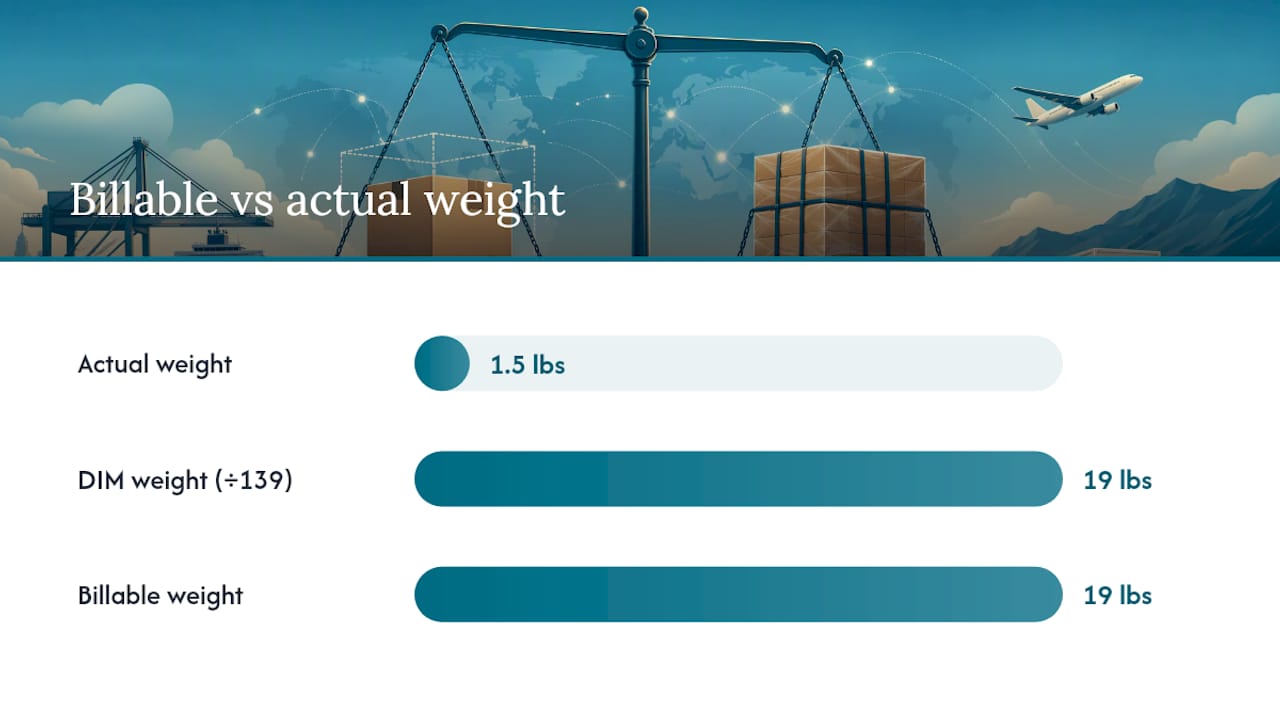
Here’s a case where DIM weight completely overrides actual weight. Imagine a lightweight throw pillow weighing 1.5 pounds packed in an 18×14×10 inch box.
| Measurement | Value |
|---|---|
| Actual weight | 1.5 lbs |
| Box dimensions | 18 × 14 × 10 in |
| Cubic size | 504 cubic inches |
| DIM weight (divisor 139) | 18.1 lbs, rounded to 19 pounds |
| Billable weight | 19 lbs |
The carrier bills for 19 pounds, not 1.5. That’s the DIM trap, and it’s the single biggest reason light, bulky products destroy shipping margins.
The fix is packaging discipline: right-size your boxes to the product, switch soft goods into poly mailers instead of rigid boxes, compress textiles before packing, and standardize box sizes for your top-selling SKUs so you’re not guessing on every order. Auditing carrier measurements periodically also matters. Carriers sometimes re-measure packages and bill the difference, and if your invoice weights consistently don’t match what you shipped, you can request a correction or dispute the charge directly with the carrier.
How Zones, Service Levels, and Surcharges Set Your Label Cost
Carrier zones are distance bands radiating out from your shipping origin, and rates climb as the zone number increases. A package moving from Ohio to Indiana might sit in Zone 2, while the same weight shipped to California could land in Zone 8. Most carrier websites offer a zone lookup tool where you enter origin and destination zip codes to see the exact zone before you commit to a rate.
Service level changes the multiplier on top of that zone rate. Ground service is your cheapest option; two-day and overnight services can run two to four times the ground rate for the same package. Choose service level based on what your customer actually needs, not what feels premium.
Surcharges stack on top of both. Common ones include:
- Fuel surcharge: a percentage add-on that fluctuates monthly with fuel prices.
- Residential delivery surcharge: applies automatically when the address is flagged as a home.
- Remote area surcharge: triggered by rural or hard-to-reach zip codes.
- Peak season surcharge: added during high-volume months, typically October through January.
Because zone, service, and surcharge combinations shift constantly, the most reliable way to get an accurate label cost is to rate-shop through a live carrier calculator rather than relying on a rate card you looked up last quarter.
Pricing Shipping for Customers: Free, Flat, or Live Rates
You have three real options for how you charge customers, and each one trades conversion against margin protection differently.
- Fully free shipping removes the biggest cause of cart abandonment. Shipping cost is consistently cited as a top reason shoppers abandon checkout, and free shipping eliminates that friction entirely. The tradeoff is that you’re absorbing the full landed cost into your product price or margin.
- Flat-rate shipping charges customers one fixed number regardless of actual carrier cost. It’s predictable for shoppers and simple to communicate, but you’ll lose money on heavy or distant orders and overcharge on light, nearby ones.
- Carrier-calculated (live) rates show the exact cost at checkout based on real package data. This is the most accurate pricing method since it reflects true billable weight and zone, but showing a live number can cause sticker shock and hurt conversion if it isn’t presented cleanly.
A common middle path is setting a free-shipping threshold. A typical threshold sits at 1.3 to 1.5 times your average order value. If your average order is $40, set the free-shipping trigger between $52 and $60. That range is wide enough to nudge shoppers toward adding one more item, while narrow enough that most orders still clear it without you eating unlimited shipping cost.
Decide whether to absorb or pass through costs using your margin, not your gut. If your product margin is thin, lean toward flat rate or carrier-calculated pricing shown transparently early in the checkout flow, not the last step before payment. Test different thresholds and presentations against your actual conversion rate. Small changes in how shipping cost is displayed can move abandonment more than the actual dollar amount does.
Cutting Shipping Costs Without Hurting the Customer Experience
Right-sizing packaging is the fastest lever most sellers ignore. Standardize box sizes around your top five or ten SKUs by volume, and you eliminate the guesswork that leads to oversized DIM charges on every shipment. Or-ner’s guide on shipping cost optimization covers packaging strategy in more depth if you want to go further than the basics here.
- Rate-shop across multiple carriers automatically using shipping software that selects the cheapest qualified option per order.
- Audit your carrier invoices monthly and flag any charge that doesn’t match your shipped weight or dimensions.
- Negotiate volume discounts once your monthly shipment count grows; carriers routinely offer better rates as volume increases.
- Consider a fulfillment center closer to your customer clusters, or a 3PL partner, once peak volume outpaces your in-house packing capacity.
Pro Tip: A 10% reduction in your average carrier rate can save roughly $12,000 a year on 1,000 monthly orders at a $10 average shipping cost. That’s the kind of number that justifies the time spent negotiating.
If you sell bulk or palletized goods and are outgrowing standard parcel shipping, a provider like Conexwest supplies shipping and storage containers worth considering as you scale into larger freight volumes.
International Shipping: Duties, Customs, and Landed Cost
Cross-border orders add cost categories that don’t exist domestically, and skipping them in your calculation understates your true landed cost significantly.
- Duties and taxes: charged based on the product’s classification and destination country, calculated as a percentage of declared value.
- Customs brokerage fees: paid to whoever handles the customs paperwork on your behalf.
- Extended transit time: international shipments often take days longer, which affects customer expectations and return rates.
- Additional surcharges: some carriers add international-specific fees on top of standard surcharges.
Who pays duties matters for your pricing. Under DAP (Delivered At Place), the customer pays duties and taxes on arrival, which can create an unpleasant surprise and increase return rates. Under DDP (Delivered Duty Paid), you build duties into the checkout price and customers see one clean total. DDP converts better but requires you to estimate duty costs accurately in advance.
Once your international volume grows past occasional orders, working with a freight forwarder or 3PL partner for cross-border logistics usually costs less than handling customs paperwork and duty calculations yourself order by order.
Monthly Shipping Audit: A Repeatable Checklist
Shipping cost management only works if you check it regularly, not once. Track these metrics monthly: shipping cost per order, shipping cost as a percentage of average order value, carrier label averages by zone, packaging cost per order, and total surcharge tallies.
- Export carrier invoices for the full month.
- Compare billed weight and dimensions against what you actually shipped.
- Flag anomalies where the invoice doesn’t match your records.
- Recalculate your per-order landed cost using the actual invoice totals.
- Adjust pricing or free-shipping thresholds if your shipping percentage of AOV has crept upward.
- Renegotiate with your carrier or switch providers if rates have drifted unfavorably.
If shipping cost exceeds 15% of your average order value, that’s a signal your pricing or packaging needs immediate attention, not a quarterly review. Build a simple spreadsheet with columns for Order ID, Weight, DIM Weight, Billable Weight, Carrier Cost, Packaging Cost, Labor Cost, Surcharges, and Total Landed Cost, and update it monthly from your actual invoices rather than estimates.
Or-ner’s Practitioner Checklist for Every Shipment
Before any shipment leaves the warehouse, run through five checks: measure the packed box, calculate DIM weight against actual weight, look up the destination zone, select the carrier and service level that fits the order, and add insurance once declared value crosses your risk threshold.
Or-ner has seen this play out concretely with apparel sellers, where soft goods packed into oversized rigid boxes routinely triggered DIM charges far above actual product weight. Switching those SKUs into properly sized poly mailers, combined with routing orders through a regional fulfillment point closer to customer clusters, cut the DIM-driven cost gap substantially without changing a single carrier contract.
For deeper operational detail, Or-ner’s guides on shipping rate calculation and full cost breakdowns walk through spreadsheet templates you can adapt directly.
The Mistake That Costs Small Sellers the Most
The single most common mistake is treating packaging and labor as rounding errors instead of real cost components. Sellers calculate margin using the carrier label price alone, see a number that looks healthy, and then wonder six months later why cash flow doesn’t match the spreadsheet. Packaging and labor rarely exceed a few dollars per order individually, but across thousands of orders they quietly erase margin that was never actually there.
If you do one thing after reading this, run last month’s orders through a full landed-cost spreadsheet, not just the carrier invoice. Then set or adjust your free-shipping threshold based on what you find. Test the change for thirty days and watch both your conversion rate and your actual margin, not just one or the other. Shipping decisions made on incomplete numbers tend to feel right and cost money anyway.
— Maayan
When to Let Or-ner Handle Your Shipping Instead
Or-ner is the practical option once shipping stops being a side task and starts eating hours every week, calculating rates, chasing carrier invoices, and untangling customs paperwork on international orders.
If your monthly order volume is climbing, your customers are spreading across multiple regions, or you’re starting to ship internationally and dread the customs forms, that’s the signal to stop managing this manually. Or-ner handles freight booking, fulfillment, cross-border customs clearance, and real-time shipment tracking as one connected system, so the calculations in this guide become something your logistics partner runs for you instead of something you rebuild in a spreadsheet every month. That’s especially true once a single shipment gets too large or too heavy for standard parcel rates and needs to move as freight instead.
Start with Or-ner’s freight booking guide for ecommerce to see exactly how the process works before your next large shipment or your first cross-border order.
Sources
For hands-on calculation, use each carrier’s own rate calculator for live zone and service pricing, and check dimensional weight against the DIM weight formula and divisor reference before you finalize packaging. Or-ner’s guide on reducing shipping costs covers negotiation tactics in more depth, while the full per-order cost breakdown explains typical ranges for every line item. For customer-facing pricing decisions, ShipperHQ’s rate comparison guide breaks down when carrier-calculated rates beat flat-rate models.
- How to reduce shipping costs for small business: 14 practical approaches | Mercury
- What is dimensional weight | Freight Figures
- How to Calculate Shipping Costs for Ecommerce (True Margin)
- How to Calculate Shipping Rates for Ecommerce | ShipperHQ
FAQ
How much should I charge for shipping in my small business?
Charge based on your full landed cost, not just the carrier label price. Many sellers set a free-shipping threshold between 1.3 and 1.5 times their average order value, then charge flat or carrier-calculated rates below that threshold.
What is the formula for calculating shipping costs?
Total landed shipping cost equals carrier label cost (billable weight × zone/service rate) plus packaging materials, pick-and-pack labor, insurance, and averaged surcharges. Billable weight is the greater of actual weight or DIM weight, calculated as length × width × height divided by the carrier’s DIM divisor (typically 139 or 166).
How do I calculate the delivery fee for my small business?
Start with the carrier’s rate for your package’s billable weight, zone, and service level, then add your packaging cost and labor time per order. Round that total up slightly to account for averaged surcharges like fuel and residential fees before setting your customer-facing delivery fee.
What is the cheapest way to ship a package for a small business?
Ground service with right-sized packaging is almost always the cheapest option, since it avoids both expedited multipliers and DIM weight penalties from oversized boxes. Rate-shopping across multiple carriers for each order, rather than defaulting to one carrier, typically finds additional savings on top of that.