Pick a multimodal visibility platform that blends carrier API coverage, first-party sensor data on the lanes that need it, and built-in orchestration that turns an alert into a resolved exception. Anything less leaves you watching problems happen in real time instead of fixing them.
That verdict rests on three things:
- Ground-truth accuracy. Carrier portals lag or go dark during handoffs; hardware trackers keep reporting location and condition straight through them.
- Connectivity that actually spans your network. A platform that connects to “everyone” but misses your top five lanes is useless. Coverage has to match your actual freight, not a marketing slide.
- Orchestration, not just observation. A decade of control-tower investment produced more dashboards but not better decisions, according to Supply Chain Management Review, because visibility without a workflow to act on it just sits there.
Get these three right and metrics like OTIF, exception response time, and customer “where is my order” (WISMO) tickets move fast. Or-ner is one platform built around that orchestration model, and it shows up later in this guide alongside the checklist you should run any vendor through.
Key Takeaways
The most reliable global logistics tracking setup pairs multimodal real-time visibility with orchestration workflows that turn every alert into a resolved action.
| Point | Details |
|---|---|
| Demand orchestration, not dashboards | Ask for a live exception demo (alert to remediation) before any procurement decision. |
| Match sensors to lane risk | Require first-party hardware trackers for condition-sensitive or compliance-heavy shipments. |
| Pilot before scaling | Run a 60 to 90 day pilot on your riskiest lane to gather real ROI evidence. |
| Budget for a realistic timeline | Expect several months per major carrier set and up to a year or more for full enterprise rollout. |
| Or-ner covers the full stack | Or-ner combines real-time tracking, orchestration, customs clearance, and fulfillment in one platform for cross-border and domestic operations. |
Table of Contents
- What a Modern Global Logistics Tracking Solution Must Deliver
- How Do You Evaluate a Global Tracking Vendor?
- How Long Does Implementation Take and What Does It Cost?
- Building a Single Source of Truth Across Systems
- Getting Started With Or-ner for Global Shipment Tracking
- Sources
- FAQ
What a Modern Global Logistics Tracking Solution Must Deliver
Before you sit through another vendor demo, know what “table stakes” actually means in 2026. A platform missing any of these isn’t incomplete, it’s the wrong tool.
- Real-time multimodal location across ocean, air, road, and rail, not just one mode dressed up as “global.”
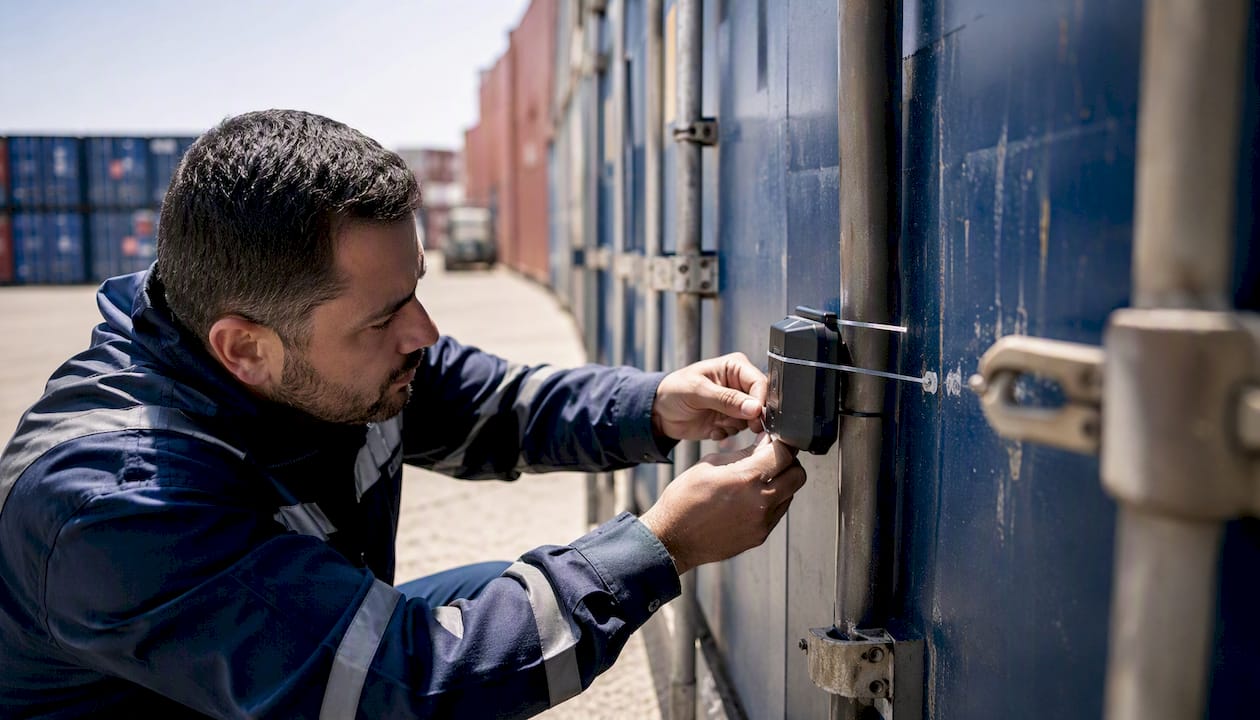
- Condition sensors for temperature, humidity, and shock on lanes carrying pharma, food, or anything fragile.
- Carrier API and EDI coverage deep enough to match your actual lane mix, not a generic “500+ carriers” claim.
- Low-latency webhooks that push exception alerts to your team in seconds, not batch-refreshed dashboards updated every few hours.
- Data harmonization that maps every shipment to one identifier across PO, SKU, and container number so nothing gets lost in translation between systems.
- Exception management and orchestration, meaning a defined workflow from alert to decision to remediation, not just a red flag on a map.
- Predictive ETA and analytics that flag delays before they happen. Sensor costs have fallen enough that predictive models now forecast some delays weeks out, per DigitalApplied’s tracking research.
- Security and compliance controls, including SOC 2 attestation and GDPR/CCPA-aligned data handling for cross-border shipment data.
- Scalability and customization so the same platform works for a 200-SKU wholesaler and a multinational brand running twelve lanes.
Each of these ties directly to a KPI you already track: condition sensors cut claims disputes, low-latency webhooks shrink WISMO volume, and orchestration workflows are what actually move OTIF numbers.
Pro Tip: Skip the dashboard tour. Ask the vendor to run a live exception demo on one of your real lanes: trigger a delay, show the alert, show the recommended action, show who owns the remediation. If they can’t do that live, the “orchestration” is marketing copy.
How Do You Evaluate a Global Tracking Vendor?
Vendor discovery calls tend to drift into feature lists. Keep yours anchored to what actually determines whether tracking data turns into action.
- Lane-level carrier coverage. Ask for the percentage of your specific lanes covered, not aggregate carrier count.
- API latency SLA. Get a number in writing (seconds, not “real-time”).
- First-party sensor options. Confirm hardware trackers are available for condition-sensitive freight.
- Orchestration and workflow depth. Can alerts route to the right owner automatically?
- Integration adapters. Confirm native connectors for your TMS, WMS, and ERP, not just a generic API doc.
- Data ownership terms. Who owns the historical tracking data once the contract ends?
- Security posture. Request SOC 2 Type II documentation, not a self-description.
- Support model and SLA. What’s the guaranteed response time for a critical exception?
- Time to first live shipment. How fast can they onboard one lane for a pilot?
- Anomaly filtering. Does the system suppress false alerts, or will your team drown in noise?
Buyers who insist on lane-level coverage data instead of “we connect to everyone” claims consistently avoid the worst surprises during onboarding, according to CargoRex’s 2026 buyer research.
Watch for these red flags:
- A vague integration roadmap (“coming soon” on your core TMS).
- No committed latency SLA, just “as fast as the carrier allows.”
- AI-powered ETA claims with no auditability behind the model.
- Thin carrier coverage disguised by a large but irrelevant carrier list.
If you’re forced to trade off, weigh connectivity and orchestration above raw feature depth. A platform with fewer bells and whistles but full coverage on your top ten lanes beats one with a beautiful interface and gaps where your freight actually moves.
How Long Does Implementation Take and What Does It Cost?
Realistic timelines matter more than optimistic sales projections. Rollouts that work tend to follow five phases: audit and data mapping, a pilot on your one to three highest-risk lanes, full carrier integration paired with any IoT hardware, predictive ETA and exception automation, then ongoing tuning.
- Audit and data mapping (weeks 1 to 3): inventory current identifiers, carrier contracts, and data gaps.
- Pilot (30 days to first shipment tracked): run one or two lanes end to end before wider rollout.
- Carrier integration (3 to 6 months per major carrier set): timeline depends heavily on how modern each carrier’s own API is.
- Full enterprise rollout (9 to 18 months): governance, training, and data quality issues are what stretch this window, according to FarEye’s enterprise visibility guide.
- Continuous improvement: ongoing tuning of anomaly filters and predictive models.
Cost bands vary by scope, but expect platform subscription fees layered with per-lane hardware costs on sensor-equipped lanes, plus a professional services fee for deeper TMS or ERP integration work. Treat the pilot as your evidence base: a 60 to 90 day pilot on your highest-risk lane, as recommended in Tive’s visibility platform guide, gives you real numbers on WISMO reduction and detention costs before you sign anything larger.
Before kickoff, confirm: a named data owner, your priority lane list, agreed success KPIs, a governance plan for exceptions, a carrier contact list, and written pilot acceptance criteria. Skip any one of these and the pilot becomes a demo instead of a decision.
Building a Single Source of Truth Across Systems
Multiple systems reporting slightly different shipment statuses is the single most common failure point in tracking rollouts. Fixing it means picking integration patterns deliberately, not by default.
The dependable combination is API-first with EDI as fallback for carriers that haven’t modernized, event-driven webhooks for anything time-sensitive, and direct telemetry ingestion for first-party trackers. Harmonization then comes down to three disciplines: mapping every shipment to canonical identifiers (PO, SKU, and shipment ID) so nothing splinters across systems, reconciling timestamps across time zones and carrier formats, and running a normalization pipeline before any data hits your dashboard.
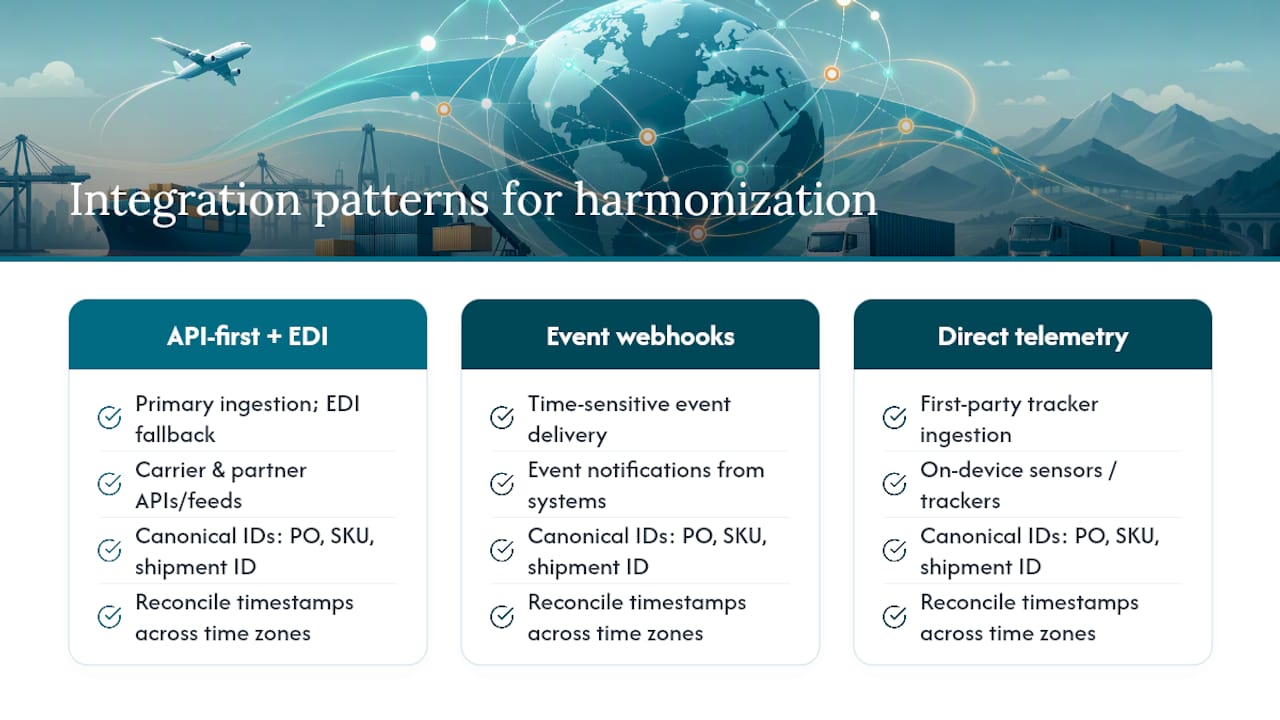
Architecturally, the visibility platform should sit between your carriers, TMS, and WMS, absorbing raw feeds and pushing out standardized events downstream. That’s also where lane-level coverage gaps and anomaly filtering get caught, before bad data reaches a human, as detailed in Or-ner’s guide to real-time logistics data.
Pro Tip: Before signing, ask for a latency SLA in writing and a live demo of anomaly filtering on your actual lanes. If the vendor can’t show missing-milestone detection on freight you recognize, you’re buying a promise, not a system.
Why Orchestration Beats a Prettier Dashboard
Visibility without a defined workflow just produces more data to stare at. What actually shortens time to action is a system where every alert has a predefined owner and a next step attached before the shipment ever leaves port. Technology doesn’t fix broken handoffs between teams. It just makes the gap more visible. Platforms built around orchestration, not dashboards, are the ones producing measurable operational gains, and that’s the standard I’d hold any vendor to.
Getting Started With Or-ner for Global Shipment Tracking
Or-ner is built around the exact model this guide argues for: real-time multimodal tracking wired directly into orchestration, not a dashboard you have to interpret manually. Across ocean, air, and land, the platform gives ecommerce sellers, wholesalers, and global brands one connected view instead of five separate carrier logins.
On the evaluation checklist above, Or-ner maps in directly: freight booking and carrier connectivity for cross-border lanes, real-time shipment tracking with exception alerts, customs clearance handled inside the same platform, and warehousing and fulfillment tools that plug into ecommerce operations including Amazon integrations. For businesses running cross-border volume, that combination matters more than an extra dashboard widget. Explore how cross-border logistics support works for your lanes, or start with reliable courier services if domestic last-mile visibility is your immediate gap. Either page gives you a direct next step toward a pilot conversation.
Sources
- What’s the missing ingredient in supply chain visibility? – Supply Chain Management Review
- Real-Time Supply Chain Visibility: What Buyers Should Test in 2026 — CargoRex Research
- Supply Chain Visibility Platforms: The Complete Guide to Real-Time Transportation Visibility Software | Tive
- Supply Chain Digital Visibility: Tracking Guide 2026
FAQ
What Is the Difference Between Tracking and Orchestration?
Tracking shows you where a shipment is; orchestration routes that information into a workflow with an owner and a next action, which is what actually resolves delays.
How Long Does It Take to Implement Global Shipment Tracking?
A pilot on one lane can go live within 30 days, while full carrier integration typically takes 3 to 6 months per carrier set and enterprise-wide rollout spans 9 to 18 months.
Do I Need First-Party Sensors or Are Carrier APIs Enough?
Carrier APIs cover most general freight, but condition-sensitive or compliance-heavy lanes need first-party hardware trackers to maintain continuity through carrier handoffs.
What Should I Ask a Vendor Before Signing a Contract?
Ask for lane-level carrier coverage percentages, a written API latency SLA, proof of SOC 2 Type II compliance, and a live exception-handling demo on your actual freight.
Does Or-ner Support International and Cross-Border Tracking?
Yes. Or-ner combines real-time multimodal tracking with customs clearance and cross-border logistics support, built for ecommerce sellers and global brands managing international lanes.