
Shipping costs can feel like a mystery until you discover how freight class shapes every price quote and delivery decision. Most people overlook the fact that over 18 billion tons of freight move across US highways every year, each shipment assigned a class that could make or break a company’s profit margins. Surprisingly, the real opportunity is not in cutting corners but in understanding the secret math behind those numbers—because with the right freight class strategy, businesses can unlock savings that competitors never see coming.
Table of Contents
- What Is The Freight Class Definition?
- Why Freight Class Matters In Shipping
- How To Determine The Correct Freight Class
- Tips For Ecommerce, Retail, And Manufacturers
Quick Summary
| Takeaway | Explanation |
|---|---|
| Understand freight class characteristics | Freight class is based on density, stowability, handling, and liability, influencing shipping costs and processes. |
| Calculate density accurately | Density is critical for freight classification; calculate it by dividing weight by volume to determine proper shipping classification. |
| Document products thoroughly | Maintain precise product documentation including dimensions and weight to ensure accurate freight classification and avoid complications. |
| Optimize packaging for cost efficiency | Strategic packaging design reduces shipping costs and helps achieve lower freight class numbers, improving overall logistics efficiency. |
| Leverage technology for classification | Use digital tools and software for efficient freight class determination, helping to streamline logistics operations and minimize errors. |
What Is the Freight Class Definition?
Freight class represents a standardized shipping classification system that determines transportation costs and handling requirements for different types of cargo. This nuanced measurement helps carriers and shippers understand the complexity, density, and transportability of goods during shipping processes.
Understanding the Fundamental Components
The freight class definition is more than a simple numerical rating. It is a comprehensive framework developed by the National Motor Freight Traffic Association (NMFTA) to categorize commodities based on four primary characteristics: density, stowability, handling, and liability. Each of these factors contributes to a specific numerical classification ranging from 50 to 500, with lower numbers indicating more easily transportable items and higher numbers representing more challenging or fragile cargo.
The following table summarizes the four primary components used to determine freight class, along with their impact on classification and shipping outcomes.
| Component | Description | Impact on Freight Class |
|---|---|---|
| Density | Weight relative to volume (space occupied) | Lower density = higher class |
| Stowability | Ease of loading/positioning with other cargo | Difficult to stow = higher class |
| Handling | Level of care needed for loading, unloading, and transit | Difficult handling = higher class |
| Liability | Risk of damage, spoilage, or theft | Higher risk = higher class |
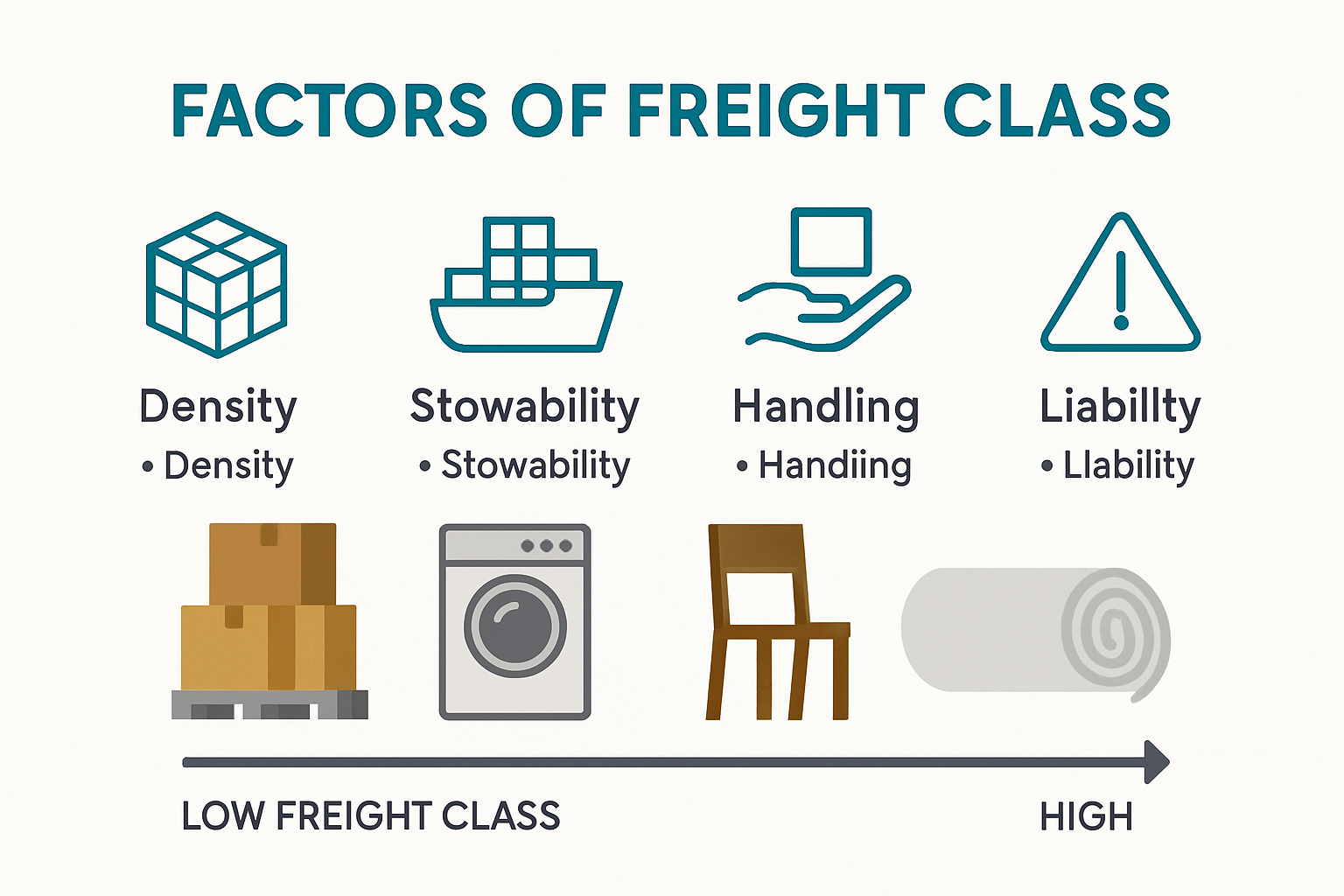
Density Calculation: This critical component determines how much space an item occupies relative to its weight. Carriers calculate density by dividing the total weight of a shipment by its total cubic feet. Lower density items typically receive higher freight class numbers, which directly impacts shipping expenses. For instance, a bulky but lightweight item like pillows would have a different classification compared to a compact, heavy metal component.
Economic and Logistical Implications
Freight class plays a crucial role in shipping economics. According to the Federal Motor Carrier Safety Administration (FMCSA), accurate freight classification helps prevent unexpected pricing variations and ensures fair compensation for transportation services. Shippers who understand their product’s precise freight class can negotiate more effectively and optimize their shipping strategies.
Businesses across various sectors rely on this classification system to predict shipping costs, select appropriate transportation methods, and manage inventory logistics. A well-understood freight class enables more accurate budgeting and helps prevent potential shipping disruptions. For ecommerce sellers and manufacturers, mastering this system can translate into significant cost savings and improved supply chain efficiency.
Read more about shipping logistics strategies that complement freight class understanding and can help businesses streamline their transportation processes.
Why Freight Class Matters in Shipping
Freight class represents a critical mechanism that transforms complex shipping logistics into a standardized, predictable system. Without this classification framework, shipping costs would remain unpredictable and inconsistent across different transportation providers and cargo types.
Pricing and Cost Transparency
Shipping costs directly correlate with freight class, creating a transparent pricing model that benefits both carriers and shippers. According to the Bureau of Transportation Statistics, this standardization helps create fair market conditions by establishing clear guidelines for transportation expenses. The numerical classification system enables precise cost calculations based on specific cargo characteristics such as weight, density, and handling requirements.
For businesses, understanding freight class means avoiding unexpected shipping expenses. Each classification represents a unique combination of factors that influence transportation complexity. Lighter items with large volumes might require more space and special handling, resulting in higher freight classes and increased shipping costs. Conversely, dense, compact items typically receive lower classification numbers, translating to more economical shipping rates.
Risk Management and Cargo Protection
Freight class serves as more than a pricing mechanism. It functions as a comprehensive risk management tool that helps carriers and shippers understand potential transportation challenges. The National Motor Freight Traffic Association (NMFTA) designed this system to provide detailed insights into cargo characteristics, enabling more effective planning and protection strategies.
Different freight classes indicate varying levels of fragility, liability, and handling complexity. High-risk items requiring specialized care receive higher classification numbers, signaling the need for enhanced protection protocols. This approach helps prevent damage during transit and ensures appropriate insurance coverage and handling procedures.
Strategic Shipping Decision Making
Beyond pricing and risk management, freight class empowers businesses to make strategic shipping decisions. Companies can optimize their logistics by understanding how different product characteristics impact transportation costs. Learn more about comparing shipping methods and their unique requirements to further enhance your logistics strategy.
Ecommerce sellers, manufacturers, and logistics professionals use freight class information to select the most cost-effective and appropriate transportation modes. By analyzing density, stowability, and handling requirements, businesses can make informed choices about carrier selection, packaging methods, and shipping routes. This strategic approach minimizes transportation expenses while ensuring cargo safety and timely delivery.
How to Determine the Correct Freight Class
Determining the correct freight class requires precision and a systematic approach. Shippers must understand the specific characteristics of their cargo to ensure accurate classification and avoid potential shipping complications or unexpected costs.
Measuring Density and Dimensional Characteristics
The foundational step in determining freight class involves calculating the cargo’s precise density. According to the National Motor Freight Classification (NMFC) guidelines, density is calculated by dividing the total weight of the shipment by its total cubic feet. This measurement provides critical insights into how the item will be classified.
Here is a step-by-step summary table outlining how to measure and calculate the density of your shipment for accurate freight class determination.
| Step | Description |
|---|---|
| 1 | Measure the package’s length, width, and height |
| 2 | Calculate total cubic volume |
| 3 | Weigh the entire shipment |
| 4 | Divide total weight by total cubic feet |
| 5 | Match the resulting density to the corresponding freight class |
Density Calculation Steps:
- Measure the package’s length, width, and height
- Calculate total cubic volume
- Weigh the entire shipment
- Divide total weight by total cubic feet
- Match the resulting density to the corresponding freight class
For example, a shipment with low density (large volume, light weight) will receive a higher freight class number, indicating more complex and potentially more expensive transportation requirements. Conversely, compact and heavy items typically receive lower class numbers, signaling easier transportability.
Evaluating Additional Classification Factors
Beyond density, shippers must consider three additional critical factors: stowability, handling, and liability. The Transportation Research Board emphasizes that these characteristics significantly impact freight classification and shipping strategies.
Stowability examines how easily an item can be loaded and transported alongside other cargo. Items that require special placement or cannot be stacked receive higher classification numbers. Handling complexity considers the level of care needed during loading, unloading, and transit. Fragile or irregularly shaped items demand more intricate handling procedures.
Liability represents the potential risk associated with transporting specific goods. Items prone to damage, spoilage, or theft receive higher classification numbers, reflecting the increased insurance and protection requirements.
Practical Classification Strategies
Professional shippers leverage multiple resources to confirm freight classifications. The NMFC provides comprehensive commodity codes that offer precise guidance for various product types. Consulting with experienced logistics professionals or comparing different shipping methods can help clarify complex classification scenarios.
Technology now offers advanced tools to streamline freight class determination. Many shipping platforms provide density calculators and classification lookup services, enabling businesses to quickly and accurately identify the appropriate freight class. However, manual verification remains crucial, especially for unique or specialized cargo.
By mastering these classification techniques, businesses can optimize their shipping strategies, control transportation expenses, and ensure smooth logistics operations. Accurate freight class determination is not just about compliance but about creating an efficient, cost-effective shipping approach that supports overall business performance.
Tips for Ecommerce, Retail, and Manufacturers
Freight class management represents a critical strategic component for businesses across ecommerce, retail, and manufacturing sectors. Understanding and optimizing freight classification can significantly impact operational efficiency, shipping costs, and overall logistics performance.
Documentation and Precise Product Reporting
According to the Federal Motor Carrier Safety Administration, accurate documentation is paramount for successful freight classification. Businesses must develop comprehensive product documentation that includes precise measurements, weight specifications, and material compositions. These details enable more accurate freight class assignments and help prevent potential shipping complications.
Key Documentation Recommendations:
- Maintain detailed product specification sheets
- Record exact dimensional measurements
- Document product weight and material composition
- Update records regularly to reflect product modifications
- Create standardized reporting templates for consistent tracking
Digital inventory management systems can streamline this process, automatically capturing and organizing critical product information. By implementing robust documentation practices, businesses reduce the risk of misclassification and associated financial penalties.
Strategic Packaging and Product Optimization
Packaging plays a crucial role in freight class determination. Research from the National Retail Federation indicates that strategic packaging design can significantly influence shipping costs and classification. Businesses should focus on creating packaging solutions that minimize dimensional weight while protecting product integrity.
Manufacturers and ecommerce sellers can optimize freight class by designing compact, efficient packaging that reduces overall volume. This approach not only potentially lowers shipping expenses but also improves sustainability and reduces environmental impact. Consider modular packaging designs that can be easily consolidated or disassembled for more efficient transportation.
Technology and Continuous Learning
Technology has transformed freight class management, offering sophisticated tools for businesses to streamline their logistics strategies. Learn more about advanced ecommerce logistics solutions that can help businesses navigate complex shipping requirements more effectively.
Professional development and continuous learning are essential for staying current with evolving freight classification standards. Businesses should invest in regular training programs that keep logistics teams updated on the latest NMFC guidelines, industry best practices, and technological innovations. Attending industry conferences, participating in webinars, and subscribing to logistics publications can provide valuable insights into emerging trends and classification strategies.
By implementing these strategic approaches, ecommerce sellers, retailers, and manufacturers can transform freight class management from a complex challenge into a competitive advantage. Proactive classification strategies not only reduce shipping expenses but also enhance overall supply chain resilience and operational efficiency.

Frequently Asked Questions
What is freight class and why is it important for shipping?
Freight class is a standardized classification system that determines transportation costs and handling requirements for various types of cargo. It is important because it influences shipping costs, risk management, and strategic decision-making in logistics.
How do I calculate the density of my shipment for freight classification?
To calculate density, measure the total weight of the shipment and divide it by the total cubic feet. This helps identify the correct freight class based on the space occupied by the item relative to its weight.
What factors are considered when determining freight class?
The four primary factors are density, stowability, handling, and liability. Each of these components affects the classification and determines how easily and economically the cargo can be transported.
How can businesses optimize their freight class to reduce shipping costs?
Businesses can optimize freight class by ensuring accurate product documentation, using strategic packaging to minimize dimensions, and leveraging technology for efficient classification. Regular training and staying updated on freight classification standards are also crucial.
Turn Freight Class Challenges Into Seamless Shipping Wins
Are confusing freight class rules driving up your costs or causing shipment delays? If you have ever struggled with classification, proper packing, or just keeping costs predictable, you are not alone. Many businesses wrestling with density calculations and documentation often end up with surprise fees or delivery exceptions. But you do not have to navigate these complexities by yourself.
Get reliable courier services and simplify your freight class headaches today. or-ner.com gives you full control and visibility over your logistics—let our platform handle booking, real-time tracking, reporting, and even automation for every shipment. Make your next move now to protect your profits and stay ahead. Discover how our all-in-one logistics solutions can power up your shipping with ease. Visit or-ner.com and see how we help ecommerce and wholesale businesses save time and money. For more on streamlining logistics, check out our page on what is ecommerce logistics and unlock real competitive advantages starting today.