TL;DR:
- E-commerce logistics require managing high return rates, often 20-30%, unlike traditional retail.
- Choosing a combined fulfillment approach with FBA, FBM, and 3PL optimizes efficiency across channels.
- Tracking key KPIs like fill rate, OTIF, and return rate is essential for continuous improvement.
E-commerce return rates run 20% to 30% compared to roughly 8% to 10% in traditional retail. That single gap forces online sellers to build a fundamentally different logistics operation, one where reverse flows, real-time inventory visibility, and carrier flexibility are not nice-to-haves but core infrastructure. This guide breaks down every major stage of the e-commerce supply chain, compares fulfillment models side by side, and gives you a practical framework for measuring what actually matters so you can stop guessing and start optimizing.
Table of Contents
- What is the logistics supply chain in e-commerce?
- E-commerce return rates and why reverse logistics matter
- Major components of the e-commerce supply chain
- Choosing fulfillment models: FBA, FBM, and 3PL compared
- Measuring logistics performance: KPIs and benchmarking
- Expert perspective: what most e-commerce logistics overviews miss
- Next steps: optimize your logistics supply chain
- Frequently asked questions
Key Takeaways
| Point | Details |
|---|---|
| E-commerce logistics is unique | It requires direct-to-consumer focus and handles far higher return rates than traditional retail. |
| Returns shape the supply chain | Robust reverse logistics and consistent return processes are critical for e-commerce success. |
| Use the right fulfillment mix | Most businesses benefit from blending FBA, FBM, and 3PL to suit their unique needs. |
| Benchmark wisely | Define clear rules for KPIs and benchmarks or risk optimizing the wrong processes. |
| Adapt for seasonality | Plan and measure logistics by season and category to respond effectively to business cycles. |
What is the logistics supply chain in e-commerce?
At its core, e-commerce logistics covers the end-to-end movement of goods and information from your suppliers all the way through inventory, fulfillment, last-mile delivery, and returns. It is not a single handoff. It is a chain of coordinated decisions that happen every time a customer clicks “buy.”
What makes this different from traditional retail logistics? Two things: order-level fulfillment and volume. A brick-and-mortar retailer ships pallets to stores. You ship individual parcels directly to customers scattered across hundreds of zip codes. That direct-to-consumer (DTC) model changes everything downstream, from how you receive stock to how you label packages to how you manage a return that arrives six weeks after purchase.
Here is how the core activities stack up in an e-commerce context:
- Receiving: Inbound goods are checked, counted, and logged against purchase orders.
- Storing: Products are slotted into warehouse locations, often by velocity or SKU family.
- Inventory management: Stock levels are monitored continuously to avoid stockouts and overstock situations.
- Packing: Individual orders are picked, packed, and labeled according to carrier specs.
- Shipping: Parcels are handed off to carriers for outbound transit.
- Last-mile delivery: The final leg to the customer’s door, usually the most expensive per-unit cost in the chain. You can explore the full picture in this last mile delivery overview.
- Returns processing: Returned goods are inspected, restocked, refurbished, or disposed of. This is where most brands lose margin without realizing it. A solid system for ecommerce returns management can recover a significant portion of that lost value.
“The e-commerce supply chain differs from traditional retail primarily because of direct-to-consumer fulfillment and the significantly higher return volumes it generates.”
That quote is not just a definition. It is a strategic warning. If your logistics setup was built for bulk shipments, it is already misaligned with what DTC demands.
E-commerce return rates and why reverse logistics matter
With the basics framed, let’s examine how return rates shape the entire logistics landscape for online retailers.
The numbers are hard to ignore. Return rates in e-commerce average 20% to 30%, while traditional retail sits around 9%. During the holiday season, e-commerce return rates jump to 30% to 40%. For some categories, like apparel, footwear, and consumer electronics, return rates can run even higher.
| Channel | Typical return rate | Holiday season peak |
|---|---|---|
| Traditional retail | ~9% | ~15% |
| E-commerce (average) | 20%–30% | 30%–40% |
| Apparel/footwear online | 30%–40%+ | Up to 50% |
Why are e-commerce returns so high? Several drivers stand out:
- Sizing and fit issues: Customers cannot try products before buying, so they guess and return when wrong.
- Bracketing: Shoppers intentionally order multiple sizes or colors, keep one, and return the rest.
- Product mismatch: Items look different on screen than in person, especially for home goods and electronics.
- Impulse buying: Lower friction to purchase means lower commitment to keep.
Reverse logistics is the operational response to all of this. It includes the processes and infrastructure needed to move goods back from the customer to a point where value can be recovered, whether that is restocking, refurbishing, liquidating, or disposing. Brands that treat reverse logistics as an afterthought tend to watch their margins erode quietly, one return at a time. Building a clean process for managing ecommerce returns is no longer optional if you are operating at any meaningful volume.
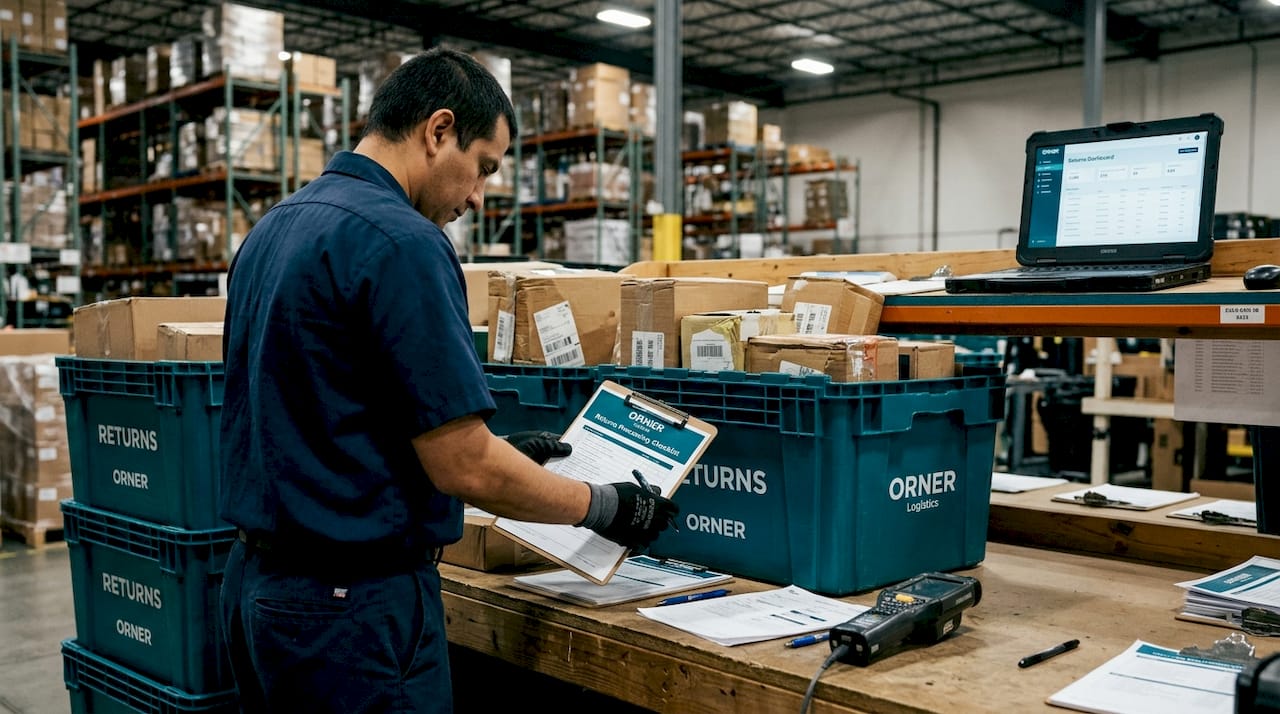
Pro Tip: Never benchmark your return rate against a general industry average. Compare within your specific product category and use a consistent time window, because a 25% return rate in footwear is normal while the same number in home goods signals a problem.
Seasonal spikes also create warehouse capacity challenges. If your 3PL or fulfillment center has not planned for a 40% surge in inbound returns during January, you will hit processing backlogs that delay refunds, frustrate customers, and slow down restock cycles.
Major components of the e-commerce supply chain
Recognizing the central role of returns, it is crucial to break down each key link in the e-commerce supply chain and understand how they connect.
Think of the supply chain not as a straight line but as a loop. Products flow out; returns flow back. Information runs in both directions simultaneously. Every link you optimize reduces cost and improves the customer experience.
Here are the eight core stages:
- Supplier coordination: Negotiating lead times, minimum order quantities, and inbound freight arrangements. The accuracy of your supplier relationships directly affects how much safety stock you carry.
- Receiving: Inbound shipments are logged at the warehouse, checked for damage, and matched against purchase orders. Errors caught here prevent inventory discrepancies later.
- Storage and inventory management: Products are assigned bin locations and tracked in a warehouse management system (WMS). Effective inventory management reduces carrying costs and stockout risk simultaneously.
- Order fulfillment: When an order comes in, the WMS triggers a pick list. Speed and accuracy here directly affect your ship time and customer satisfaction scores.
- Packing: Cartonization decisions, protective materials, and labeling all happen at this stage. Getting this wrong increases damage rates and adds unnecessary dimensional weight charges.
- Shipping: Carrier selection, rate shopping, and handoff. This is where a reliable courier service makes or breaks your promised delivery window.
- Last-mile delivery: The final leg is the costliest and most visible to the customer. Delays here generate most of the customer service contacts. Understanding last-mile delivery solutions is critical for any brand scaling its DTC operation.
- Returns processing: Returned items are inspected, graded, and routed to the appropriate disposition. Fast processing means faster restocking and faster refunds.
“In a DTC model, every one of these stages touches the customer experience directly, not indirectly through a retailer. That changes your margin for error at each step.”
The interconnectedness of these stages is what trips up most growing e-commerce brands. Optimizing shipping in isolation while ignoring receiving bottlenecks, for example, will not move your overall throughput. You need visibility across the entire loop.
Choosing fulfillment models: FBA, FBM, and 3PL compared
Now that the core supply chain stages are clear, choosing the right fulfillment methodology becomes critical.
Three models dominate e-commerce fulfillment, and each has a specific profile that fits certain business situations better than others.
Fulfillment by Amazon (FBA): Amazon stores your inventory, picks, packs, ships, and handles returns. You pay storage fees and fulfillment fees per unit. The biggest advantage is Prime eligibility, which dramatically boosts conversion for Amazon marketplace listings. The downside is limited packaging control and unpredictable long-term storage fees for slow-moving SKUs.
Fulfillment by Merchant (FBM): You or your team handle everything in-house. This gives you maximum control over packaging, branding, and customer experience, but it requires the infrastructure, labor, and systems to execute reliably. It works well for low-volume sellers or brands with highly customized packaging requirements.
Third-Party Logistics (3PL): You outsource warehousing and fulfillment to a specialized provider. A good 3PL offers the operational expertise you need without the overhead of running a warehouse yourself. You maintain more control than with FBA while avoiding the capital commitment of in-house operations. Comparing 3PL vs 4PL options helps clarify which level of outsourcing fits your growth stage.
| Feature | FBA | FBM | 3PL |
|---|---|---|---|
| Storage fees | Variable, can spike | Your overhead | Contracted rate |
| Brand/packaging control | Low | Full | Medium to high |
| Operational burden | Low | High | Low to medium |
| Prime eligibility | Yes | Seller Fulfilled Prime possible | Possible via integration |
| Returns handling | Amazon manages | You manage | Provider manages |
| Flexibility | Limited | High | High |
| Best for | Amazon-focused brands | Small volume or custom brands | Multi-channel scalers |
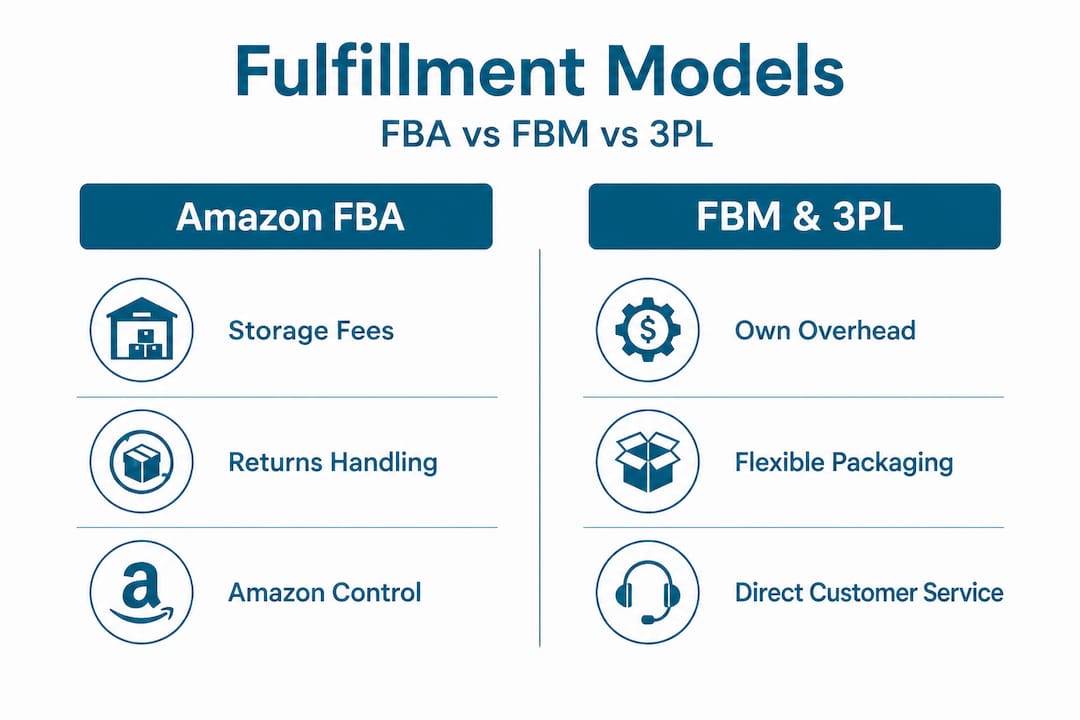
The most effective fulfillment strategy is rarely a single model. Running a portfolio approach, where FBA handles your fast-moving Amazon SKUs, a 3PL manages your DTC website orders, and FBM covers specialty items or custom configurations, gives you the flexibility to optimize by channel and product type simultaneously. This is especially important as your catalog grows and your channel mix becomes more complex.
Key factors to evaluate when mixing models:
- SKU velocity and margin profile
- Channel mix (Amazon vs. website vs. wholesale)
- Return rate by category
- Storage cost sensitivity during peak seasons
- Packaging and branding requirements
Measuring logistics performance: KPIs and benchmarking
With fulfillment structures set, ongoing measurement, and the nuance of how you define it, becomes the driver for actual improvement.
You cannot improve what you do not measure consistently. The challenge in e-commerce logistics is that many teams track the wrong metrics, or they track the right metrics with inconsistent definitions, making benchmarking unreliable.
The foundational KPIs every logistics manager should track:
- Fill rate: The percentage of orders fully shipped as requested. Low fill rates signal inventory or supplier issues.
- OTIF (On Time In Full): Measures whether orders arrive at the right time and with all items. A favorite of major retailers and increasingly relevant for DTC brands.
- Return rate: Total returns divided by total orders, broken out by product category and time period.
- Order accuracy rate: Percentage of orders shipped without errors. Directly affects returns and customer satisfaction.
- Last-mile delivery success rate: Percentage of deliveries completed on the first attempt.
- Warehouse throughput: Orders processed per labor hour, a key efficiency metric.
- Days of inventory on hand: How long your current stock will last at average sales velocity.
You can find a deeper breakdown of these in this guide to logistics KPI examples and additional frameworks covering essential supply chain metrics.
Benchmarking is where most brands get tripped up. The measurement rules you define matter as much as the numbers themselves. Are you measuring return rate against gross orders or net orders? Are you including marketplace returns in your total? Are you comparing holiday weeks to non-holiday weeks? If you skip these definitions, your numbers can lead you to optimize something that is actually performing fine while the real problem hides in a different segment.
Pro Tip: Set up a simple dashboard that splits your KPIs by product category, sales channel, and season. A quarterly review where you look at these segmented numbers will reveal patterns that your blended averages completely hide.
Expert perspective: what most e-commerce logistics overviews miss
Most logistics guides give you a framework, a table, and a clean narrative about how to pick the right fulfillment model. What they rarely tell you is how much variation exists beneath every benchmark.
Two brands can sell nearly identical products at similar price points and have completely different logistics profiles. One ships primarily to urban zip codes with fast last-mile options. The other serves rural areas where delivery windows are longer and carrier options are fewer. One peaks in Q4; the other peaks in Q2 because of a seasonal product line. Their return rates look similar in aggregate but completely different by category and month.
The real lesson is that tailoring your logistics solutions to your specific product mix, customer base, and seasonal pattern is more valuable than copying what a competitor appears to be doing. The frameworks in this guide are starting points, not answers.
The brands that consistently outperform their peers on logistics are not necessarily using better models. They are measuring more carefully, adapting faster, and treating their own data as the primary input rather than industry averages. Agility and self-awareness matter more than finding the theoretically perfect setup.
Next steps: optimize your logistics supply chain
Having laid the logistical foundation, here is how you can apply these strategies and find the right support for your next steps.
ORNER is built for exactly the kind of multi-stage logistics complexity this guide describes. Whether you need a reliable courier service for your last-mile operations, practical courier service tips to tighten your outbound shipping process, or a deeper look at ecommerce warehousing best practices to reduce storage costs and improve throughput, the platform connects every link in your supply chain. ORNER integrates with Amazon and major DTC platforms, supports cross-border freight, and provides real-time tracking across ocean, air, and ground modes. If your current logistics setup is creating bottlenecks at any stage from receiving to returns, now is the time to close those gaps before they cost you customers.
Frequently asked questions
What is the main difference between e-commerce and traditional retail logistics?
E-commerce logistics must handle direct-to-consumer, single-order fulfillment and far higher return volumes, often three times the rate of traditional retail, which requires a fundamentally different operational structure.
How high are return rates in e-commerce?
Typical return rates average 20% to 30% across e-commerce categories, spiking to 30% to 40% during the holiday season, compared to roughly 9% for traditional retail.
Which fulfillment model works best for e-commerce?
A portfolio approach using a mix of FBA, FBM, and 3PL is usually the most effective strategy, with each model assigned to the SKUs and channels where it performs best based on cost, control, and flexibility.
What are the most important logistics KPIs for e-commerce?
The most critical KPIs include fill rate, OTIF (On Time In Full), return rate by category, order accuracy rate, and last-mile delivery success rate, since these together cover the full order lifecycle.
Why is benchmarking challenging in e-commerce logistics?
Without clearly defined measurement rules covering time windows, category segmentation, and what counts as a return, benchmarks can point you toward the wrong problem and waste both time and budget.
Recommended
- Effective strategies for managing logistics partners in ecommerce – ORNER
- Types of logistics solutions for ecommerce: optimize fulfillment – ORNER
- Global logistics solutions: optimize your ecommerce supply chain – ORNER
- End-to-end logistics overview: boost ecommerce fulfillment – ORNER
- Courier integration explained: streamline your global shipping