TL;DR:
- Customer delivery preferences now emphasize certainty, speed, and cost transparency, shaping purchase decisions. Clear, benefit-focused labels and structured tiers improve customer satisfaction, reduce support volume, and align logistics with expectations. Prioritizing accurate delivery promises and proactive communication significantly enhances customer loyalty and operational efficiency.
Customer delivery preferences are the specific choices and expectations customers hold about how, when, and where their online orders arrive, covering speed, cost, location, and communication. These preferences now shape purchase decisions as directly as price or product quality. Walmart’s expansion of 30-minute-or-less delivery to 33 U.S. markets signals how aggressively the industry is moving to meet rising expectations. For ecommerce professionals and logistics managers, understanding these preferences is no longer optional. It is the operational foundation of customer satisfaction and repeat revenue.
What are current customer delivery preferences in ecommerce?
Customer delivery preferences in 2026 center on three demands: speed, certainty, and cost transparency. Customers now expect 3–4 days for standard delivery and 1–2 days for expedited options. That is a dramatic compression from the 10-day windows that felt acceptable just a few years ago.

Speed matters, but certainty matters more. Research from Metapack shows that retailers misread customer demand for speed. Shoppers do not necessarily want the fastest option. They want to know exactly when their order will arrive. A confirmed Thursday delivery beats a vague “2–3 business days” promise every time.
Delivery location preferences vary significantly by demographic and product type. Consider these patterns:
- Home delivery remains the default for large or fragile items and older demographics.
- Pickup points are gaining ground fast. Over 50% of deliveries in some countries now go to pickup locations rather than home addresses. Pickup points reduce missed delivery attempts and lower carrier costs.
- Office delivery is common among urban professionals ordering during work hours.
- Same-day delivery is growing as a premium tier, with Walmart’s 33-market rollout covering over 100,000 eligible items for a $10 member fee.
“Customers are not just buying a product. They are buying a delivery promise. Break that promise and you lose the next order too.” — Metapack delivery research, 2026.
Cost perception is the fourth variable. Customers evaluate total purchase cost, not product price alone. A $40 item with an $8 shipping fee registers as a $48 purchase in the customer’s mind. That mental math directly influences whether they complete checkout or abandon the cart.
How does labeling delivery options affect customer choices?
The way you present customer shipping choices at checkout shapes behavior as much as the options themselves. Generic labels like “Standard” or “Express” force customers to guess what they are actually getting. That guesswork creates frustration, erodes trust, and drives support tickets.
Ecom Design Pro’s UX research identifies the core problem clearly. Generic labels cause delivery mistakes because customers interpret them differently. One shopper reads “Standard” as three days. Another reads it as a week. Both can be wrong, and both will blame the retailer.
The fix is benefit-focused labeling with specific delivery windows. Compare these two approaches:
| Generic label | Benefit-focused label |
|---|---|
| Standard Shipping | Free Delivery (arrives Thu, Jun 12) |
| Express Shipping | Fast Delivery, 1–2 days ($6.99) |
| Next Day | Order by 2 PM for delivery tomorrow ($12) |
| Economy | Budget Shipping (arrives in 5–7 days, free) |
Benefit-focused labels outperform carrier-name labels for conversion. They remove ambiguity and set a clear expectation the operations team can be held to.
A well-designed shipping selector should display four elements: the method name, the price, a specific delivery date or date range, and any conditions affecting that estimate. Conditions include carrier cutoff times, warehouse location, public holidays, and address type. Operational constraints like carrier cutoffs must be surfaced at checkout, not buried in a confirmation email.
Pro Tip: Add a real-time countdown to your checkout page. “Order within 2h 14m for next-day delivery” converts better than a static label because it creates urgency without being deceptive.
Clear labeling also reduces inbound support volume. When customers know exactly what to expect, they stop emailing to ask where their order is. That is a direct operational cost saving.
What are the trade-offs between delivery speed, cost, and satisfaction?
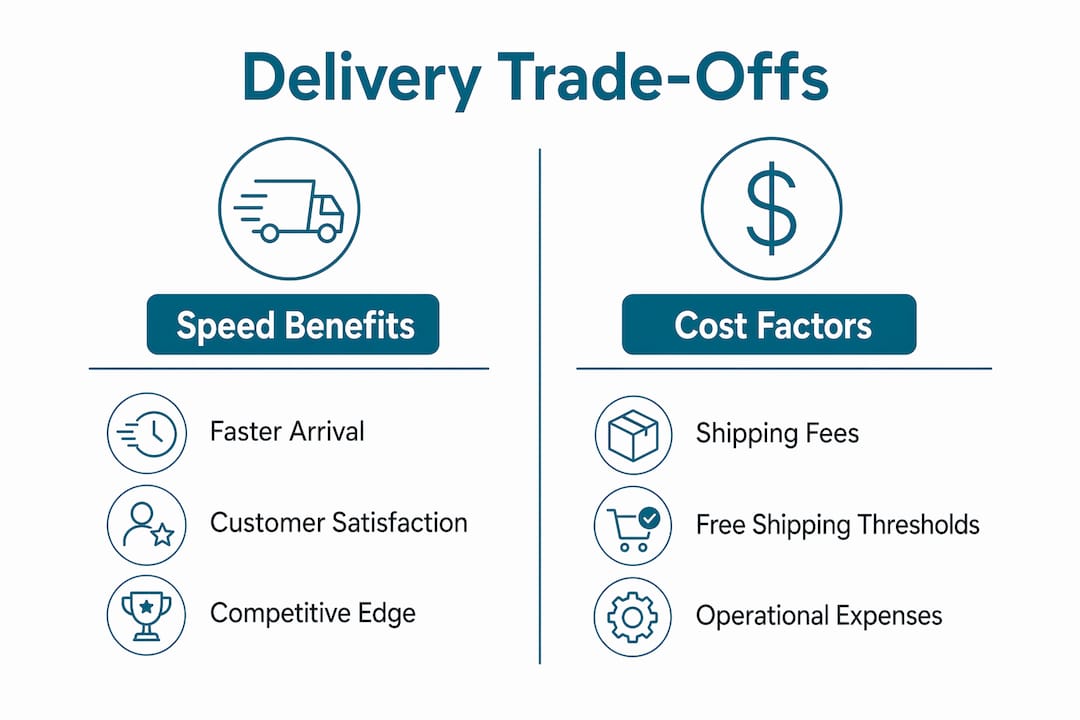
Speed and cost pull in opposite directions, and the customers who want both simultaneously are the ones most likely to abandon checkout. The strategic answer is not to pick one. It is to offer structured tiers that let customers self-select based on their own priorities.
A tiered delivery structure that works in practice looks like this:
- Economy tier: Free or low-cost, 5–7 day window. Attracts price-sensitive buyers and reduces shipping cost pressure on margins.
- Standard tier: Moderate cost, 3–4 day window. The default for most customers.
- Express tier: Premium price, 1–2 day window. Captures urgency-driven buyers willing to pay.
- Pickup point option: Low or no cost, flexible timing. Appeals to customers who want reliability over speed.
Free shipping thresholds are a proven tool for managing cost perception. Customers accept slightly longer wait times when free shipping is the reward. Setting a threshold at your average order value plus 15% pushes customers toward larger baskets without requiring you to absorb shipping costs on every order.
The impact of delivery speed on customers is most visible in the last mile. That final leg of the journey is where promises are kept or broken. A fast warehouse operation means nothing if the carrier misses the delivery window. Logistics managers need to align carrier performance data with the promises made at checkout.
Transparent communication is the bridge between speed expectations and operational reality. When customers understand why a delivery takes four days instead of two, they accept it. When they receive no explanation and the order is late, they escalate. The difference between those two outcomes is a single clear message sent at the right moment.
How can ecommerce businesses optimize delivery options for customers?
Optimizing delivery options for customers starts with reducing choice overload. Too many options at checkout cause decision fatigue and reduce conversion. Fewer, well-matched choices outperform sprawling menus every time. Aim for three to four clearly differentiated tiers plus a pickup point option.
Here is a practical framework for building a delivery option set that converts:
- Audit your current options. Count how many delivery choices you currently show at checkout. If it is more than five, you have too many. Identify which options customers actually select and cut the rest.
- Map options to product categories. A customer buying a fragile lamp has different needs than one buying a phone case. Tailor available options to product weight, size, and fragility where your platform allows.
- Implement real-time cutoff messaging. Display countdowns like “Order within 3h for next-day delivery.” Real-time cutoff messaging improves decision-making and builds trust by showing the customer you have a real operational process behind the promise.
- Align backend systems with frontend messaging. A mismatch between logistics schedules and checkout messaging is one of the most common sources of customer frustration. Your warehouse cutoff times, carrier pickup schedules, and checkout display must be synchronized.
- Track and test. Run A/B tests on label wording, tier pricing, and threshold amounts. Use delivery performance metrics like on-time delivery rate, cart abandonment at checkout, and post-purchase support ticket volume to measure what is working.
Pro Tip: Survey customers who abandoned checkout and ask specifically about the delivery options they saw. Exit intent data on delivery is more actionable than general abandonment analytics.
Tracking transparency is non-negotiable at this stage of the market. 90% of customers want to track their orders. That statistic means proactive tracking is now a baseline expectation, not a premium feature. Invest in shipment tracking tools that push updates automatically rather than requiring customers to check a portal.
Customer loyalty grows from consistent, reliable delivery rather than discounts alone. Small improvements in clarity and reliability compound into meaningful long-term revenue. A customer who receives three accurate deliveries in a row does not need a coupon to come back.
Key Takeaways
Winning on customer delivery preferences requires certainty, clear communication, and structured tiers rather than simply offering the fastest or cheapest option available.
| Point | Details |
|---|---|
| Certainty beats speed | Customers prioritize a confirmed delivery date over the fastest possible option. |
| Benefit-focused labels convert | Replace generic labels like “Standard” with specific dates and customer-benefit language. |
| Tiered options reduce friction | Offer economy, standard, express, and pickup tiers to match diverse customer needs. |
| Tracking is a baseline expectation | 90% of customers want order tracking; proactive updates reduce support volume. |
| Backend alignment is critical | Mismatched logistics schedules and checkout messaging are the leading cause of delivery frustration. |
The shift I keep seeing logistics teams get wrong
I have spent years watching ecommerce operations pour budget into faster carrier contracts while their checkout page still shows “Standard” and “Express” with no dates attached. The speed investment is real. The communication investment is not. That gap is where customer satisfaction breaks down.
The most consistent finding across the teams I have worked with is that customers do not leave because the delivery was slow. They leave because they did not know when it was coming. A four-day delivery with a confirmed date and a tracking link outperforms a two-day delivery with vague messaging almost every time. The data from Metapack backs this up, but honestly, you can see it in your own support ticket queue. Count how many tickets say “where is my order” versus “my order was late.” The first category is almost always larger, and it is entirely preventable.
The other mistake I see is treating pickup points as a niche option. In several European markets, pickup point delivery already exceeds home delivery volume. American ecommerce is moving in the same direction. If you are not offering a pickup option at checkout today, you are leaving a cost-efficient, high-reliability delivery method off the table.
My practical advice: start with your labels. Rewrite every delivery option at checkout to include a specific date or date range and a clear price. Do that before you renegotiate carrier contracts or build new fulfillment infrastructure. The label change costs almost nothing and the conversion lift is immediate.
— Maayan
How Or-ner helps you align delivery with customer expectations
Or-ner is built for ecommerce professionals who need logistics operations to match the promises made at checkout. The platform covers freight booking, real-time shipment tracking, and fulfillment coordination across ocean, air, and land transport modes. If you are working through how to structure your delivery tiers or align carrier schedules with frontend messaging, Or-ner’s freight booking step-by-step guide gives you a practical operational framework to start from. For teams focused on tracking transparency, Or-ner’s real-time order tracking resources cover the tools and processes that turn tracking from a reactive feature into a proactive customer experience driver.
FAQ
What do customers value most in delivery options?
Customers prioritize certainty of delivery date over raw speed. Research from Metapack confirms that a confirmed delivery window consistently outperforms a vague fastest-available promise in customer satisfaction scores.
How many delivery options should I show at checkout?
Three to four clearly differentiated tiers plus a pickup point option is the recommended range. More than five options causes decision fatigue and increases cart abandonment.
Does free shipping actually change customer behavior?
Yes. Customers accept longer delivery windows when free shipping is the trade-off, and they mentally add shipping fees to the product price when evaluating total cost. Free shipping thresholds tied to your average order value are an effective tool for managing both behaviors.
What is the biggest operational mistake in managing delivery preferences?
Misaligning backend logistics schedules with the delivery promises shown at checkout. When carrier cutoff times, warehouse processing windows, and checkout messaging are not synchronized, customer expectations are set incorrectly and support volume rises.
How does order tracking affect customer satisfaction with delivery?
Proactively sharing tracking information reduces customer anxiety and support requests. With 90% of customers wanting to track their orders, automated tracking updates are now a baseline requirement for competitive ecommerce operations.