

TL;DR:
- Most ecommerce businesses treat shipping as a cost instead of designing it as an experience, leading to lost conversions and operational issues. Customizable shipping options based on rules engines improve relevance, support multi-carrier workflows, and enhance last-mile delivery, increasing customer satisfaction. Successful implementation depends on operational backing, realistic promises, and continuous data-driven optimization.
Most ecommerce businesses treat shipping as a cost to minimize rather than an experience to design. That’s a costly mistake. Customizable shipping options give you the ability to match delivery choices to customer expectations, order types, and carrier capabilities at the same time. When your checkout offers nothing but “Standard” and “Express,” you’re leaving conversion on the table and sending customers to competitors who actually let them choose. This guide breaks down how shipping option customization works, how to implement it technically, and how to build it in a way that your backend can actually support.
Table of Contents
- Key takeaways
- What customizable shipping options actually mean for your store
- How to implement flexible shipping solutions technically
- Personalized delivery options that actually improve satisfaction
- Best practices for rolling out custom delivery solutions
- What most ecommerce brands get wrong about shipping customization
- How Or-ner supports your shipping strategy
- FAQ
Key takeaways
| Point | Details |
|---|---|
| Rules engines drive relevance | Filtering shipping options by location, order value, and product type keeps checkout offers accurate and profitable. |
| Multi-carrier APIs save time | A unified shipping API centralizes label creation, rate shopping, and tracking across carriers in one workflow. |
| Customer choices are commitments | Every delivery preference you surface at checkout must be supported by your actual fulfillment operations. |
| Last-mile personalization cuts failures | Offering pickup points, delivery windows, and in-flight adjustments significantly reduces failed delivery rates. |
| Simplicity beats endless options | Presenting three to five well-chosen shipping options outperforms overwhelming customers with a dozen choices. |
What customizable shipping options actually mean for your store
Shipping option customization is the practice of dynamically controlling which carriers, speeds, and delivery methods appear to a shopper based on real conditions. Not every product should offer the same choices. A heavy piece of furniture ships differently than a phone case, and a customer in rural Montana has different carrier availability than one in Chicago.
The mechanics rely on rules engines that evaluate multiple variables before presenting options. Those variables typically include:
- Destination: Carrier availability and transit times vary by zip code, region, or country.
- Order value: Free shipping thresholds or insurance requirements change which services are viable.
- Product type: Weight, dimensions, and hazmat classification affect carrier eligibility.
- Shipping class: Custom classes let you group products with similar handling requirements.
When these rules run correctly, shoppers only see shipping methods you can actually fulfill. That keeps checkout conversion high and prevents the operational chaos of accepting orders you can’t process the way the customer expects.
The customer-experience benefit goes beyond logistics. When a shopper can choose your delivery method based on cost, speed, or convenience, they take partial ownership of the outcome. That shift in ownership reduces refund requests and improves satisfaction scores, even when delays occur.
Pro Tip: Set up separate shipping zones with distinct carrier rules rather than one catch-all rule. Zone-level control prevents cheap domestic rates from accidentally appearing for international orders.
Multi-carrier workflows are the natural extension of this approach. Instead of committing your entire catalog to one carrier, you route different orders to different carriers based on which service fits best. A bulky item going to the West Coast might route to a regional freight partner, while a lightweight accessory routes to a flat-rate postal service.
How to implement flexible shipping solutions technically
Getting flexible shipping solutions into your checkout requires more than a plugin toggle. The technical work happens at three layers: rate retrieval, logic execution, and label generation.
Here is the typical implementation sequence:
- Connect to a real-time rate API. The ShipStation Checkout API allows you to embed live shipping options at checkout using rules tied to location, order details, and destination. This keeps option visibility and pricing dynamic rather than static.
- Configure conditional product grouping. WooCommerce supports multiple shipping packages with conditional logic, so you can split a cart into separate shipments based on product weight, category, or shipping class. That means one cart can produce two packages with different carriers and rates.
- Add a unified multi-carrier layer. A unified approach like the one Unified.to describes centralizes rate retrieval, label generation, and tracking with stateful shipping workflows. One API call manages the full carrier roster instead of maintaining separate integrations.
- Implement stateful workflow tracking. Stateful workflows mean the system remembers where each shipment is in the fulfillment process. If a label is voided, a new rate pull needs to reflect that. Without state management, you get orphaned shipments and tracking gaps.
- Automate label creation with compliance checks. ShipStation’s shipping API handles multi-box orders with master tracking numbers and programmatic label creation across 200+ carriers, including international compliance handling.
Here’s a comparison of two common implementation approaches to help you decide where to start:
| Approach | Best for | Key advantage | Main limitation |
|---|---|---|---|
| Platform-native rules (e.g., WooCommerce) | Small to mid-size stores | Low setup cost, no custom dev | Limited cross-carrier flexibility |
| Unified multi-carrier API | Mid-size to enterprise | Full carrier roster, stateful tracking | Higher initial integration effort |
Pro Tip: Before going multi-carrier, audit which carriers actually serve your top shipping destinations. Adding five carriers when two cover 90% of your volume creates maintenance overhead without proportional benefit.
EasyPost GlobalShip takes this further by adding intelligent rate shopping across carriers, which can cut shipping spend while maintaining delivery reliability. Splitting cart shipments into multiple packages based on product conditions also enables more accurate per-package pricing rather than forcing one blended rate across mismatched items.
Personalized delivery options that actually improve satisfaction
Customization at checkout is only half the story. What happens after the label prints matters just as much, and this is where most ecommerce stores leave significant customer satisfaction gains unrealized.
Personalized delivery options at the last mile include:
- Delivery windows: Letting customers choose morning, afternoon, or evening delivery slots reduces the chance of a missed package.
- Pickup points and lockers: Offering a nearby pickup location as an alternative to home delivery is especially effective for urban customers and high-value orders.
- Special delivery instructions: Gate codes, leave-at-door preferences, and signature waivers reduce redelivery attempts.
- In-flight adjustments: The ability to change delivery preferences after dispatch is a powerful retention tool.
Personalized delivery options like these reduce failed deliveries and improve customer communication, but operational constraints like cutoff times and route capacity must tightly align with what customers can actually select.
That last point deserves real emphasis. The system Geopost built with their Predict and myDPD app shows what this looks like at scale. With 35 million users across 16 countries able to specify in-flight delivery preferences, first-attempt delivery success improved dramatically. The reason it works is that preference changes reflect in carrier and driver instructions before the route runs, not after.
Customer-facing delivery options must be treated as operational commitments, not just UX features. If your backend can’t honor a choice, don’t offer it.
That means post-label personalization, changing a delivery window or adding a gate code after dispatch, requires those changes to sync with carrier and driver instructions and show up in scan confirmations. Without that loop closed, the instruction gets lost and the customer still misses the delivery.
For ecommerce businesses with their own parcel tracking infrastructure, adding delivery preference management to the tracking portal is a natural next step. It gives customers a single place to manage their order from dispatch to doorstep.

Best practices for rolling out custom delivery solutions
Rolling out custom delivery solutions without a clear plan is how you end up with a checkout that promises two-day delivery in regions you ship to in five days. Here is what separates stores that execute this well from those that don’t.
Start with delivery promise integrity. Before you add flexibility, lock down your baseline. Know your actual transit times per carrier per zone and build your rules to reflect those numbers. Presenting only realistic shipping services at checkout increases both conversion and fulfillment predictability.
Balance the speed, cost, and reliability triangle. Every shipping option sits somewhere on that triangle. Free standard shipping attracts cost-sensitive buyers. Paid same-day attracts urgency-driven buyers. Your job is to offer choices that serve both segments without subsidizing the premium service across the board. Good shipping cost optimization practices help you figure out where the real cost drivers are before you price customer-facing options.
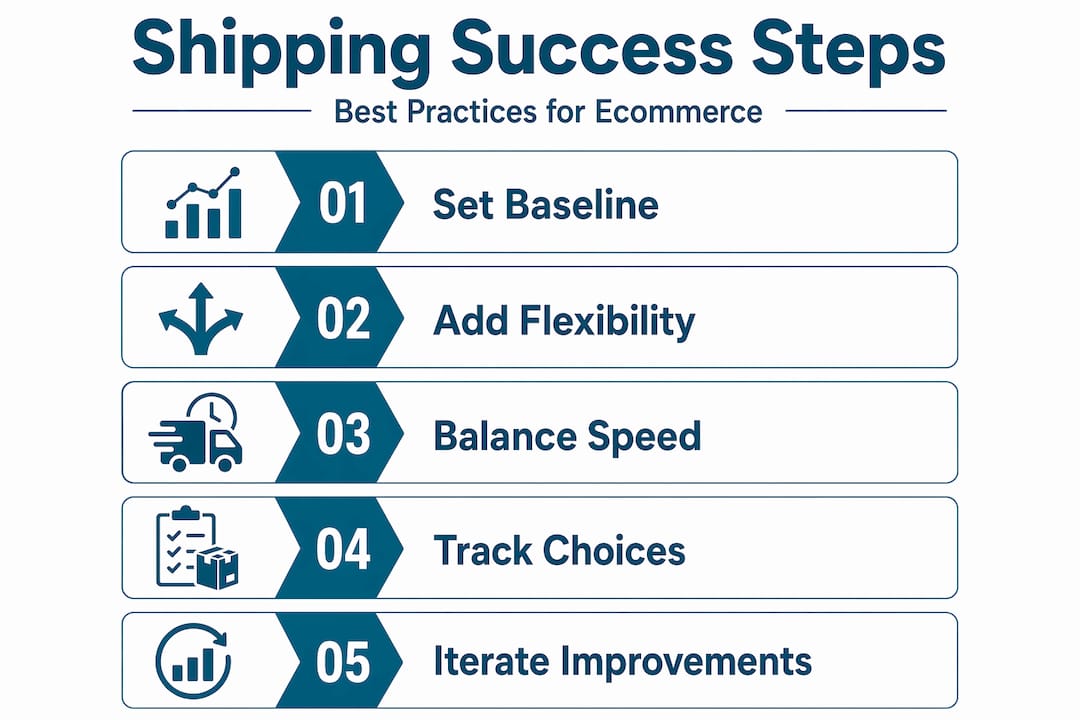
Set choice guardrails. More options are not always better. Research consistently shows that checkout friction increases with the number of decisions. Three to five shipping options with clear labels and honest delivery windows outperform eight options with ambiguous descriptions.
Here is a practical pre-launch checklist:
- Confirm carrier coverage for every shipping zone you serve
- Test rules engine output for edge cases (oversize items, hazmat, PO boxes)
- Validate that free shipping thresholds calculate correctly for split shipments
- Run a test order through every option you plan to offer
- Set up monitoring for option selection rates and post-purchase complaint data
Iterate based on data, not assumptions. Track which shipping options customers choose, which ones trigger complaints, and which ones correlate with returns. If 80% of customers pick the cheapest option, you may be overcomplicating your offering. If premium options convert well, consider expanding them to more zones. The right carrier mix often emerges from data, not theory.
What most ecommerce brands get wrong about shipping customization
I’ve seen hundreds of ecommerce setups over the years, and the pattern is almost always the same. A merchant spends weeks configuring carrier integrations and building out a beautiful checkout with six delivery options. Then, three weeks after launch, customers are complaining that the two-day option arrived in four days.
The problem was never the frontend. It was that nobody audited whether the backend could actually execute what the checkout promised.
What I’ve learned is that customization without operational grounding is worse than no customization at all. When you offer choices and fail to deliver on them, you’ve made an explicit promise and broken it. That’s harder to recover from than simply offering standard shipping and delivering it reliably.
My other strong view: too many merchants treat shipping customization as a feature to add rather than a system to build. The real work is in the rules engine, the carrier contracts, and the exception handling. The checkout UI is the easy part.
I also push back on the instinct to add more options whenever conversion dips. Usually, the answer isn’t more choice. It’s better-labeled options with accurate ETAs. A customer who sees “Arrives by Thursday, 98% on time” makes a faster, more confident decision than one who sees “Standard Shipping: 3-5 Business Days.”
The brands I’ve seen do this best treat every shipping option as a product with a clear value proposition, a real cost model, and operational accountability behind it.
— Maayan
How Or-ner supports your shipping strategy
If you’ve been building out your shipping customization approach and realize the gap is in carrier infrastructure, Or-ner is worth a close look. Or-ner’s reliable courier services are built specifically for ecommerce businesses that need multi-carrier flexibility without the overhead of managing a dozen separate carrier relationships.
Or-ner handles freight booking, real-time tracking, and cross-border logistics through one platform, which maps directly to the multi-carrier and stateful workflow principles covered in this article. For businesses shipping across categories like apparel, home goods, or electronics, the platform’s rules-based routing aligns carrier selection with product type and destination automatically. If you’re also looking to scale internationally, Or-ner’s cross-border shipping solutions give you the carrier reach to offer truly tailored shipping services to customers in markets you may not currently serve well. Or-ner gives you the infrastructure to back up the promises your checkout makes.
FAQ
What are customizable shipping options in ecommerce?
Customizable shipping options let ecommerce businesses control which carriers, speeds, and delivery methods appear at checkout based on rules tied to location, order value, and product type. This keeps offers relevant, profitable, and operationally executable.
How do shipping rules engines work?
A shipping rules engine evaluates order conditions like destination, weight, and shipping class, then filters and displays only the carrier services that match those conditions. The ShipStation Checkout API is one example of how rules can be applied dynamically to control option visibility.
What is a unified multi-carrier shipping API?
A unified shipping API connects to multiple carriers through a single integration, handling rate retrieval, label generation, and tracking in one workflow. This approach, as outlined by Unified.to, simplifies maintenance and enables richer shipping customization.
How do personalized delivery options reduce failed deliveries?
When customers can choose delivery windows, pickup points, or provide special instructions, packages are more likely to arrive when and where someone can receive them. Geopost’s myDPD platform shows this at scale, with real-time in-flight preference changes driving higher first-attempt delivery success.
How many shipping options should I offer at checkout?
Three to five clearly labeled options with accurate delivery windows is the practical standard for most ecommerce stores. More than that increases decision fatigue without meaningfully improving conversion or customer satisfaction.