Cross-border ecommerce shipping is the process of getting a product from a seller in one country to a buyer in another, including customs clearance, duty and tax collection, and last-mile delivery. The single priority that determines whether it works is landed-cost accuracy at checkout, paired with clean compliance documentation. Get those two right, prefer Delivered Duty Paid (DDP) once volume justifies it, and the rest, carriers, returns, and tech, becomes a matter of execution rather than crisis management.
TL;DR:
- Using Delivered Duty Paid (DDP) at checkout is advisable once monthly shipment volumes reach a few hundred or across markets with high customs fee sensitivity to reduce refusals and support costs.
- Accurate customs documentation, clear HS codes, and matching product descriptions are critical to avoiding delays and customs holds, especially as regulations tighten with lower de minimis thresholds.
- Calculating landed costs with real-time duty and tax engines prevents margin loss and customer shock, with duty surcharges typically adding 10 to 25 percent to the total cost.
- Carrier reliability varies by lane and season, so establishing primary and backup carriers plus regional last-mile partners improves delivery success and tracking transparency.
- Automating HS classification, landed-cost calculation, and tracking within an integrated platform reduces errors and speeds clearance, minimizing hidden costs and support tickets.
Table of Contents
- What Are the Core Components of Cross-Border Ecommerce Shipping?
- Which Documents and HS Codes Do You Need for Customs Clearance?
- How Do You Calculate and Present Landed Cost Without Losing Margin?
- How Should You Choose and Route Carriers Across Borders?
- How Do You Handle Returns and Reverse Logistics Internationally?
- What Technology Actually Reduces Customs Errors and Delays?
- An Editorial Take on What Actually Moves the Needle
- Run a Lane Audit Before Your Next Peak Season
- Sources
- FAQ
What Are the Core Components of Cross-Border Ecommerce Shipping?
International shipping for ecommerce runs on three layers that most merchants manage separately, often with three different vendors: carriers, compliance, and technology. Carriers move the box. Compliance determines whether that box clears customs without a fine or a return-to-sender. Technology ties the two together so pricing, tracking, and paperwork stay synchronized instead of drifting apart as volume grows.
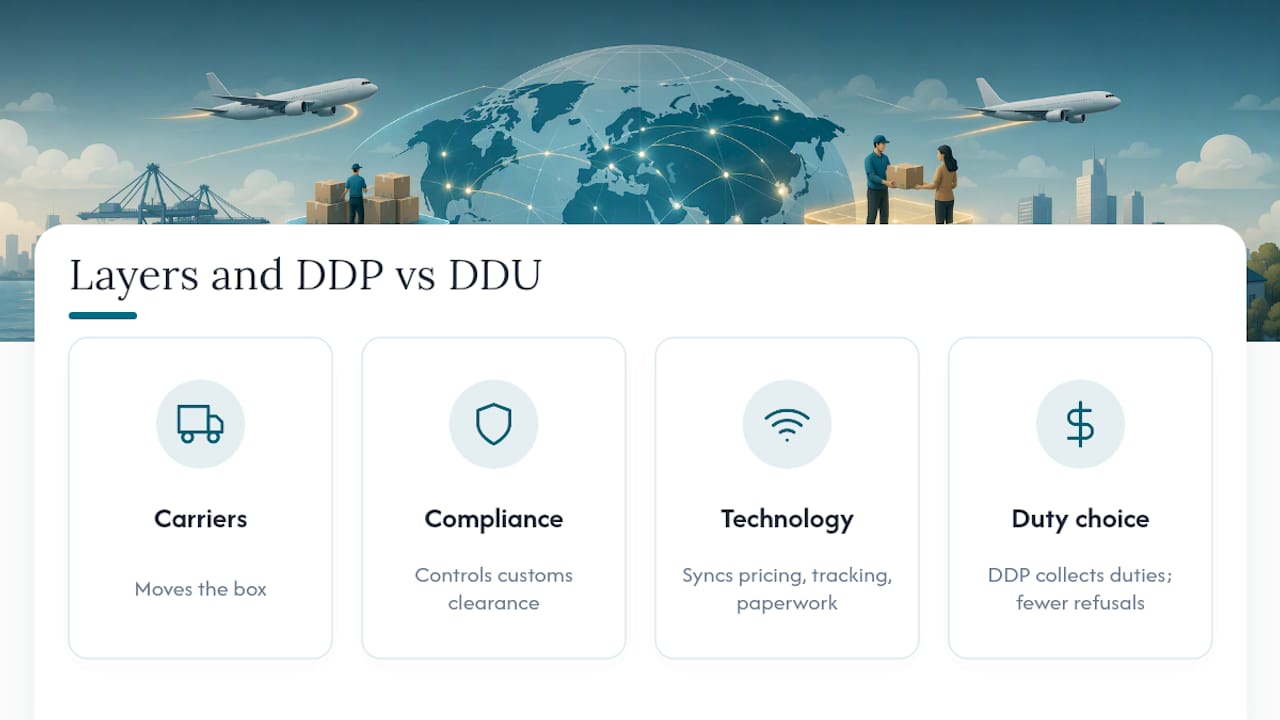
The DDP versus Delivered Duty Unpaid (DDU) decision sits at the center of this. Under DDP, you collect duties and taxes at checkout and the buyer never sees a surprise invoice. Under DDU, the carrier or customs authority bills the buyer on arrival, which is cheaper to set up but drives refusals and abandoned deliveries when the bill lands unexpectedly. A practical rule of thumb: once a lane crosses a few hundred monthly shipments or a market shows high price sensitivity to surprise fees, DDP usually pays for itself in reduced refusals and support tickets. Implementing DDP at checkout materially increases conversion in markets where customs sticker shock is common.
Regulatory context is shifting the calculus further. Lower de minimis thresholds and new compliance programs in several markets mean shipments that once slid through informally now need advance data and formal declarations. That raises the cost of getting documentation wrong and raises the value of getting it automated.
Which Documents and HS Codes Do You Need for Customs Clearance?
Customs and documentation errors cause more shipment delays than any carrier failure. Accurate customs documentation, correct HS codes, and matching product descriptions are the single biggest factor separating clean clearance from a held shipment.
Every cross-border shipment needs:
- A commercial invoice with accurate value, currency, and buyer/seller details
- The correct Harmonized System (HS) code for each product line
- A detailed product description that matches the invoice and the HS code
- Country of origin declaration
- Quantity and weight per line item
U.S. Customs and Border Protection outlines exactly this kind of shipment data as the baseline importers must supply, and most other customs authorities ask for the same core fields with local variations.
Build an HS classification workflow with a clear owner, usually a compliance lead or operations manager, who audits new SKUs against an HS database before they ship, not after a shipment gets flagged. Smaller catalogs can manage this manually with quarterly spot checks; catalogs above a few hundred SKUs need an HS classifier tool or a carrier’s brokerage service to keep pace.
That choice, in-house compliance versus carrier-brokered clearance, depends on volume and complexity. High-volume, high-SKU sellers often justify an in-house compliance function. Lower-volume sellers usually do better letting the carrier’s brokerage handle it. Country-specific programs are worth watching closely: Brazil’s Programa Remessa Conforme now requires advanced shipment data and platform accreditation for faster clearance, a model other markets are likely to copy as de minimis exemptions tighten.
How Do You Calculate and Present Landed Cost Without Losing Margin?
Landed cost is the full price a buyer actually pays: product price, freight, duties, value-added tax (VAT) or sales tax, brokerage fees, and any foreign exchange (FX) spread on the transaction. Miss one component and you either eat the difference or shock the customer with a bill after checkout.
Pulling reliable inputs means connecting to a duty and tax calculation engine that references current HS codes and country-level tariff schedules, rather than relying on static spreadsheets that go stale the moment a country adjusts its rates. Most modern checkout platforms integrate this through an API rather than a manual lookup table.
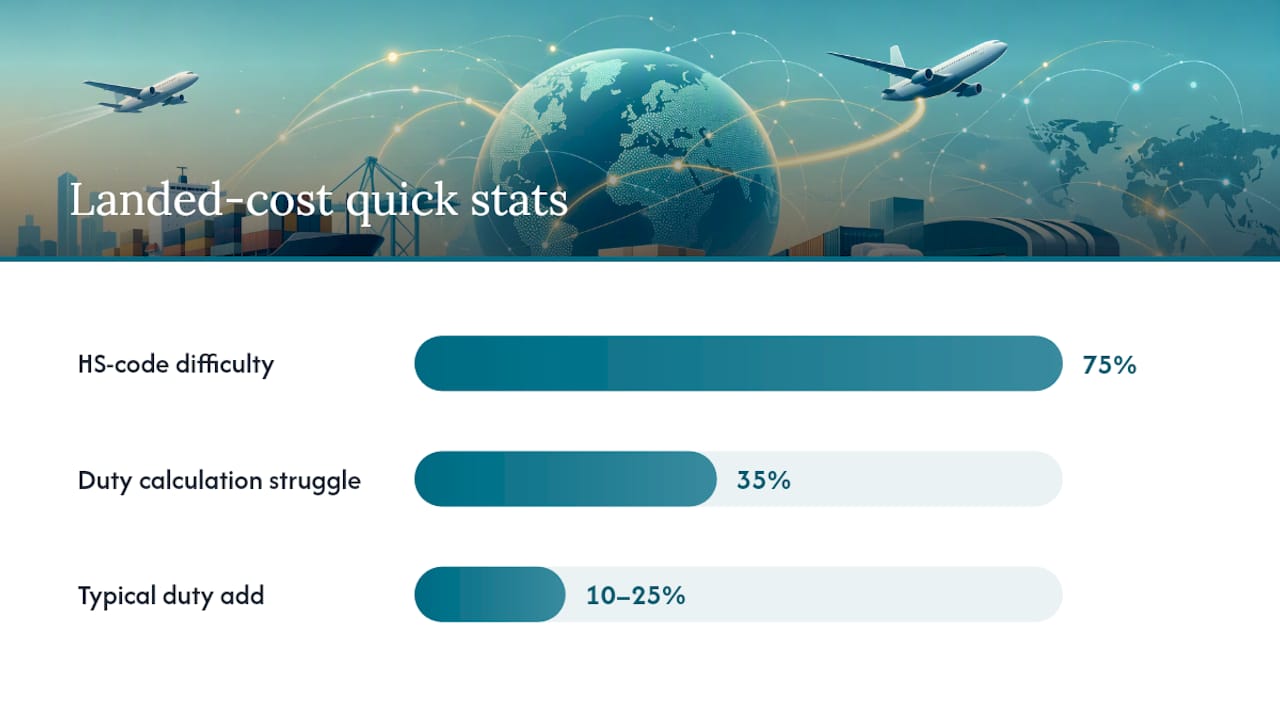
Statistic Callout: Roughly 75% of merchants say HS-code classification is one of their hardest cross-border tasks, and 35% struggle specifically with duty calculation, which is exactly the gap a landed-cost engine is built to close.
At checkout, you have two real options: prepay everything through DDP, or show a duty estimate and let the carrier collect on delivery. DDP converts better in duty-sensitive markets because buyers hate surprises more than they mind paying upfront.
To protect margin as you scale:
- Build a duty and tax surcharge into pricing for high-tariff categories instead of absorbing it
- Set minimum order thresholds on lanes where per-unit freight cost erodes margin
- Rate-shop carriers per lane rather than defaulting to one global contract
- Typical duty ranges add 10 to 25% to landed cost, so pricing that ignores this gap will bleed margin on every international order
How Should You Choose and Route Carriers Across Borders?
Carrier reliability is not uniform. It swings by lane, season, and even by which local delivery partner a carrier subcontracts to for last-mile drop-off. Treat carrier selection as a risk-management exercise, not a one-time procurement decision, and build in redundancy from day one.
- Assign a primary carrier for each high-volume lane based on transit time and clearance track record.
- Contract a backup carrier on the same lane so a service disruption does not stall your whole operation.
- Add a regional last-mile partner in markets where the primary carrier’s local delivery network underperforms.
- Set an on-time delivery threshold per lane (most operators target 90% or higher) and flag any carrier falling below it for review.
- Run quarterly DIM (dimensional) weight audits against your actual package sizes, since carriers frequently reprice based on volumetric weight rather than actual weight.
- Renegotiate rates annually using your shipped volume as leverage, especially on lanes where you have hit or exceeded prior commitments.
Carrier choice also affects visibility: DHL Express, FedEx, UPS, and national postal services differ meaningfully in tracking granularity and customs brokerage support, which matters as much as price once a lane scales.
Pro Tip: Build carrier failover logic directly into your shipping software so a lane automatically reroutes to your backup carrier when the primary misses its on-time threshold for two consecutive weeks, rather than waiting for a manual review.
How Do You Handle Returns and Reverse Logistics Internationally?
International returns are where margin quietly disappears. Reverse freight, re-inspection, and repackaging can cost more than the original outbound shipment, especially on low-value items where the return shipping alone exceeds the product’s price.
- Decide upfront whether a category is worth physically returning or better handled as refund-without-return
- Use regional returns hubs once a market generates enough return volume to justify local receiving and inspection
- Build a simple triage process: inspect, refurbish for resale, consolidate for restocking, or dispose
- Publish a clear, honest returns policy at checkout, since ambiguous return terms are a common reason for cart abandonment on international orders
A returns policy that sets realistic expectations for cross-border delivery services also reduces post-purchase support tickets, which is often the hidden cost nobody budgets for.
What Technology Actually Reduces Customs Errors and Delays?
The tech stack that matters most for ecommerce logistics solutions has four pieces: a transportation or order management system (TMS/OMS) to coordinate shipments, an HS classification API to automate product coding, a landed-cost engine for checkout pricing, and a tracking platform that gives visibility from origin to final delivery.
- TMS/OMS to route orders to the right carrier and warehouse automatically
- HS classification API to reduce manual coding errors on new SKUs
- Landed-cost engine to calculate duties and taxes in real time at checkout
- Tracking platform with multi-carrier visibility in one dashboard
Automating HS classification and landed-cost calculation at checkout reduces manual errors and speeds clearance, which lowers post-delivery disputes over unexpected charges.
Statistic Callout: Watch three metrics weekly: on-time delivery rate by lane, landed-cost accuracy rate at checkout, and international return rate by category. A quarterly review cadence catches lane deterioration before it becomes a customer complaint pattern.
An Editorial Take on What Actually Moves the Needle
Most merchants treat cross-border shipping as a shipping problem. It is really a data problem wearing a shipping costume. The carrier gets blamed for delays that actually started three steps earlier, with a mislabeled HS code or a stale duty table nobody updated after a tariff schedule changed.
The uncomfortable truth is that DDP feels like the “safe, premium” choice, and DDU feels like the cheap default. In reality, DDU is often the expensive option once you count refused deliveries, support tickets, and abandoned carts from buyers who never expected a customs bill. The math flips faster than most operations teams assume, usually well before volume feels “big enough” to justify the switch.
Where a platform like Or-ner earns its place is in collapsing those three layers, carrier, compliance, technology, into one system instead of three vendor relationships that only talk to each other through spreadsheets. That is the operational shift worth making before the next regulatory tightening forces it.
— Maayan
Run a Lane Audit Before Your Next Peak Season
Or-ner gives merchants a way to stop treating carriers, customs, and checkout pricing as three separate headaches. The platform handles freight booking, customs clearance, real-time tracking, and warehousing under one system, so a landed-cost error at checkout and a customs hold at the border get caught by the same team instead of falling through the gap between vendors.
If you are still routing shipments through a single carrier contract or recalculating duties by hand, a lane-by-lane audit is the fastest way to find where margin is leaking. Or-ner’s freight booking guide walks through exactly how to structure that process, from carrier selection to clearance handoff. Pair it with the customs clearance walkthrough if your documentation workflow still runs on manual checks. Request a 30-day lane benchmark with Or-ner to see where your current setup is losing time or margin, and get a freight-booking checklist built around your actual shipping volume.
Sources
- How to Build a Cross-Border Shipping Operation That Actually Scales in 2026
- A paradigm shift in cross-border e-commerce regulatory compliance: evidence from Brazil
- Global ecommerce market trends
- The Complete Guide to International Shipping for Ecommerce
- Cross-Border Ecommerce Statistics 2026: 30+ Data Points
FAQ
What Is Cross-Border Ecommerce Shipping?
It is the process of shipping products from a seller in one country to a buyer in another, covering customs clearance, duty and tax collection, and international delivery. Getting landed cost right at checkout is the step most sellers underestimate.
Should I Use DDP or DDU for International Orders?
DDP works better once a lane has meaningful volume or buyers are sensitive to surprise fees, since it improves conversion by avoiding checkout surprises. DDU can work for lower-volume, exploratory markets where setup cost matters more than conversion optimization.
Who Pays Duties and Taxes on International Shipments?
Under DDP, the seller collects and remits duties and taxes at checkout. Under DDU, the buyer pays them on delivery, often triggering refusals when the amount is unexpected.
How Do I Avoid Customs Delays on International Shipments?
Accurate HS codes, a detailed commercial invoice, and matching product descriptions prevent the vast majority of customs holds. A dedicated classification owner or an HS classifier API catches errors before they reach the border.
What Does Multi-Carrier Shipping Actually Protect Against?
It protects against lane-level service failures, since a single carrier’s reliability can vary sharply by region and season. Running a primary and backup carrier per lane keeps deliveries moving when one carrier underperforms.
How Much Does International Shipping Typically Cost?
Standard international shipping generally runs $15 to $35 with a 7 to 21 day transit, while express service runs $25 to $60 with 3 to 7 day delivery.