TL;DR:
- Business continuity in logistics involves having tested plans that keep goods moving during disruptions. Only 5 percent of organizations are fully prepared, and most fail to account for deeper supply chain dependencies and financial triggers. Implementing proactive strategies, advanced technology, and clear authority matrices can significantly improve response speed and resilience.
Business continuity in logistics is the practice of maintaining critical freight, fulfillment, and distribution functions without interruption when disruptions hit. The formal industry term is business continuity planning (BCP), and it covers everything from supplier diversification to disaster recovery logistics and emergency rerouting protocols. The gap between theory and practice is stark: only 5% of logistics organizations report comprehensive readiness for disruptions, while 40% describe themselves as generally prepared. That gap is where operations break down, shipments stall, and revenue disappears.
What is business continuity in logistics and why does it matter now?
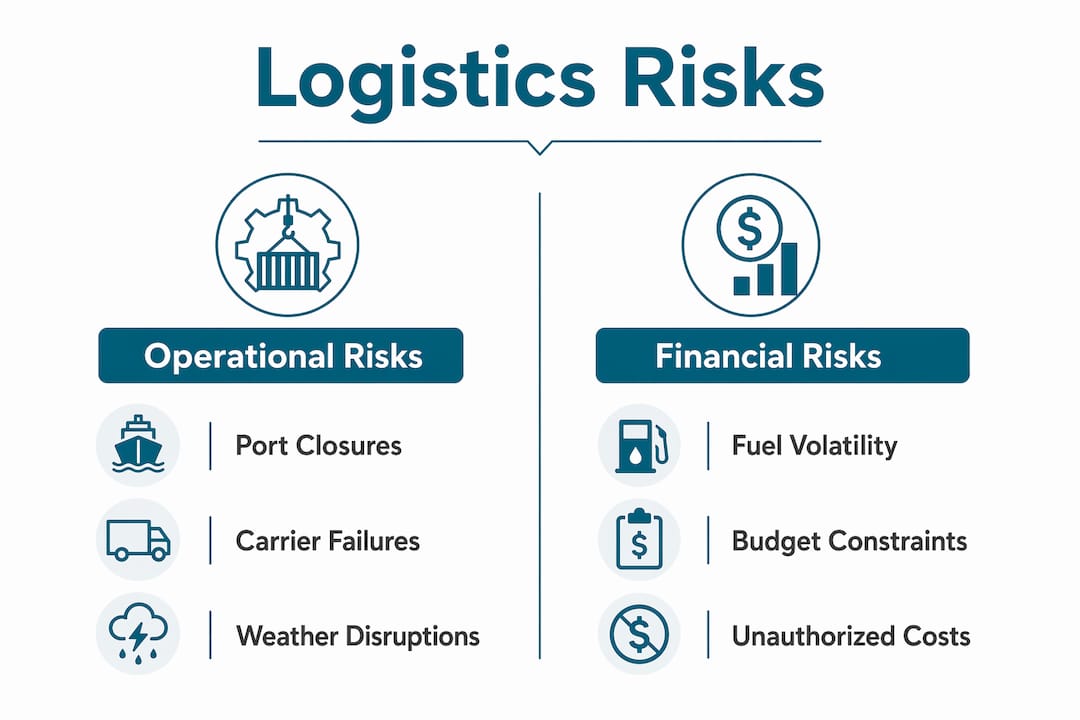
Business continuity in logistics means having documented, tested plans that keep goods moving when a port closes, a carrier fails, or a natural disaster cuts off a key lane. Without those plans, logistics managers are left improvising under pressure, which is the worst time to make high-stakes decisions.
The response time data makes the urgency concrete. Only 23% of logistics specialists can respond to a major disruption within 24 hours, though 90% can mobilize within one week. A week of paralysis in a high-velocity supply chain can mean missed delivery windows, stockouts, and broken customer commitments. The organizations that respond fastest are those that made decisions before the crisis, not during it.
Supply chain resilience is not a single action. It is a system of pre-qualified alternatives, pre-approved budgets, and pre-tested communication protocols. Logistics managers who treat BCP as a compliance checkbox rather than an operational discipline are the ones caught flat-footed when disruptions cascade.
What are the key risks logistics professionals face for maintaining continuity?
Disruptions in logistics fall into four broad categories, and each one demands a different response.
- Geopolitical events: Trade restrictions, sanctions, and border closures can shut down entire corridors overnight. The Red Sea disruptions of 2024 forced carriers to reroute around the Cape of Good Hope, adding weeks and significant cost to European-Asian lanes.
- Natural disasters: Earthquakes, floods, and severe weather damage ports, roads, and warehouses. These events are unpredictable in timing but entirely predictable in their eventual occurrence.
- Infrastructure failures: Port congestion, rail outages, and IT system failures create bottlenecks that ripple across networks. A single failed terminal operating system can delay thousands of containers.
- Labor strikes: Dock worker actions at major ports have historically frozen entire trade lanes for days or weeks, with no advance warning beyond a few days at best.
The deeper problem is that most logistics managers treat these risks as liabilities to be insured against rather than variables to be actively managed. Successful firms embed strategic risk management in daily operations, measuring, transferring, mitigating, or accepting each risk based on its probability and impact. That is a fundamentally different posture than checking a compliance box once a year.
Financial triggers add another layer of complexity. Fuel cost volatility directly affects the economics of contingency routing. A plan that calls for air freight as a backup becomes far more expensive when jet fuel prices spike. Continuity plans must include pre-approved spending thresholds so logistics managers can act without waiting for finance sign-off during a crisis. Plans without predefined financial authorization triggers consistently fail at the moment they are needed most.
Pro Tip: Map your top five disruption scenarios and assign a dollar threshold to each one. Get finance to pre-approve those thresholds before a crisis forces the conversation.
How can logistics managers design effective continuity plans?
The most common failure in operational continuity planning is stopping at Tier 1. Most critical disruptions cascade from Tier 2 and Tier 3 suppliers that logistics managers have never audited and cannot see. Effective BCPs must map beyond Tier 1 to include deeper dependencies, and those maps must be tested with joint exercises and contractual resilience agreements.
A practical framework for building a logistics BCP follows four steps:
- Map your full supply chain. Document every supplier, carrier, warehouse, and port your operation depends on, down to Tier 3 where possible. Identify single points of failure at each tier.
- Qualify alternative suppliers now. Qualifying alternative suppliers takes 12–18 months. That process must start before you need them, not after a disruption forces your hand.
- Build multi-carrier booking into your standard operating procedure. Relying on a single ocean carrier is a single-point-of-failure risk. Multi-carrier strategies let you shift volume during blank sailings, port closures, or weather events without renegotiating contracts under pressure.
- Run scenario-based tests twice a year. Tabletop exercises that simulate a port closure or a key supplier failure reveal gaps in your plan before a real event does. Document what broke and fix it.
The comparison below shows how reactive and proactive continuity approaches differ in practice:
| Dimension | Reactive approach | Proactive approach |
|---|---|---|
| Supplier qualification | Starts after disruption | Completed 12–18 months in advance |
| Financial authorization | Requires crisis-time approval | Pre-approved spending thresholds |
| Carrier strategy | Single primary carrier | Multi-carrier with volume flexibility |
| Supplier visibility | Tier 1 only | Tier 1 through Tier 3 mapped |
| Testing cadence | Ad hoc or never | Scheduled scenario exercises |

Pro Tip: Include your legal and finance teams in BCP tabletop exercises. The bottleneck during a real crisis is almost never operational. It is approval authority.
What role does technology play in logistics business continuity?
Technology does not replace a continuity plan. It executes one faster and with better information. Cloud logistics platforms give logistics managers real-time visibility across carriers, modes, and geographies, which is the foundation of any credible supply chain disruption response.
The specific capabilities that matter most for continuity are:
- Real-time shipment tracking: Knowing exactly where every shipment is at the moment a disruption hits lets you triage by urgency rather than guessing. Platforms that aggregate tracking data across ocean, air, and land modes eliminate the manual phone calls that slow response times.
- Data analytics for early warning: Supplier performance monitoring tools flag deteriorating on-time rates, capacity constraints, and financial stress signals weeks before they become crises. That lead time is the difference between a managed reroute and an emergency.
- Automated communication protocols: Pre-built notification workflows alert customers, internal teams, and partners the moment an exception is detected. Manual communication during a crisis is slow and inconsistent.
- Multi-modal rerouting tools: Freight booking platforms that span ocean, air, and road let logistics managers shift cargo between modes in hours rather than days.
The data integration layer matters as much as the tools themselves. A platform that connects inventory management, freight booking, and carrier performance data in one view gives logistics managers the full picture they need to make fast decisions. Or-ner’s platform, for example, integrates real-time shipment tracking with multi-modal freight booking and warehouse visibility, which directly supports the kind of rapid rerouting that continuity plans require.
| Technology capability | Continuity benefit | Response time impact |
|---|---|---|
| Real-time tracking | Immediate disruption detection | Reduces triage time from hours to minutes |
| Predictive analytics | Early supplier risk signals | Weeks of advance warning |
| Automated alerts | Consistent stakeholder communication | Eliminates manual notification delays |
| Multi-modal booking | Fast mode switching | Hours instead of days for rerouting |
How do sustainability objectives intersect with logistics continuity?
Sustainability and continuity pull in opposite directions during acute disruptions. The evidence is direct: sustainability objectives are deprioritized during crises unless environmental threats are the immediate cause. When a port closes, logistics managers charter whatever capacity is available, regardless of carbon footprint. That is the rational short-term choice.
The solution is not to force sustainability into crisis decisions. The solution is to embed it into pre-crisis infrastructure so that the default options are already more sustainable. Fleet electrification, modal shifts, and energy efficiency investments made during the preparedness phase produce more environmentally sound outcomes when disruptions occur, because the infrastructure is already in place.
“Sustainability that survives a crisis is sustainability that was built into the system before the crisis started. Anything added after the fact gets stripped out the moment pressure rises.”
Modal consolidation is one area where sustainability and resilience genuinely reinforce each other. Consolidating shipments into fewer, fuller loads reduces both emissions and carrier dependency. A logistics manager who has already built consolidation into their standard operating procedure has fewer single-carrier relationships to manage when disruptions hit. For a deeper look at integrating sustainability into long-term logistics planning, the Or-ner guide on sustainable logistics solutions covers the practical steps in detail.
Pro Tip: Audit your contingency carriers for sustainability credentials during the qualification phase, not during a crisis. Pre-qualifying greener alternatives means you do not have to choose between speed and responsibility under pressure.
Key takeaways
Effective business continuity in logistics requires proactive supplier qualification, multi-carrier strategies, pre-approved financial triggers, and technology that delivers real-time visibility across every mode and tier.
| Point | Details |
|---|---|
| Readiness gap is real | Only 5% of logistics organizations are comprehensively prepared for disruptions. |
| Qualify suppliers early | Alternative supplier qualification takes 12–18 months and must start before a crisis. |
| Map beyond Tier 1 | Most cascading failures originate in Tier 2 and Tier 3 suppliers with no direct visibility. |
| Pre-approve financial triggers | Plans without pre-authorized spending thresholds stall at the moment of execution. |
| Embed sustainability early | Sustainability investments made before a crisis produce better outcomes than crisis-time decisions. |
What I have learned about continuity planning that most guides skip
Logistics continuity planning fails most often not because the plan is wrong, but because no one has the authority to execute it when the moment comes. I have seen well-documented BCPs sit unused during actual disruptions because the logistics manager on duty could not approve a $50,000 emergency air freight booking without a VP signature. The VP was unreachable. The shipment missed its window.
The fix is not a better plan document. The fix is a clear authority matrix, signed off by finance and leadership before any crisis, that defines exactly who can approve what spending at what threshold without escalation. That single change converts a theoretical plan into an executable one.
The other mistake I see constantly is treating logistics risk management as an annual review exercise. Risk is not static. Carrier financial health, geopolitical conditions, and infrastructure quality change every quarter. The organizations that maintain continuity through repeated disruptions are the ones that treat risk assessment as a monthly operational habit, not a yearly compliance task. Cost pressure pushes managers toward single-carrier contracts and lean inventory. Both choices reduce resilience. The savings rarely survive the first serious disruption.
— Maayan
Or-ner’s platform for reliable logistics continuity
Logistics managers who want to move from reactive to proactive need tools that work across every mode and carrier relationship from a single interface.
Or-ner’s global logistics platform connects multi-modal freight booking, real-time shipment tracking, and warehouse visibility in one place, which directly reduces single-carrier dependency and speeds up rerouting decisions. The platform supports ocean, air, and land freight across a global carrier network, giving logistics teams the flexibility to shift volume when disruptions hit. Data dashboards surface supplier performance signals and exception alerts before they become crises. For ecommerce sellers and supply chain teams that need reliable courier services backed by genuine network depth, Or-ner is built for exactly that operational reality.
FAQ
What is business continuity planning in logistics?
Business continuity planning in logistics is the process of documenting, testing, and maintaining plans that keep freight and fulfillment operations running during disruptions. It covers supplier diversification, carrier redundancy, financial authorization protocols, and technology-enabled visibility.
How do you ensure logistics continuity during a disruption?
Activate pre-qualified alternative suppliers and carriers, execute pre-approved financial authorizations, and use real-time tracking data to triage shipments by urgency. Organizations that respond within 24 hours have these decisions made before the disruption occurs.
Why do most logistics continuity plans fail?
Most plans fail because they lack pre-approved financial triggers, stop at Tier 1 supplier visibility, and are never tested through scenario exercises. Plans without predefined authorization stall at the moment execution is needed most.
How far in advance should you qualify alternative suppliers?
Alternative supplier qualification requires 12–18 months from initiation to readiness. Logistics managers who start this process only after a disruption hits will not have qualified alternatives available when they need them.
How does technology support supply chain resilience?
Cloud logistics platforms provide real-time tracking, predictive analytics, and multi-modal booking that reduce response times from days to hours. Automated exception alerts and consolidated data views give logistics teams the information they need to act before disruptions escalate.